

Reviewed and Validated by: Richa Thakur, Associate
Understanding White-Collar Crimes in India & Role of Regulatory Bodies
Over the past few years, white-collar crimes in India, have taken a significant toll on the country’s economy, affecting business, investment, and overall economic growth. Financial crimes like corporate fraud, insider trading, money laundering, bribery, and tax evasion are becoming an increasing concern for regulatory bodies, which play a crucial role in preventing, detecting, and prosecuting these offenses. As economic offenses and financial frauds have surged, the enforcement mechanisms of the State have been strengthened, leading to harder penalties.
Various regulators have stepped up their efforts, be it SEBI and securities fraud, RBI and banking regulations, or ED and anti-money laundering actions. Still, it is found that there have been corporate malfeasance and financial frauds that need to be dealt with through policies, collaboration, and investigations backed by technological sophistication.
This article reviews how regulatory authorities in India tackle white-collar crimes, and examines the legislation that provides the framework for such institutions, the challenges facing enforcement agencies, and the counter-measures that can improve financial crime prevention mechanisms.
White Collar Crimes in India and Their Understanding
What are White-Collar Crimes?
White-collar crimes refer to a category of non-violent financial crimes committed by government officials, individuals, or businesses for financial gain. Unlike public crimes, these offenses are primarily defined by deception, fraud, and manipulation for financial gain.
Types of White-Collar Crimes in India
- Corporate Fraud: Misrepresentation of financial statements, falsification of accounts, and fraudulent business practices.
- Insider Trading: Trading securities based on non-public information, creates an unfair advantage.
- Money Laundering: The process of concealing the origin of illegally obtained money, typically by funneling through legal business channels.
- Tax Evasion: Intentionally evading tax payment through deception.
- Bribery and corruption: Offering or accepting bribes to influence the decision-making process.
- Banking Fraud: Includes Loan Fraud, Credit Card scams, and Financial Scams involving banks and NBFCs.
- Ponzi Schemes: Fraudulent investment schemes promising high returns to attract investors.
Explored our other article E-Commerce and Data Privacy: A Comprehensive Guide for Businesses
How White-Collar Crimes Affect India’s Economy
- The decline in investor confidence in financial markets.
- Erosion of corporate governance and business ethics.
- Financial instability leads to cyclical downturns.
- Obstruction in foreign investments and economic growth.
Key Laws & Regulations to Combat White-Collar Crimes in India
1. Securities and Exchange Board of India (SEBI)
India has the Securities and Exchange Board of India (SEBI) to regulate and bring transparency to the stock market.
- Insider Trading Prevention: SEBI enforces stringent regulations, including those outlined in the SEBI (Prohibition of Insider Trading) Regulations, 2015 to prevent market manipulation.
- Corporate Governance: SEBI sets disclosure norms for companies to prevent corporate fraud and protect investor interests.
- FUTP (Fraudulent & Unfair Trade Practices) Regulations: SEBI takes against entities involved in market manipulation, fraudulent or deceptive practices related to securities, and publication of false stock recommendation articles.
- Major SEBI Investigations: SEBI has taken significant action against major entities, including Yes Bank, Satyam Computers, and the Sahara Group, for fraudulent practices.
2. Reserve Bank of India (RBI)
Role of RBI in Banking Fraud Prevention and Money Laundering Monitoring.
- Banking Supervision: RBI ensures compliance with financial rules and regulations in banks and monitors loan frauds.
- AML & KYC Regulations: To minimize suspicious transactions and combat money laundering, RBI has enforced mandatory compliance with Know Your Customer (KYC) guidelines.
- Fraud Risk Management: RBI sets guidelines for banking compliance to assess and mitigate the risk of financial fraud.
- Latest Banking Frauds: RBI has implemented tight regulatory oversight to prevent banking frauds such as the Punjab National Bank (PNB) scam and the Yes Bank crisis.
3. Enforcement Directorate (ED)
The ED investigates money laundering cases under the Prevention of Money Laundering Act (PMLA), 2002.
- Tracking Financial Crimes: ED investigates cross-border money laundering, Hawala transactions, and forex violations.
- Seizure of illicit assets: ED seizes properties gained through financial crimes
- Top Notch Fraud Cases: ED has investigated high-profile economic frauds, including criminal cases against Vijay Mallya, Nirav Modi, and AgustaWestland.
4. Central Bureau of Investigation (CBI)
CBI investigates corporate fraud, bribery, and corruption cases involving both public and private sectors.
- Economic Offenses Wing (EOW): Handles financial scams, bank frauds, and corporate mismanagement.
- CBI’s Role In High Profile Cases: Investigates major cases like the Coal Scam, 2G Spectrum Scam Case & Vijay Mallya Fraud.
- Coordination with Other Agencies: The CBI collaborates with SEBI, RBI, and ED to investigate economic offenses.
5. SFIO (Serious Fraud Investigation Office)
SFIO, a specialized agency under the Ministry of Corporate Affairs, investigates complex Financial frauds.
- Powers Under the Companies Act, 2013: SFIO investigates corporate mismanagement and issues related to shell companies.
- High-profile Cases: SFIO had probed major frauds, including the IL&FS fraud, Satyam scam, and Amrapali realty fraud.
6. Financial Intelligence Unit – India (FIU-IND)
The Financial Investigation Unit (FIU-IND) monitors financial transactions and detects suspicious financial activities.
- Reporting of Suspicious Transactions: FIU collaborates with banks to flag unusual banking transactions.
- AML & Counter-Terror Financing (CTF) Monitors the funding of terrorism through financial structures.
Legal Basis of Supportive Regulatory Agencies
- Prevention of Money Laundering Act (PMLA), 2002: Strengthens enforcement related to money laundering and financial fraud.
- Companies Act, 2013: Promotes compliance with corporate governance and regulatory standards.
- India Act, 1992: Regulates securities markets and insider trading.
- Banking Regulation Act, 1949: Aims to prevent banking fraud and financial mismanagement –.
Regulatory Bodies in India – Overview and Challenges
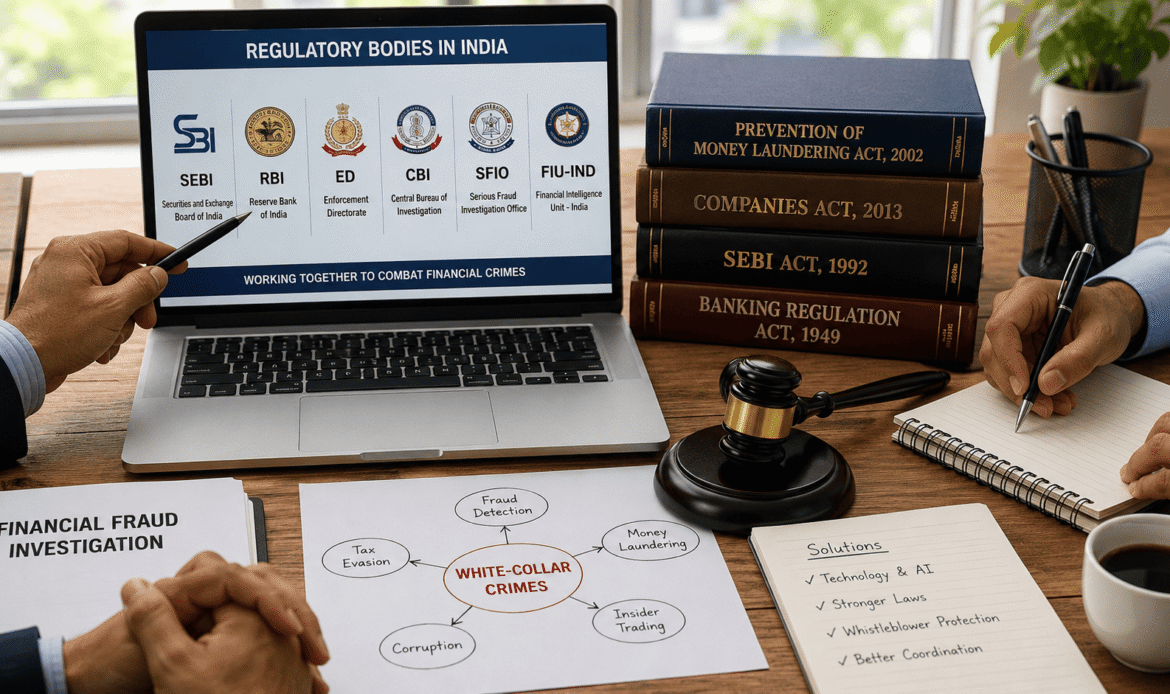
- Coordination Failures and Jurisdictional Overlaps: Regulatory bodies often face challenges in coordinating efforts due to overlapping jurisdictions.
- Lobbying by Political and Corporate Interests: Corporate and political pressures can undermine the effectiveness of enforcement efforts.
- Obstruction Due to Systematic Issues: Challenges arise from delays and discrepancies in regulatory actions, as illustrated by data from October 2023.
How India Can Strengthen Financial Fraud Prevention & Regulations
- AI and Data Analytics for Fraud Detection: Implementing advanced technologies to identify and prevent fraudulent activities more efficiently.
- Stronger Whistleblower Protection Laws: Enhancing legal safeguards to encourage the reporting of financial crimes.
- Improved Coordination Among Regulatory Agencies: Fostering better collaboration between agencies to streamline enforcement and investigations.
Frequently Asked Questions (FAQs) – White Collar Crimes in India
Q1. What are the main causes of white-collar crimes in India?
Corporate greed, ineffectual enforcement, loopholes in financial regulation, and weak corporate governance are key factors. These create an environment ripe for financial crime.
Q2. How can clients guard against becoming victims of financial fraud?
Investors should carefully assess investment schemes, stay informed of SEBI’s alerts, and avoid high-risk Ponzi schemes. Conducting due diligence and seeking advice from financial experts can also limit the risks.
Q3. Who are the regulators trying to prevent white-collar crimes in India?
Prominent regulators include the Securities and Exchange Board of India (SEBI), Reserve Bank of India (RBI), Enforcement Directorate (ED), Central Bureau of Investigation (CBI) and the Serious Fraud Investigation Office (SFIO). Each agency plays a specific role in overseeing and regulating financial activities to prevent fraudulent practices.
Q4. Which legal frameworks aid in combating white-collar crimes in India?
Important laws include the Prevention of Money Laundering Act (PMLA), 2002, the Companies Act, 2013, the Securities and Exchange Board of India Act, 1992, and the Banking Regulation Act, 1949. These statutes provide the legal foundation for regulatory actions combating financial crimes.
Q5. What are the challenges regulatory bodies face in fighting white-collar crimes?
Challenges include jurisdictional overlaps, political and corporate lobbying, limited resources, and delays in legal proceedings. These obstacles can hinder effective enforcement and timely justice.
