

Reviewed and Validated by: Aakrist Goyal, Associate
Introduction
Understanding employment laws is crucial for both employers and employees in India. These laws not only govern the workplace but also ensure fair treatment and compliance with regulations. This comprehensive overview of employment law in India delves into the historicical background, key legislations, regulatory authorities, recent amendments, and their implications.
Historical Background of Employment Law in India
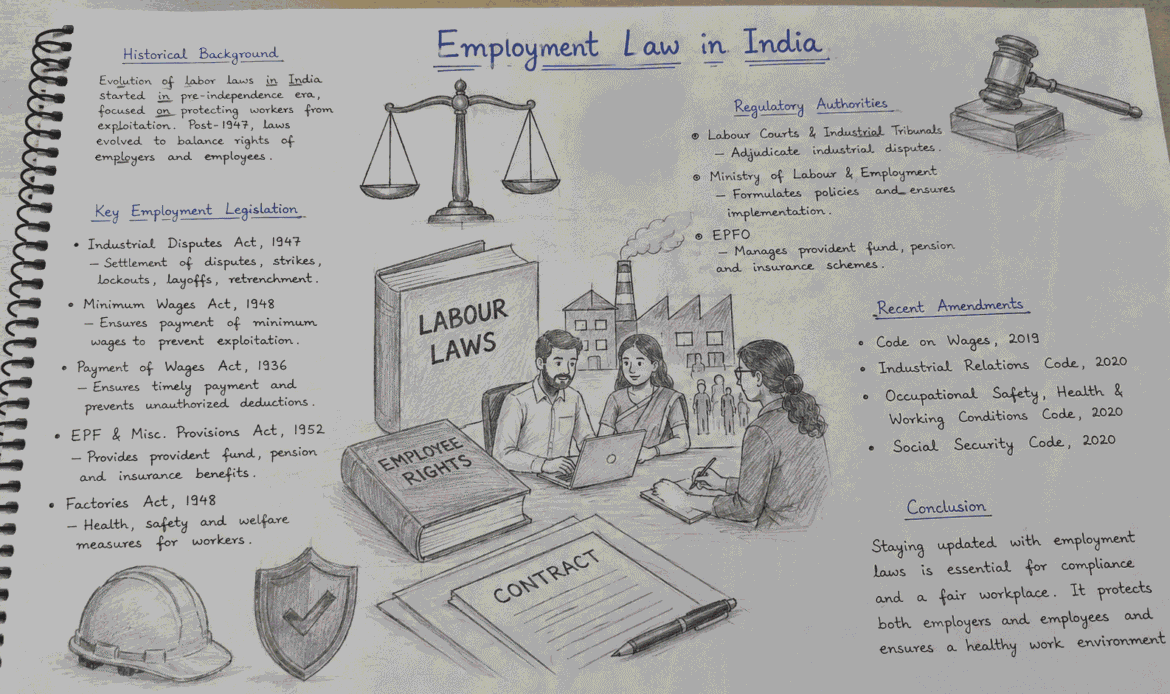
The evolution of employment laws in India dates back to the pre-independence era, with significant developments post-1947. Initially, labor laws were focused on addressing the exploitation of workers in colonial industries. Over time, these laws evolved to balance the interests of employers and employees, culminating in a comprehensive framework that governs various aspects of employment.
Read another article: White-collar Crimes in India: Types of White-collar Crimes – Part – 2
Key Employment Legislation in India
India’s employment law framework comprises several key statutes:
- The Industrial Disputes Act, 1947: This Act provides mechanisms for the investigation and settlement of industrial disputes. It outlines procedures for strikes, lockouts, layoffs, and retrenchment.
- The Minimum Wages Act, 1948: Ensures that workers are paid minimum wages as fixed by the government, preventing exploitation and guaranteeing a basic standard of living.
- The Payment of Wages Act, 1936: Regulates the payment of wages to certain classes of employed persons, ensuring timely disbursement and preventing unauthorized deductions.
- The Employees’ Provident Funds and Miscellaneous Provisions Act, 1952: Provides for the institution of provident funds, pension funds, and deposit-linked insurance funds for employees.
- The Factories Act, 1948: Governs labor in factories, focusing on health, safety, and welfare measures for workers.
Regulatory Authorities in Indian Employment Law
Several regulatory authorities ensure compliance and address disputes under Indian employment laws:
- Labor Courts and Industrial Tribunals: These bodies adjudicate industrial disputes and enforce labor laws.
- The Ministry of Labor and Employment: This governmental body formulates policies and ensures the implementation of labor laws.
- The Employees’ Provident Fund Organization (EPFO): Manages provident fund, pension, and insurance schemes for the workforce.
Recent Amendments in Employment Law
Recent legislative changes have aimed at simplifying and consolidating labor laws:
- The Code on Wages, 2019: Consolidates four labor laws and aims to simplify the wage structure.
- The Industrial Relations Code, 2020: Merges three laws related to industrial disputes, strikes, and trade unions.
- The Occupational Safety, Health, and Working Conditions Code, 2020: Integrates laws relating to safety, health, and working conditions.
- The Social Security Code, 2020: Amalgamates laws related to social security and welfare benefits for employees.
These changes reflect an ongoing effort to modernize labor laws, improve compliance, and enhance the ease of doing business.
Conclusion
Staying updated with employment laws is essential for legal compliance and fostering a fair workplace environment. Continuous monitoring of legislative changes ensures that both employers and employees are well-informed and protected under the law.