

Reviewed and Validated by: Srijan Jha, Associate | How to Check Company Name Availability in India
Introduction
While the choice of the name for a business is often viewed as a purely creative exercise driven by the goal of establishing a brand and setting the direction of the company’s growth, when we view the same from a legal perspective, the name of the company is the first thing that comes into fruition before even the company comes into existence. Thus, the choice of the company’s name is an essential stage for the registration of trademarks and incorporation of the company.
A common misunderstanding in the minds of stakeholders is that the registration of the name of a company is a straightforward procedure. However, this could not be further from the truth, as the registration of a name involves complex steps such as checking the availability of the name, filing the relevant forms, and obtaining approval from the Ministry of Corporate Affairs. Without proper guidance, it is easy for an application to be rejected.
The rejection of a name is not simply due to a direct match with an existing name, as an application can also be rejected due to the proposed name sounding similar to an existing name/trademark, which creates conflict between the two names, or because the name includes words that are restricted by regulations. An entrepreneur must also ensure that the prospective name is registered as a trademark to mitigate all risks.
The founders must therefore ensure that they cross-check the MCA registry, the trademark database, and online resources to ensure that any name that comes to mind is thoroughly vetted and is not likely to pose a risk in the future.
The Problem with Surface-Level Checks
Founders commonly find themselves assuming that the basic search tool offered by the MCA ensures that a name registration will be smooth. However, the MCA tool does not account for phonetic similarities or search the trademark registry; thereby, these activities must be done manually to ensure that the application submitted via SPICe+ or RUN is approved.
Therefore, the search tool offered by the MCA only acts as a starting point, and founders must take action to manually review trademark databases and names that are phonetically similar. .
This guide provides comprehensive guidelines on the legal requirements, procedures, and best strategies relevant for checking company name availability and filing for the registration of a proposed name before the MCA.
Read our also other article: How to Legally Register a Brand Name in India
Legal Framework for Company Names in India
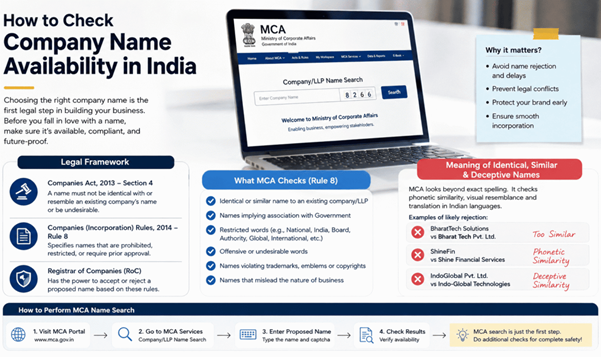
Section 4 of the Companies Act, 2013 establishes the statutory regulations pertaining to corporate names and registration requirements in India. It states that any proposed company name must not be identical to or deceptively similar to an existing company name. To ensure the enforcement of the said provision, the Ministry of Corporate Affairs, operating through the Registrar of Companies, holds the authority to register or reject applications for the registration of names.
Section 4, sub-section (2) of the Companies Act, 2013 is the primary legislation that addresses disputes arising out of the name of a company. The provision empowers the Central Government to reject any proposed name if the said name is deemed undesirable by the Central Government. Furthermore, the Companies (Incorporation) Rules, 2014 specifically provide the benchmarks and criteria for determining such undesirable criteria.
How to Check Company Name Availability in India
Name Approval Rules under Companies (Incorporation) Rules, 2014
While the companies act provide the substantive law on the registration of name, the Companies (Incorporation) Rules, 2014, contain detailed procedural norms around naming. Rule 8 is the key provision, broken into the following themes:
- Names that are prohibited because of resemblance to existing entities;
- Names that include words requiring Central Government approval (like ‘Board’, ‘Authority’, ‘National’);
- Names that imply association with the Government or misleading business activity; and
- Names that violate provisions under emblems, trademarks, or offensive expressions.
For instance, if your proposed company is “Bharat Finserve Pvt. Ltd.”, and there already exists a “Bharat Fin Services Ltd”, the MCA may reject the name even though the exact string doesn’t match due to deceptive similarity.
Therefore, it is evident that name registration with the MCA is a complex task, which requires numerous hours to ensure that there is no phonetic or visual similarity between the proposed name and an existing name. Thus, it is best advised for founders to seek professional advice in order to safeguard themselves from potential risks and save time.
Meaning of Identical, Similar, and Deceptive Names (Rule 8)
Rule 8 goes beyond literal spelling and looks at how names might appear or sound when spoken, abbreviated, or transcribed.
Here are some practical interpretations used by the Registrar when rejecting or flagging names:
- BharatTech Solutions vs Bharat Tech Pvt. Ltd. – Seen as deceptively similar.
- ShineFin vs Shine Financial Services – Rejected under phonetic resemblance.
- IndoGlobal Pvt. Ltd. vs Indo-Global Technologies – Likely objection raised on use of “Indo” and “Global” in identical order.
That distinction must be major in nature so as not to impact the approval of the company name. The interpretation of founders that making minor punctuation edits, using plural forms, or simple word rearrangements creates legal distinctiveness is unsound and shall not be deemed distinct under Rule 8.
Step-by-Step Process to Check Name Availability
The MCA portal serves as the primary entry point for verifying name availability. This can be done by using the publicly accessible tool titled “Check Company Name” on the official website of the Ministry of Corporate Affairs (MCA),
To use it:
- Visit the Ministry of Corporate Affairs website (www.mca.gov.in);
- Click on “MCA Services” > “Find CIN or Company Name” > “Check Company Name”;
- Enter the full or partial proposed name, and
- Review the results, especially if close matches appear.
The MCA online search tool only searches the proposed name through the ROC database of LLPs and companies. This creates concern for founders, as the search does not eliminate issues that arise from trademark searches, international business registries, domain availability, or restricted terminology under applicable laws.
Interpreting Search Results Correctly
The search result screen may give a false sense of clarity. If your proposed name isn’t shown, that doesn’t mean it’s safe to use. MCA often rejects names that are:
- Phonetically close to another name (even with spelling differences);
- Using generic suffixes like “Technologies”, “Systems”, or “Consultants”, and
- Conflicting with LLPs, foreign company registrations, or NGOs with similar branding.
Let’s say your proposed name is “Finova Edge Pvt. Ltd.”, and you run a search and find nothing similar. However, if there’s an active “Finovate Edge Solutions LLP”, you might still get an objection under Rule 8.
What next required step is to check whether a similar trademark exists. A trademark owner may later sue, even if your name got MCA approval, because MCA clearance is not a license to ignore IP law.
Common Errors Founders Make During Search
Here’s where early-stage businesses slip up:
- Over-reliance on the MCA tool and skipping a parallel trademark check;
- Assuming slight variations (adding “India” or “Tech”) makes the name different;
- Submitting names that include restricted expressions without prior approval; and
- Believing that if a domain name is available, the company name must be too.
To avoid these, treat the MCA search as only the preliminary check and one part of a broader check. If you’re serious about incorporation, combine it with:
- Trademark registry search (https://ipindiaonline.gov.in/tmrpublicsearch/);
- Domain and social handle availability; and
- Advisory vetting against Rule 8 and naming guidelines.
Below is a table summarizing key differences across checks:
TABLE: Comparing Name Availability Tools
Here are the four checks that a startup must perform while finalising the name of the company:
Check Type | What It Covers | Limitations |
MCA Company Name Search | Existing companies/LLPs registered in India | Doesn’t detect trademarks or deceptive similarity |
Trademark Registry Search | Registered brand names under IP law | Doesn’t show company incorporations |
Domain Search | Domain (.com/.in) availability | No legal bearing on name registration |
RUN/SPICe+ Submission | Formal approval request by MCA | Time-consuming if name is likely to be rejected |
MCA Name Reservation System Explained
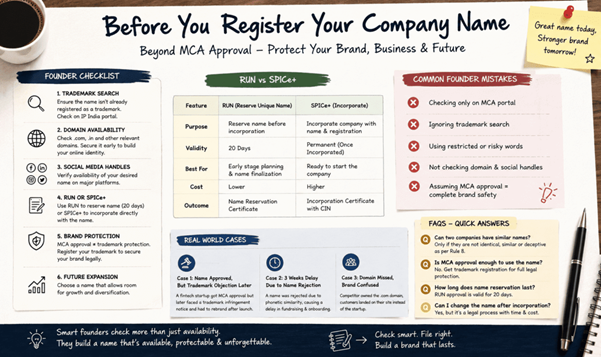
The RUN (Reserve Unique Name) form, which was introduced by the Ministry of Corporate Affairs, is available on its portal to provide a simplified mechanism for reserving a company’s name prior to drafting the incorporation documents. However, the reservation of a name must not be confused with the registration of the business. The form simply acts as a provisional approval of the name for a period of 20 days for companies and 60 days for an LLP. In the event that the company fails to submit the incorporation documents, the provisional approval becomes void.
A lot of founders think filing RUN is mandatory, but it isn’t, not if you’re using SPICe+ for direct incorporation. Still, it’s a good tool to lock in a name if your business plans are a few weeks away from execution. Especially if you’re unsure whether your chosen name might get picked up by someone else.
Founders asking how to check if a company name is available in India often skip RUN, thinking the MCA portal search is enough, but it’s not. Submitting RUN is the only way to get a clear yes/no on your name before putting effort into drafting the rest.
SPICe+ Form Name Application: When and How to Use It
SPICe+ (Simplified Proforma for Incorporating Company Electronically Plus) is a comprehensive and consolidated form that serves as an integrated one-stop shop for the incorporation of a company. It covers both name reservation and incorporation aspects, including registrations for PAN, TAN, EPFO, ESIC, and other services. IncorpX The form comprises two parts: Part A, which deals with name reservation, and Part B, which handles the incorporation filing alongside linked services.
When you’re ready to incorporate immediately and already have your documents and board resolutions lined up, use SPICe+ instead of RUN. The benefit is that you submit the name reservation and incorporation in one go. But there’s a downside too: if your name is rejected, the entire application gets delayed, and you’re forced to revise.
Founders who are confident in their company name availability, especially those who’ve consulted with advisors, may prefer SPICe+, as it speeds up the process, provided all goes well.
Differences Between RUN and SPICe+: Key Use-Cases
TABLE: RUN vs SPICe+ — Name Reservation Workflows
Feature | RUN Facility | SPICe+ Name Application |
Purpose | Standalone name reservation | Name reservation + incorporation |
Application Validity | 20 days for companies, 60 for LLPs | N/A – used in full incorporation |
Number of Names Allowed | 2 names in a single application | 1 name only |
Time for MCA Response | Usually within 1–2 working days | 2–3 working days |
Use Case | Uncertain founders, early planning | Ready-to-incorporate companies |
Edits & Resubmissions | Limited to 1 resubmission | Requires full resubmission if failed |
This clarity helps you avoid failed filings and ensures smoother business name approval in India within the larger company name registration process in India.
Trademark Check & Intellectual Property Conflicts
A major misconception that most founders have is that relying solely on the MCA site for checking name availability and securing approval from the MCA grants them an absolute right to the proposed name of the company. However, this is far from reality, as the MCA’s name check is only a primary search. The company must ensure that prior to adopting any name, it reviews whether such a name or a similar name is present in intellectual property records, such as trademark registries. This prevents founders from facing legal challenges arising from the infringement of existing trademark rights.
What that means in practice is simple: Always run a trademark check, and it’s not optional.
This extra step may seem like overkill, especially when founders are eager to launch. But it’s far cheaper to rebrand before day one than to fight a Section 29 infringement suit under the Trade Marks Act, 1999.
Step-by-Step Guide to Checking Trademark Name Conflicts
Fortunately, the process of conducting a trademark search in India is free of cost and can be conducted by any individual through the publicly accessible IP India online portal. This allows founders to check similar names in the relevant classes where they are seeking to incorporate their entity. Consequently, this enables founders to mitigate risk by conducting an intensive search of existing trademarks in India.
Here’s how to check trademark conflicts:
- Visit the official trademark search site: https://ipindiaonline.gov.in/tmrpublicsearch/;
- Choose ‘Wordmark’ as the Search Type;
- Enter your proposed company name (without Private Limited).
- Select the appropriate Class based on your sector (e.g., Class 41 for education, Class 35 for services, etc.); and
- Click ‘Search’.
Now, review the results:
- Exact match already registered? Choose another name.
- Similar-sounding mark in the same class? You’re legally at risk.
- Similar name in unrelated class? Less risky, but still worth reviewing.
This part of the company name search in India process is often neglected, but it’s where real branding exposure sits. You may get name approval today and still face a rebrand 6 months later when investors conduct due diligence.
Before Registering Your Company Name
Cases Where MCA Approval Was Granted But Trademark Objections Followed
Here are a few real examples (names anonymised):
- A tech startup received MCA approval for “Zentrova Solutions Pvt. Ltd.”. However, a medical diagnostics firm already held the trademark “Zentrova” under Class 5. They issued a cease-and-desist notice within 45 days of launch. The founder had to rebrand after already printing merchandise and business cards.
- Another founder incorporated “Netlogiq India Pvt. Ltd.” and passed MCA checks, but “Netlogic Inc.”, a US-based company, held prior international trademarks and had Indian representation. The result? A trademark opposition before launch, and months of silence before relaunching under a new name.
There are numerous instances of founders facing monetary losses due to conflicting names in India, despite having their company name successfully registered with the MCA. Founders must ensure that they thoroughly review their prospective name against the Intellectual Property Registry (IPR), specifically the Trademark Database, prior to registration to safeguard against potential legal conflicts.
Do’s and Don’ts for Selecting a Company Name
One point of importance is that the uniqueness of a name must be determined by the standards established under Rule 8 of the Companies (Incorporation) Rules, 2014, and not by personal perceptions of uniqueness. As regulatory clearance for a company name is subject to these provisions, strict adherence ensures a smooth approval process for name registration.
The following categories routinely trigger rejections:
- Names too descriptive or generic (like “Tech Solutions Pvt Ltd”);
- Use of government-like terms (say, “National,” “India Council,” or “Commission”);
- Financial industry terms without RBI/SEBI/NBFC approvals (“Bank,” “Stock Holding”);
- Any word that could mislead the public about your business activity;
- Phonetic closeness to an existing registered company, even if the spelling is slightly different; and
- Use of words suggesting a professional body, e.g., “Institute”, or “University”, which require special permissions.
One mistake that many startups make is relying entirely on the MCA’s auto search feature. The company name search India portal may show green, but remember, it does not scan for sensitive words, approvals, or even full brand conflicts, as much of that is handled at the backend by a compliance reviewer.
That’s why a formal legal vetting is worth doing before filing your RUN or SPICe+ application. You’ll catch issues before they delay your business name approval in India or force a resubmission.
Naming Strategy, Going Beyond Legal Clearance
A major misconception is that securing name registration is the final step in protecting a brand identity. However, MCA clearance and IPR registration represent only one aspect of brand protection. Elements such as domain registration, social media handles, and digital identity presence must also be taken into consideration by founders in this age of digital revolution.
Ask these questions:
- Is your domain name (e.g., .in or .com) available?
- Are social handles free?
- Can someone easily spell or remember your name in conversation?
- Does it sound too similar to a larger brand in your field?
- Have you checked what Google shows when you search it?
This part is often missed. For instance, someone might register “Zennova Solutions Private Limited” thinking it sounds futuristic, but find later that Zennova.org is a defunct company with negative media coverage in another country. Now you’ve attached your new business to that mess unintentionally.
The tool to check business name availability online in India won’t protect you from poor branding choices. That’s a separate due diligence you must handle or have your legal advisor flag upfront, and don’t forget the long-term SEO or international considerations. If you have expansion plans, don’t lock yourself into a name that only works in Hindi or sounds clunky outside the local region.
What MCA Doesn’t Tell You About Infringement Risks
Securing a name through the MCA website does not grant total immunity to founders or companies against legal risks. Registration before the MCA simply indicates that no similar corporate entity exists in its database and does not address intellectual property clearance. This is largely because the MCA is not the designated authority for trademark examination. As a result, businesses must review the trademark status of a proposed name prior to using it, as any infringement may lead to monetary loss as well as litigation.
Let’s break this down using a table of common issues:
Problem | Legal Trouble You May Face | How to Catch It Early |
Phonetically similar name | Trademark opposition under Sec. 11 of the Trade Marks Act | Run a detailed TM registry search (Class-wise) |
Similar logos, visual identity | Passing off / deceptive similarity under common law | Avoid design that mimics established brands |
Use of prior user’s mark | Prior use doctrine may apply | Google search, industry scan, B2B platforms |
International trademark conflict | WIPO or Madrid Protocol objection | Search global TM databases if planning exports |
So even if your company name availability application on the MCA gets through, you might still face a notice from a trademark holder asking you to cease use or rebrand. That’s why experienced legal teams don’t just rely on MCA approval. They layer it with IP risk checks, domain and SEO filters, and market recall evaluation, all part of building a durable identity.
Name Availability Check for LLPs, OPCs, and Foreign Subsidiaries
Yes, structurally and procedurally, there are small but important variations. For LLPs, the RUN form is the only method to reserve a name. SPICe+ is not applicable for LLPs. So when you check business name availability in India for LLPs, don’t expect the same portal paths as for private limited companies. Also, the naming suffixes differ. LLPs must end with “LLP”, e.g., “Strivex Consulting LLP”. One Person Companies (OPCs) must include “OPC Private Limited”, e.g., “Tanvax Foods (OPC) Private Limited”.
Founders must ensure that the terms used in their entity’s name comply with the naming requirements described under applicable laws. An entity that is a One Person Company must explicitly include “(OPC) Private Limited” at the end of its name, whereas an entity that is a Limited Liability Partnership must have “Limited Liability Partnership” or “LLP” at the end of its name rather than “Private Limited.”
Naming Rules for Wholly Owned Subsidiaries of Foreign Companies
If your Indian entity is being set up as a wholly owned subsidiary (WOS) of a foreign parent, name availability takes on another layer of complexity. You can use the parent company’s name in the Indian company name, e.g., “XYZ Holdings India Private Limited”, but only if certain conditions are met:
- The foreign company must issue a NOC (No Objection Certificate) permitting the use of its name;
- The business objects in the Indian company’s MOA must align with the parent company, and
- The parent company must be a registered legal entity overseas and provide charter documents.
This requirement isn’t flagged by the basic company name search tool in India. But at the stage of the company name registration process in India, MCA reviewers specifically look for the parent company’s authorization and documentary evidence.
Additional Filings or Caution for Cross-Border Structures
If you’re incorporating as part of a multi-national group, watch for:
- FEMA compliance issues (in case of investment into an Indian company);
- Brand licensing if using global trademarks locally;
- RBI and RoC scrutiny in case of overlapping board members or shared brand names; and
- Risk of rejection if the name implies government association or sovereignty.
For instance, a proposal like “EuroUnion Finance India Pvt. Ltd.” might be rejected due to resemblance to “European Union,” unless there’s a clear brand lineage and legal permission. Also, ensure that the trademarks are not just cleared in India but also not in conflict with foreign registrations, especially if the business has export or digital SaaS plans. These name-layer checks matter, even if your core focus is only to check if a company name is available in India. When cross-border factors enter, regulators look beyond basic MCA clearance.
Case Studies & Examples
In practice, issues around company name clearance almost never look like textbook examples. More often than not, things go wrong where the founder assumes things have gone right. We’ve included below a few real scenarios, drawn from past matters handled by startup legal teams or corporate advisors, which show that even after MCA approval, risks around trademarks, branding collisions, and practical digital overlaps can still derail execution. These aren’t edge cases, but common.
When MCA Missed It, But Phonetics Didn’t
There was one client who came to us after his name application, “Zylex Innovations”, got rejected. Now, here’s the thing: he had done the SPICe+ Part A run, checked the MCA portal, even saw the green flag, and thought it was safe.
But after filing, the rejection came in less than a week. Turns out, there was another company called “Xylex Solutions” registered two years earlier in Bengaluru, in the same class, but MCA’s system hadn’t flagged it. But the phonetic similarity got caught by the officer handling manual vetting, and under Rule 8 of the Company Incorporation Rules, that’s enough to reject, even if the spellings are distinct.
The founder wasn’t expecting it. It meant redoing the paperwork, rechecking logos, and honestly, revisiting the entire positioning. We often think the portal is the final word, but the backend still relies heavily on human discretion, especially in edge-name cases. It wasn’t the money. It was the wasted time that hurt more.
When Trademark Killed It Post-Incorporation
A health-tech startup incorporated as “Medinote Healthcare Pvt. Ltd.” after passing MCA clearance without objections, only to receive a legal notice two months later from a pharmaceutical giant holding a Class 5 trademark for “MediNote.” Because MCA approval covers entity registration rather than trademark clearance, the company was forced into a costly six-month rebrand—requiring website migration, server updates, investor explanations, and the loss of early brand equity. This situation highlights a critical misstep among founders: assuming Ministry clearance guarantees intellectual property protection, when in reality, the MCA and the Trade Marks Registry operate independently, leaving an incorporated entity fully exposed to third-party trademark infringement claims if a prior trademark check is omitted.
When the Domain Broke Everything
Domain names also play a vital role in determining the name of a company and securing its brand identity. This can be illustrated by the example of a Hyderabad-based fintech startup that registered its corporate name as “Fintrail Technologies Pvt. Ltd.” only to discover later that the domain name “fintrail.com” was already owned by an active UK compliance advisory firm that ranked high on search engines. Within weeks of launching their minimum viable product, the Indian company began receiving emails intended for the UK firm, and vice versa. One investor even forwarded a pitch deck containing details from the wrong Fintrail.
At that point, the only real option was to rebrand. They picked “FintrailX,” registered a new domain, and shifted all marketing material. It wasn’t legally mandatory, but from a reputational and operational standpoint, it had to be done. And they lost about six weeks of momentum right when they were getting investor traction. All this could’ve been prevented if the founders had treated the domain check as a critical part of the clearance, not an afterthought.
Frequently Asked Questions (FAQs)
Can two companies have similar names in different states?
No, a name that has been approved by the MCA applies throughout India. Two legal entities cannot exist with the same name, even if they operate in different states.
What happens if MCA rejects my proposed name?
When the MCA rejects a company name registration application, it provides specific grounds for the rejection. A founder can take corrective action to resolve the discrepancies mentioned in the rejection communication prior to resubmitting the relevant form to ensure the name gets approved on the next filing attempt. It’s usually rejects the application on the following grounds:
- Similarity with the existing company or LLP name;
- Trademark conflict (if observed during internal screening);
- Use of restricted or sensitive terms (like “India,” “Bank,” “Council”);
- Incorrect use of suffix (like “Ltd” or “LLP”); and
- Phonetic or brand-level confusion.
How many times can I reapply for name reservation?
While there is no statutory limit on the number of times a founder can file a name reservation application, each refiling of the name application requires payment of the relevant government fee. This causes not only financial loss but also delays the overall incorporation of the company.
Can I use a registered trademark in my company name?
A founder can only use a registered trademark as their company name if they own the trademark or hold relevant documentation authorizing its use, such as a consent letter or assignment deed. If a founder uses a trademark without meeting these standards, the company faces financial loss due to trademark infringement as well as cancellation of the name registration by the MCA.
Is the name availability search free?
Yes. The MCA provides a free-to-use name check system on its portal through the SPICe+ application interface. But this tool is only the first layer. It checks basic availability against already registered company names.
Conclusion
Summary: Legal Readiness + Strategic Naming
Founders frequently underestimate the complexity of the company name registration process. They often treat registration as a quick task that can be achieved simply by checking availability on the MCA portal, failing to evaluate it from the perspective of brand building and risk mitigation. On a surface level, the search conducted on the MCA portal acts as a primary tool; however, founders must examine additional factors to ensure that the name they select does not create financial liability in the future.
Comprehensive name registration ensures a multi-level compliance check across three core perspectives: MCA availability, intellectual property rights, and digital presence such as domain names. Conducting clearance across all these areas prevents post-incorporation legal friction and avoids situations where company operations are disrupted due to inadequate initial research.
And for founders, especially those moving fast or bootstrapping, investing time early in this diligence pays off. It’s not just about saving a few days of delay; it’s about setting up a foundation that won’t shake when scale begins.
Final Word: Getting Professional Help Early
In almost every scenario of a branding crisis arising out of similar names, the most common cause is poor due diligence in naming the entity. This may be due to the assumption that securing a name is a straightforward task that only requires a single search on the MCA portal. However, the process also involves reviewing the trademark registry and domain availability, as well as considering other factors such as whether the proposed name is phonetically similar to existing names.
A corporate lawyer, a company secretary, or a compliance specialist would be able to spot subtle warning signs relating to regulation. Such a professional would check proposed names against all relevant factors, whether requirements under the Companies Act and the rules thereunder or the trademark registry.
It is important to treat name availability as a crucial legal step rather than a simple formality. Before printing business cards, securing a domain name, or adding new team members, the only sensible thing to do is to ensure that the brand identity is secured across all legal and digital channels.
To recap the real-world essentials:
- Use the company name availability MCA tool, but don’t rely on it blindly.
- Cross-verify the name through a trademark public search (especially for similar-sounding or descriptive terms).
- Consider domain and social handle ownership, not just for branding, but for operational clarity.
- Avoid restricted words without approval. Words like “India”, “National”, “Finance”, etc., require prior consent or higher capital thresholds.
- Run a phonetic similarity test, if needed, through your legal team or a CS.
- If your business spans states or languages, check transliterations and regional risks as well.
By being thorough at this stage, you not only improve your chances of swift incorporation but also save yourself months of rework later. That’s not bureaucracy, that’s just a good strategy.