

Reviewed and Validated by: Srijan Jha, Advocate
Employee Stock Ownership Plan (“ESOP”) is an employee benefit plan which aims to provide the employees with the certain stock representing ownership of the employer’s company. The drafting of an ESOP scheme is essential to ensure that a well-structured document has been enforced by the employer to protect the company’s interest all the while rewarding the employees for their efforts. In relation to transfer of such ESOPs from a foreign entity to the Indian subsidiaries, the employer must ensure that such plan is aligned with the statutory requirements under the Indian legislation which includes but is not limited to foreign exchange regulation under FEMA and the taxation laws.
This article aims to shed light on the legal framework, required approvals and license, taxation, and structuring issues pertinent to the issuing of the ESOP from the foreign entity to the Indian subsidiary.
Are ESOPs Legal in the case of Indian Subsidiaries of foreign parents?
The ESOP Plans of Indian Subsidiaries must be drafted in a manner which is legally compliant and that such plan is duly authorised with all the requisite approvals being undertaken by the entities.
Legal compliance of any issuance of ESOP shall be determined by the character of ESOP which may be as follows:
- ESOP of the Indian subsidiary; or
- ESOP of the foreign parent company.
Each kind of the ESOP has its own compliance requirements and subject to different regulations enforced by the relevant authority.
Can an Indian subsidiary grant ESOPs in shares of the foreign parent?
Yes, the Indian subsidiary has the power to grant its employees ESOP of their foreign parent company. However, such issuance shall be subject to the regulatory obligations under the RBI guidelines, FEMA and Company Act, 2013.The statutory obligations for issuance of ESOP are as follows:
- The foreign parent company should implement a scheme for the employees with respect to the ESOP;
- The grant of the ESOP should be in accordance with the FEMA and other applicable laws;
- The statutory obligations with respect to the disclosure requirements must be complied with;
- Consideration must be in accordance with the foreign exchange regulations.
The model of transferring of ESOP from foreign entity to Indian entity is often referred to as a Cross-border ESOP structure India. The implementation of such model requires a well compliant document policies which is in accordance with the Indian and foreign law.
Is Section 62(1)(b) of the Companies Act applicable?
Section 62(1)(b) of the Companies Act, 2013 applies to any company which falls under the jurisdiction of the Companies Act, 2013 and specifically governs the further issuance of share capital by a company. The provision thereby is applicable on the shares of the Indian subsidiary whenever being issued as employee stock options.
This provision mandates that the company conduct the following to ensure that it remains compliant with the law:
- Board resolution passed by the Board of Directors granting approval for the issuance of these shares;
- Special resolution passed by the shareholders granting approval for the issuance of these shares;
- Compliance with the statutory requirements under the Companies (Share Capital and Debentures) Rules, 2014;
- Maintaining records in a register for the ESOP;
- Disclosure of the issuance of the ESOP in Board’s Report.
These compliances form the minimum requirements for the issuance of ESOP being compliant with the Companies Act, 2013.
However, in a cross-border transaction with respect to the ESOP, the specific compliance under the Section 62(1)(b) requires consideration of the following factors:
- Whether the ESOP issuance constitutes issuance of shares domestically;
- Whether these ESOP comply with the accounting and disclosure obligations;
- Whether such ESOP affects the financial statements and how the same is recorded in the financial statement.
What Approvals Are Required to Implement as an ESOP in an Indian Subsidiary?
ESOP in an Indian subsidiary requires the minimum approval of the board of the company and in the instance where applicable the shareholders through the passing of a special resolution. However, the specific requirements of such ESOP in an Indian subsidiary is subject to the relations between all the concerned stakeholders as well as the internal structure of the companies.
As far as the regulatory requirements applicable on the drafting ESOP Plans of Indian Subsidiaries are concerned, the key obligations arise from the approval requirements under the Companies Act, 2013, the applicable rules thereunder. However, in the instances where the shares of the company are foreign securities, the companies are also required to review such structure from the FEMA perspective. Any applicable regulatory approvals which are applicable on the such ESOP which may arise from Companies Act, 2013 and FEMA regulations may attract penalty on the company and its officers in case of non-compliance.
Board Approval: Does an ESOP require Board Approval?
The approval of the boards is an essential element in any action which is being undertaken by a company. It essentially provides authorisation to any actions which are undertaken by the company and thereby is required for any issuance by the company. Thus, the issuance and adoption of the ESOP scheme must be first approved by the Board of Directors through a board resolution and in any applicable instance the resolution must be presented before the shareholders.
Board’s approval through the resolution must contain the following:
- The implementation of the ESOP scheme;
- Determination of the terms under the ESOP scheme;
- Pricing and mechanism for determination of the pricing under the ESOP scheme; and
- Constitution of the delegated committee.
The resolution of the board must be clearly documented and must be utilised for the following instances:
- Such resolution may be presented along with the notice of shareholder;
- Required to be filed before the Registrar of Companies under the Companies Act, 2013; and
- For transparency and internal practices.
In accordance with the Companies Act, 2013, the ESOP registration requires the approval of both the Board and the Shareholder through the relevant resolution being passed.
In the case of the ESOP being transferred with respect to cross-border transaction, the board of the Indian subsidiary can restrict its approval to:
- Being subject to the policies and other internal process of the foreign parent company; and
- Requirement under the cost and reporting requirements.
Board approval ensures that the Indian and the foreign entities are aligned on the internal governance structures such as policies and other process.
When Is Special Resolution by Shareholders Mandatory?
In event where the Indian subsidiary has shareholders, the Indian subsidiary is required to obtain a special resolution of shareholders. The obligation to pass a special resolution is required in the Section 62(1)(b) of the Companies Act, 2013 read with the Companies (Share Capital and Debentures) Rules, 2014.
The assenting resolution of the shareholders is required under the following instances:
- Setting up ESOP by the company;
- Directors are offered the employee stock options;
- The ESOP creates a material change in operations of the Company.
The notice of shareholders’ meeting should have an explanatory statement, which must disclose the following items and information:
- Number of employee stock options;
- Employees to whom the ESOP shall be applicable;
- Vesting conditions and terms;
- Price determination mechanism;
- Maximum length of time during which the options can be vested;
Allotment of any ESOP without the duly authorised special resolution will be deemed invalid is likely to create procedural, legal and financial risk. Thereby, any ESOP plan must specifically record the requirements of special resolution to ensure compliance.
Do Separate Approvals Have to be made on Managerial Personnel?
While, the specific separate approval such as special resolution is not mandatory under the law. It becomes an obligation in the instances wherein such ESOP are being offered to the key managerial personnel of the company such as directors or major managerial staff.
Key considerations while determining the requirement of such ESOP are as follows:
- ESOP being issued to the independent;
- ESOP being issued to whole-time directors and managing directors; and
- ESOP on individual where there are specific provisions governing the wages limiting issue of security.
In the event that the ESOP pertains to the grant of security which is included in general managerial compensation, the following must be taken into consideration:
- Examination by the remuneration committee; and
- Disclosure under the board report of the company.
In a listed company, stock options being issued to a director requires higher disclosure requirements.
Are there other Compliance Obligations of Listed Subsidiaries?
Yes, there are certain additional requirements under the security laws with respect to the issuing of the employee stock options. Such compliance includes:
- Employee stock option being compliant with the securities regulations;
- Shareholder approval by way of special resolution obtained as per the regulatory requirements;
- Terms and conditions of such stock options have been determined by the company in accordance with the security laws; and
- Adherence to the statutory disclosures.
In addition to the abovementioned, listed companies are also required to comply with the following:
- Constituting and implementation of a nomination and remuneration committee;
- Supervision of the ESOP by an independent director; and
- Certain disclosure of any potential dilution arising out of the establishment of the ESOP.
In the case where the ESOP are being listed with respect to cross-border transaction, the companies must ensure adherence to the foreign security laws as well as the company law in India.
Connection with the Exchange Control Regulations
Wherever, the employee stock option is concerned with the foreign securities, the entities are required to adhere with the RBI guidelines. The Indian entity must ensure the compliance with the following:
- Appropriate disclosures and record keeping as per global regulatory requirements;
- FEMA statutory disclosure with respect to employee stock options are made within the prescribed timeline;
- Ensure that the pricing mechanism is in accordance with RBI guidelines;
- The maintenance of the records pertaining to the foreign ESOP held by foreign employee; and
- Disclosure under the FEMA and corporate approval are obtained simultaneously.
How Do FEMA and RBI Regulations Apply to Cross-Border ESOP Structures?
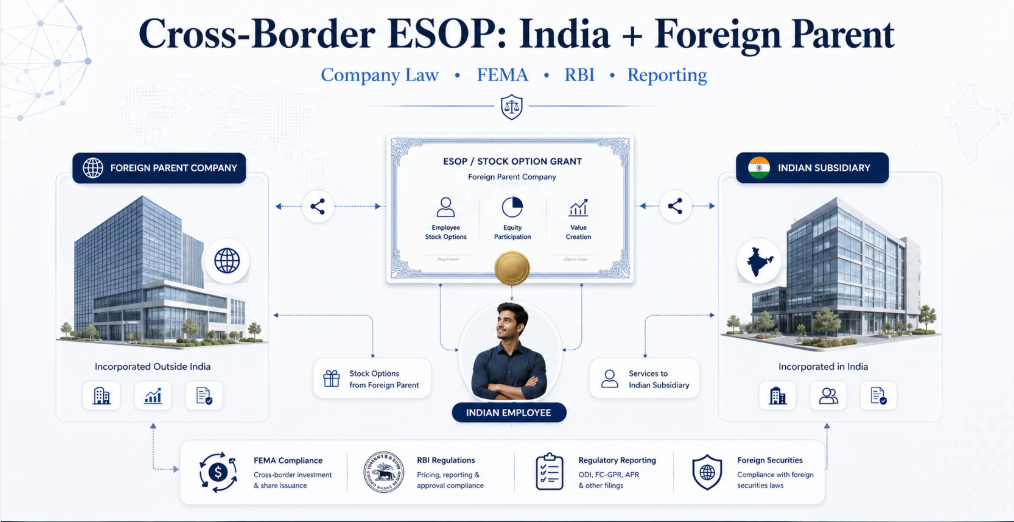
Drafting ESOP Plans for Indian Subsidiaries involving foreign parent shares must comply with exchange control regulations governing foreign securities acquisition by Indian residents.
This falls squarely within the framework of RBI regulations on ESOP for Indian employees.
Can Indian Employees Hold Shares of a Foreign Parent?
Yes, an Indian employee can hold the employee stock options of the foreign entity if such foreign securities are permitted under the ESOP.
The terms governing the issuance are subject to the conditions which include the following:
- The ESOP must offer the securities on a cross-border level;
- Shares must be issued by the foreign parent entity; and
- Reporting requirements under the FEMA and company law.
The preparation of the ESOP involving a Cross-border ESOP structure India, mandates the coordination between foreign entity issuer and Indian subsidiary.
FEMA Reporting Requirements
Under applicable foreign exchange regulations, the Indian subsidiary must undertake the reporting of the employee stock options by complying with regulatory requirements, which may include:
- Filing of annual return relating to foreign employee stock option;
- Disclosure of employee stock option acquired by Indian employees; and
- Compliance with reporting timelines under the FEMA.
Non-compliance of the disclosure or procedure may attract penalties under the Foreign Exchange Management Act.
Remittance of Exercise Price
Employees acquiring the foreign parent employee stock options may remit funds abroad for exercise in the mechanism which has been established under the FEMA.
Such remittance must be made in the following manner:
- All outward remittances must be in accordance with the FEMA law and must be routed through authorised dealer banks;
- Comply with applicable limits prescribed under the laws, regulations and schemes;
- Be properly strategised and documented in compliance with the law.
Employers must establish proper document and processes which provide guidance to employees regarding documentation requirements for the issuance of the ESOP.
How Should the ESOP Plan Be Structured for Tax Efficiency in India?
A well-structured ESOP plan ensures that it manages tax events at exercise and sale stages in a manner which reduces financial burden on the entity.
Tax at the Time of Exercise
At exercise, the difference between:
- Fair Market Value (FMV) of shares; and
- Exercise price paid by employee, is treated as a perquisite and taxed as salary.
The employer must:
- Determine FMV as per prescribed rules;
- Deduct tax at source;
- Reflect the perquisite in Form 16.
For foreign shares, valuation must comply with prescribed valuation methodology.
Tax at the Time of Sale
Upon sale of shares, capital gains arise.
Classification depends on:
- Holding period ideally 24 months for long term securities;
- Nature of security and whether such securities are listed or unlisted; and
- Place of listing.
Capital gains computation involves:
- Sale consideration; and
- FMV at exercise.
Withholding Obligations
The Indian subsidiary typically bears withholding responsibility at exercise stage.
Key compliance steps:
- Obtain valuation report from a merchant banker as authorised by the SEBI;
- Deduct appropriate TDS;
- Deposit tax within prescribed timelines under the taxation rate;
- Issue tax certificate under the relevant form.
Failure to withhold may trigger disallowance and financial risk exposure.
What Key Clauses Must Be Included in the ESOP Plan?
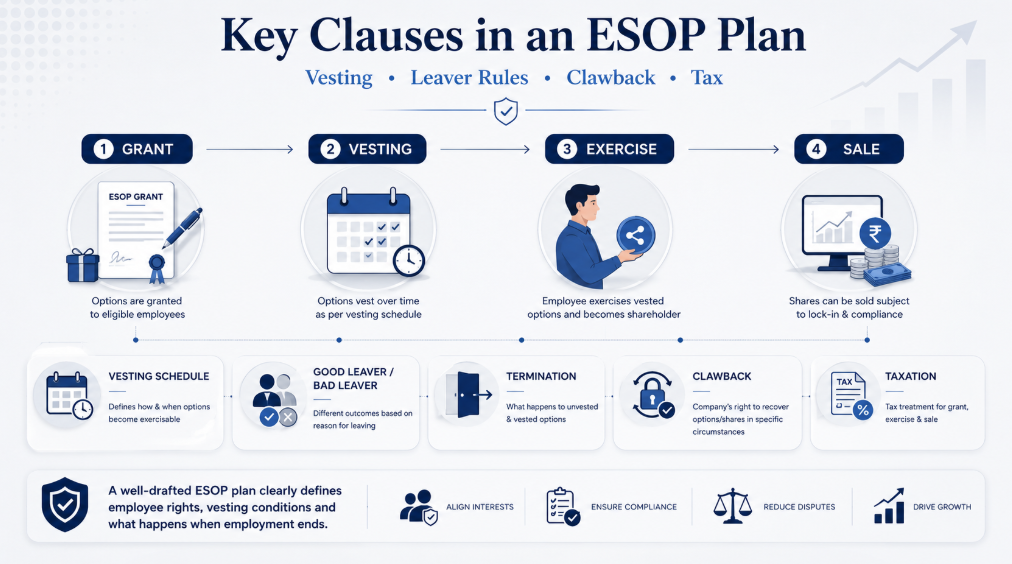
Drafting ESOP Plans for Indian subsidiaries must ensure that it comprises the following clauses whilst ensuring that such clause is in compliance with the foreign parent company documentations.
Vesting Schedule
The plan should specify:
- Minimum vesting period which is one-year subsequent to which employee stock options can be converted into shares;
- Time-based or performance-based vesting of the employee stock options;
- Provisions for prompt vesting if such vesting is impacted by the acceleration triggers.
Clear drafting of the vesting rights and schedules ensures there is a mitigation of litigation risk.
Good Leaver and Bad Leaver Provisions
The plan should clearly establish the following provisions:
- Mechanism and rights arising out of voluntary resignation;
- Termination for cause which includes but is not limited to fraud, misconduct, or breach of confidentiality;
- Retirement of such employee from the entity; and
- In the event of death or disability of the concerned employee.
The consequences may include:
- Immediate lapse of unvested options;
- Extended exercise window; and
- Forfeiture of the employee stock options.
Improper drafting of the ESOP wherein the good and bad leavers are not determined proportionally may cause litigation risk.
Termination and Clawback
Clawback provisions must address the following:
- Fraud;
- Misconduct;
- Material breach of confidentiality; and
- Financial restatement.
Such clauses must align with employment contracts to ensure that the same is harmonious with other terms applicable on the employee.
How Should Inter-Company Agreements Be Structured?
The Inter-company agreements must be structured in a manner that careful implements the accounting and tax aspects all the while ensuring that it is legally compliant.
Cost Recharge Mechanism
The agreement must specifically provide provisions for the following:
- The entity bearing the cost for implementation of the ESOP;
- Timing of recharge;
- Mark-up (if any);
- Documentation ensuring that all the agreements, internal policies and documentations are prepared.
Poor structuring of inter-company agreement is likely to create operational and financial risk with respect to the transfer pricing.
Accounting Treatment
The Indian subsidiary should figure out:
- Recognition of employee compensation expense in terms of the fair value of such securities;
- Indian AS or Indian GAAP treatment; and
- Fair value measurement.
Tax deductibility can be affected by accounting treatment.
Do Startups Have any Special Considerations?
Startups are eligible for certain benefits which must be recorded in the ESOP Plans of Indian subsidiaries which includes provision for tax deferral
Conditions to establish the eligibility for the ESOP benefits are as follows:
- Proof of startup status under the DPIIT;
- Turnover not exceeding INR. 100 crores; and
- Must be a private company.
What Is the ESOP Practice in the Event of Exit or M&A?
ESOPs of the Indian subsidiaries must ensure that their plan address the following with respect to exit or M&A:
- Allow prompt vesting of the employee stock options at the time of exit;
- Offer cash payout as settlement;
- Replacing of the existing employee stock options upon exit;
- Provide the impact on the unvested grants whether such employee stock options are vested, lapsed or replaced.
In cross-border acquisitions, they have to be coordinated with exchange control measures.
What Are The Common Drafting errors to avoid?
ESOP must be carefully be prepared keeping the operational and legal requirements aligned to ensure mitigation of risk. Any plan being formulated by the Indian subsidiary must ensure that such document is compliant with the foreign parent document. The common errors in preparing of such documents includes the following:
- Compliance with the FEMA reporting requirements;
- Failure to ensure the TDS liabilities under the taxation regime applicable on the ESOPs in India;
- Lack of board and shareholder consent for the issuance of ESOP;
- The definition of vesting differs occasionally; and
- Failure to establish the governing law and dispute resolution.
All the aspects should be checked in terms of regulatory timeline and shall ensure that all the disclosures are accurate.
Frequently Asked Questions (FAQs)
Can the Indian subsidiary directly issue employee stock option of its foreign parent possible?
No, the employee stock option cannot be issued of the foreign parent entity without specific authorisation by the foreign entity since the foreign and Indian entity are separate entities.
Are the Indian employees supposed to be RBI approved to take foreign shares?
No, the employee stock option offered to the Indian employees does not require approval from the RBI.
Is ESOP income taxable?
Yes, the ESOP are taxable in instances of exercising of the options and upon sale.
Should ESOP plans be registered with the ROC?
The ESOPs are required to be disclosed in the director’s report and filings as ESOP compliance under Companies Act, 2013.
Conclusion
The process of determining the ESOP for the Indian Subsidiaries mandates a careful and strategic harmonisation of the company law, foreign exchange control laws, and tax laws. The structuring of such ESOP requires greater commercial and legal understanding when foreign shares of parents are involved in such ESOP.
A well drafted ESOP of an Indian Subsidiary must ideally comprise of the following:
- Statutory approvals under company and FEMA laws;
- Adherence to RBI requirements on ESOP of Indian employees;
- Board and shareholder approvals;
- Taxation applicable to such ESOPs in India;
- Transparency in contracts, policies and other internal documents.
Effective implementation of cross-border ESOP is legally permissible but the entities must ensure that it has attained all the relevant approvals prior to such issuance. It must also ensure that it has such document strategized and prepared as a means to promote transparency and reduce financial risk rather than as a formality.