

Reviewed and Validated by: Shreya Paharia, Advocate
Introduction
Usually for e-commerce businesses, legal risks don’t begin with a court notice or a regulator email but on the website. A privacy policy copied from another brand, website terms drafted as a one-time formality, return conditions that do not align with the actual customer handling customer language but it somewhere in the checkout flow, are not minor drafting oversights. They are often the earliest signs that the legal structure of the business has not grown with the business itself. In case of online retailers, website terms of use and privacy policies are not decorative pages added to the footers just for the sake of mere competition. They are core operating documents. They shape how customer relationships are defined, how personal data is collected and used, how disputes are managed, how liability is allocated, and how trust is built in a digital environment wherein consumers rarely interact with the seller in person. This is usually why e-commerce privacy and terms should never be approached as a mere template exercise.
Website Legal Documents as Operational Infrastructure (Not Formalities)
An e-commerce business may have a polished website, an active order flow, multiple digital vendors, and a growing customer base, yet may carry serious exposure if the legal documents on the platform do not reflect the way business actually operates. In many cases, the legal problem is not the absence of documentation but the misalignment of both the businesses on the website and in practice. From the perspective of compliances, e-commerce businesses lie at the intersection of consumer protection, digital contracts, and personal data governance. From a commercial perspective, these documents do something even more important, that is, they reduce friction. They tell the customer what to expect, help the business set boundaries and create a written framework for handling the situation that most commonly lead to complaints. A well-drafted privacy policy should explain how customer data is collected, processed, shared, stored, and protected. A well-drafted terms of use document should set out the rules of engagement for the platform, including account usage, product information, payment terms, cancellations, returns, refunds, limitation of liability, and dispute handling. These documents together form a part of the legal defence system, including the trust infrastructure. For this reason, e-commerce website legal compliances are not just about meeting statutory expectations, but about building a more defensible and reliable online business. The stronger the digital operations, the more important it is that the legal documentation behind them are precise, usable, and in alignment with actual business practices. What does this article help you understand?
This article tells through why digital business terms and conditions and privacy policies matter for online retailers, what they should ideally cover, where e-commerce businesses usually go wrong, and why drafting privacy policy for online shops require a business-specific approach rather than copied wordings. At the heart of them all lies one increasingly important concern, consumer data protection for online retailers and the ability of a business to show that the way it collects and manages customer data is both transparent and commercially viable.
Why do these documents matter more in e-commerce businesses than in many traditional businesses?
An e-commerce business totally depends on digital trust. Unlike a physical store, an online business first asks customers to act first and verify later. The customer shares personal details, payment details, accepts delivery terms, relies on return policies, and often consents to ongoing communication all through a digital interface. This means the legal quality of the website experience matters far more than any businesses realize. When the privacy policy is vague, when the terms are ambiguous, or when the actual process differs from the written one, the resulting risk is not merely on paper. It can show up through customer disputes, payment-related frictions, platform complaints, chargeback scenarios, due diligence exercises, vendor reviews, and reputational damage. For this reason, businesses should stop viewing these documents as passive disclosures. They are active legal tools. They communicate the business model to the customer and help protect the businesses when things do not go as planned.
What should a privacy policy for an e-commerce website usually cover?
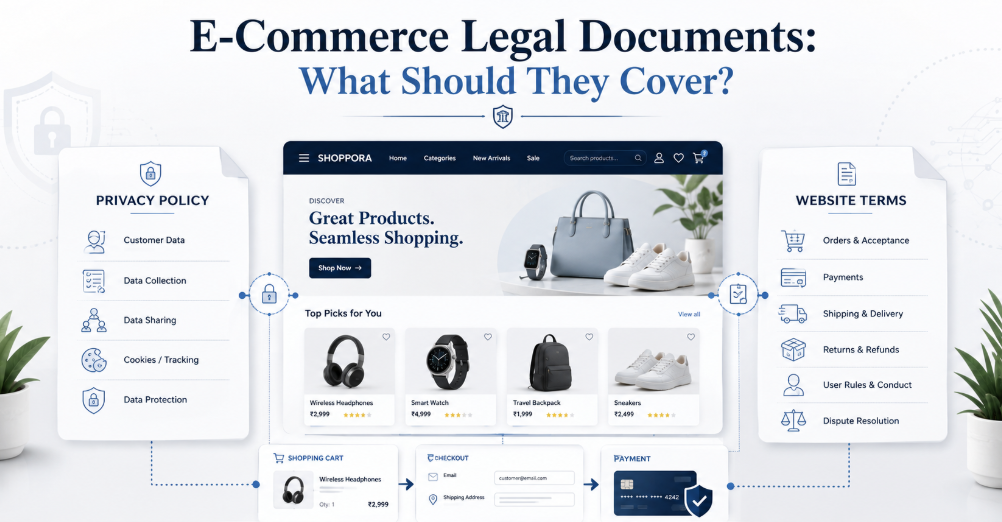
A privacy policy, as aforementioned, should not rewrite borrowed legal templates. It should reflect the actual movement of customer information through the business. In a typical e-commerce context, that means clearly addressing the nature of the data collected, such as names, contact details, shipping addresses, payment-related information, order history, account credentials, browsing behaviour, and customer support interactions. It should also explain why the data is being collected, whether for order fulfilment, service improvement, fraud prevention, marketing analytics, customer support, or legal compliances. Similarly, the policy should also disclose whether confirmation, customer information is shared with the logistics providers, payment gateways, technology vendors, analytic tools, communication platforms, or third-party service providers. Many online retailers forget that the real privacy story of the business, it is not just what they collect directly, but when, but how the information is processed post collection. Therefore, a robust policy should also deal with retention, user choices, cookies, or tracking tools, grievances, or contact details, and the business’s general approach to data protection. In practical language, the policy should be accurate enough that a regulator, investor, payment partner, or even a careful customer can understand how the business handles personal data in real life.
What do website terms of use usually cover for online retailers?
If the privacy policy governs data, the terms of use govern customer relationships. For e-commerce companies, this usually includes website access, acceptable use, account registration, product disruption, IP, limitation of liability, account suspension rights, shipping processes, returns, refunds, exchanges and promotional terms, and grievance redressal mechanisms.
The robust digital business terms and conditions are not drafted as mere one-sided legal warnings. They are drafted as commercially clear rules. They help the customer understand the buying framework and reduce ambiguity. However, one of the most common mistakes businesses make is drafting terms that sound legally polished but do not match the actual checkout fulfilment or support process. If the website says one thing, customer support says another, and the warehouse process says third, the business has created unnecessary exposure for itself.
Where do e-commerce businesses usually get it wrong?
The legal documents of many online businesses fail for a surprisingly simple reason. They were drafted too early and never updated. A brand may start with a basic website, a product catalogue, and a straightforward order process. Over time, it adds marketing tools, remarketing flows, multiple payment options, WhatsApp support, third-party logistic partners, loyalty programs, customer data analytics, marketplace integrations, and referral systems. Yet the privacy policy and terms remain restricted to the language used during launch. This is usually where e-commerce website legal compliance becomes an ongoing concern.
The business grows, but the legal drafting does not. Another recurring issue is the use of generic foreign templates that do not reflect Indian legal expectations or the business realities of the Indian e-commerce market. Businesses also resort to under-disclose third-party sharing, overstate consent language, simplify refund rules beyond what operations can support, or fail to align grievance mechanisms with complaint redressal systems. In many cases, the problem is not negligence, it is the mistaken belief that these are standard website pages that do not require personalized legal thought processes.
Why does personalized drafting matter?
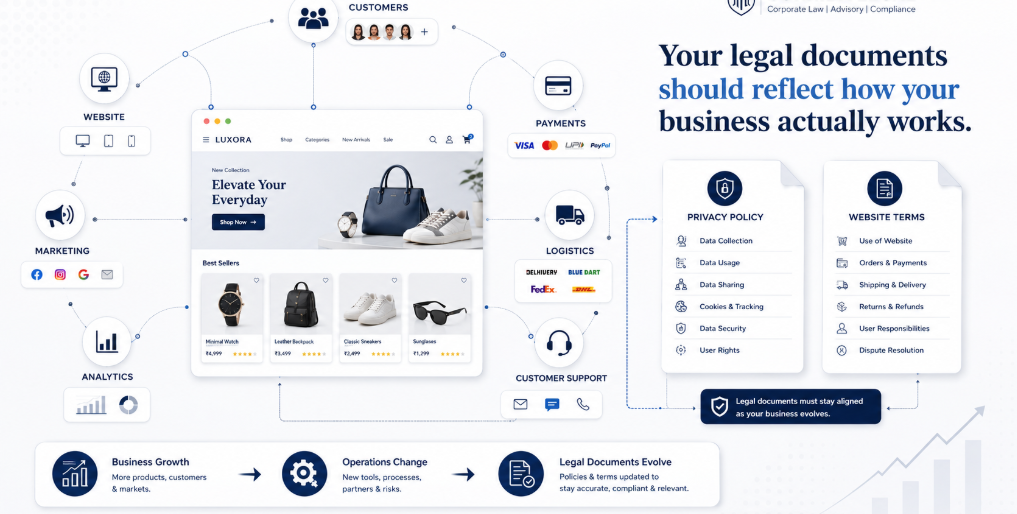
A wellness platform, a subscription-based e-commerce business, a marketplace seller, or a fashion brand do not all function in the same process. Their data flows, return patterns, pricing structures, customer expectations, and service dependencies differ considerably. This is why drafting privacy policies for online shops cannot be reduced to a mere universal template. The respective documents must account for how the business sells, how it markets, how it delivers, how it communicates, and how it handles customer redressal grievances. This is usually why customer data protection for online retailers should be considered a business issue and not merely a legal obligation. The more data a business relies on for customization, marketing, fulfilment, or retention, the greater the need for clarity and discipline in how the data is documented and governed.
Frequently Asked Questions (FAQs)
Is a privacy policy necessary for every e-commerce website?
Well, in practical terms, yes. If an e-commerce website collects customer information through its application or website, a clear privacy policy is a basic requirement. It helps businesses explain what data it collects, why it collects, how it uses it, and who it shares it with.
Are website terms of use and a privacy policy the same thing?
Although synonymously used, a privacy policy deals with customer data and how it is processed, whereas terms of use govern the contractual relationship between the website and the user, including purchasing rules, account conduct, returns, refunds, disclaimers, and dispute-related clauses. Both these documents serve different legal functions and shall be drafted separately.
Can an e-commerce website use a standard online template for drafting such documents?
Although a template can be used as a basic document, but it is rarely sufficient. These documents must reflect the real-time business model, digital tools, operational processes, and customer journey. Any mismatch between the document and the business model can generate more risk than having a simpler but more accurate draft.
Do marketplace sellers also need to have their own privacy policies and terms of service?
If a marketplace seller runs its own website, has a direct checkout page, campaign landing page, or data collection funnel, then separate business-specific documentation is necessary. Marketplace documentation does not automatically resolve compliances for all direct digital communications.
What are the most common legal mistakes retailers make in such documents?
The most common mistakes include copying another company’s templates, failing to disclose actual third-party data sharing processes, using the refund terms that do not actually match in practice, drafting overly broad disclaimers, and not updating policies as and when operations change.
Conclusion
In our experience, issues with e-commerce privacy and terms of service rarely arise because the business had no documentation at all. However, they arise because the documentation could not keep pace with the business activities. We have observed this pattern across a broad mix of digital businesses, from early-stage online brands launching their first direct storefront to established D2C companies tightening their return and refund design to premium consumer businesses refining customer journeys ahead of investments or expansions.
The challenge in each of these cases was not merely to produce legal documents; it was to make sure the legal texts matched the business model, the technology stack, the fulfilment process, and the realities of customer interaction. This is where Corrida Legal’s approach stands apart from others. We do not look at privacy policies and website terms as isolated compliance documents. We look at them as operating documents for digital businesses. The goal is not only to make the website look legally inclusive, but the goal is to make businesses more aligned, defensible, and better prepared for scalability. For e-commerce companies, strong legal drafting skills is not about sounding legal and professional, but about reducing vagueness, protecting trust, and ensuring that the legal framework behind the platform is as thoughtful as the business model. If your website terms or privacy policies were drafted during its incorporation and have not been revised since your business operations have evolved, it is the right time to review them. Corrida Legal works closely with online businesses to draft and refine website terms, privacy policies, and related customer-facing legal documents in a way that reflects actual business operations and not merely borrowed templates.
