


Reviewed and Validated by: Shreya Paharia, Advocate
What is the 50% rule under the Code on Wages?
The 50% rule Code on Wages mandates that the “wages” component of an employee’s total remuneration must constitute at least 50% of the total salary. If excluded components exceed this threshold, the excess amount is deemed part of wages for statutory calculations.
This rule is rooted in the statutory wage definition under Code on Wages 2019, and directly impacts how employers structure compensation. It is not merely a drafting guideline, it is a compliance induction that affects provident fund, gratuity, and bonus liabilities.
In practice, the rule ensures that:
- Employers cannot disproportionately inflate allowances to reduce statutory contributions
- A minimum wage base is preserved for social security calculations
- Salary structuring aligns with statutory intent rather than cost optimization
How are “wages” defined under the Code on Wages, 2019?
The definition of wages forms the foundation of the 50% rule Code on Wages. Section 2(y) of the Code adopts a structured inclusion–exclusion framework.
What components are included in “wages”?
Under the wage definition under Code on Wages 2019, “wages” broadly include all remuneration expressed in monetary terms, such as:
- Basic salary
- Dearness allowance (DA)
- Retaining allowance (if applicable)
These form the core wage base and are always included without exception.
Which salary components are excluded from “wages”?
The law specifically lists exclusions from wages calculation India, which typically include:
- House Rent Allowance (HRA)
- Bonus (statutory or otherwise)
- Overtime wages
- Commission
- Conveyance allowance
- Employer contributions to PF or pension
- Gratuity payable on termination
However, these exclusions are not absolute. Their treatment is conditional upon the 50% threshold.
How does the inclusion–exclusion framework operate in practice?
The framework operates in two stages:
- First, identify all included and excluded components
- Second, test whether exclusions exceed 50% of total remuneration
If exclusions exceed 50%, the excess is added back into wages. This is the operative mechanism of the 50% rule Code on Wages.
How does the 50% rule apply to salary structuring in India?
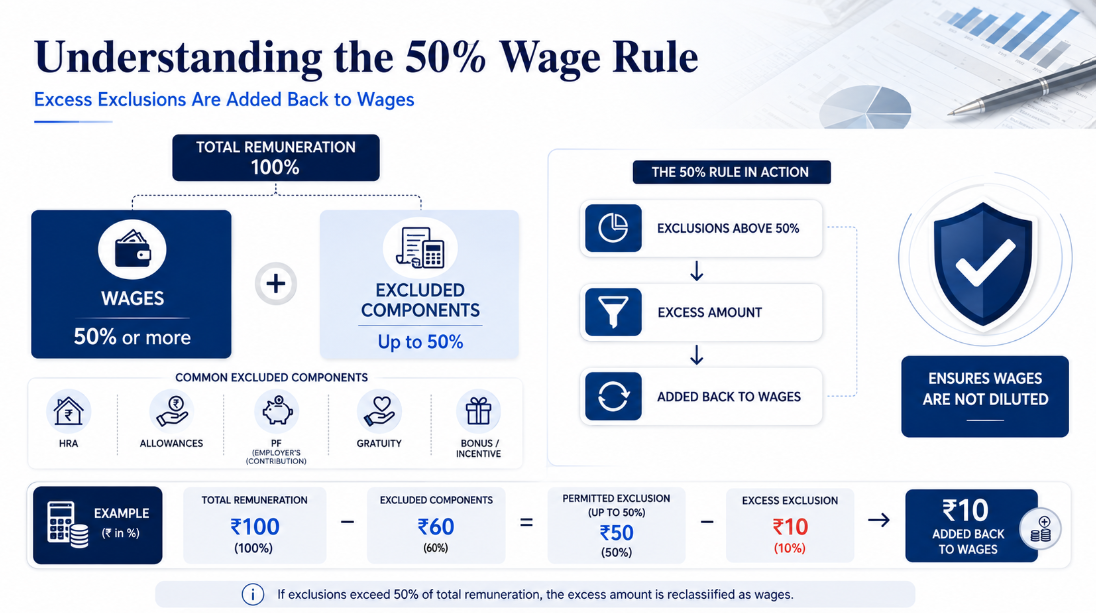
The salary restructuring labour codes India landscape has been fundamentally altered by this rule. Employers can no longer rely on high allowance structures to minimise statutory payouts.
What happens if excluded components exceed 50% of total remuneration?
Where exclusions (such as HRA, bonuses, allowances) exceed 50% of total remuneration:
- The excess portion is reclassified as “wages”
- This reclassification is mandatory and not discretionary
- It directly increases the base for statutory contributions
How are excess allowances reclassified as wages?
The law imposes a mathematical adjustment:
- Calculate total remuneration
- Identify excluded components
- If exclusions > 50%, reduce exclusions to 50%
- Add the excess back into wages
This ensures compliance with the wage definition under Code on Wages 2019.
How should employers rebalance salary structures to comply?
Employers must revisit compensation models and:
- Increase the proportion of basic salary and DA
- Rationalize variable allowances
- Align payroll systems with statutory definitions
Failure to restructure may lead to automatic reclassification during audits.
Why was the 50% rule introduced under the new wage definition?
The legislative intent behind the 50% rule Code on Wages is corrective rather than expansionary.
What compliance gaps existed under the previous wage regime?
Under earlier laws:
- Employers structured salaries with minimal basic pay
- Allowances formed a disproportionate share of CTC
- Statutory contributions were reduced artificially
This led to inconsistent interpretation across statutes and jurisdictions.
How does the rule prevent artificial salary structuring?
The rule introduces a uniform threshold:
- Limits excessive exclusions
- Standardizes wage computation across laws
- Ensures equitable social security contributions
It effectively eliminates aggressive structuring practices that diluted employee benefits.
What is the impact of the 50% rule on provident fund, gratuity, and bonus?
The most immediate impact of the 50% rule Code on Wages is on statutory payouts.
How does the rule affect PF contributions?
Provident Fund (PF) is calculated on wages. With an expanded wage base:
- Employer and employee contributions increase
- PF liability becomes more predictable
- Avoidance through structuring is restricted
What is the impact on gratuity calculations?
Gratuity is linked to last drawn wages. With higher wage components:
- Gratuity payouts increase over time
- Long-term employee benefits improve
- Employers must account for higher provisioning
Does the rule increase overall employer cost?
In most cases:
- Yes, due to higher statutory contributions
- However, cost impact depends on existing salary structures
- Organizations with balanced structures may see minimal change
How does the 50% rule affect CTC and take-home salary?
The salary restructuring labour codes India framework requires recalibration of both employer cost and employee earnings.
Will employees see a reduction in take-home pay?
In certain cases:
- Take-home salary may reduce marginally
- This is due to higher PF contributions
- However, the reduction is offset by long-term benefits
How does restructuring impact long-term benefits?
Employees benefit through:
- Higher retirement savings (PF)
- Increased gratuity payouts
- Improved statutory protections
Thus, while immediate cash flow may adjust, long-term financial security improves.
Are all employers required to follow the 50% wage rule?
The 50% rule Code on Wages applies uniformly across sectors, subject to the enforcement of the Code.
Does the rule apply to all sectors and establishments?
Yes, once notified:
- It applies to all employees
- Covers organized and unorganized sectors
- Extends across industries without distinction
Are there any exemptions or exceptions?
The Code does not provide specific exemptions from the wage definition framework. However:
- Implementation timelines depend on government notification
- State rules may influence procedural aspects
What are the compliance risks if the 50% rule is not followed?
Non-compliance with the 50% rule Code on Wages exposes employers to regulatory scrutiny.
Can authorities reclassify salary components during inspections?
Yes. Inspectors have the authority to:
- Examine salary structures
- Reclassify components
- Demand differential contributions
What penalties may apply under the Code on Wages?
Consequences may include:
- Monetary penalties
- Backdated liability for PF and gratuity
- Litigation risk from employees
The risk is both financial and reputational.
How should employers implement the 50% rule in practice?
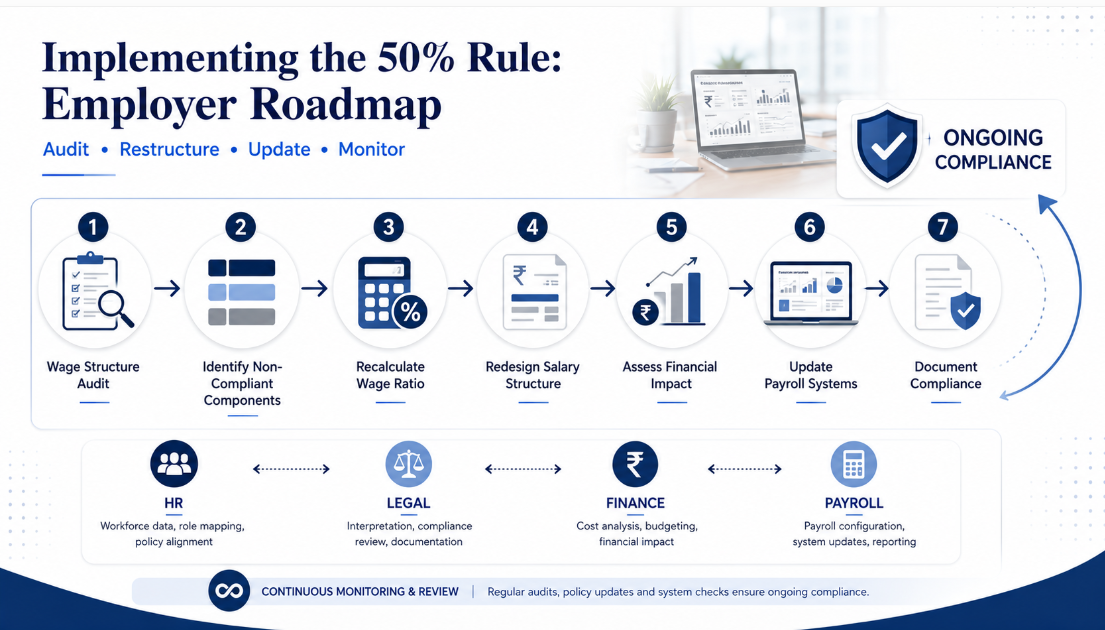
Implementation of the 50% rule Code on Wages requires a structured, cross-functional exercise involving legal, HR, payroll, and finance teams. It is not limited to salary adjustments; it extends to documentation, systems, and ongoing compliance monitoring.
From a practitioner’s standpoint, implementation must be approached as a compliance transition project, not a one-time restructuring exercise.
What steps should HR and legal teams take?
A defensible implementation strategy begins with a detailed internal audit and ends with system-level alignment. The following steps typically form the core of execution:
1. Conduct a comprehensive wage structure audit
The starting point is to assess whether existing compensation structures align with the wage definition under Code on Wages 2019.
This involves:
- Reviewing salary break-ups across employee categories;
- Identifying the proportion of basic wages vis-à-vis allowances;
- Mapping all components against statutory inclusions and exclusions from wages calculation India.
In practice, organizations often discover that legacy structures are heavily allowance-driven, which may trigger automatic reclassification under the 50% threshold.
2. Identify non-compliant salary components
Once the audit is complete, the next step is to detach elements that may breach the threshold.
Key indicators of non-compliance include:
- Allowances forming more than 50% of total remuneration;
- Excessive reliance on variable or discretionary components;
- Structuring patterns designed to minimize PF or gratuity exposure.
At this stage, legal teams must interpret whether certain components genuinely qualify as exclusions or risk being reclassified during inspection.
3. Recalculate wage and exclusion ratios
A technical re-valuation must be undertaken to test compliance with the 50% rule Code on Wages.
This requires:
- Computing total remuneration (CTC or gross, depending on structure)
- Segregating included vs excluded components
- Determining whether exclusions exceed 50%
Where the threshold is breached:
- The excess must be added back into wages
- Revised wage figures must be used for statutory contributions
This step is critical, as errors here may lead to downstream non-compliance across PF, gratuity, and bonus calculations.
4. Redesign salary structures
Post-identification, employers must move to salary restructuring labour codes India compliance.
Typical restructuring measures include:
- Increasing the basic salary component;
- Rationalizing allowances such as HRA, special allowance, and bonuses;
- Reducing artificial fragmentation of salary heads.
Importantly:
- Restructuring must not reduce agreed total remuneration unless contractually permissible;
- Changes should be implemented prospectively to avoid disputes.
5. Assess financial and provisioning impact
Before rollout, finance teams must evaluate cost implications.
This includes:
- Increased employer contribution towards PF
- Higher gratuity provisioning over time
- Impact on bonus calculations
Organizations with historically low basic wages may experience a measurable increase in statutory liabilities.
6. Align payroll systems and processes
Implementation is incomplete without system-level changes.
Employers should:
- Update payroll software to reflect revised wage definitions
- Automate 50% threshold checks
- Ensure statutory contributions are calculated on compliant wage bases
Manual workarounds increase the risk of inconsistency and audit exposure.
7. Document internal positions and assumptions
Given the interpretational aspects of the wage definition under Code on Wages 2019, employers should maintain internal documentation on:
- Classification of salary components
- Basis for inclusion/exclusion decisions
- Methodology used for threshold computation
This becomes critical during inspections or disputes.
How should employment contracts and policies be revised?
Contractual configuration is an essential component of implementation. Without updating documentation, even a compliant salary structure may face enforceability issues.
1. Update employment agreements and offer letters
Employers must revise contractual templates to reflect:
- Revised salary break-ups
- Clear identification of wage and non-wage components
- Alignment with statutory terminology
Ambiguity in drafting may lead to disputes, particularly where employees challenge restructured pay components.
2. Align definitions with statutory language
Contracts and HR policies should adopt language consistent with the wage definition under Code on Wages 2019.
This includes:
- Avoiding outdated or inconsistent definitions of “basic,” “allowances,” or “gross salary”
- Ensuring internal terminology mirrors statutory interpretation
Such alignment reduces interpretational conflicts during enforcement.
3. Review variable pay and incentive structures
Variable pay plans must be examined carefully.
Employers should:
- Assess whether incentives qualify as exclusions
- Ensure they are not structured to artificially reduce wages
- Clearly document performance-linked criteria
Improperly structured incentives may be reclassified as wages.
4. Ensure consistency across policies and payroll documentation
A common compliance gap arises where:
- Offer letters reflect one structure
- Payroll records reflect another
- HR policies use inconsistent definitions
To mitigate this, employers must ensure:
- Uniformity across all documents
- Alignment between contractual terms and actual disbursement
5. Communicate changes to employees
While not strictly a statutory requirement, communication is a practical necessity.
Employers should:
- Explain the rationale for restructuring
- Clarify impact on take-home pay and long-term benefits
- Address employee concerns proactively
Poor communication often leads to disputes, particularly where take-home salary is affected.
6. Plan transition timelines carefully
Immediate restructuring without transition planning may create operational and legal friction.
A phased approach may involve:
- Implementing changes for new hires first
- Gradually aligning existing employees
- Synchronizing changes with appraisal cycles
This reduces disruption while ensuring compliance.
Practical Considerations for Implementation
From an enforcement perspective, authorities are likely to examine substance over form. Accordingly:
- Cosmetic restructuring without realignment of wage ratios may not withstand scrutiny
- Consistency in treatment across employee categories is critical
- Documentation and system alignment are as important as numerical compliance
In practical terms, the 50% rule Code on Wages transforms compensation structuring from a cost-optimization exercise into a regulated compliance function. Employers who approach implementation as a one-time adjustment risk repeated exposure, whereas those who embed it into ongoing payroll governance are better positioned to manage long-term compliance.
How does the 50% rule interact with other labour codes?
The wage definition under Code on Wages 2019 has been adopted across other labour codes, ensuring consistency.
Does the definition of wages remain consistent across labour codes?
Yes, the same definition applies under:
- Code on Social Security, 2020
- Industrial Relations Code, 2020
- Occupational Safety, Health and Working Conditions Code, 2020
This uniformity reduces interpretational disputes.
What overlaps exist with social security and industrial relations laws?
The expanded wage base effects:
- Social security contributions
- Retrenchment compensation
- Bonus eligibility
Thus, the 50% rule Code on Wages has cross-code implications.
FAQs on the 50% Rule under the Code on Wages
Is the 50% rule mandatory or advisory?
The 50% rule Code on Wages is mandatory once the Code is brought into force. It is embedded within the statutory definition and not optional.
Does the 50% rule apply to existing employees or only new hires?
It applies to all employees. Existing salary structures must be realigned to comply with the law.
Can employers reduce allowances to comply with the rule?
Yes. Employers may rebalance salary components, provided total remuneration remains contractually compliant.
How is bonus calculated under the new wage definition?
Bonus calculations will rely on the revised wage base, subject to applicable thresholds under bonus legislation.
Does the rule apply differently to startups or small businesses?
No differential treatment is provided. The rule applies uniformly irrespective of size or sector.
When will the 50% rule come into full force?
The 50% rule is applicable from the date of enforceability of the Code on Wages, 2019, read with the relevant rules brought into force thereunder.
Conclusion
The 50% rule under the Code on Wages 2019 is considered a significant compliance measure that limits the scope for allowance-heavy salary structure, which further reduces the base statutory wage. By requiring certain excluded components to be added back once the prescribed threshold is crossed, the law reinforces a substance-based approach to determination of wages. In practical terminology, employers must first assess salary structures not only from a commercial perspective but also in light of statutory design and compliances. From a legal standpoint, this rule further reflects a broader shift under the Indian labour law towards consistency, transparency, and reduced interpretational flexibility in computation of wages. The resultant impact extends beyond payroll mechanics and directly influences provident fund, gratuity, bonus, and other wage-related obligations. Any review of salary structuring must therefore consider both the wording of the provisions and the practical consequences of non-compliance.
At Corrida Legal, our view remains that the 50% rule should be understood by businesses as a part of the larger compliance framework rather than as a solitary test. For businesses, the key issue is whether the overall remuneration framework remains defensible under the code and is in alignment with the legislative intent behind these compliances.
