

Reviewed and Validated by: Aamna Munaima, Advocate
Under the Code on Social Security, 2020, gratuity is calculated at the rate of 15 days’ wages for completion of service for a full year, including any part of service exceeding six months. The law provides a method and formula to ensure that the process is uniform and mechanical for all establishments covered under the Code.
For determining the gratuity payable in India, the employer should strictly use the formula that is given in the Code and should not include salary components that are not considered under the legal definition of “wages”.
Standard Formula Under the Code
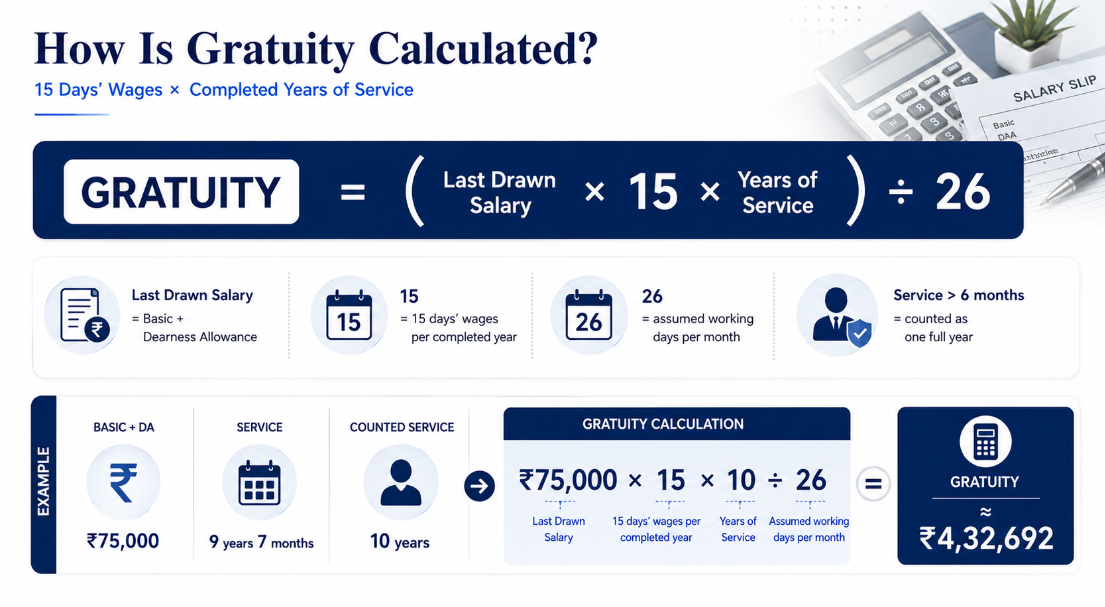
For employees, gratuity is calculated using the following formula:
- Gratuity = (Last Drawn Salary * 15* Years of Services completed)/26)
Each element of this formula has a specific statutory relevance:
- Last drawn salary refers to Basic Pay along with Dearness Allowance.
- 15 represents the 15 days’ wages payable after each year of service completed.
- 26 is the assumed number of working days per month, excluding the weekends as rest days.
- If the employee has worked for a period exceeding six months, it is counted as one full year for the purposes of calculating gratuity.
This formula applies uniformly to the covered establishments, including private companies employing more than 10 or more persons, where payment of gratuity becomes a statutory obligation.
What Is Included in Last Drawn Salary?
Basic salary and Dearness Allowance are included for the purpose of calculating gratuity. That said, House rent allowance (HRA), Bonus, Incentive payment, Commission (where it is not part of regular wages), Overtime payments, etc. The omissions are consistent with the statutory definitions of wages under the Code.
Why is 15/26 in the Formula?
The divisor 26 is used because law assumes the number of days of work per month to be 26, excluding weekly rest days.
The multiplier “15” reflects:
- The wages equivalent to 15 days of every completed year of service.
- The legislative intent is to provide half-monthly wage benefit every year.
This standardized structure prevents inconsistency in calculating.
Counting Question Counting Periods of Service
For the purpose of gratuity computation:
- Only completed years of service are taken into account.
- A service of more than six months is regarded as a year.
- Less than six months of service is ignored.
These principles apply in addition to the broader Gratuity eligibility requirements, which mandate completion of 5 years of continuous service, except in cases where exempted by law.
Is there a Change of Formula on Resignation or Termination?
Statutory formula remains the same regardless of the exit mode, unless there is a forfeiture provision as per section 53(6) of the Code (corresponding to the earlier section 4(2) of the Payment of Gratuity Act).
Forfeiture of gratuity is permitted only in certain circumstances, such as:
- To the extent the property of the employer has been injured; or
- Where an employee is terminated for misconduct on issues of moral turpitude, misconduct or violence at work.
Is There an Overhead to the Amount Computed?
Yes, the amount of gratuity is calculated as per the statutory formula mentioned above. That said, the statutory ceiling for gratuity liability is Rs. 20 lakhs.
Key points:
- The ceiling applies to establishments that are under the Code.
- Employers may, through employment contracts or internal policies, choose to pay gratuity beyond the statutory limit.
- When gratuity paid exceeds the threshold, different tax implications may arise depending on the nature of employment and applicable tax laws.
Illustration of Calculation
Example:
- Last drawn Basic + DA = ₹75,000
- Service completed = 9 years and 7 months.
Count of years served = 10 years.
Gratuity = (75,000 × 15 × 10) ÷ 26
= ₹4,32,692 (approx.)
When this figure falls within the statutory limit, then it will be payable.
Establishment Statutory Covers
The Act applies to:
- All factories, oilfields, mines, plantations, ports and railway companies.
- Any shop and establishment with 10 or more persons.
- Any originally covered plant, even in the case when the strength of the employees is less than 10.
Accordingly, the gratuity towards employees of a private company will be obligatory in cases when the number of 10 employees is reached.
Gratuity eligibility criteria
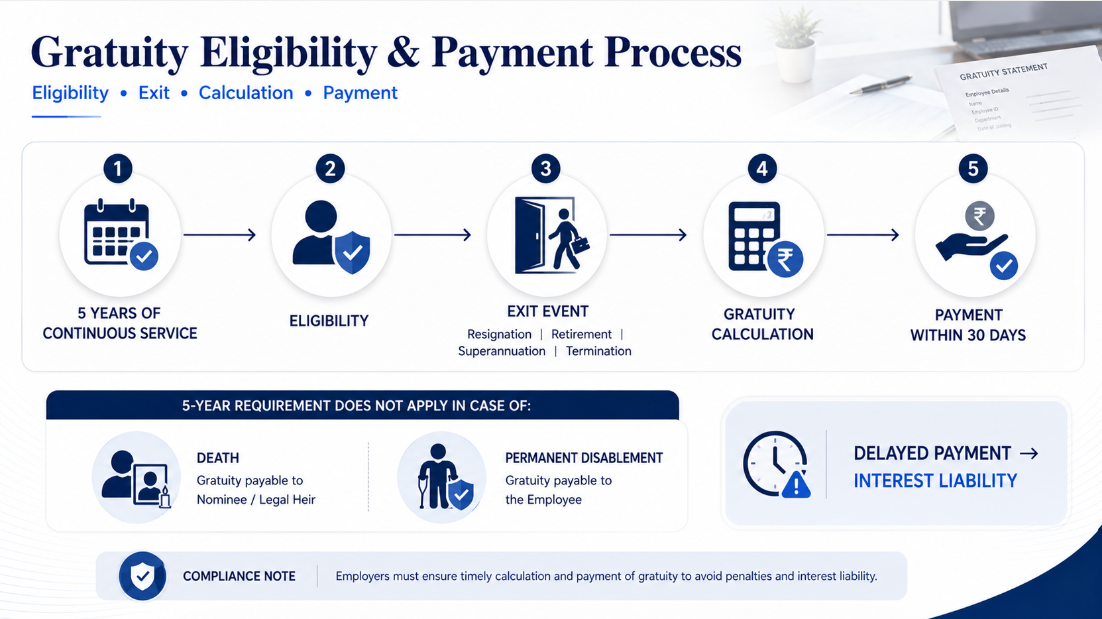
An employee will be eligible when:
- They have completed five years of continuous service; and
- Employment is terminated because of:
- Resignation
- Retirement
- Superannuation
- Termination of employment (other than termination of misconduct leading to forfeiture)
- Death
- Permanent disablement
The general rule is completion of five years of service.
Exception to Five-Year Requirement
The requirement of 5 years of service does not apply to cases of:
- Death of the employee;
- Accidental or disease-related permanent disability.
In such cases:
- Gratuity becomes payable irrespective of the length of service.
- The payment is made to the employee’s nominee or legal heir.
This is a statutory exception and cannot be altered by an employer.
What Is “Continuous Service”?
Under the Code on Social Security, 2020, the concept of continuous service remains relevant for determining gratuity eligibility. It includes uninterrupted service, even when the service of an employee is interrupted by certain recognized circumstances such as:
- Sickness
- Approved leave
- Accident
- Strike (not illegal)
- Layoff
- Lockout
- Cessation of work not caused by fault of the employee.
In cases where uninterrupted services cannot be established, to determine continuity of service the statute considers the number of days actually worked by the employee during the relevant period.
An employee generally is deemed to be in continuous service if they have worked for:
- At least 240 days during a preceding 12 month time
- At least 190 days in certain establishments like mines.
Judicial decisions have held that in certain factual circumstances, 4 years and 240 days was may satisfy the five-year requirement. This is doesn’t arise from law and it is up to the interpretation that pertains to the High Court in question.
Other Employers that are not under the Act
In establishments where the gratuity provisions do not apply, employers may still provide gratuity as a contractual benefit through appointment letters or company policies. In such cases, gratuity is determined by the terms of the contract.
This is commonly provided as per the payment equivalent to 15 day’s wages per completed year of service or half a month’s salary for each year of service.
In other cases, employers may provide gratuity at the rate of 30 days’ salary per year. In these situations the contractual terms govern the entitlement and calculation of gratuity.
What If Salary is Variable?
Where the workers are paid on a piece basis:
- Of average wages earned during the three months immediately preceding the date or termination of employment.
- While computing this average overtime is excluded.
How Do You Calculate the Gratuity of Employees who resign?
An employee who resigns from service is entitled to gratuity, provided they have completed at least 5 years of continuous service, except it is exempted by law.
Limiting gratuity under the Indian law
- The maximum gratuity payable is subject to the statutory ceiling prescribed under the Code on Social Security, 2020.
- This limit applies to employees covered under the gratuity provision of the Code.
- The Central government has the power to revise the gratuity ceiling by issuing an official notification.
Is it within the Power of Employers to Pay More Than ₹20 Lakh?
Yes.
- The Act gives a cap to the statutory liability.
- The employers may pay more gratuity as:
- Internal policies of the Company
- Employment contract or appointment letter
- Settlement agreement
How Is Gratuity Taxed in India?
Tax treatment depends on whether the employee is a government or private employee.Government Employees are fully exempted from tax.
For Private Sector Employees tax exemption is limited to the least of the following:
- ₹20 lakh
- Actual gratuity amount received
- The exemption amount is calculated as per the formula prescribed under the Income Tax Act.
- Any amount received in excess is taxable under “Income from Salary.”
How Is Gratuity Calculated in Case of Death?
If an employee dies during service:
- The requirement for completing 5 years of continuous service does not apply.
- Gratuity becomes payable to the nominee or legal heir of the employee.
- The amount is calculated using the last drawn salary and period of completed service.
What Is the Procedure to Claim Gratuity?
Employer must:
- determine the gratuity amount payable to the employee.
- Issue a written notice specifying the gratuity amount.
- Pay the gratuity amount within 30 days from the date it becomes payable.
Delay in Payment
If gratuity is not paid within 30 days:
- Interest becomes payable on the delayed amount.
- The rate of interest is as notified by the Central Government.
Recovery Mechanism
An employee may:
- Approach the Controlling Authority under the applicable gratuity provisions.
- File an application within 90 days from the date gratuity becomes payable.
- Seek issuance of a recovery certificate for the recovery of the amount.
Frequently Asked Questions (FAQs)
Would I Be Reciprocated with 4 Years and 240 Days?
Generally, gratuity is paid after five years of uninterrupted service. However, in some situations, courts have held that completion of 4 years and 240 days may be sufficient to meet the statutory requirement, especially where the employee has worked for 240 days in the fifth year.
This is based on judicial interpretation and not expressly stated in law; the position may vary depending on the jurisdiction and facts of each case.
Is Gratuity Calculated on CTC?
No. Gratuity is not calculated using the cost to Company (CTC). It is only calculated using wages as they are provided in the statute, which usually includes Basic Salary and Dearness Allowance.
Components such as house rent allowance, bonus, commission (except when considered as a part of regular wages), and other allowances are not included unless they form part of regular wages.
Is it mandatory to give gratuity to all employers?
No. Gratuity is mandatory only for establishments employing ten or more persons. Once an establishment becomes covered, the obligation continues even if the employee count later falls below ten.
Is it possible to Pay Gratuity on monthly basis?
No. Gratuity is a terminal benefit and is payable only when employments due to retirement, death or designation. It is meant to be paid as a lump sum and not as a monthly payment.
Is Gratuity Applicable to Startups?
Yes, startups are required to pay gratuity once they employ ten or more persons. The is no separate exemption for startups, and the same law applies as they do to other private establishments.
Conclusion
Understanding how to calculate gratuity in India requires reference to the prescribed statutory formula, eligibility conditions, salary structure, and reason for exit. While the calculation is mechanical, issues such as eligibility, timely payment and forfeiture require careful legal compliance
Employers must ensure proper computation and prompt payment to avoid interest liability and potential disputes.