

Reviewed and Validated by: Srijan Jha, Advocate
The Code on Wages, 2019 was implemented on 21.11.2025, its key objective is to streamline the law governing the: (i) definition of wages, (ii) establishing a national floor wage and the interaction between the floor wage and the minimum wage, (iii) the implementation of the 50% rule and the deductions applicable to such rules, (iv) equality of remuneration, (v) greater scope by being applicable on all employees and (vi) amended obligation pertaining to inspection and record-keeping and penalty for non-compliance. These amendments introduced by the Code on Wages, 2019 introduce compliance requirements which need refining of the agreements, policies, human resource operations and payroll to ensure compliance with the applicable laws.
This article aims to provide a detailed insight into the new statutory requirements under the Code on Wages, the actions steps which will be applicable to employers, the main statutory thresholds, and the regulations to be complied with immediately. The analysis acts as a compliance tracker which shall be applicable to the compliance requirements under the Code on Wages that employers need to strategise and implement in order to prevent legal, operational and financial risk.
What Is the Code on Wages, 2019 and What Is Its scope?
The Code on Wages, 2019 is a comprehensive code which has been enacted to repeal the existing laws applicable on the concept of wages in India. While the code has been enforced, the actual implementation of the code is subject to the rules published by the competent authority of state government.
The Code on Wages, 2019 repeals the following labour laws: the Payment of Wages Act, 1936, the Minimum Wages Act, 1948, the Payment of Bonus Act, 1965 and the Equal Remuneration Act, 1976, and thereby acts as a single piece of legislation providing comprehensive obligations with respect to the wages. The provisions of the Code on Wages, 2019 presently establish a legal compliance with respect to the wages whereas further implementation of the provisions shall be subject to the rules or notification published by the Central Government and the state governments.
Important legal considerations with respect to the Code on Wages, 2019:
- Rules and regulations published by the Central or State government providing the implementation of concepts such as floor wage, minimum wages, and other obligation under the Code on Wages, 2019;
- The Code on Wages, 2019 is applicable to all employees unless such employees are specifically exempted under the notification published by the competent authority; and
- Due to the phased implementation of the Code on Wages, 2019, the employers are required to observe both central and state notifications, to ensure legal compliance as and when a provision becomes operative.
What is the New Meaning of “Wages” under the Code on Wages?
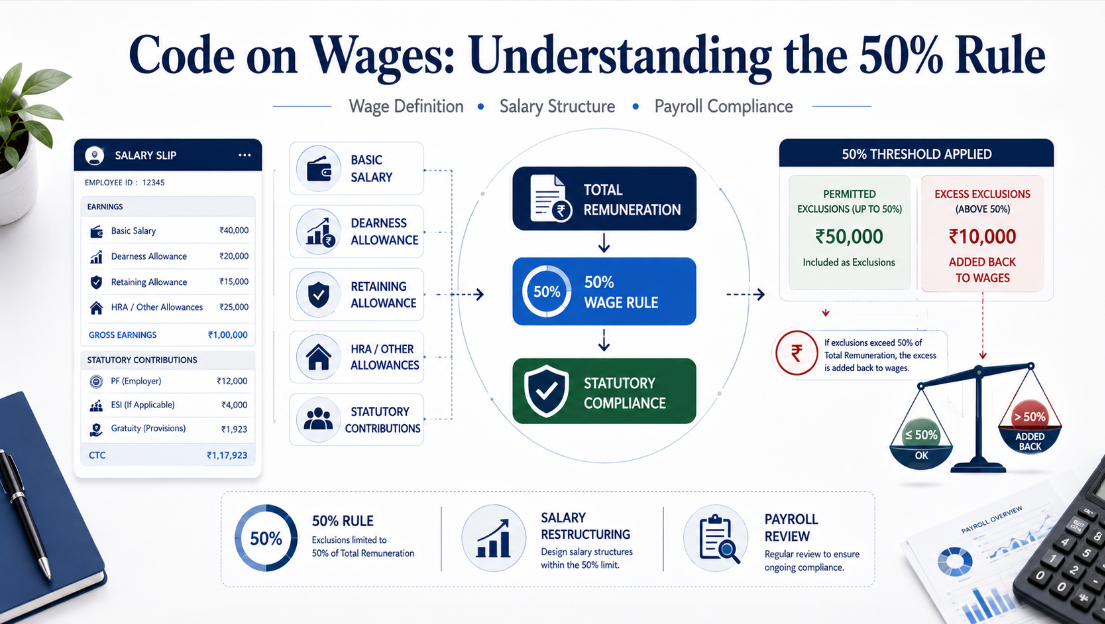
One of the key objectives of the Code on Wages, 2019 is to standardise the scope of wages by establishing a comprehensive definition of the term “wage” and mandating that the employer complies with the 50% rule. The 50% rule mandates that the wage of an employee should be 50% of the total remuneration.
This creates an instance wherein the employer is required to comply with the now defined scope of the term wage for the computation of the minimum wage, bonus, and other statutory contributions. Thereby, the definition of wage under the Code on Wages, directly impacts the payroll and financial commitments of the employers.
The actionable steps with respect to the new scope of ”Wages” includes the following practical steps:
- 50% rule: Ensure that the excluded contributions as per the definition of “wage” are not greater than 50% of the total remuneration of the employee;
- Re-structuring: Employers should re-structure the total remuneration to ensure compliance with the Code on Wages, 2019; and
- Contract and policy review: Review its internal documents such the employment agreements and payroll policies to ensure compliance with the Code on Wages, 2019.
What are the New Minimum Wage Requirements under the Code on Wages?
The employers are required to pay a minimum wage in accordance with the minimum wage which has been published by the State Government. The minimum wage is determined based on the skill level, geographical location and type of work. The Code on wages further provides the concept of floor wage which essentially prohibits the minimum wage from being lower than the floor wage prescribed by the Central Government. However, the State Government has the power to set minimum wage higher than the floor wage.
Employer responsibilities with respect to the minimum wages are as follows:
- Determine the minimum wage of the classification of work and area of operation based on the notification of the competent authority.
- Adjust payroll to accommodate modification in minimum wage in stipulated periods to ensure mitigation of legal and financial risk.
Employer must ensure that it retains a comprehensive report indicating compliance with the minimum wages.
Which Rules of Payments and Deductions do Employers Face Under the Code?
The Code on Wages, 2019 provides the provisions applicable on the deductions, the time period for making payments and other provisions pertaining to the deduction under the Code on Wages, 2019. This ensures that the employers are punctual in making payment of the wages, limit the deductions and keep records of wage.
Operational checklist (list):
- Make sure that the wages are paid on time and that the employee is provided salary slips;
- Restrict deductions to only the authorised deductions;
- Establish wage payment channels; and
- Ensure documentation which is audit ready.
Does the Code on Wages imply Equal Remuneration Obligations?
The Code on Wages, 2019 comprises provisions contained under the Equal Remuneration Act, 1976 and aims to ensure equal pay irrespective of gender. Thus the Code aims to promote the restriction on gender discrimination with respect to wages. Employers should make sure that their pay structures as well as other HR practices are non-discriminatory.
Compliance actions with respect to such provision are as follows:
- Carry out pay audits to ascertain equality between male and female employees;
- Form standardised pay bands and component structures to ensure there is no discrimination in the organisation; and
- Make sure that recruitment, promotion and bonus policies are non-discriminatory.
Does the Code on Wages, 2019 Extend Coverage to All Employees and Contractors?
The Code on Wages, 2019 has a greater coverage than the previous laws as the same is applicable to every workplace such as factories, mines, construction sites, and other sectors. It is also applicable to the employees who are engaged in the managerial roles. Thus, the Code on Wages, 2019 has a broad scope and protects a larger class of workers.
Employer responsibilities:
- Assess the definition of employees under the Code on Wages, 2019 and the applicable minimum wage and payment obligations;
- Ensure contracts with vendors and contractors include clauses requiring compliance with wage obligations and indemnities for non-compliance; and
- Map payroll obligations to ensure uniform documentation and audit ready document.
What New Inspection, Record-Keeping and Facilitation Mechanisms Exist?
The Code on Wages, 2019 introduce the concept of the Inspector-cum-Facilitator and mandates that the employer retains registers, returns and prescribes further record-keeping requirements. The Code on Wages, 2019 provides the inspectors enforcement powers to direct the employer to produce records on demand.
The Inspector-cum-Facilitator role is designed to provide assistance with the compliance facilitation all the while also conducting the enforcement activities. The officers may inspect premises, require production of registers, and initiate proceedings for any non-compliance of the Code on Wages, 2019.
Maintenance records provisions prescribed under the Code on Wages, 2019 creates action steps which are as follows:
- Maintain statutory wage registers, attendance records, and wage slips for the period required by law;
- Implement mechanisms to ensure inspections process and any other statutory requirement within the prescribed timeline; and
- Adopt digital record-keeping and reporting wherever permitted and ensure such record is audit ready.
What Penalties and Enforcement Mechanisms Apply for Non-Compliance?
The Code on Wages, 2019 prescribes specific monetary penalties for any non-compliance of the obligations under the Code on Wages, 2019. These penalties may include fines ranging from INR 50,000 to INR 1,00,000. In certain instances such contravention also includes imprisonment.
Enforcement checklist (list):
- Maintain timely compliance to avoid penalties ;
- Use the compounding provisions to ensure risk mitigation; and
- Preserve documentary evidence of compliance to protect against potential disputes.
How Will the 50% Rule Affect Salary Structure and Social Security Contributions?
The 50% rule ensures that the wages of the employee does not include more than 50% of the excluded allowances. This ensures that the wage is fairly treated for the purpose of the calculation of statutory contributions. Employers must therefore conduct salary restructuring to ensure compliance with the law and ensure that all statutory component are paid in accordance with the law.
The key obligation and action points with respect to the 50% rule are as follows:
- Structure the wage in accordance with 50% rule;
- Review the restructuring impact on PF, gratuity and other benefits; and
- Update employment documents to ensure compliance with the wage requirement.
What Steps Should Employers Take Immediately to Comply?
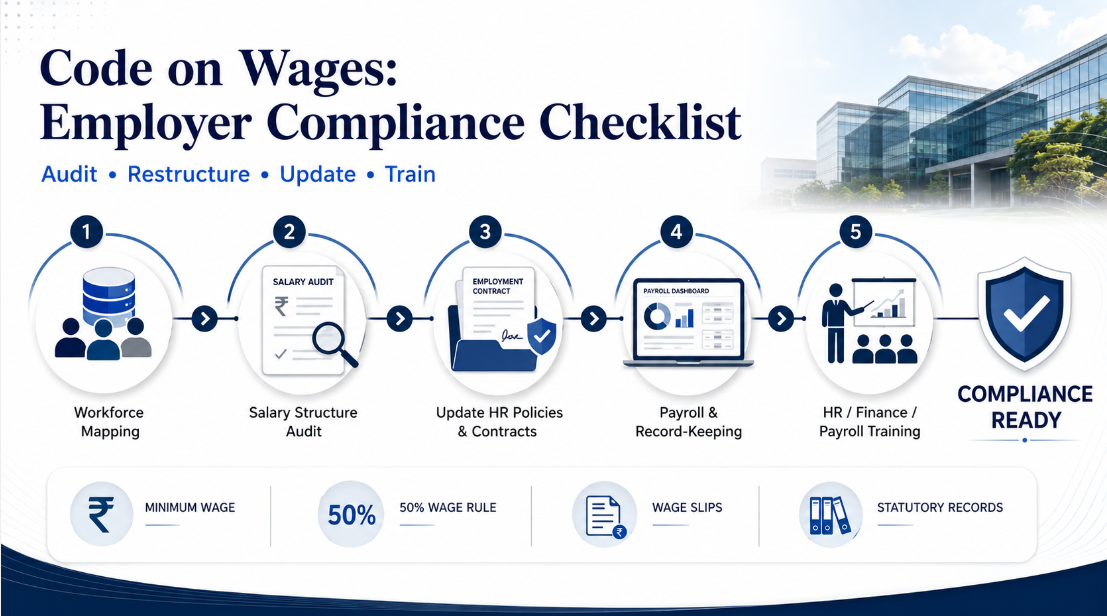
Employers should undertake steps to ensure compliance with the developments in the labour code. Such compliance includes taking the following steps: (a) mapping of workforce, (b) audit salary structures, (c) update payroll and HR policies, (d) implement record-keeping and inspection-ready processes, and (e) train HR and payroll teams on new obligations.
The immediate checklist with respect to the Code on Wages, 2019 are as follows:
- Conduct a mapping of the wages of the employees of the organisation in accordance with the Code on Wages compliance requirements;
- Conduct gap assessment of the salary structure to analyse non-compliances;
- Restructuring of the salary and amendment to the employment agreements and internal policies to ensure alignment with the Code’s definitions and deduction rules; and
- Implement processes for ensure awareness and compliance with the notifications with respect to the minimum wages.
The Code on Wages, 2019 is being implemented in phased manner and all employer must ensure that it is compliant with the salary requirements under the code. The other provisions of the Code on Wages, 2019 shall subsequently come into force through the notification of the relevant authority.
Frequently Asked Questions (FAQs)
Does the Code on Wages apply to startups and small businesses?
Yes, the Code on Wages, 2019 is applicable on start-up and small businesses. The applicability of the Code on Wages, 2019 is not subject to the size of the organisation but is rather subject to the classification of the employee. Specific exclusion will be determined by the state or central notifications.
Are contractors responsible for compliance under the Code on Wages?
Yes, the contractors are mandated to comply with the Code on Wages, 2019.
Can an employee file a claim for failure to comply with the payment requirements with respect to the wages?
Yes, the Code on Wages, 2019 provides specific provisions governing the grievance redressal and the penalty provisions with respect to wages.
Does the Code on Wages override state minimum wage notifications?
The Code on Wages, 2019 provides the provisions governing wages and the mechanism in which minimum wages are going to be published. Thereby, the notification of minimum wage shall remain in force and must be read along with the Code on Wages, 2019. Provided that in the instance where such minimum wage is less than the floor wage then such notification will be deemed ultra-vires under the Code on Wages, 2019.
Is the floor wage already notified by the Central Government?
No, the floor wage has not been published by the Central Government.
What happens if an employer pays less than the prescribed minimum wage?
Non-compliance with the Code on Wages specifically with respect to the minimum wage attracts penalties and enforcement action.
Does the Code on Wages Apply to Highly Paid or Managerial Employees?
Yes, the Code on Wages, 2019 applies to all employees unless specifically excluded by the notifications of the competent authority.
Can Employers Structure Allowances to Reduce the Wage Component?
No, the restructuring of the wages cannot violate the 50% rule under the Code of Wages, 2019. Any failure to comply with the Code on Wages creates the legal and financial risk on the employer.
Are Employers Required to Issue Wage Slips Under the Code on Wages?
Yes, the employer is mandated to provide employee with the wage slips in accordance with the format published by the applicable rules. This ensures transparency and protects the employer against penalties arising due to non-compliance.
Conclusion — Practical Compliance Imperatives
The Code on Wages, 2019 aims to not only provide a single legislation governing the wages in India but also aims to refine the concept of wage to meet the requirements applicable to modern era. The new obligations which are applicable under the Code on Wages are as follows (i) comprehensive definition wages; (ii) strict compliance with minimum wage and introduction of the concept of floor wage; (iii) observance of payment, deduction and record-keeping obligations; and (iv) introduction of the Inspector-cum-Facilitator regime.
To summarise the key actionable steps under the Code on Wages, 2019 are as follows:
- Ensure that the current salary structures adheres to the 50% rule and statutory wage definition;
- Update HR policies, employment contracts and payroll systems to ensure compliance with the Code on Wages, 2019;
- Establish a mechanism to ensure that the timelines and notifications are recorded on an as and when published basis; and
- Conduct HR, finance and payroll training with respect to the Code on Wages, 2019.
Compliance with the Code on Wages is both a legal obligation and a practical requirement to avoid financial and reputational consequences. Employers should prioritise such compliance by implementation of legal and payroll audit to ensure that the organisation is in compliance with the provisions of the Code such as statutory definition of wages, minimum wage, payment timelines, and inspection ready documentation.