

Reviewed and Validated by: Shreya Paharia, Advocate
Salary structuring in India is no longer considered just a commercial or an HR decision. In modern hiring times, it is now closely tied to statutory compliance under labour laws in India. The Code on Wages 2019 creates a uniform framework for identification of salary components that qualify as wages, which fall outside it, and how the statutory threshold is applicable. This has a direct bearing on provident fund gratuity, bonus, and overall payroll compliance, making it essential for employers to carefully review all the components of wages in the salary structure in India.
What is the definition of ‘wages’ under the Code on Wages, 2019 (“Code”)?
The definition of wages under the Code on Wages 2019 is provided under Section 2(y) of the Code and sets out the consolidated and uniform framework for wage determination across multiple labour legislations. In specific terms, wage refers to all remuneration, whether by way of salaries, allowances or otherwise expressed in money, payable to a person employed in respect of the employment, subject to certain specific inclusions and exclusions. This definition completely replaces the fragmented position under the earlier labour laws and establishes a standard compliance regime for across India. Read our another article: How to comply with the Code on Wages, 2019
What does Section 2(y) specifically provide?
Section 2(y) adopts a three-part structure:
- Inclusive portion – specifying what forms part of wages
- Exclusion list – identifying components that are not wages
- Threshold rule – reclassifying excess exclusions into wages
This structure ensures that the wages definition under Code on Wages, 2019 India cannot be attenuated through artificial salary structuring.
Why was a uniform definition introduced?
Prior to the Code, different statutes i.e the Payment of Wages Act, Minimum Wages Act, and Payment of Bonus Act adopted inconsistent definitions. This led to:
- Divergent judicial interpretations
- Structuring arbitrage by employers
- Compliance uncertainty across statutes
The current definition eliminates these ambiguities and aligns wage determination across all major labour law obligations.
What components are included within “wages” under the Code on Wages, 2019?
The Code adopts a broad inclusion principle to capture the core elements of employee remuneration.
Which salary elements are expressly included?
The following components are included within wages:
- Basic salary
- Dearness allowance (DA)
- Retaining allowance (if applicable)
These form the substance of what is included in wages under labour codes, and are central to statutory calculations.
Treatment of core salary components
- Basic pay is always included without qualification;
- Dearness allowance is specifically included to account for inflation-linked compensation;
- Retaining allowance applies in seasonal industries and is treated as wages.
These elements collectively represent the “fixed and assured” portion of remuneration, forming the base for statutory compliance.
What components are excluded from “wages” under the Code on Wages, 2019?
The statute expressly carves out certain payments from the definition, subject to the 50% threshold rule.
Key exclusions from wages:
The following are exclusions from wages Code on Wages:
- Statutory bonus payable under law
- Value of house accommodation or housing-related benefits (HRA)
- Employer contributions to provident fund or pension
- Conveyance allowance or travel reimbursements
- Overtime payments
- Commission payments
- Gratuity payable on termination
- Retrenchment compensation
These exclusions reflect payments that are contingent, reimbursement-based, or statutory in nature rather than forming part of regular remuneration.
Practical classification issues
In practice, employers often classify significant portions of salary under allowances such as:
- House Rent Allowance (HRA)
- Special allowance
- Conveyance or reimbursements
However, such classification must now be tested against the statutory threshold, failing which reclassification into wages is triggered.
What is the 50% rule in the definition of wages under the Code on Wages, 2019?
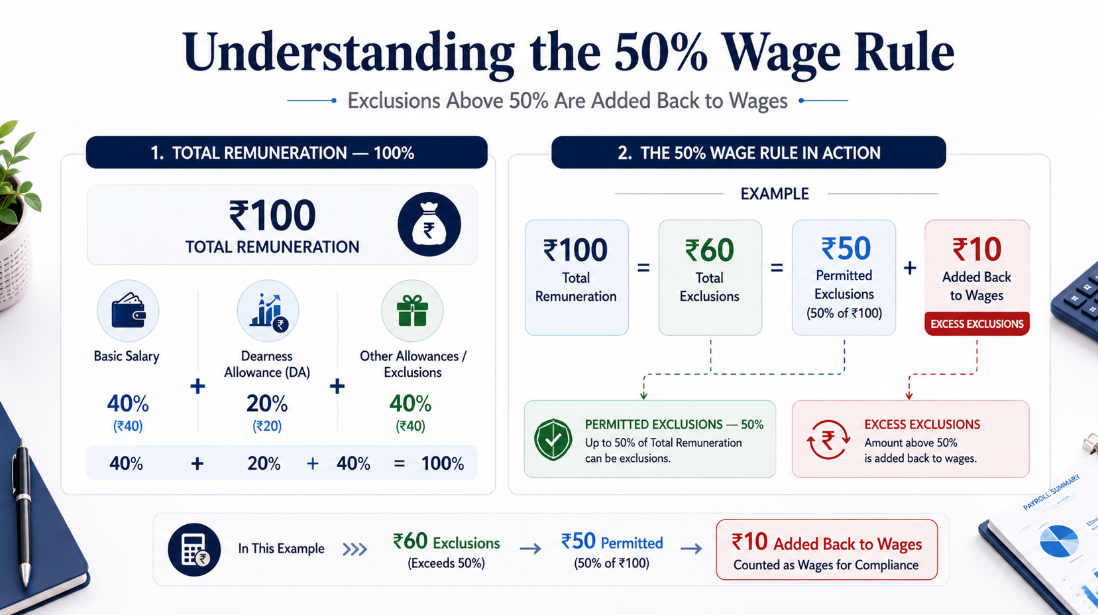
The most significant feature of the Definition of wages Code on Wages 2019 is the statutory 50% cap on exclusions.
How does the 50% threshold operate?
The law provides that:
- If excluded components i.e. (HRA, conveyance, special allowances) exceed 50% of total remuneration,
- The excess portion will be added back to wages for calculation of statutory benefits.
This rule ensures that wages constitute at least 50% of total compensation.
Illustration of the 50% rule
- Total remuneration: ₹100
- Excluded components: ₹60
- Permissible exclusion: ₹50
- Excess ₹10 → reclassified as wages
This mechanism directly impacts components of wages salary structure India, particularly in high-allowance compensation models.
How does the definition of wages impact salary structure in India?
The Definition of wages Code on Wages 2019 has materially altered how employers design compensation structures.
Key implications for employers
- Reduction in excessive allowance-based structuring
- Increase in base wage component
- Alignment of salary structures across employee categories
Impact on cost-to-company (CTC)
Employers must now account for:
- Higher statutory contribution base
- Increased gratuity liability
- Potential increase in bonus eligibility thresholds
This has led to a shift from flexible structuring to compliance-driven structuring in Indian payroll systems.
How does the definition of wages affect statutory contributions like PF, gratuity, and bonus?
The redefined wage base directly affects all labour law-linked computations.
Provident Fund implications
Under the Employees’ Provident Funds and Miscellaneous Provisions Act, 1952:
- Contributions are linked to wage components
- Higher wage base results in increased employer and employee contributions
Gratuity implications
Under the Payment of Gratuity Act, 1972:
- Gratuity is calculated based on last drawn wages
- Increased wage base leads to higher terminal liability
Bonus implications
Under the Payment of Bonus Act, 1965:
- Bonus eligibility and computation depend on wage thresholds
- Expanded wage definition increases coverage and payout exposure
How does the Code on Wages definition differ from previous labour laws?
The earlier regime suffered from multiple definitional inconsistencies.
Key differences
- Different definitions under each statute
- No uniform inclusion/exclusion principle
- Absence of a threshold mechanism
The current definition:
- Introduces uniformity across laws
- Eliminates ambiguity
- Reduces scope for litigation
This harmonisation is a core objective of labour law reform in India.
How have courts interpreted the concept of “wages” in India?
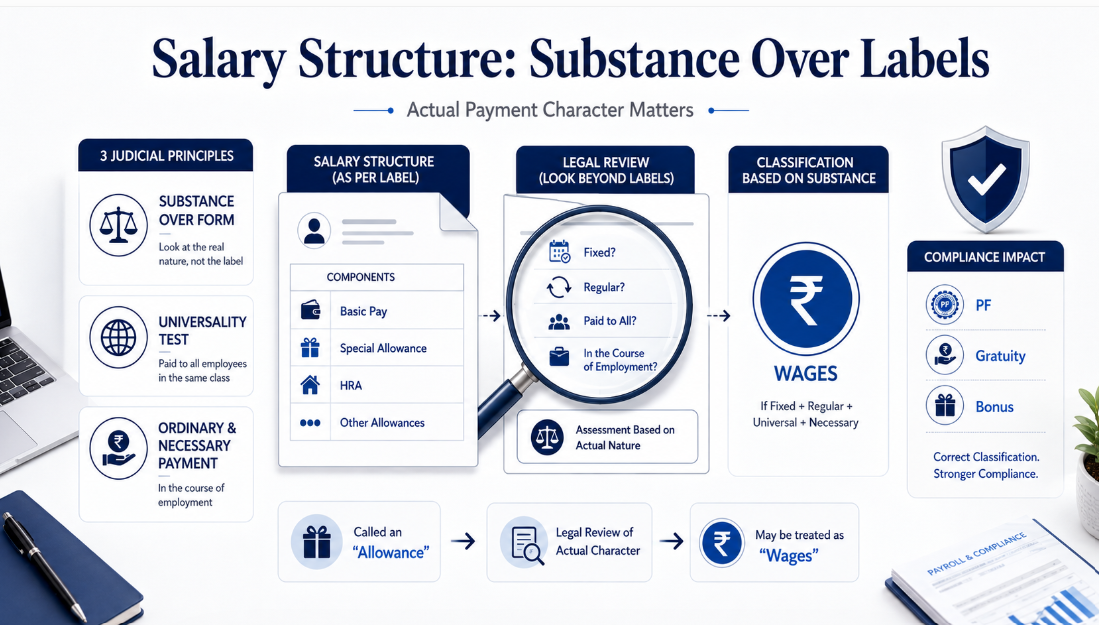
The judicial approach to “wages” in India has consistently focused on the substance of remuneration rather than its nomenclature. Courts have examined whether a payment is intrinsically linked to employment, rather than accepting employer-driven classification at face value.
This interpretative framework now directly informs the Definition of wages Code on Wages 2019, particularly in curbing artificial structuring and ensuring statutory benefits are not diluted.
What principles have courts laid down on wage components?
The most authoritative exposition is found in Regional Provident Fund Commissioner (II) West Bengal v Vivekananda Vidyamandir & Ors. (2019) 18 SCC 786, where the Hon’ble Supreme Court of India undertook a detailed analysis of wage structuring practices.
The Court rejected the mechanical distinction between “basic wages” and “allowances” and laid down a functional test.
Core judicial principles emerging from the ruling:
- Universality Test: Any allowance paid universally to all employees forms part of wages. If a component is not contingent or exceptional, it cannot be excluded.
- Ordinary and Necessary Payment Test: Payments made ordinarily, regularly, and necessarily in the course of employment are wages, irrespective of how they are labelled.
Only those payments which are:
- Linked to performance,
- Dependent on extra output, or
- Paid under special circumstances,
can legitimately fall outside wages. - Substance over Form Principle:
The Court held that employers cannot rely on terminological structuring (e.g., “special allowance”) to bypass statutory obligations. - Anti-Avoidance Approach:
Any attempt to split salary into multiple allowances with the objective of reducing statutory contributions is impermissible.
How did courts address artificial salary structuring?
Indian courts have repeatedly observed that employers often restructure salary packages to minimise liability under statutes such as provident fund or gratuity laws.
The Hon’ble Supreme Court of India in the aforementioned case clarified:
- Merely naming a component as “allowance” does not exclude it from wages
- If such allowance:
- Is fixed in nature
- Paid across the board
- Not linked to any specific contingency it must be treated as wages
This position has significantly narrowed the scope of exclusions from wages Code on Wages, even before the statutory codification.
How do earlier judicial precedents align with this position?
Prior to the 2019 ruling, courts had taken varying views. Some earlier decisions allowed exclusions where allowances were contractually structured, leading to inconsistent compliance practices.
However, the Hon’ble Supreme Court consolidated the position by:
- Rejecting fragmented interpretations
- Establishing a uniform test based on payment character
- Aligning wage determination with the objective of social welfare legislation
This marked a decisive shift towards employee-benefit protection.
How do these judicial principles influence the Code on Wages, 2019?
The wages definition under Code on Wages 2019 India effectively incorporates and codifies the principles evolved by courts.
Direct statutory alignment:
- Restriction on exclusions
The Code specifies a closed list of exclusions, limiting employer discretion. - Introduction of the 50% threshold
Even where exclusions are permitted, excessive structuring is neutralised through the statutory cap. - Focus on real remuneration
The definition captures the true earning capacity of the employee, consistent with judicial reasoning.
What is the practical impact on employers?
The judicial principles, now embedded in statute, impose a stricter compliance framework.
Employers must now ensure:
- Salary structures are substantively compliant, not merely contractually compliant
- Allowances are genuinely variable or role-specific, not universally applied
- Payroll design withstands scrutiny based on functional tests, not labels
From a component of wages salary structure India perspective, this has resulted in:
- Reduction in artificial allowance segmentation
- Increased base wage proportions
- Higher statutory contribution exposure
What risks arise if judicial principles are ignored?
Failure to align with judicial interpretation can result in:
- Reclassification of allowances into wages during inspection
- Retrospective liability for provident fund and gratuity
- Interest and penalties under applicable labour statutes
- Increased litigation exposure
Courts have demonstrated a consistent inclination to pierce through contractual structuring where it defeats statutory intent.
What compliance risks arise from incorrect classification of wages?
Non-compliance with the wage’s definition under Code on Wages 2019 India exposes employers to regulatory action.
Key risks
- Underpayment of statutory contributions
- Incorrect gratuity calculations
- Misclassification of salary components
- Labour inspections and penalties
Penalties under the Code
The Code on Wages, 2019 prescribes:
- Monetary penalties for contraventions
- Enhanced penalties for repeat offences
- Potential prosecution in serious cases
Risk mitigation measures
Employers should:
- Conduct wage structure audits
- Align payroll systems with statutory requirements
- Review employment contracts and CTC break-ups
Frequently Asked Questions (FAQs)
Is HRA included in wages under the Code on Wages, 2019?
HRA is generally excluded. However, if total exclusions exceed 50% of remuneration, a portion of HRA may be reclassified as wages.
Are bonuses part of wages under the new labour codes?
Statutory bonus is excluded from wages. However, its treatment must be assessed in light of the overall compensation structure.
Does the 50% rule apply to all employees?
Yes. The threshold applies uniformly across all categories of employees covered under the Code.
How should companies restructure salaries to comply?
Companies must ensure that:
- Wages constitute at least 50% of total remuneration
- Allowances are not disproportionately high
- Statutory contributions are recalibrated accordingly
Is the Code on Wages, 2019 applicable to all sectors?
Yes. The Code applies across industries, subject to its enforcement notification by the appropriate government.
When will the wage definition provisions be fully enforceable?
The Code has been enacted but awaits full notification along with the other labour codes. Implementation timelines depend on central and state government notifications.
Conclusion
The definition of wages under the Code on Wages 2019 has fundamentally changed how employers shall approach salary structuring and labour law compliances in India. By incorporating a standard statutory framework designed on inclusions/exclusions and the 50% threshold, the law shifts the focus from mere label-based structuring to the real substance of employee remuneration. For employers, this is not merely a drafting or a payroll issue anymore. The wages definition directly affects provident fund exposure, gratuity liability, bonus calculations and wider statutory compliance. As a result, businesses must examine what is included in the wages under the labour codes, review the permissible exclusions, and accordingly assess whether their current salary models remain legally viable.
At Corrida Legal, we consistently advise businesses on documentation related to employment, workforce structuring, statutory compliances, and risk-sensitive legal positions. We understand that wage-related issues are rarely isolated and often affect the payroll structuring, internal HR policies, goodwill, employment contracts, and future dispute exposure. Our approach is therefore not limited to merely interpreting the law in the abstract, but to help businesses apply it in a practically commercial, workable, and legally viable manner. Therefore, whether your organization is reviewing an existing salary structure, assessing compliance under the labour codes, or seeking to reduce exposure arising from outdated compensation practices, Corrida Legal can assist with end-to-end legal review, compliance strategies, and documentation support.
An early legal assessment can help employers build a more legally robust and future-ready framework in an era where the cost of getting the structure wrong can be significant.
