

Reviewed and Validated by: Aamna Munaima, Advocate
In India, leave encashment refers to the monetary value paid to employees for unused earned leave. The calculation of the amount is typically based on the employee’s last drawn salary and the number of unutilized leave days.
The exact method used to calculate is depends on the statutory provisions, the employer’s internal policy and at which stage encashment should be paid.
This article describes how leave encashments are calculated in India, including the legal framework, the basis upon which it is calculated, the relevant aspects of salary, tax and the effects of resignation, termination or retirement on payment. The aim is to provide both statutory clarity and administrative compliance.
What Is Leave Encashment and when can it be paid in India?
Leave encashment means when an employee is compensated for earned leave. It is commonly made at the date of termination of employment or, in a few instances subject to the company policy and legal compliance.
The obligations to provide leave encashment under the Indian labour laws are usually acquired as a result of:
- The state-specific Shops and Establishments Acts.
- The Factories Act, 1948 for industrial establishments (now under the Occupational Safety, Health and Working Conditions Code, 2020).
- Employer’s leave policies and employment contracts.
When is Leave Encashment Payable?
It is typically payable:
- upon resignation
- at the time of retirement or superannuation.
- upon termination of employment
- in the event of death (to nominee/legal heir)
For certain organisations, it is permitted to encash after every employment period if such is permitted and supported by company policies..
How do you compute Leave Encashment in India?
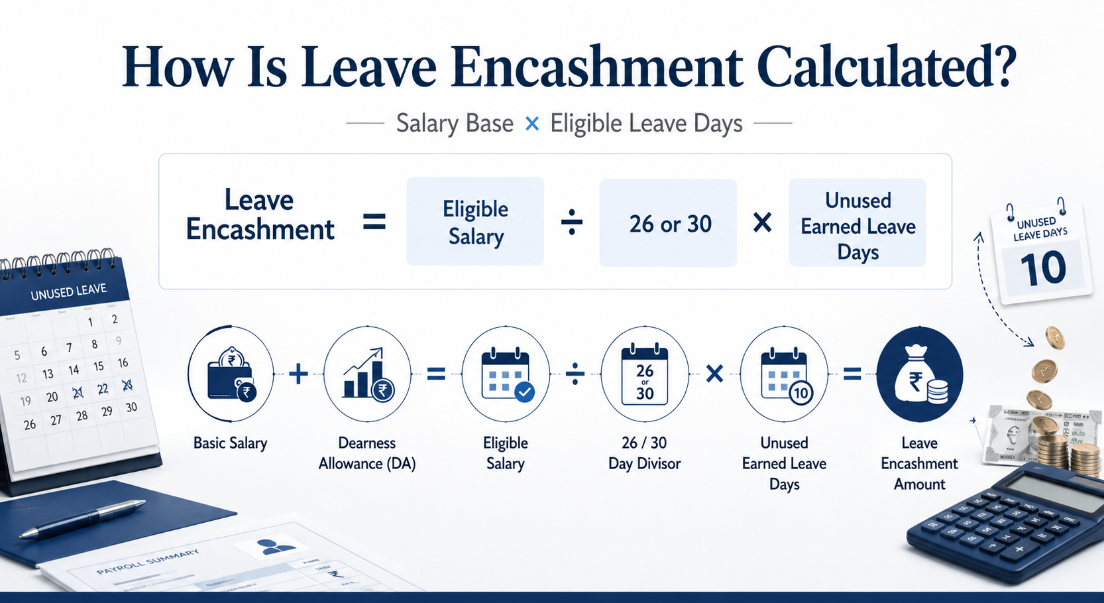
In India, the leave encashment is generally calculated by converting the employee’s unused earned leave into a monetary equivalent based on their last salary drawn. This includes determining the per-day salary rate and multiplying it by the number of leave days.
In determining the calculation of leave encashments in India, the employer will have to identify the appropriate salary component, the number of monthly working days as divisor, and number of earned leave days unavailed.
Standard Computation Method
The formula used in calculating Leave encashment that is commonly used in India is:
Leave Encashment = (Last Drawn Salary/Applicable Monthly Working Days) *Number of Unused Earned Leave Days.
While the computation is mechanical the accuracy relies on the proper classification of the leave and salary elements.
What Is the Divisor (26 or 30 Days)?
The divisor used in calculating leave encashment is not uniform and differs across organisations. In practice, two common approaches are followed which include:
- 26 working days: This method excludes the days off per week and the salary is linked to working days.
- 30 calendar days: This method considers the monthly salary on full calendar basis.
The statutory framework of the establishment must be consistent with the statutes and the company’s internal policies.
What Is Considered “Last Drawn Salary”?
In the case of leave encashment, “last drawn salary” includes the following components:
- Basic Salary
- Dearness Allowance (if applicable)
Generally, excluded elements are:
- House Rent Allowance (HRA)
- Bonuses and incentives
- Variable pay components
- Overtime
This approach aligns with the mainstream interpretation used in most earned leave encashment frameworks in India, unless a different and more expansive definition is provided under the internal policies of the company.
How is the Leave Balance Determined?
Before calculating the employer should calculate the accumulated leave, which involves:
- Determining total earned leave accrued.
- Deducting leave already availed.
- Applying statutory limits on carry-forward of leaves.
- Ensuring that the leaves are eligible for encashment under law and policy.
Generally, only earned leave (privilege leave) is the only leave that can be encashed. Casual leave and sick leave are usually not encashable except to the extent stipulated under the internal policy of the company.
Is there a different formula for resignation or Retirement?
The method of computation is the same irrespective of how the employment ends. When there is leave encashment at resignation, there is an application of the same salary divisor and leave balance calculation as at retirement.
Taxation can, however vary based on:
- Amount received during employment;
- Amount received on retirement and is subject to the limit of tax exemption in the form of the leave encashment under the Income Tax Act.
How does the Earned Leave become monetary value?
The monetary value of earned leave is computed by calculating the amount of eligible leaves of the employee and multiplication by the wage rate (in terms of daily salary). The conversion is not at the discretion but must be on the statutory rules of accrual of leave and carry forward.
When it comes to computing leave encashments in India, then one must ensure that he/she has verified the entitlement of leave under the relevant law, and then proceed with the formula of calculating leave encashment in India.
Step 1: Find out total earned leave accrued
Earned leave is calculated as follows:
Under the State Shops and Establishments Acts, at rates provided by the respective state; or under the Factories Act, at one day for every twenty subject to eligibility conditions.
Step 2: Implement Statutory Limits of Carry-forward
Before converting leave into cash, the employer ought to verify that:
- The maximum leave accumulation permitted by law;
- Whether any portion of leave has lapsed due to statutory limit;
- Whether the company’s internal policy provides for more favorable carry-forward rights.
Step 3: Find Encashable Leave Balance
Only the balance of earned leaves that remains unavailed can be encashed, which includes leaves unutilised:
- At the time of resignation, retirement or termination; or
- In excess of the permissible accumulation cap, where an annual encashment permit is a possibility.
The casual and sick leaves are ordinarily not encashable unless company policy expressly provides for it.
Step 4: Choose Conversion Salary Base
Daily wage rate can be derived from:
- Last drawn Basic Salary; and
- Where there is Dearness Allowance.
Other components such as HRA, incentives and bonuses may form part of the salary structure, but are usually excluded from leave encashment calculation unless specified in the policy.
Step 5: Daily Wage x Encashable Leave Days
Daily wage is calculated by dividing the monthly salary by the number of working or calendar days. The encashment amount is then calculated as follows:
- (Last Drawn Salary /Applicable Monthly Working Days) * Encashable Leave Days
The same applies in calculation of leave encashment on resignation and termination. The only exception is with respect to tax implications, where encashment is received at the time of retirement which may qualify for exclusions under the tax laws applicable in India.
Is Leave Encashment Calculated on Gross Salary?
No. Leave encashment is generally not calculated on gross salary unless specified in the contract.
As per the law:
- Use Basic + Dearness Allowance.
- Follow the applicable state laws or the internal policy of the employer.
Availability of clarity in employment contracts avoids disputes during full and final settlement.
What Is Leave Encashment in case of resignation or termination?
On resignation, encashment is payable for unused earned leave as per the applicable law.
In this regard, the employer shall:
- Calculate the accrued leave.
- Use the statutory/policy-based formula.
- Include encashment in the final settlement.
Would Leave Encashment be paid at Termination?
Yes, mostly unless:
- There is a specific statutory forfeiture.
- Restricted by policy.
Unlike gratuity, forfeiture of leave encashment is not the norm unless there are provisions that expressly allowed.
How Is Leave Encashment Calculated at the Time of Retirement?
At retirement, the employer must determine:
- Total accrued leave.
- Carry forward leave.
- Final leave balance.
The payout is then calculated based on standard daily wages derived from the salary.
What Is the Taxation of Leave Encashment in India?
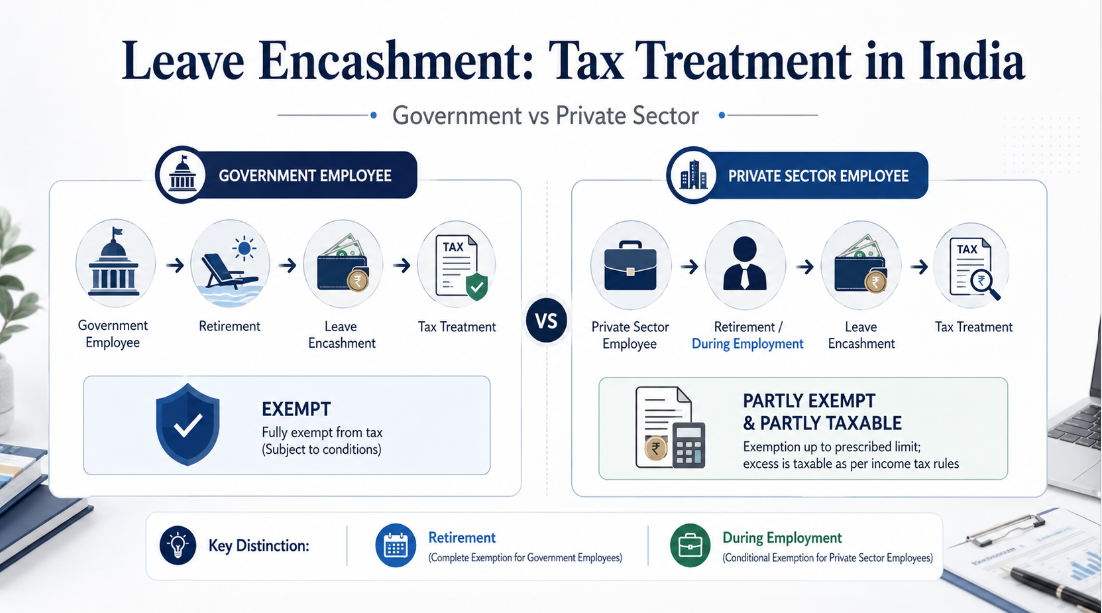
Tax is dependent on employment and payment.
Government Employees
Encashment of leaves at the time of retirement is fully tax-exempt.
Private Sector Employees
It is governed under section 10 (10AA) of the Income Tax Act.
- Exemption on retirement is capped at Rs. 25 lakh
- Exemption is the lowest of 10 months’ average salary
- Exemption is the lowest of cash equivalent of leave balance.
Encashment during employment is fully taxable.
What Impact do State Laws have on the Calculation of Leave Encashment?
Shop and Establishment Acts regulate
- Maximum accumulation
- Leave accrual rates
- Mandatory encashment on exit.
Occupational Safety, Health and Working Conditions Code, 2020
For factory workers:
- 1 day per 20 days worked.
- Carry-forward permissible within legal limits.
- Encashment payable on exit.
However, employers must ensure state-specific compliance before calculation.
Can employers refuse Leave Encashment?
Yes, when required by law or contract.
The employers are not permitted to refuse when the state law stipulates that payment should be made on separation. Non-payment may:
- Lead to labour disputes.
- Trigger recovery proceedings on employers.
Can Pay Leave Encashment When Employed be Coercible?
Certain companies allow annual encashment beyond a limit and also encashment of excess leave
Such payments are fully taxable, based on company policy and not mandatory unless required by state law.
How Is Leave Encashment to the private workers calculated?
The determining factors in regard to a case of Leave encashment of the employees, which are private, include:
- Relevant state Shops and Establishments Act;
- Employment contract;
- Company policy.
The method of calculation is the same as above, which is:
- Identify the balance of earned leave.
- Calculate the salary (26 or 30 days).
- Multiplied by eligible leave days.
- Include in the complete and final settlement.
Frequently Asked Questions (FAQs)
How many earned leaves could be forwarded in India?
Carry-forward limit depends on the applicable state law, with no uniform national standard. As per the Shops and Establishments Act, this limit ranges between 30-60 days. However, as per the union law, the limit is different. In practice, the employers can offer higher limits but not reduce it.
Is Leave Encashment Calculated on CTC?
No. Encashing of leaves is not calculated based on Cost to Company (CTC). It is calculated on Basic Salary and Dearness Allowance, unless stated otherwise in the contract or policy.
Can an Employer Refuse to Pay Leave Encashment?
No, where the payment is obligatory by statute or even by a binding contract. Non-payment can lead to legal action and override statutory obligations.
Does Full and Final Settlement include Leave Encashment?
Yes. It is part of the employer’s final dues.
Conclusion
The issue of determining how to compute the leave encashments in India requires proper analysis of the earned leave accrual, statutory limits, salary components, and tax treatment. While the method of calculation is simple, accuracy depends on correctly applying laws and contract terms.
To prevent the statutory exposure, employers should align the leave policy with the statutory law and ensure proper settlement.