


Reviewed and Validated by: Kartavya Ostwal, Advocate
An employee leave policy should do more than list the number of leaves available to employees. It should explain the purpose of leave, categories of leave, eligibility, approval process, documentation, treatment of leave without pay, notice period restrictions, carry forward rules, leave encashment, attendance linkage, maternity and paternity leave, and the consequences of unauthorised absence.
A practical leave policy should balance employee wellbeing with business continuity. Employees should be encouraged to use leave responsibly , but leave should also be planned, approved and recorded so that work is not disrupted.
Purpose of a Leave Policy
The purpose of a leave policy is to create a structured framework for availing leave. It should help employees understand their entitlements and the process for using them, while allowing the company to plan work, manage teams and maintain records.
A good policy should also recognise that rest, personal time and work-life balance support employee wellbeing and productivity. At the same time, it should make clear that leave must be applied for, approved and recorded in accordance with company policy and procedure.
Legal Framework Governing Employee Leave in India
It is essential for the organizations to ensure that the eave policies comply with applicable employment and labour laws. The leave entitlements that employees are entitled to in India may arise from company policy, employment contracts, State Shops Standing Orders, among other relevant laws. Statutory leave benefits like maternity leave and other protected categories cannot be reduced or limited via the organization’s policy.
Applicability of the Leave Policy
The policy should specify who it applies to.
For a standard employment framework, the leave policy may apply to all employees of the company. For part-time employees, leave may be pro-rated, except for categories that are governed separately by law or company policy. For fixed-term employees, leave entitlement may be restricted to accrual or entitlement within the contract tenure.
This clarity is important because leave rules may differ for full-time employees, part-time employees, probationers, fixed-term employees, consultants, interns and employees on notice period.
Leave Categories Should Be Clearly Defined
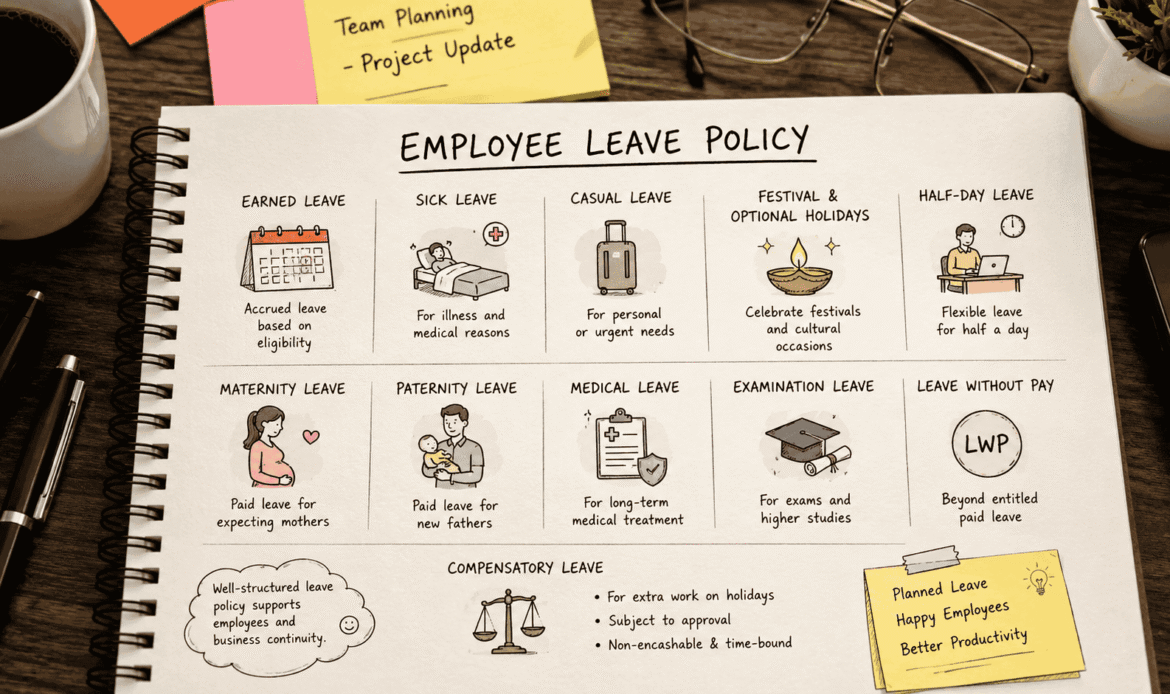
The policy should define each leave category separately.
Common categories may include earned leave, sick leave, casual leave, festival holidays, optional holidays, maternity leave, paternity leave, half-day leave, leave without pay, medical leave of absence, personal leave of absence, examination leave, extraordinary leave and compensatory leave.
The policy should not mix all leave types into a single pool unless that is the company’s conscious structure. Each leave type should have its own purpose, eligibility and process.
Read another article: Flexible Working and Base Location Policy: Legal and HR Framework for Indian Employers
Earned Leave
Earned leave should be drafted carefully because it is usually linked with accrual, carry forward and encashment.
The policy should state the number of earned leaves days available in a calendar year, when they accrue, whether probationers can use them, whether advance earned leave may be sanctioned and how unused earned leave is carried forward.
The policy should also specify whether earned leave can be encashed during employment or only at the time of separation. One drafting approach is to provide that earned leave encashment is available only at separation and not during employment.
Sick Leave
Sick leave should cover illness-related absence and medical documentation.
Employees should be required to inform their manager at the earliest if they are unable to attend work due to illness. The employee should also inform the manager of the likely period of absence and regularise the sick leave as soon as possible.
For sick leave beyond a defined number of days, the policy may require a certificate from a registered medical practitioner. Where the illness is prolonged, the policy may allow the employee to use earned leave for any shortfall, or allow additional sick leave at the company’s discretion.
When necessary, within the context of legalities, the company may request additional medical verification before approving sick leave.
Casual Leave
Casual leave is generally used for personal reasons.
The policy should specify the number of casual leaves available in a year, whether unused casual leave lapses at year-end, whether it can be carried forward, how many casual leaves can be availed at a stretch and whether casual leave can be clubbed with earned leave.
The policy should also make clear that casual leave should be applied for in advance wherever possible, except in genuine urgent situations.
Festival and Optional Holidays
The policy should distinguish between compulsory holidays and optional holidays.
One practical structure is to provide a fixed number of paid holidays in a calendar year, with certain compulsory holidays and other optional festival holidays to be selected by the employee from the list available on the HR portal.
The company may also circulate the holiday list in advance every year. This helps employees plan leave and helps teams anticipate absences.
Requirements for public holidays could differ depending on the state legislation and employers has to make sure of their adherence while preparing annual holiday lists.
Half-Day Leave
If half-day leave is permitted, the policy should say so expressly.
It should state that half-day leave may be availed and that the leave balance shall be deducted on a pro-rata basis in accordance with the company policy
This avoids disputes where employees take partial-day absences but there is no clear deduction mechanism.
Leave Without Pay
Leave without pay should be clearly regulated.
The policy may state that any leave availed beyond the employee’s available leave entitlement will be treated as leave without pay. Such leave may be granted only after reviewing the company’s business consideration
This language is useful because employees should not assume that unpaid leave is automatically available merely because paid leave has been exhausted.
Maternity Leave
A maternity leave policy should explain eligibility, duration, documentation and payment treatment.
One policy framework states that a woman employee who has worked for at least 80 days in the 12 months preceding the expected delivery date is eligible to avail maternity leave and benefits. It provides 26 weeks of maternity leave for eligible employees, with a restriction on how much leave may precede the expected delivery date. It also provides a shorter leave period where the employee has two or more surviving children.
These eligibility criteria and benefits should be aligned with applicable statutory provisions.
The policy should also require relevant medical or legal documents to be submitted to HR, and should address the company’s obligation to maintain maternity benefit records.
Where the policy covers miscarriage, adoption, medical termination or illness arising from delivery, the documentation required should be separately stated.
Paternity Leave
A paternity leave policy should define eligibility, duration and timing.
One policy approach grants paternity leave to male employees who are biological, adoptive or commissioning fathers. It requires advance application and provides that the leave should be availed within a specified period from childbirth or adoption and in continuity.
Another structure provides that paternity leave may be availed within a defined period after birth or adoption and must be taken as a single continuous block.
The drafting should be clear on whether paternity leave is paid, whether it applies only for a limited number of children and what documents must be submitted.
Medical Leave of Absence
A medical leave of absence may be required where illness, surgery or a medical event keeps the employee away from work for a longer period than ordinary sick leave.
The policy may require manager approval, HR involvement, medical certification, expected duration of illness and periodic updates from the employee. It may also state that medical leave is granted for the medically necessary period, subject to a maximum period and business considerations.
The employee should remain in contact with the manager and HR regarding the return-to-work status. If the employee cannot return on the expected date, a medical statement should be provided before the original return date.
Personal Leave of Absence
A personal leave of absence should be separately defined.
One policy structure treats leave without pay for more than 30 calendar days as personal leave of absence and requires higher-level approval.
This is useful where the company wants to distinguish short unpaid leave from longer absence that affects staffing, role continuity and business planning.
Examination Leave
If the company permits examination leave, the policy should define eligibility, notice, duration and approval.
One policy structure allows examination leave after completion of a minimum tenure, requires advance intimation to the reporting manager or supervisor and treats such leave as leave without pay.
This is a useful employee development benefit, but it should be controlled through advance notice and manager approval.
Compensatory Leave
Compensatory leave should not be vague.
The policy should specify when compensatory leave is permitted, when it is not permitted, how it is approved, whether it can be encashed and when it lapses. One drafting approach allows compensatory leave where employees are authorise to work on holidays or days off due to business needs for project-related work at a client or customer request, but not where the employee comes to office on a holiday for personal work.
The policy may also state that compensatory leave is not encashable and must be availed within a defined period, failing which it lapses.
Leave Application Process
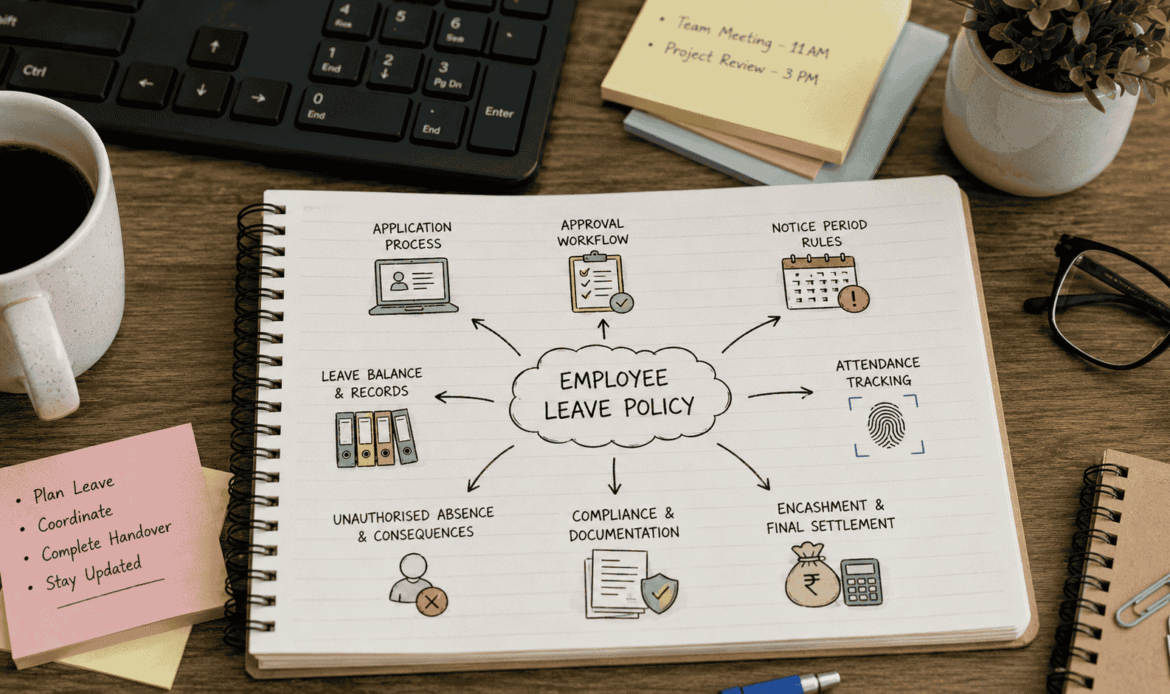
The policy should clearly explain how leave is applied for.
Employees should apply for leave through the HR portal or the designated leave and attendance system. For longer leaves, the policy may require advance application within a defined period.
The policy should also state that leave approval depends on business needs, work dependency, team requirements and the circumstances of the request.
Leave should not be treated as approved unless it has been sactioned by the designated authority in accordance with the company policy.
Leave Cannot Always Be Claimed as a Matter of Right
The policy should state that leave cannot be claimed as a matter of right, except where protected by applicable law or company policy.
The company may refuse, postpone or change leave request on account of business needs, unless such right is granted under existing laws. Suspension will be carried out according to rules and regulations of the company. . Employees serving notice period may be permitted to take leave only for emergencies or were authorised by law or company policy.
This protects the company’s ability to manage business continuity, especially during deadlines, handovers, audits, project closures or critical staffing periods.
Leave During Notice Period
The policy should specifically address leave during notice period.
Employees serving notice period may be permitted to take leave only for emergencies or where authorised by law or company policy. When leave is taken while within the notice period and it is permitted under the employment contract as well as any relevant laws, the notice period will be correspondingly extended.
Separately, an exit policy may state that employees on notice period are not eligible for upcoming accrual leave benefits.
This avoids disputes where employees try to use accumulated leave to shorten the notice period without approval.
Unauthorised Absence and Overstay
Unauthorised absence should be clearly addressed.
Any absence not supported by an approved leave request, on-duty travel information or approved work-from-home arrangement may invite disciplinary action.
The policy should also state that extension of leave must be requested before the sanctioned leave expires and is valid only if approved by the appropriate authority.
An overstay without approval beyond the agreed-upon leave period may be treated as unauthorised absence and managed under the organisation’s policy. . A clear unauthorised absence clause helps HR act consistently and reduces ambiguity.
Attendance and Leave Records
The leave policy should be connected with attendance records.
Leave records should be administered, maintained and updated regularly by the designated function or HR. Employees should provide timely notification of leave, and supervisors should ensure that leave record are reported properly.
The HR department may carry out periodic audits of attendance and leave records.
Attendance controls are important because leave, salary, payroll, overtime, absence, full and final settlement and performance discussions may all depend on accurate records.
Compliance and Record Retention
The employer will ensure that leave application forms, attendance records, medical certificates and approval documentation in line with company policy and applicable legal requirement. Proper record keeping will facilitate audit processes, dispute management and compliance.
Leave Encashment
Leave encashment should be clearly drafted.
The policy should state which leave categories are encashable, whether encashment is available during employment or only at separation, what formula is used and how carried-forward leave is treated.
At separation, earned leave accrued in the current calendar year may be calculated on a pro-rata basis up to the employee’s last working day. Earned leave carried forward from the previous year may remain eligible for encashment in accordance with the company policy.
The exit process should ensure that attendance records up to the last working day are updated and shared with HR so that leave encashment, salary payable and working days can be calculated correctly.
Leave Policy and Full and Final Settlement
Leave balances should be considered during full and final settlement.
At exit, HR should calculate leave encashment, salary payable, working days, notice period recovery where applicable and other dues based on attendance and clearance records.
This is why the leave policy should be aligned with the separation policy. If leave records are incomplete or inaccurate, full and final settlement may become disputed.
Sample Leave Policy Clause
The Company recognises the importance of rest, personal time and work-life balance in maintaining employee wellbeing and productivity. This Policy provides a structured framework for availing leave while ensuring that business operations remain uninterrupted.
Employees shall be eligible for leave in accordance with the categories, eligibility conditions, approval process and limits specified by the Company from time to time. Leave may include earned leave, sick leave, casual leave, festival holidays, optional holidays, maternity leave, paternity leave, half-day leave, leave without pay and such other leave categories as may be notified by the Company.
All leave must be applied for through the Company’s HR portal or designated leave and attendance system. Leave shall not be treated as approved unless sanctioned by the reporting manager, HR or other authorised person in accordance with the Company’s process.
Leave cannot be claimed as a matter of right, except were protected under applicable law or expressly provided under Company policy. The Company may refuse, revoke or defer leave based on business needs, work dependency, team requirements or organisational priorities.
Any absence not supported by approved leave, approved work-from-home arrangement, on-duty travel information or other authorised record may be treated as unauthorised absence and may invite disciplinary action.
Any leave availed beyond the employee’s available leave balance may be treated as leave without pay, subject to approval by the Company after reviewing business needs.
Employees serving notice period may take leave only in emergencies or were authorised by applicable law or Company policy. The leave taken during notice period may impact the last working day, the notice period completion, and the full and final settlement under company policy and employment terms.
At the time of separation, leave encashment, if any, shall be calculated in accordance with the Company’s policy and applicable requirements, based on approved leave records and attendance records up to the last working day.
Practical Drafting Checklist
- Define the purpose of the leave policy.
- Specify who the policy applies to.
- Define each leave category separately.
- State annual entitlement and accrual rules.
- State carries forward and lapse rules.
- Specify leave encashment rules.
- Define application and approval process.
- Require advance notice where applicable.
- Require medical documents for sick or maternity leave where applicable.
- Regulate leave without pay.
- Address half-day leave.
- Address maternity and paternity leave.
- Address compensatory leave.
- Address leave during notice period.
- State circumstances under which leave requests may be deferred or modified.
- Define unauthorised absence consequences.
- Require HR audits of leave and attendance records.
- Align the policy with full and final settlement.
Common Drafting Mistakes
- The first mistake is listing leave numbers without explaining the process.
- The second mistake is not defining carry forward and lapse rules.
- The third mistake is failing to regulate leave without pay.
- The fourth mistake is allowing leave during notice period without clear rules.
- The fifth mistake is not requiring documentation for medical or maternity leave.
- The sixth mistake is not defining unauthorised absence.
- The seventh mistake is not linking leave records with attendance records.
- The eighth mistake is not clarifying whether leave encashment is available during employment or only at separation.
- The ninth mistake is failing to state who approves leave.
- The tenth mistake is Not keeping up or regularly auditing leave and attendance records.
- The eleventh mistake is that of not having leave policies with applicable relevant labour laws.
FAQs
What Should an employee leave policy contains?
It should contain leave categories, eligibility, entitlement, application process, approval authority, documentation, leave without pay rules, carry forward, encashment, notice period restrictions, attendance linkage and consequences of unauthorised absence.
Can leave be claimed as a matter of right?
A leave policy may state that leave cannot be claimed as a matter of right, except were protected by applicable law or authorised by company policy. The company is allowed to deny, postpone or alter any requests for leave, depending on the laws of the organization.
What is leave without pay?
Leave without pay means leave that can be taken by an employee once his paid leave entitlements have been exhausted or when the employer has approved leave that would otherwise be unpaid. . It may be granted only after reviewing business needs and approval requirements.
Can employees take leave during notice period?
The policy may restrict leave during notice period to emergencies or leave authorised by law or company policy. Leave during notice period may also affect notice period completion depending on the policy.
Should sick leave require medical documents?
The policy may require a registered medical practitioner’s certificate where sick leave extends beyond a defined number of days.
What happens if an employee is absent without approval?
Absence not supported by approved leave, on-duty travel information or work-from-home approval may invite disciplinary action.
Is leave encashment linked to separation?
A policy may provide that earned leave encashment is available at separation and calculated based on approved leave and attendance records up to the last working day.
Is there a statutory requirement for leave benefits?
The statutory leave benefits that are required under relevant laws cannot be limited via company policies
Corrida Legal Note
A leave policy should be practical, not merely numerical. It should help employees plan rest, help managers plan work and help HR maintain accurate records. The policy should clearly define leave categories, approval process, documentation, LWP, unauthorised absence, notice period restrictions and leave encashment so that leave administration remains consistent and legally compliant.