

Reviewed and Validated by: Kartavya Ostwal, Advocate
An overtime policy has to clearly define as to how overtime is structured in the organisation rather than just mentioning that employees will be paid for all extra hours on top of their regular ones. Establish a definition of normal working hours and circumstances in which overtime would be approved, who can approve such overtime and how any additional work is recorded. The policy has to provide clarity on whether overtime is paid or compensated with time off, approach toward weekend and holiday work, and measures to check excessive, informal or unauthorised overtime (as applicable).
Every overflow moment requires paperwork matching real operational demands. Legal standards around labour shape these choices closely. Rules stick better when everyone sees where they apply.Overtime management is one of the vital components of the HR policies that every employer needs to consider in India. Overtime management can be instrumental in improving the working hours, welfare of employees, payroll, adherence to law and dispute resolution. Employees working must have fair payment for that an appropriate policy can help.
Purpose of an Overtime Policy
The purpose of an overtime policy is to explain how the company will handle work performed beyond the employee’s standard schedule. The policy framework also develops a systematic arrangements for overseeing employee working hours and company law policies.
The policy should aim to ensure that employees are consistently and correctly compensated for approved additional work, while reducing overtime abuse, productivity loss, health and safety risks, payroll and disputes.
The policy should make clear that overtime will be handled in accordance with applicable requirements and company procedures. It should not operate as an informal understanding between employees and managers.
Define Standard Working Hours
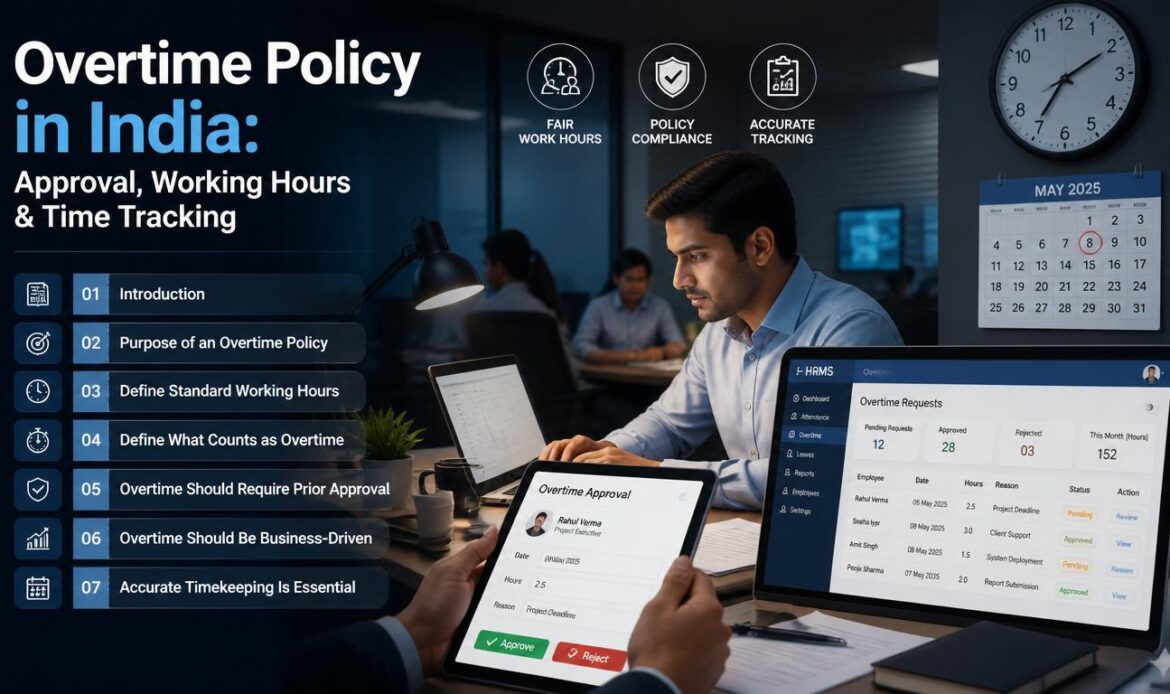
The policy should begin by defining standard working hours.
Standard working hours are the employee’s regularly scheduled working time, usually specified in the employment contract, appointment letter, HR policy, shift schedule or applicable attendance framework.
The employment agreement may also state that normal working hours are as set out in the relevant schedule, and that the employee may be required to work additional hours as necessary for proper performance of duties, subject to overtime compensation or compensatory off in accordance with applicablelaw and company policy. . Any extra employment work time shall be properly recorded with the help of employers approved attendance or HRMS system to maintain clarity, traceability, observance and wage computation procedures.
This alignment is important. The overtime policy should not contradict the employment agreement. The policy framework shall comply with relevant commercial establishment regulations, service rules, industrial rules and state level employment compliance standards if applicable.
Define What Counts as Overtime
The policy should define overtime clearly. The interpretation must be aligned with relevant labour law principles regarding with applicable state shop law or Factory law as required.
A practical definition is that overtime is the time worked in addition to the employee’s standard working hours, provided the work is approved by the company and accepted for business purposes.
The policy should avoid a situation where employees remain online, available or present without approval and later claim overtime. It should also avoid a situation where managers informally ask employees to work extra hours but do not record or approve the work. Work duration consumed over fixed working time without official work instruction in writing permission HRMS-based entry shall not directly count overtime.
Overtime Should Require Prior Approval
The policy should state that overtime must be approved in advance by the reporting manager, HOD or other authorised person. In emergency situations things can move pretty fast. Getting approval first is not always realistic so the overtime gets reported as soon as there is a chance. That way it can be reviewed later and made regular.
Hybrid work, remote workand flexible work policies may also provide that employees should not work overtime without prior managerial approval.
Prior approval is critical because it allows the company to decide whether overtime is genuinely necessary, whether work can be rescheduled, whether additional staffing is needed, whether the work is urgent and how the extra hours will be recorded. Each authorised overtime must be duly entered by means of firms HR platform, attendance record to maintain compliance , traceability precise wage calculation needs.
Overtime Should Be Business-Driven
Overtime should be allowed only where there is a genuine business requirement. The above should also be in accordance with the maximum hours of work prescribed under labour laws and relevant provisions of Shops & Establishment / Factories Act. Common examples may include urgent client work, emergency deliverables, statutory or payroll deadlines, project closure, technical failures , business continuity requirements, unavoidable operational workload or approved weekend or holiday work.
The overtime policy should state that employees should work overtime only when necessary to finish urgent work and that the company will try to ensure that work is ordinarily be completed during standard working hours. Extra work hours will remains optional company decision of the employer and shall not be considered as automatic right of staff.
This prevents overtime from becoming a regular substitute for poor planning.
Accurate Timekeeping Is Essential
Employees and managers should follow the company’s timekeeping system so that accurate overtime records are maintained. These records will be considered as primary evidence for the confirmation of overtime claims.
The policy should define how overtime is recorded. This may be through the HRMS, timesheets, biometric records, attendance system, project tracker, manager approval emails or any other company-approved method.
The procedure should ideally require:
- The employee and manager to agree on the overtime needed.
- The overtime not to exceed permitted limits.
- The employee and manager to accurately record overtime.
- HR or payroll to process overtime pay or compensatory off based on approved records. Overtime should not be paid or credited without proper approvals with their system-based/written records.
HRMS and approved timekeeping systems shall constitute records assessment overtime requests.
Manager Responsibility
Managers should not casually ask employees to work extra hours.
A good overtime policy should require managers to avoid asking or encouraging team members to work excessive overtime. It should also require managers to plan work so that employees can ordinarily complete tasks during standard working hours. Team leads shall also ensure ina way that extra working hours remains within governing legal shift work limit set out in accordance with labour laws such as state shop laws or factory act as required.
Managers should approve overtime only when required, confirm the reason for additional work, ensure that time records are accurate and avoid discriminatory selection of employees for overtime work. Entire overtime sanctions plus non approvals need to be recorded in writing or through company payroll system to support clarity and reviewability.
Manager responsibility is essential because most overtime disputes arise from informal instructions.
Employee Responsibility
Employees should also be responsible under the policy.
Employees should not work unnecessary overtime merely to increase overtime pay or compensatory off. The policy should discourage employees from working avoidable overtime where it affects work quality or creates abuse of the system.
Employees should also obtain approval, record time accurately, complete work efficiently and raise concerns if they are regularly asked to work beyond standard hours. All hours worked, including overtime, is recorded only in the company HRMS or attendance application. Messages, emails or other informal ways to connect with the supplier will not work. Nothing is recognized from outside the system; they track it all.
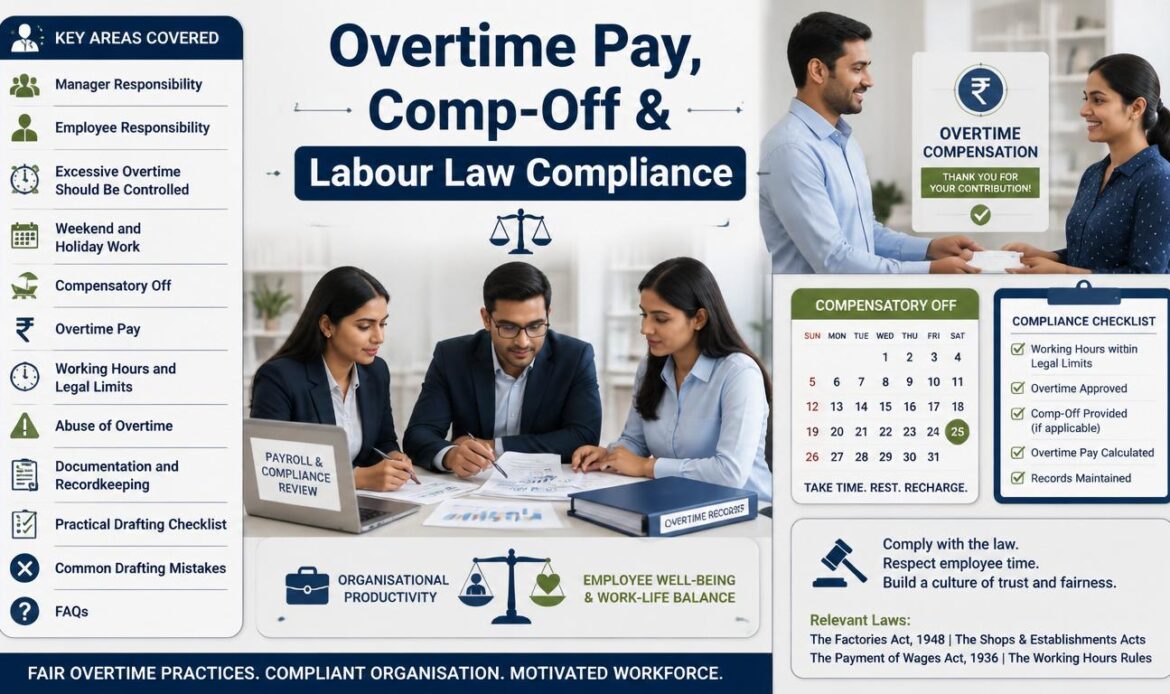
Excessive Overtime Should Be Controlled
Frequent or excessive overtime can affect employee health, quality of work, productivity and morale. Overtime beyond the permissible limits shall continue to be governed by maximum working hours provided by law, under applicable labour laws such as the Shops and Establishments Act or Factories Act, as it may be.
The policy should state that the company will record overtime accurately, advise employees to work overtime only for urgent work, create processes to enable completion of work during standard hours and take steps to reduce overtime where decline in work quality or other issues are observed. Overtime is not a regular or routine form of workforce planning and will only be utilised where an actual operating need exists.
The policy may also include a daily or weekly overtime cap, subject to applicable requirements and business needs.
Overtime in Shift-Based Systems
Shift-based work requires special attention.
A policy may state that employees on night shifts should not be asked to work more than a limited number of overtime hours except in emergencies, and that employees working long schedules should not be encouraged to take additional or double shifts beyond the permitted framework. Any extra working times or extra shift work in shift scheduling framework shall be advance supervisory , permission and accurate.
This type of clause is useful for companies that operate customer support, IT operations, security operations, logistics, manufacturing support or 24/7 service
Overtime in Remote and Hybrid Work
Remote and hybrid work can create hidden overtime.
Employees may remain online beyond working hours, respond to latecommunicatios , attend extended client calls or work across time zones. The policy should therefore expressly state that remote or hybrid employees cannot work overtime without prior approval.
At the same time, employees working remotely should not be denied overtime merely because they are not physically in office, where the overtime is approved and accepted for company business purposes. A policy may state that employees are entitled to overtime pay regardless of where they work, so long as the work performed is accepted for business purposes.
Team members should not include outside the scope working hours because they are on duty only if it is given or cleared it looks like maintain from going beyond limits around expectations in certain conditions to comply but online Prescence may arise based on position.
Weekend and Holiday Work
Overtime policy should be linked with the weekly off and holiday policy. In compliance with employment laws covering state shop establishment law and further relevant state wise employment provisions.
If employees work on compulsory public holidays or weekends, the policy should require approval from the respective lead or manager. The team lead should confirm the business requirements and the reason the employee worked on the declared holiday.
The company may provide a payout or allow compensatory off depending on its policy framework. If compensatory off is allowed, the employee should apply through the ESS or HRMS portal after approval and should avail it within the defined period, failing which it may lapse.
The Policy framework shall clearly define in case where alternative weekly breaks are required when employees perform duties legally required weekly off days.
Compensatory Off
Compensatory off should be clearly defined.
A compensatory off policy may provide that compensatory off is available only when the employee works for more than a defined number of hours on a holiday for project-related work at a client or customer request. It may also state that comp off is not available where the employee comes to office on a holiday for personal work.
The policy should state whether compensatory off is encashable, when it must be availed, who approves it and how it is recorded. One policy structure states that compensatory leave is not encashable and should be availed withinthe prescribed period , failing which it lapses unless otherwise in written format by the entity based on work requirements.
Overtime Pay
The policy should state how overtime pay is processed.
Where overtime pay is applicable, HR or payroll should calculate the payment based on approved overtime records and process it with the next scheduled payroll cycle or as per company procedure.
The policy should also state that overtime pay will be made at the correct applicable rate and within the required timeline.
The drafting should avoid loose phrases like “extra work will be adjusted later” unless the adjustment method is clearly explained.
Overtime wages must be paid at the required overtime rate if the law says so. This rate is based on the employment law that applies to you.
Read another article: Employee Leave Policy in India: Practical Drafting Guide for Employers
Working Hours and Legal Limits
The policy should provide that employees will not be asked to work more than the maximum hours permitted under applicable requirements. It should also state that the company will not discriminate when deciding who must work overtime or how employees are compensated. In line with relevant industrial laws such as state shop & establishment legislation, Factories act and workforce rules as applicable.
Where a company is preparing a state-specific or location-specific policy, working hours, overtime caps, spread-over limits, rest intervals and overtime rates should be checked for the relevant establishment and state. Internal compliance material also recognises working hour compliance, extra wages for overtime and overtime triggers as key employment law action points. Employees should be granted reasonable break periods, weekly holidays and spread-over limitations in compliance with legal requirements.
Abuse of Overtime
The policy should prevent abuse by managers and employees. .
Managers should not encourage excessive overtime or use overtime as a routine method of getting work done. Employees should not work unnecessary overtime to increase pay, create artificial workload or accumulate compensatory off. Whichever misues of working time excess in case of on the part of team leads or staff shall be treated as a breach of rules and result in HR action as per applicable rules.
The company should be able to investigate repeated overtime patterns, unexplained late working, unusual overtime claims, manager-driven excessive overtime and productivity decline linked with long hours.
Documentation and Recordkeeping
Overtime documentation should be treated seriously.
The policy should require:
- Prior approval.
- Reason for overtime.
- Date and duration.
- Work performed.
- Manager confirmation.
- Attendance or timekeeping record.
- Payroll or HRMS entry.
- Compensatory off or payout decision.
This documentation helps payroll process compensation, helps HR address disputes, and helps management identify unhealthy workload patterns. We need to keep records of overtime approvals and payments. Our company also has its rules, for keeping records of overtime approvals and payments. We have to follow these rules for records of overtime approvals and payments.
Sample Overtime Policy Clause
The Company recognises that employees may occasionally be required to work beyond their standard working hours due to urgent business requirements, client requirements, project deadlines, operational emergencies or other approved work requirements. The maximum limit for overtime shall comply with the daily and weekly working hours prescribed by relevant labour laws (e.g. Shops and Establishments Act, Factories Act, etc.) respectively.
Overtime means time worked beyond the employee’s standard working hours, provided such work is approved by the Company and accepted for Company business purposes. Overtime will not be considered as a matter of course and is not an automatic right or entitlement, nor does it form a part of any Contract – all requests for overtime must continue to remain at managerial discretion and will remain dictated by business needs.
Employees shall not work overtime without prior approval from their reporting manager, HOD or other authorised person. Any overtime worked without approval may not be treated as approved overtime unless subsequently regularised by the Company in writing.
Managers shall approve overtime only where it is genuinely required. Managers shall avoid asking or encouraging employees to work excessive overtime and shall take reasonable steps to ensure that work is ordinarily completed within standard working hours.
Employees and managers shall accurately record overtime in the Company’s HRMS, attendance system, timesheet, approval email or other designated system. HR or payroll shall process overtime pay or compensatory off based on approved records and applicable Company policy.
All extra working hours entries shall be maintained for the purpose of review , scrunity and observance in accordance with applicable laws. Extra working time wages, shall be paid as per prescribed rates set under laws cannot be below legal obligations.
Employees working remotely, under a hybrid arrangement, on weekly offs, weekends or declared holidays shall also require prior approval before performing overtime or additional work.
Where compensatory off is granted, it must be applied for and availed within the period specified by the Company. If not availed within the prescribed period, it may lapse, unless otherwise approved by the Company.
The Company may take action where overtime is abused, falsely claimed, worked without approval, encouraged excessively by managers, or used in a manner that affects productivity, health, safety or work quality. Oral permission shall not be considered valid unless and until later recorded by written record through the authorised platform.
Practical Drafting Checklist
- Define standard working hours.
- Define overtime.
- State who is eligible.
- Require prior approval.
- Identify approving authority.
- Require business reason for overtime.
- Require accurate timekeeping.
- Define manager responsibility.
- Define employee responsibility.
- Outline the emergency overtime process
- Discourage excessive overtime.
- Set daily or weekly caps where applicable.
- Regulate shift-based overtime.
- Regulate remote and hybrid overtime.
- Regulate weekend and holiday work.
- Define overtime pay process.
- Define compensatory off process.
- State comp off lapse period.
- Prevent overtime abuse.
- Maintain payroll and HR records.
- Align with employment agreement and attendance policy.
- Establish a clear process for record retention.
Common Drafting Mistakes
- The first mistake is allowing overtime without prior approval.
- The second mistake is not defining standard working hours.
- The third mistake is not recording overtime accurately.
- The fourth mistake is allowing managers to informally ask for extra work.
- The fifth mistake is failing to regulate or treating remote overtime casually.
- The sixth mistake is not linking weekend or holiday work with approval.
- The seventh mistake is not defining whether payout or compensatory off applies.
- The eighth mistake is allowing compensatory off to accumulate indefinitely without expiry rules.
- The ninth mistake is not preventing employees from engaging in unnecessary overtime.
- The tenth mistake is not reviewing repeated overtime as an indicator of workload or staffing issue.
FAQs
What is an overtime policy?
An overtime policy explains how the company handles work performed beyond standard working hours. It covers approval, timekeeping, compensation, compensatory off, limits, manager responsibility and employee responsibility.
Should overtime require prior approval?
Yes. Employees should not work overtime without prior approval from the reporting manager or authorised person. Hybrid work policies may also expressly prohibit overtime without prior managerial approval.
Can remote employees claim overtime?
Remote employees may be eligible for overtime compensation where the work is approved and accepted for company business purposes. The policy should not deny overtime solely on the basis the employee worked outside office permises.
Can employees work on weekends or public holidays?
Employees should work on weekends or declared holidays only with prior approval. The reporting manager or manager should confirm the working status and reason for such work.
What is compensatory off?
Compensatory off is time off granted in lieu of approved work performed on a weekly off, holiday or other non-working day, subject to applicable company policy. It should be approved, recorded and availed within the prescribed period.
Can compensatory off lapse?
Yes. A policy may state that compensatory off must be availed within one month or 30 days, failing which it lapses.
Why should overtime be controlled?
Overtime should be controlled to prevent abuse, productivity decline, health and safety issues, payroll disputes and excessive workload patterns.
Corrida Legal Note
An overtime policy should protect both the employee and the company. Employees should be paid or compensated where additional work is approved and required, but overtime should not become an informal habit, a manager-driven pressure tool or an employee-driven claim mechanism. The best policy is one that requires approval, records time accurately, prevents abuse and aligns overtime with the company’s attendance, payroll and holiday framework.