

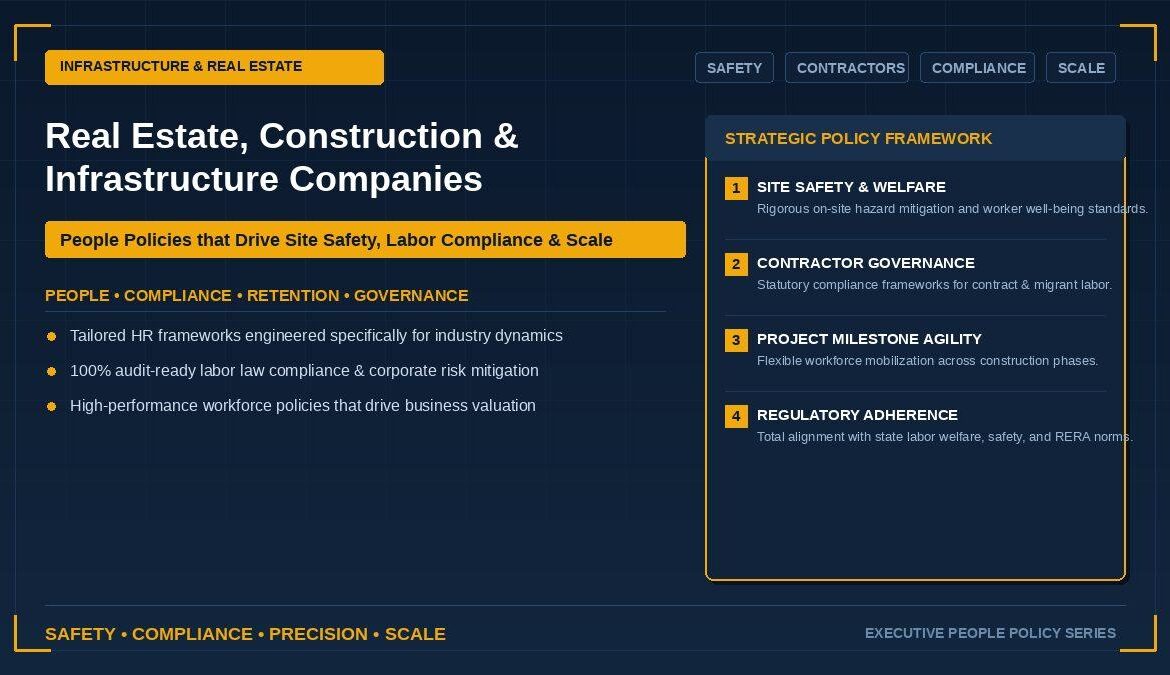
Legal Support for Real Estate, Construction and Infrastructure Companies in India
The real estate industry plays a vital role in the economic development of the country. The industry has been reported as the third-largest sector in India. The real estate industry which is a large sector is further bifurcated into four subcategories, which are housing, retail, hospitality, and commercial. Being a major industry in India, the sector is highly regulated and is primarily governed by the Real Estate (Regulation and Development) Act, 2016. Due to the complexity and the nature of real estate, the sector is governed by numerous documents, each of which plays a vital role in every aspect of real estate, from the ownership of a property to the success of a project.
Real estate is not a sector wherein the drafting of a document by itself would suffice to ensure compliance with applicable laws and guarantee legal risk mitigation. The sector mandates comprehensive due diligence of the documents which are executed pertaining to the property as well as a review of the development plan of the area. The execution of a document is also not a one-stop process wherein one document will ensure that the entire transaction is governed by it and usually requires several documents such as title or lease documents, sanctioned plans, project agreements, and completion certificates.
Our services include conducting comprehensive due diligence of project sites, drafting and negotiating agreements, assisting with dispute resolution, ensuring regulatory compliance and providing advice on other aspects of law that coincide with the real estate sector. We at Corrida Legal understand that all laws are interconnected and provide our clients with a one-stop shop for all their legal requirements.
Property Title, Lease and Occupancy Due Diligence
Before acquiring, leasing or investing in a property-based business, the documents should establish the nature of the company’s rights over each premises. In our experience, we have seen that ownership of a property is not restricted to one document. The process of determining actual ownership requires careful analysis of all the documentation available with an entity.
The review may examine:
- ownership, lease, licence or other occupancy documents;
- stamping and registration of the relevant document;
- peaceful and exclusive possession;
- payment of rent and other amounts;
- defaults, waivers or concessions under the lease;
- restrictions on the permitted use of the premises;
- mortgages, charges, liens and other encumbrances;
- notices issued by a landlord or Government authority; and
- rights over common areas, access, utilities and facilities.
The due-diligence exercise should also consider whether the address is being used for the purpose permitted under the document. A company occupying premises under a leave-and-licence arrangement should be able to show a valid right to occupy and should not rely only on informal consent from the owner. Therefore, we ensure that whilst we prepare the documents, we specifically review them from the perspective of the purpose of the property to ensure that our clients have the flexibility required to expand its businesses.
The financial review may separately cover lease obligations, mortgages, capital commitments, fixed assets, deposits, guarantees and contingent liabilities connected with the property or project. In our experience, we ensure that we implement terms which safeguard our clients by ensuring that duration such lock-in periods are applicable to both the parties in order to promote operational certainty.
Agreements to Sell, Sale Deeds and Property Regularisation
The agreement to sell and the sale deed should record the property, ownership rights, consideration and the obligations being transferred between the seller and the buyer. In our prior experience, the ownership of the property is always the point of contention in any agreement to sell. To safeguard our clients, we implement relevant representations and warranties to ensure that our clients are protected in the event of any dispute.
A separate agreement may be required where the transaction cannot be completed without an occupancy certificate, completion certificate, approved floor plan or another approval relating to the existing construction. These documents are crucial documents, absence of which creates major hinderance to any transaction. For several of our clients, we protect their interests by requiring the production of these documents as conditions precedents in an agreement.
The regularisation arrangement should identify:
- the documents and cooperation to be provided by the seller;
- the authority before which the process will be undertaken;
- responsibility for penalties, charges and compounding fees;
- the portion of the consideration retained until completion;
- adjustment of the retained amount against the actual regularisation cost;
- responsibility where the cost exceeds the retained amount; and
- the position if the authority does not complete the process within the expected period.
Where a cheque or another payment instrument is provided only as security for the retained consideration, the document should state when it may be presented and whether a prior notice and cure period must be given. In our years of experience, we have found this to be a major point of concern as it creates several grounds for litigation specifically under the Negotiable Instruments Act, 1881.
The sale document and the regularisation arrangement should also be consistent. A short supplemental agreement should not inadvertently amend the ownership, consideration or other commercial terms intended to be contained only in the sale deed. We ensure this by reviewing the supplemental agreement in conjunction with the sale deed. This method allows for us to obtain a comprehensive overview and prevents any material clause from slipping through the cracks.
EPC Contracts for Construction and Infrastructure Projects
An engineering, procurement and construction agreement may place responsibility on the contractor for design, engineering, procurement, construction, erection, installation, testing, commissioning and delivery of the completed works. Thus, from a review perspective, we ensure that the agreement comprehensively covers all aspects for our clients. From the contractor’s perspective the process involves reviewing liability clause whereas from the other party’s perspective the process involves reviewing the performance guarantees, liabilities and milestones.
The scope should identify the equipment, materials, utilities, labour and services to be provided by the contractor. It should also connect the work with the project documents, owner requirements, applicable permits, land-use requirements, technical standards and manufacturer instructions.
A project manager may be appointed as the primary point of contact for the works. The agreement can define the project manager’s authority, reporting obligations and responsibility for reviewing drawings, monitoring the project schedule, checking manpower planning, attending inspections, approving milestone-related invoices and supervising commissioning and tests. With the implementation of the new labour codes, the need to ensure that the EPC agreement does not constitute a contract labour agreement becomes all the more crucial. We ensure this by incorporating relevant provisions into the agreement to safeguard our clients from any potential statutory scrutiny.
The project manager’s authority should not be treated as unlimited. A person supervising the site should not be able to amend the contract price, project schedule or other material terms unless the agreement expressly permits it. We ensure this by explicitly defining the mechanism that govern the amendment of key contractual obligations.
Construction Milestones, Change Orders and Payment Protection
The project schedule should identify the principal milestones and the documents required to confirm that each milestone has been achieved. The documents required should substantively establish the development of the project rather than acting as an indicative documents.
Where the contractor falls behind for reasons attributable to it, the agreement may require additional personnel, extended working hours, revised sequencing or other corrective steps to bring the project back on schedule. We ensure that our clients’ interests are protect by ensuring that the cost of extra hours or personnel does not fall on our clients.
Changes to the scope, specifications, schedule or contract price should be processed through a written change-order procedure. Site instructions and email exchanges should not become the only evidence of additional work for which payment or an extension is later claimed. Beyond this, we ensure that the authorised personnel for both sides are the only ones who can execute such amendments and that they have to present the relevant authorising documents.
Payment provisions may link invoices with milestone approval, supporting records and completion of the relevant deliverables. Additional expenses should require prior written approval rather than being included in a later invoice without a recorded commercial decision. To promote transparency in an agreement, we mandate the production of itemised records for any additional expenses that are being charged.
The wider project review may also cover customer or contractor advances, retention amounts, security deposits, bank guarantees, capital-expenditure creditors and liquidated-damages claims.
Testing, Completion, Handover and Defect Liability
Completion of a construction or infrastructure project may occur through several contractual stages rather than one final event.
The agreement may distinguish installation or mechanical completion, commissioning, performance testing, provisional acceptance and final acceptance. Each stage should have its own conditions, notice requirements, reports and certificate. To ensure that there is timely completion of the project, these milestones are required to be specifically mentioned in the agreement. This also enables the parties to determine risk allocation.
A notice of completion should contain enough information for the owner to determine whether the applicable requirements have been met. The owner may require inspection by its representative, an independent engineer or another authorised person before issuing the certificate. Thus, the mechanism and right to conduct inspection must specifically be drafted into the agreement. In one of our previous engagements, we were able to conduct an inspection of the property through a third party despite hindrance due to the presence of the relevant clause in the agreement.
Outstanding work can be recorded through a punch list without treating every incomplete item as preventing the relevant stage of completion. The agreement should state which items can remain open and the period within which they must be completed. By clearly establishing such clauses in the agreement, we have been able to secure the streamlining of operational feasibility while ensuring that no item remains pending beyond a certain period.
Handover documents may include:
- as-built drawings;
- test and inspection reports;
- operation and maintenance manuals;
- permits and approvals;
- training records;
- manufacturer warranties;
- equipment and spare-parts records; and
- documents required for continued operation of the facility.
Final acceptance may remain subject to completion of performance tests, correction of defects, payment of applicable damages and transfer of warranties to the owner.
Operations and Maintenance Agreements for Infrastructure Assets
An O&M agreement should identify the facilities, systems and equipment covered during the operating term.
The services may include preventive, corrective and predictive maintenance, inspection, testing, calibration, monitoring, specialist repairs, security and management of spare parts and consumables. We have witnessed that in certain cases our clients have faced concerns with respect to the authenticity of the measurement metrics. To ensure transparency, we specifically add provisions allowing third party inspection.
The contractor may also be required to maintain:
- maintenance plans and work orders;
- equipment and operating logs;
- fault, outage and incident reports;
- performance reports;
- inventory and consumable records;
- warranty and insurance records; and
- emergency-response procedures.
The performance standard should be measurable. Depending upon the asset, this may involve availability, output, performance ratios, response times or another operating requirement identified in the agreement. We understand that the key performance indicators vary case-by-case basis and we here at Corrida Legal know that it is not a one-size-fits-all scenario. Thus, we undertake an in-depth analysis of the requirements of the clients into consideration prior to formulating clauses pertaining to key performance indicators.
The O&M contractor should also be required to preserve the documents and operating data needed by the owner to assess performance, raise warranty claims and manage the facility after the agreement ends.
Contractors, Vendors and Subcontractors
Construction and infrastructure businesses frequently depend on multiple contractors, consultants, equipment suppliers, maintenance providers and specialist subcontractors.
The principal contractor may remain responsible for the work performed by its subcontractors. The agreement may also require prior approval before a major subcontractor is appointed or replaced. In many instances, the client appoints a certain contractor due to the previous work or brand value of such a contractor. To ensure that the purpose of such an appointment is not defeated, we ensure that the core scope of work cannot be assigned.
Contractor and vendor documents may address:
- personnel qualifications and deployment;
- replacement of unsuitable personnel;
- access to the site;
- quality and safety procedures;
- service levels and reporting;
- confidentiality and ownership of documents;
- insurance and indemnity;
- subcontracting;
- payment and expense approvals; and
- termination, transition and handover.
A vendor should not be permitted to bind the company or make representations on its behalf unless that authority has been given in writing.
The company should also retain the right to review records supporting the vendor’s invoices, time spent, reimbursable expenses and additional charges. This prevents the client from being overcharged by the vendor. We have also implemented such clauses to ensure that the vendor’s performance can be reviewed by the company should the performance be deemed insufficient or unsatisfactory.
Site Safety, Environmental and Regulatory Compliance
The project documents should allocate responsibility for health, safety, environmental compliance and control of the site.
The contractor may be required to follow the project’s health and safety policy, environmental-management plan and emergency procedures and to remedy identified non-compliance immediately.
The site process should address reporting of serious injuries, fatalities, fire, environmental incidents and other events which may affect the project, surrounding property or continued operation of the facility.
The contract may also deal with permits, hazardous materials, waste disposal, site security, statutory inspections and compliance by subcontractors. For our clients to ensure adequate protection from all perspectives of site safety, we conduct a complete audit of all documents and processes to ensure compliance with the applicable laws.
Where an existing site is operating without an approved fire-safety position, appropriate hazardous-storage arrangement or another critical approval, the response may require immediate containment together with a longer corrective plan. We conduct an audit of the documents and prepare the appropriate corrective action plans to ensure that the process is streamlined, efficient and effective whilst ensuring the least legal and operational risk.
Corporate Approvals, Project Finance and Real Estate Due Diligence
A transaction involving a property-owning or infrastructure company may require review beyond the underlying land or project contract.
The due-diligence exercise may cover corporate records, authority to enter into the transaction, board and shareholder approvals, related-party arrangements, financing documents, charges, guarantees and contractual restrictions. We also conduct due diligence which is specific to the title of the property, the decision making authority of the other organisation and other key factors such as passing of relevant documents. We have witnessed several instances where a deal faces operational concerns due to the signatory not having authorisation to do the same. Due to such events, we conduct a comprehensive review of the authority of the individual who is signing the document.
The financial information may need to identify:
- capital expenditure and unpaid project creditors;
- advances received from customers;
- deposits and bank guarantees;
- mortgages and other security;
- lease and purchase commitments;
- liquidated-damages exposure;
- pending or threatened litigation; and
- other contingent liabilities.
Material acquisitions, disposals, borrowings and project commitments should be approved by the person or corporate body having authority under the company’s internal documents. We further add specific representations and warranties in a document to safeguard the interest of our client against potential non authorisation of the other side.
The approval process should be completed before the company signs the transaction or issues a commitment which cannot later be performed without lender, shareholder or third-party consent.
Construction Disputes, Delay Claims and Recovery
Construction disputes commonly arise from delayed work, changes in scope, defective performance, incomplete testing, unpaid invoices, rejected milestones, warranty claims and failure to hand over documents or the site.
Property disputes may separately involve title, possession, lease defaults, unauthorised use, missing approvals, regularisation costs or withheld consideration. We represent our clients from the pre-litigation stage to final execution to ensure that each decision is made in a manner that does not create any legal exposure.
The starting record may include:
- the signed agreement and amendments;
- drawings and technical specifications;
- purchase orders and change orders;
- project schedules and progress reports;
- site instructions and meeting minutes;
- inspection and test reports;
- completion and acceptance certificates;
- invoices, payment records and guarantees; and
- notices relating to delay, defects or default.
Pre-dispute support may include payment and recovery notices, breach notices, replies, notices invoking arbitration and communications with contractors, customers, landlords or authorities.
Where the issue affects several projects or reveals connected governance, safety or documentation gaps, the company may also require a structured risk assessment and corrective-measures exercise rather than action under one contract alone.
Ongoing Legal Retainer Support for Real Estate and Infrastructure Companies
An ongoing legal retainer may cover property documents, lease deeds, customer and vendor agreements, purchase orders, EPC and maintenance contracts, negotiations, employment matters, licences, notices and dispute support. Our engagement also provides for comprehensive due diligence prior to the drafting of any legal document.
The engagement allows project documents to be reviewed against earlier approvals, technical records and commercial commitments. It also helps ensure that a site instruction, customer communication or payment decision does not create a position inconsistent with the principal agreement. We offer not only legal advisory services but also provide commercial and operational expertise, which has been developed through our previous experience.
Conclusion
The real estate sector is growing at an exponential rate and is one of the most labour-intensive sectors. To ensure that an entity is fully compliant with the applicable laws and best practices, entities have to review their functions beyond the Real Estate (Regulation and Development) Act, 2016. The real estate sector requires careful analysis of all the documents and the strategic planning of the documentation governing project execution and title deeds.
We at Corrida Legal ensure that we provide our clients comprehensive coverage of all aspect of the real estate sector. This is achieved by not only providing you with legal opinions on statutory compliance or drafting relevant documents but also conducting due diligence of the entire transaction. We also provide our clients with strategic insights into the field that enable them to better structure their transactions to be operationally and financially protected.
Frequently Asked Questions
What documents should be checked before acquiring or leasing commercial premises?
The review may cover title or occupancy documents, stamping and registration, permitted use, possession, rent, defaults, encumbrances, approvals and notices affecting the premises. We ensure for all our clients that we conduct a comprehensive review of the available documents to ensure that the lessor holds title of the property, is compliant with the applicable laws and that any past disputes arising out of the property are duly identified and informed.
What is the difference between an agreement to sell and a regularisation agreement?
The agreement to sell records the proposed transfer and its commercial terms, while the regularisation agreement may separately allocate responsibility for obtaining pending approvals and bearing the related costs. We ensure that in the event, at any later stage it is discovered that there is a material deficiency, a regularisation agreement is entered into by the parties to rectify any non-compliance. This method has enabled us to protect our clients from several severe liabilities.
Can part of the property consideration be retained until approvals are obtained?
The documents may provide for retention or postponement of part of the consideration and should state how it will be adjusted and when the balance becomes payable.
What should an EPC contract cover?
It should define the design, procurement, construction, installation, testing, commissioning, project schedule, price, change orders, acceptance, warranties, safety and subcontracting arrangements. Whilst these are essential terms, we ensure that terms such as key performance indicators, third-party auditing and indemnity are implemented to protect the interests of our clients.
How should additional construction work be approved?
Material changes should be processed through the contractual change-order procedure, with the effect on scope, price and schedule recorded in writing. We ensure that unless the additional construction constitutes a material change in the work, the key clauses of the previous agreement remain unchanged. Additionally, we ensure that each additional construction work agreement is duly signed by the authorised representatives of the parties.
What documents are required at project handover?
The requirement may include as-built drawings, test reports, manuals, warranties, approvals, training records, spare-parts information and completion certificates. We ensure that the handover requirements are enshrined in the original agreement as a condition subsequent to bind the parties to exchange such documents.
What should an O&M agreement include?
It should describe the maintenance services, performance standards, reporting, personnel, spare parts, safety, warranties, operating data and handover requirements. We offer the service of drafting such O&M agreements on a case-by-case basis to ensure that each agreement is drafted based on the operational requirements and commercial understanding of the parties.
Is a contractor responsible for the work of its subcontractors?
The agreement may keep the principal contractor responsible for subcontracted work and require approval before specified subcontractors are engaged or changed. We have witnessed in our experience that implementing a specific clause which binds the contractor to the actions of such subcontractors ensures not only that the company is legally safeguarded from damages but is also operationally secure.
What records are important in a construction delay dispute?
The project schedule, progress reports, site instructions, change orders, correspondence, manpower records, invoices and completion documents are usually central to the review.
When is an ongoing legal retainer useful for a real estate or infrastructure company?
A retainer is useful where property documents, project contracts, vendor matters, approvals, payments and disputes require continuing legal input across several projects. By having an ongoing legal retainer, the company ensures that each decision is undertaken after conducting comprehensive due diligence. It also ensures that each communication that takes place is least likely to cause risk and that all documents are drafted in a manner that safeguards the company.
