

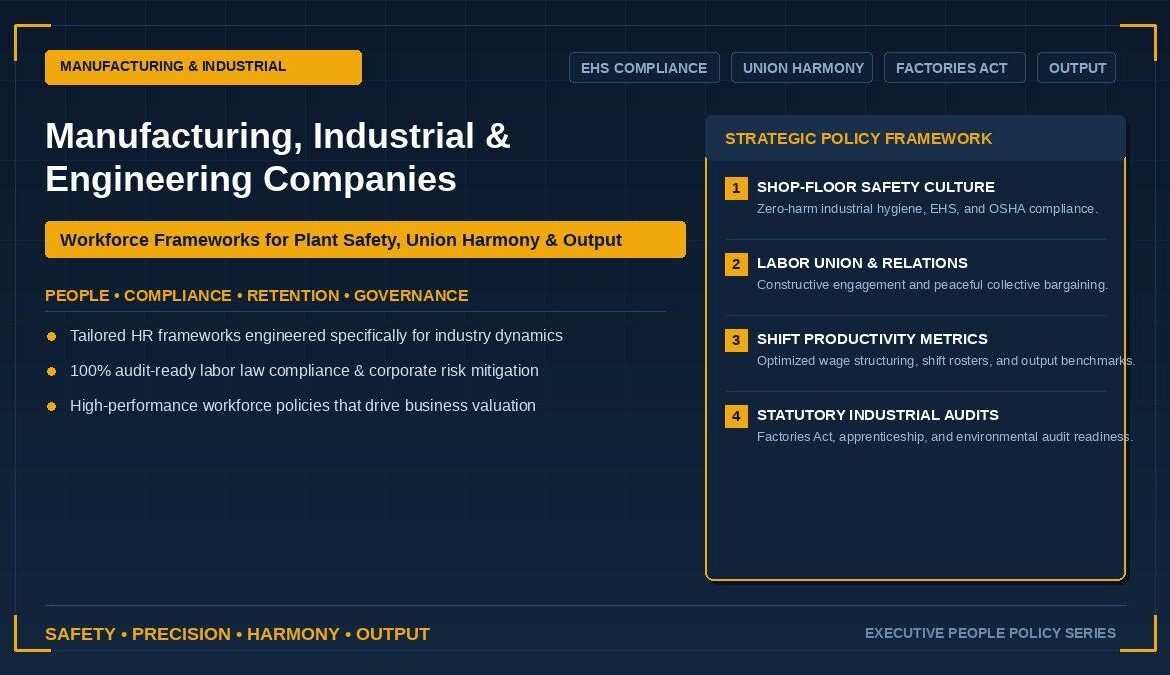
Legal Support for Manufacturing, Industrial and Engineering Companies in India
Manufacturing and engineering companies operate by way of interconnected operational methods, where one compliance issue may have consequences on the entire supply chain. In such companies, legal disputes do not arise from an isolated event. Engineering approvals, customer commitment, or quality concerns may affect project timelines, deliverables, customer obligations, or warranty. Resolving these matters requires understanding both the operational and contractual framework that gave rise to such conflicts.
As external counsel, Corrida Legal advises businesses drafting contracts, reviewing compliance and approval methods, commercial documentation and other corrective measures that reduce such risks (operational and contractual).
Manufacturing, Supply and Procurement Contracts
The contract should identify the product or equipment being supplied, the agreed technical specifications, delivery requirements, inspection and testing process, acceptance criteria, payment terms, warranties and the consequences of delay or non-conformity.
Commercial commitments should not remain divided between the principal agreement, purchase order, technical sheet and emails exchanged by the sales, technical and operations teams. These documents need to be read together before the company accepts a deviation or communicates its final position to the customer.
The document set may include:
- manufacturing and supply agreements;
- customer and vendor contracts;
- purchase orders and standard terms of sale;
- equipment procurement agreements;
- framework supply agreements
- technology-transfer and licence agreements;
- annual maintenance contracts;
- quality assurance and control agreements;
- non-disclosure agreements; and
- agreements with logistics, installation and service providers.
Where the company is purchasing critical equipment or materials, the agreement may also need to address approved manufacturers, inspection rights, quality standards, replacement obligations, documentation, delivery records and warranty support.
In cases where the scope of work keeps changing, or additional work is added without a change order process being followed, these documents must clearly identify whether entitlement to additional time has been preserved by the contractor or such claim might lead to inadequate contractual records.
EPC Contracts for Engineering and Industrial Projects
An engineering, procurement and construction agreement may cover the design, engineering, procurement, construction, erection, installation, testing, commissioning and performance testing of the facility or project.
The scope should identify the work to be performed, the equipment to be supplied, the project documents and the standards against which performance will be measured.
The project schedule should be supported by clear milestones and reporting requirements. Where the contractor falls behind for reasons attributable to it, the agreement may require corrective steps such as increasing personnel, working additional hours or otherwise accelerating the work.
Changes to the scope, project schedule or contract price should be processed through an agreed change-order mechanism. Informal instructions issued at the site should not remain the only record of a material change.
The agreement may also require coordination with other contractors, suppliers, off-takers and persons working at the same facility. Delay or cost caused by a failure to coordinate should be allocated expressly.
Testing, Commissioning, Acceptance and Defect Liability
Project completion should not be treated as a single event.
The documents may distinguish mechanical or construction completion, commissioning completion, performance testing, provisional acceptance and final acceptance. Each stage should have identified deliverables, certificates and consequences.
Testing provisions may address the procedure, notice period, attendance of the parties, independent testing, failure of a test and the steps required before retesting.
The contractor may also be required to provide as-built drawings, operating manuals, test reports, warranties, approvals and other records required for the continued operation, maintenance and regulatory compliance of the facility.
Defect-liability provisions should identify the applicable period, the contractor’s obligation to repair or replace defective work and the effect of replacement on the remaining warranty period.
Product Specifications, Quality and Warranty Risk
A product risk may arise where the material manufactured or supplied does not match the specification presented to the customer or the documentation issued with the product.
The review may require comparison of customer commitments, technical sheets, product classifications, test documents, warranty certificates, manufacturing records and the specifications followed at the plant.
Liability, indemnity and warranty obligations in the agreements ensure that any risk allocation with respect to the contract corresponds to the operational coverage of the company.
Particular attention is required where the customer was promised a regulatory, safety or performance characteristic which is not supported by the product supplied or the available technical record.
The legal assessment may cover:
- misleading or inaccurate technical specifications;
- deviations from customer or regulatory product requirements;
- liability allocation between suppliers, subcontractors, and manufacturers;
- product-performance and safety representations;
- warranty exposure;
- non-compliance with certification requirements or any other contractual inspections;
- product liability and consumer claims;
- corrective customer communications; and
- containment of future contractual or regulatory exposure.
The company should also identify whether the issue is limited to one transaction or arises across a category of products, projects or certificates.
Operations and Maintenance Agreements for Industrial Facilities
An O&M agreement should identify the equipment and activities covered during the operational term.
The services may include corrective, preventive and predictive maintenance, specialist repair, statutory inspection, testing, calibration, security, equipment monitoring and procurement and management of spare parts.
The contractor may also be required to prepare maintenance plans, equipment logs, fault and outage reports, facility-performance reports, work-order systems, consumable-material reports and emergency-response procedures.
Performance obligations should be measurable. Depending on the facility, the contract may use availability requirements, performance ratios, service levels or other operating standards.
The agreement should also deal with warranty management, equipment claims, insurance, approvals, qualified personnel, training, maintenance records and access to operating data.
Vendors, Subcontractors and Internal Procurement Controls
The principal contractor should remain responsible for work performed through its subcontractors unless the agreement provides otherwise.
The contract may require approval of major subcontractors and restrict particular services to persons having the required expertise, equipment or manufacturer authorisation.
Vendor documentation should address personnel qualifications, replacement of personnel, quality control, confidentiality, safety, access to the site, insurance, indemnity and handover.
In agreements where performance of the object of contract is intended on the subcontractor, the subsequent downstream agreement should reflect the quality, indemnity, delivery and warranty obligations ensuring minimal liability arises.
Internal procurement decisions require a separate governance review where they involve unsupported commitments, conflicts, inventory decisions or transactions which do not follow the company’s approval process.
The company should be able to establish who requested the purchase, who approved it, what specification was ordered, what was received and how the transaction was recorded.
Plant Safety, Environmental and Regulatory Compliance
Responsibility for site access and safety should be allocated expressly between the owner, contractor and subcontractors.
The site documentation may include a safety plan, emergency-response plan, environmental-management plan and procedures for reporting injuries, fatalities and other significant health and safety incidents.
A contractor may be required to notify the owner promptly when an incident occurs and to take immediate action to contain the effect and reduce continuing risk.
Environmental and operational requirements may also address hazardous materials, waste disposal, permits, site security, statutory inspections and compliance by subcontractors.
The use and storage of hazardous materials should be connected with the quantity required for operations, applicable permits and the procedures followed for safe collection and disposal.
Where the plant is operating outside an approved fire-safety, storage or environmental standard, the company may require an immediate legal and operational corrective plan rather than a general compliance recommendation.
Wage Structures and Workforce Requirements in Manufacturing
Manufacturing companies may require a separate review of compensation and salary structures where changes in the definition or treatment of wages affect payroll costs.
The review may involve basic pay, allowances, benefits, variable pay and the resulting provident-fund, employee-state-insurance and gratuity implications.
Scenario-based calculations may be required before the company changes its salary structure. The company should understand both the compliance position and the financial effect of the proposed restructuring.
Industrial contracts may also require contractors to deploy appropriately qualified and experienced personnel, maintain adequate staffing, provide training and comply with labour, health and safety obligations applicable at the site.
Manufacturing Disputes, Recoveries and Corrective Action
Disputes may arise from delayed delivery, defective or rejected goods, failure to meet performance standards, incomplete commissioning, change orders, warranty claims, unpaid invoices or vendor defaults.
The signed agreement should be reviewed with the purchase order, technical documentation, inspection reports, acceptance records, invoices and emails through which any deviation or additional commitment was approved.
When an issue arises with respect to either the terms of contract or quality of products, the legal analysis must identify the underlying cause, engineering approvals, and manufacturing defects, ensuring remedial actions are taken in future transactions instead of just resolving the current single dispute.
Where the issue extends beyond one contract, the company may require a written legal opinion and a separate risk assessment and corrective-measures report.
The review may categorise risks as immediate, medium-term and contingent; identify governance, compliance and documentation gaps; assess regulatory trigger points; and recommend remedial and defensive measures.
A corrective-action exercise may also examine whether recovery proceedings against former management personnel, employees or counterparties are sustainable and which documents are required before action is commenced.
Ongoing Legal Retainer Support for Manufacturing Companies
Manufacturing and engineering businesses may require continuing support across customer contracts, procurement, projects, employment matters, plant compliance, investigations and disputes.
An ongoing engagement allows a technical or operational issue to be reviewed against the company’s existing customer commitments, approvals, contracts and records.
It also helps separate an immediate containment measure from the longer work required to correct the underlying contract, process or governance gap.
Frequently Asked Questions
What should a manufacturing supply agreement cover?
It establishes responsibility for quality control and any changes in delay at every stage from manufacturing to supply. It should identify the product, specifications, quantities, delivery, inspection, acceptance, payment, warranty, liability and the consequences of delay or non-conformity.
How should a deviation from an agreed technical specification be handled?
The company should review the contract, purchase order, technical sheets, approvals, manufacturing records and customer communications before accepting the deviation or communicating a corrective position.
What should an EPC contract include?
The agreement may cover design, engineering, procurement, construction, installation, testing, commissioning, project schedules, change orders, acceptance, warranties, safety and subcontractors. It also allocates any risk associated with the project, responsibility in case of delays, and consequences when performance standards fail to be met.
What is the purpose of provisional and final acceptance?
They create separate stages for taking over the work and confirming that the remaining obligations, documents, testing and defect-related requirements have been completed.
What should an O&M agreement cover?
The agreement should define the maintenance services, performance standards, reporting, spare parts, qualified personnel, inspections, safety, warranties, insurance and operating records.
Is the principal contractor responsible for its subcontractors?
The contract may keep the principal contractor responsible for subcontracted work and may require prior approval for major subcontractors.
What should happen after a serious plant safety incident?
The responsible party should notify the required persons, take immediate steps to contain the risk, preserve the incident record and follow the applicable safety and reporting process.
Can wage restructuring affect provident fund, ESIC and gratuity costs?
Yes. Changes in salary components and the treatment of allowances, benefits or variable pay may alter the company’s resulting employment costs.
What documents are important for a warranty claim?
The company may require the supply agreement, specifications, inspection and test reports, acceptance records, warranty documents, maintenance records and evidence of the defect.
When is a risk assessment and corrective-measures report useful?
It is useful where an issue affects more than one transaction or raises connected concerns relating to products, plant operations, procurement, governance, regulatory exposure or former management conduct. It also helps in identifying the cause of the issue, potential risks, and establishing a remedial action to prevent it from happening again in the future,
Conclusion:
Proactive legal assistance in drafting contracts, quality management, or internal decision-making ensures that businesses identify gaps in documentation and allocate potential risks appropriately. When these projects become complex, contractual obligations become interconnected, and legal advisors who understand commercial realities along with contractual obligations become very beneficial for such businesses.
At Corria Legal, we review your contractual documentation, internal approvals and operational practices, and identify the risks before they create regulatory issues. Throughout the lifecycle of your business, we act in your commercial interests and provide you with sustainable solutions and facilitate execution of efficient projects.
