

Reviewed and Validated by: Kartavya Ostwal, Advocate
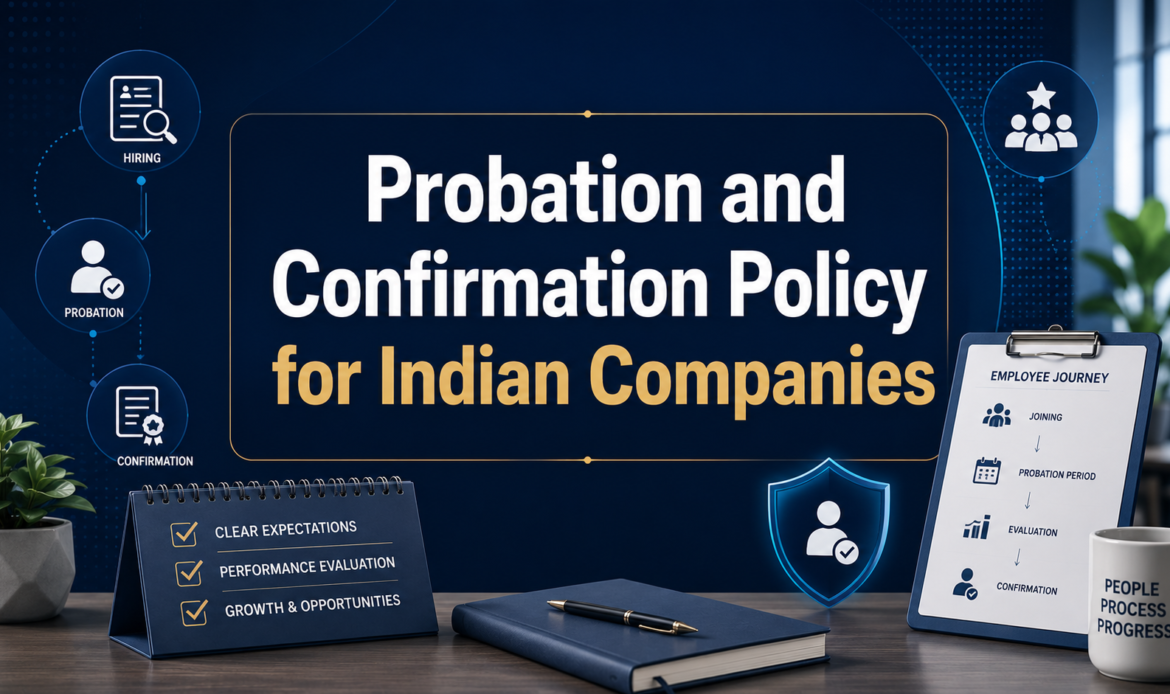
One of the foundational employment governance documents in any Indian company is a good probation and confirmation policy. Probation framework should specify the duration of the probation period, expected performance during that time followed by reviews by the reporting manager with an outline of how feedback is communicated and a clearly defined process to confirm employment at the end of this period; or extend as necessary in case a confirmation requires more time as well as to detail possible grounds for extension and consequences involving written confirmation for unsatisfactory performance, misconducts or lack of fit on role.
From the employer’s perspective, probation is a somewhat formal evaluation phase during which the organisation determines whether or not the employee is appropriate for the role and operational needs together with supervisory structure, workplace behaviour standards performance expectations as well as organisational culture. It also gives the employees a chance to get familiar with company systems, roles and responsibilities, compliance requirements and culture.
In fact, we find that many employments disputes stem from poor documentation of the probation process or failure to implement it consistently, rather than from the notion of probation itself. Lack of written confirmation and ambiguous language may lead to unnecessary disputes regarding confirmation, whether the employment is terminated, notice obligations. It is essential that the probation policy drafted covers timely, documented and transparent decisions on matters related to probation and confirmation along with compliance to the employment documentation as well as applicable labour law requirements.
,
Purpose of a Probation
The purpose of a probation policy is to evaluate a new employee’s suitability for regular employment.
A probation appraisal system helps the company gauge the performance of a new entrant and create a quality performance consciousness from the beginning of employment. The appraisal before confirmation also works as a support document for regularising the employee’s employment.
A good probation policy should therefore help the company answer four questions.
First, has the employee understood the role and expectations?
Second, has the employee performed satisfactorily during the probation period?
Third, does the employee require more time, training or supervision before confirmation?
Fourth, should the employment be confirmed, extended or ended?
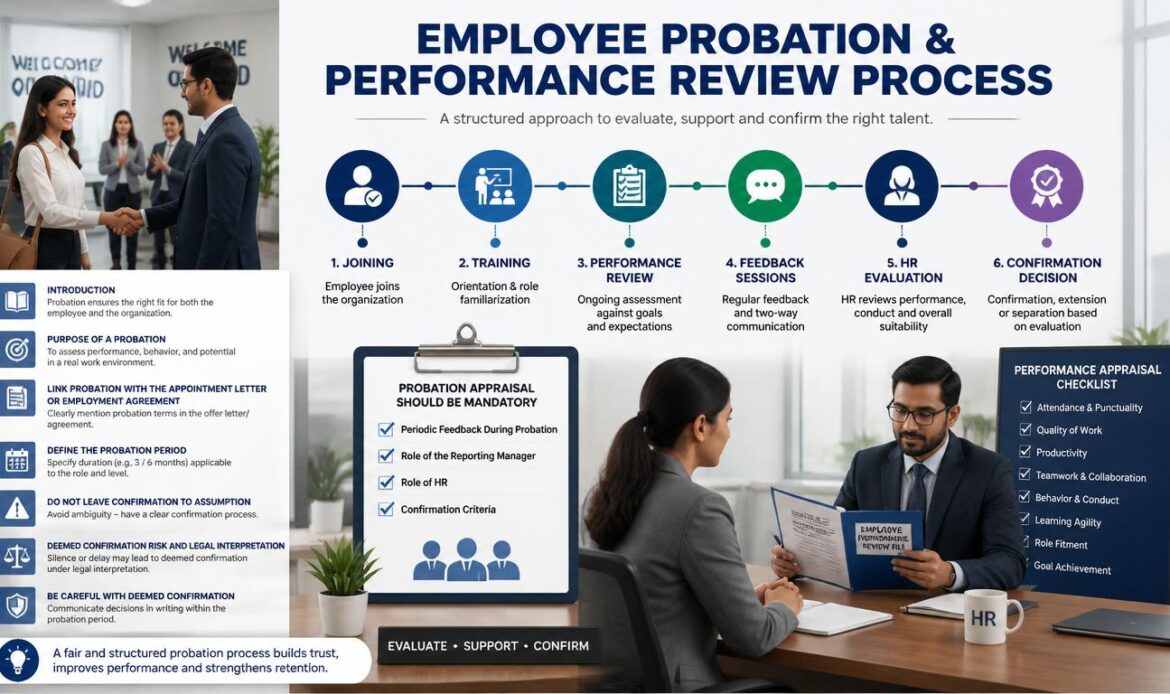
Link Probation with the Appointment Letter or Employment Agreement
The probation policy should align with the employee’s appointment letter or employment agreement.
Appointment letters may classify employees as temporary, trainee, probationary, permanent or contractual depending on experience, qualifications, skill sets, job requirement and nature of work.
The employment agreement may separately state the probation period, the company’s discretion to confirm employment, and the company’s right to reduce, dispense with, discharge or extend the probation period. In situation where in validated employment standing provisions, service conditions, in house workforce regulations or relevant law-based provisions apply to the undertaking or group of workers. The probation guideline along with the service documents should also continue to be complaint in accordance with those provisions.
The policy should not contradict these documents. If the agreement says six months and the policy says three months, or if the policy says automatic confirmation but the contract requires written confirmation, disputes can arise. The safest approach is to make the policy and contract speak the same language.
Define the Probation Period
The policy should clearly state the length of the probation period.
One structure provides that new entrants other than trainees are on probation for six months, while trainees serve the training period specified in their appointment letter.
Another structure provides that the probation and notice period will be as stated in the joining documents, appointment letter or employment contract, and that employees may be treated as confirmed after completing a defined period unless the probation is extended through written notes from the manager and HOD to HR. Whichever increase or decrease as well as release regarding trial period is required to best practice shall be notified towards such workers via formal writing and kept in their individual’s tenure record.
The policy should also state whether probation may be reduced, extended or waived by the company, and who has authority to approve that decision. The policy framework should be equally explained if any applicable under trial employment period or additional assessment term governs as per the service contract, validated service standing provisions and employment rules or relevant law related to employment.
Do Not Leave Confirmation to Assumption
A confirmation process should ideally require written confirmation.
One probation framework provides that if the employee receives a satisfactory rating at the end of probation, the employee will be confirmed in writing. If the work is unsatisfactory, probation will be extended. If the employee is rated poor, services may be terminated.
Deemed Confirmation Risk and Legal Interpretation
If the employment documents included a presumption of confirmation clause or where the employer has not communicated any extension / termination before the probation expiry date, then automatic confirmation can be claimed by an employee. When it comes to probation disputes, courts and labour authorities often rely on HR records, appraisal documentation, behaviour of the parties involved and internal policies to decide if the period of probation was properly extended or completed.
Written confirmation is useful because it gives both sides certainty. The employee knows that employment has been confirmed. HR knows which notice period and benefits apply. Payroll and managers know the employee’s employment status. In order to reduce lack of uncertainty along with the service issues firms must secure so that trail period supervision remains automated through the HRMS with specified deadlines regarding evaluation launch team lead input.
Read another article : Legal Requirements for Startups in India
Legal Position in India:
In India, interpretation of probation is mainly based on the terms and conditions of the employment contract / appointment letter, HR policy, and Certified standing orders (if any) as applicable to its context. Except for an express clause providing that the employment is confirmed automatically or by deemed confirmation, no such automatic confirmation of a probationary employee continues after completion of the probation period unless in writing from the employer.
Be Careful with Deemed Confirmation
Some employment agreements may provide for deemed confirmation if no formal communication is issued by the company at the end of the probation period. Constructive acceptance terms apply strictly as per the terms clauses and need to be treated applied as per line with such service deed HR policy framework and governing Indian based service law doctrine. Such clauses may also state the effective date on which confirmation is deemed to take effect.
If the company uses such language, HR must be disciplined. Probation reviews should be completed before the due date. If confirmation is not intended, an extension or termination decision should be communicated on time. Lag in the place of default during sending on time regularisation renewal else separation notice can lead to any chance of implied validation claims from the worker.
Otherwise, the employee may be treated as confirmed by default under the contract language.
Probation Appraisal Should Be Mandatory
A probation appraisal should be a mandatory step before confirmation. Assessment period confirmation in India stands primarily based on the written service performance assessment along with managerial review subject to the applicable service contract along with the HR policy
The appraisal should evaluate work performance, role understanding, attendance, conduct, learning ability, teamwork, communication, quality of work, compliance with company policies and suitability for continued employment. The said review process serves as the primary principal written record during any claims arising from confirmation while under probation or separation during probation subject to law relating to labour in India.
A performance appraisal framework may require the appraisal form to be sent to the appraiser before the confirmation or annual appraisal due date, the employee to complete self-appraisal, the appraiser to provide feedback and ratings, and feedback to be shared through an appraisal discussion.
This process helps avoid last-minute, undocumented decisions.
Periodic Feedback During Probation
The policy should require periodic feedback during probation. The said is in line as per just HR methods under national labour law norms and supports establish written output review over this trail period terms.
Waiting until the last day of probation is poor HR practice. Managers should provide feedback during the probation period so that the employee knows what is working, what is not working and what needs improvement. The above written remarks also minimise this chance risk of claims relating to the trail approval assumed confirmation or claims in respect of the unfair exist within worker trial policy framework in Indian context.
A probation policy may provide that confirmation decisions will be based on periodic feedback and appraisal at the end of probation. Structured documentation and review-based decision making supports the probation confirmation process which is made in line with HR probation policy India standards.
This gives the company a better basis for extension or non-confirmation, and it also gives the employee a fair opportunity to improve.
Role of the Reporting Manager
The reporting manager should be responsible for observing performance and providing feedback. This is a portion of systematic probation assessment under HR probation arrangement India structures and maintains the guardianship of fair evaluation before confirmation choices.
The manager should review whether the employee is meeting job expectations, completing work on time, following instructions, showing required skills, communicating properly, maintaining attendance discipline and complying with company policies. These observations ought to be well documented with written feedbacks in compliance with employee probation policy India so as to mitigate any disputes regarding probation confirmation or deemed confirmation.
The manager should not wait for HR to ask for a review. A month or fifteen days before confirmation or appraisal due date, the process may be initiated so that the appraiser, employee and HR can complete the review in time.
Role of HR
HR should own the probation calendar. Such forms section in internal HR governance as per HR policy framework India and secure supports systematic observances as per probation approval process. …..
HR should track joining dates, probation end dates, review deadlines, pending appraisals, extension decisions, confirmation letters and termination documentation. The correct HR record likewise assist reduce claims linked with trial validation assumed along with unjust exist claims in accordance with employee trial standard policy framework with the India. Where an employee’s probation is extended, HR should ensure that written records from the manager and HOD are available.
HR should also ensure that confirmation letters or extension letters are issued before the due date, especially where the employment agreement contains deemed confirmation language.
Confirmation Criteria
The policy should identify the criteria for confirmation. In India, confirmation during probation is almost always defined by the employment contract and guidance provided by HR policy at the organisation as well as performance-based evaluation criteria.
Common criteria may include satisfactory performance, conduct, attendance, policy compliance, role suitability, teamwork, communication, technical ability, integrity, completion of assigned training and manager recommendation.
The policy should avoid vague language such as “management will decide” without any reference to performance, conduct or business suitability. At the same time, it should preserve company discretion, because confirmation is a business and employment decision. These criteria also provide objective indicators to not only objectively measure the completion of the probation period, but they also play an important role in either eliminating or significantly reducing disputes arising out of an employee confirmation policy based on deemed confirmations and arbitrary termination or dismissal during probation.
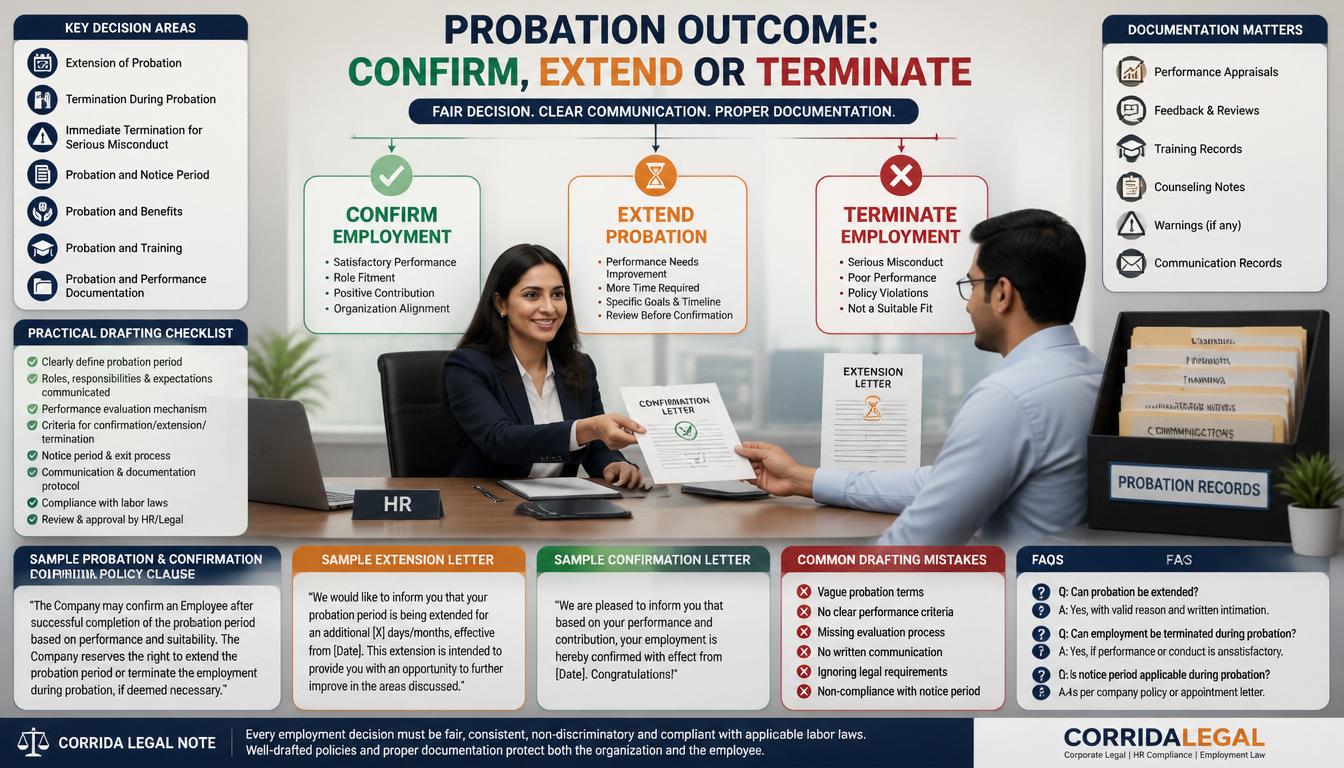
Extension of Probation
The policy should clearly state when probation may be extended.
Probation may be extended where the employee’s work is found unsatisfactory, where the company needs more time to evaluate performance, where attendance or conduct is under review, where role expectations have not yet been met, or where the employee needs further supervision or training. Probation extension shall be subject to employment contract, appointment letter and HR policy under relevant probation framework & employee probation policy India regulation
The policy should require written communication of extension. It should mention the extended period, reasons for extension in appropriate terms, improvement areas, review date and consequences if performance does not improve. Written extension should be issued before the completion of the original probation period. Delay in communication of extension may, depending on the language of the contract, lead to disputes on deemed confirmation or implied regularisation of employment under probation and confirmation policy for employees.
Where a handbook provides that unsatisfactory work will lead to extension, the company should support the extension with performance feedback or appraisal records.
Termination During Probation
The policy should address separation during probation. Separation in the course of the trail period shall be controlled in accordance with the terms of service agreement along with offer letter and will take precedence general human resource rules where any conflict arises.
An employment agreement may provide that the company can terminate employment during the probation or extended probation period without assigning reasons and without notice or notice pay, except salary up to the date of termination, subject to the specific contract wording. However, natural justice principles and relevant disciplinary procedure will be applied where termination is as a result of misconduct in accordance with company policy & employment law principles.
A separation policy may also state that termination of a probationary employee does not require prior notice unless otherwise provided in the employee’s agreement.
The termination/extension communication should take place before the expiry of probation period, where applicable, otherwise it may lead to some disputes with respect to deemed confirmation or implied regularisation of employment depending on contract wording.
The drafting should be careful. The company should always check the employee’s specific contract, appointment letter and policy before acting.
Immediate Termination for Serious Misconduct
The policy may reserve the company’s right to terminate immediately in cases of serious misconduct.
For example, policies may provide immediate termination rights in cases of misappropriation, embezzlement or fraudulent transactions, regardless of whether the employee is confirmed or not.
An employment agreement may also allow immediate termination for material or persistent breach, dishonesty, false or misleading information during hiring, discrimination or harassment, gross misconduct, gross negligence, failure to carry out duties, loss of right to work in India or conduct harmful to the company.
In case where the company separates a worker because of complaints relating to involving like indiscipline, fraud, intimidation the organization may examine and thereafter follow law and maintain fair process where an employee is alleged engaged in act like rules breaking or misconduct.
The company should still maintain documentation and follow the process required by the applicable policy and facts.
Probation and Notice Period
The probation policy should identify the applicable notice period during probation. The said notice period governing during trail period will be controlled by such offer letter, service agreement operative service conditions and applicable law relating to labour.
One employment agreement structure provides that the employee may terminate employment during probation or extended probation by giving a specified written notice, failing which the employee may be liable for notice pay, subject to management’s rights under the contract.
The company may in accordance with such employment agreement and operative policy framework exempt reduce or direct completion of the such notice period based on the business needs and the situation of separation.
A separation policy may also state that employees, whether on probation or permanent, are required to serve the notice period or salary in lieu thereof as applicable, unless the agreement provides otherwise.
The policy should avoid general statements and should refer employees to the appointment letter or employment agreement where notice periods may differ. The above policy framework promotes observance under probation guidelines in India and framework related to the employee confirmation system and securing uniformity in HR practices.
Probation and Benefits
The policy should clarify whether probationary employees are eligible for benefits.
Some benefits may apply from the date of joining. Others may apply only after confirmation, completion of a defined service period, or enrolment under the relevant scheme. The policy should not leave this ambiguous.
Where salary, insurance, leave, bonus, incentive or reimbursement rules differ for probationary employees, the policy should say so clearly.
Probation and Training
Probation should be linked with induction and training.
The joining and induction process should help employees understand organisational policies, structure, business, reporting lines, office protocol, attendance, facilities and role expectations.
If employees are not properly onboarded or trained, it becomes harder to fairly evaluate them during probation. A probation policy should therefore be connected with onboarding and manager-led role orientation. In assessing the performance of the probationer, one must consider the training, assistance and resources available to him/her during the onboarding process.
Probation and Performance Documentation
The company should maintain proper documentation during probation.
This may include:
- Appointment letter or employment agreement.
- Job description or role expectations.
- Induction records.
- Training records.
- Attendance records.
- Manager feedback.
- Self-appraisal.
- Probation appraisal form.
- Performance review notes.
- Extension letter, if any.
- Confirmation letter, if any.
- Termination communication, if any.
Proper documentation helps HR avoid disputes and helps managers make decisions based on records rather than impressions.
Sample Probation and Confirmation Policy Clause
Every new employee may be required to serve a probation period as specified in the appointment letter, employment agreement or other joining document. The Company may, at its discretion and subject to applicable employment documents, confirm, extend, reduce, dispense with or terminate the probation period. The probation framework shall be read and interpreted along with the appointment letter, employment contract, Certified Standing Orders (if applicable), service rules and other relevant documents governing employment.
During probation, the employee’s performance, conduct, attendance, role suitability, policy compliance, learning ability, teamwork and overall suitability with the Company may be assessed by the reporting manager, HOD, HR and other authorised persons. When someone is on probation the company should look at how they’re doing in a fair way. This means the assessment should be reasonable and not biased towards any person. The assessment of the employee, during probation should be fair and reasonable and not discriminatory it should be based on the role requirements and the business expectations.
The reporting manager shall provide periodic feedback during the probation period. Before the end of the probation period, a probation appraisal may be conducted. The employee may be required to complete a self-appraisal, and the reporting manager may record feedback and ratings.
If the employee’s performance and conduct are found satisfactory, the employee may be confirmed in writing. If the employee’s performance, conduct or suitability requires further assessment, the Company may extend the probation period and communicate the extension in writing. If the employee’s performance, conduct or suitability is not satisfactory, the Company may terminate employment in accordance with the appointment letter, employment agreement and applicable Company policy. HR is expected to maintain proper documentation and preserve records of each review, feedback discussions, appraisal observations for extension or confirmation.
No employee should assume confirmation merely upon completion of the probation period unless the employment agreement or written Company communication expressly provides otherwise. Where the employment agreement provides for deemed confirmation, HR shall ensure that confirmation, extension or termination communication is issued within the applicable timeline.
In case where steps are based upon claims relating to indiscipline, dishonesty or regulatory breaches such team can adopt applicable inquiry corrective mechanism that might be necessary in accordance with relevant laws. In cases involving fraud, misappropriation, embezzlement, serious misconduct, gross negligence, false information, breach of confidentiality, harassment, discrimination or any other serious violation, the Company may take immediate action in accordance with the employment agreement and Company policy.Continuation of employment after the probation period does not automatically mean you are confirmed. The Company must specifically tell you in writing that you are confirmed.
Sample Probation Extension Letter
Dear [Employee Name],
This is with reference to your probation period, which was scheduled to be reviewed on [date].
Based on the review of your performance, conduct, role suitability and feedback received from your reporting manager, the Company has decided to extend your probation period for a further period of [number] months, ending on [date].
During the extended probation period, you are expected to improve and demonstrate satisfactory performance in the following areas:
- [Improvement Area 1]
- [Improvement Area 2]
- [Improvement Area 3]
Your performance and conduct will be reviewed again before the end of the extended probation period. Depending on the outcome of the review, the Company may confirm your employment, further extend the probation period where permit, or take appropriate action in accordance with your employment documents and Company policy.
All other terms and conditions of your employment shall continue to remain unchanged.
Kindly acknowledge receipt of the above letter through signing along with the submitting a signed copy of the said notice before HR team.
Regards,
[Authorised Signatory]
Sample Confirmation Letter
Dear [Employee Name],
We are pleased to inform you that, based on the review of your performance and conduct during the probation period, your employment with the Company is confirmed with effect from [date].
You will continue to be governed by the terms of your appointment letter, employment agreement, employee handbook, Company policies, procedures, circulars and internal guidelines issued or amended from time to time.
We look forward to your continued contribution to the Company.
Regards,
[Authorised Signatory]
Practical Drafting Checklist
- Define the probation period.
- Link probation with the appointment letter or employment agreement.
- Define whether probation applies differently to trainees.
- State whether probation may be reduced, waived or extended.
- Require periodic feedback.
- Require probation appraisal.
- Identify confirmation criteria.
- Require written confirmation.
- Address deemed confirmation risk.
- Define extension process.
- Require written extension communication.
- Define termination during probation.
- Define notice period during probation.
- Reserve action for serious misconduct.
- Clarify benefit eligibility.
- Link probation with onboarding and training.
- Maintain performance and appraisal records.
- Ensure HR tracks probation review dates.
Common Drafting Mistakes
- The first mistake is mentioning probation only in the offer letter and not in the HR policy.
- The second mistake is not tracking probation end dates.
- The third mistake is allowing deemed confirmation by silence.
- The fourth mistake is extending probation orally.
- The fifth mistake is confirming employment without written communication.
- The sixth mistake is terminating a probationer without checking the employment agreement.
- The seventh mistake is failing to conduct probation appraisal.
- The eighth mistake is not giving periodic feedback.
- The ninth mistake is failing to reserve disciplinary and serious misconduct rights.
- The tenth mistake is not linking probation with onboarding and training.
FAQs
What is a probation period?
A probation period is the initial assessment period during which the company evaluates whether a new employee is suitable for continued employment based on performance, conduct, attendance, role suitability and policy compliance.
Should probation be mentioned in the employment agreement?
Yes. The probation period, extension rights, confirmation process and termination rights should be aligned with the appointment letter or employment agreement.
Should confirmation be in writing?
Yes. A strong policy should provide that satisfactory performance results in written confirmation. This gives clarity to both the employee and HR.
Can probation be extended?
Yes. Probation may be extended where performance or suitability requires further assessment. The extension should be communicated in writing and supported by review or feedback records.
Can an employee be deemed confirmed?
This depends on the employment agreement and policy wording. Some agreements may provide for deemed confirmation if no formal written communication is issued at the end of probation. HR should track timelines carefully where such wording exists.
Can employment be terminated during probation?
Yes, subject to the employee’s specific employment agreement, appointment letter and company policy. Some agreements provide for termination during probation without notice or notice pay, except salary up to the date of termination.
Can serious misconduct lead to immediate termination during probation?
Yes. Policies and employment agreements may reserve immediate termination rights for fraud, misappropriation, embezzlement, gross misconduct, false information, harassment, discrimination or other serious violations.
Corrida Legal Note
A probation and confirmation policy should help companies make timely, documented and fair decisions at the start of employment. The policy should define the probation period, require periodic feedback, mandate probation appraisal, clarify confirmation and extension, and align termination rights with the employment agreement. Probation should not be treated casually, because silence, delay and poor documentation can convert a simple HR process into an avoidable employment dispute.