

Reviewed and Validated by: Kartavya Ostwal, Advocate
Performance Improvement Plan or PIP can be explained as a formal and structured performance management mechanism to address employees whose performance is unsatisfactory. It consists of written, measurable and timed development plan for employee performance issues. A clear and well-written policy will assist an employer to distinguish performance issues, communicate expectations for performance improvement, deliver adequate training, provide coaching and finally determine if the employee is capable of improving his or her performance to meet acceptable standards of the position.
The PIP policy must specify the conditions under which PIP may be commenced, the nature of the proof that may establish employee’s performance concerns, performance objectives expected, methods for monitoring performance, support mechanisms, the evaluation of performance after the period and the possible consequences of non-improvement. PIP must not be used as a planned step towards terminating an employee; rather it should serve as a fair, transparent and neutral process giving employees reasonable time to improve while an organization keeps well-maintained records. Performance expectation should be clear and measurable, performance gaps, targets, review schedule, evaluation standards and possible consequences for non-improvement of the expected performance criteria should be included in PIP.
Purpose of a PIP Policy
The purpose of a PIP policy is to create a structured mechanism for addressing performance deficiencies.
A PIP should help the employee understand what is not working, what improvement is expected, what support will be provided and how performance will be assessed during the review period. It should also help the company maintain a proper record of the steps taken before deciding whether to continue, extend, escalate or terminate employment.
The policy should make clear that a PIP is meant to support performance improvement. It should not be used as a punishment, a threat or a pre-decided termination formality.
Equitable treatment, consistency, visibility, employee performance framework, capability gap, performance objectives support measures evaluation findings maintained in writing conveyed. The aim is to increase employee productivity and work output providing written framework improving poor performance.
Legal Framework Governing Performance Improvement Plans in India
In India, Performance Improvement Plan (PIP) does not have a definite definition in any of the labour legislations. However, the legal validity of a PIP comes from employment law jurisprudence. According to the provisions of the Industrial Disputes Act of 1947, the termination of employment for poor performance could in some instances qualify as “retrenchment.” Courts in India demand that the employer make sure that there are grounds for poor performance; there is an adequate opportunity to improve; an objective evaluation is made; and there is observance of the principles of natural justice.
When Should a PIP Be Used?
A PIP should be used when an employee’s performance standards fall below expected levels.The evaluation to begin PIP measurable performance benchmarks identifiable duty related shortcomings and not subjective views, relationship issues and occasional lapses.
The policy should state that an employee will not be placed on a PIP without documents evidencing performance deficiencies. The performance records should be capable of proving, objective, areas of underperformance not fulfilled performance goals or ongoing capability concerns linked to the employee’s roles.
This is one of the most important safeguards If the company cannot show the performance issue through records, manager feedback, missed targets, quality concerns, client escalations, error logs, attendance-linked performance impact or objective work data, the PIP may look arbitrary.
Read another article : Can an Employee or HR Head Be Appointed as an Independent Trustee of an ESOP Trust in India?
PIP Should Be for Performance, Not Misconduct
A PIP is meant for capability or performance concerns. It should not be used for every workplace issue.
A capability framework may apply where there is a genuine lack of capability in the work the employee is asked to deliver, such as lack of skill, aptitude, knowledge or ability. It may not apply to genuine sickness absence, redundancy or misconduct, which should be handled under the appropriate policy or procedure.
where there is doubt with respect to whether the issues involves with underperformance or a policy violation the organisation may carry out a suitable review or inquiry before concluding the process to be followed.
This distinction is critical. If the issue is misconduct, fraud, harassment, insubordination, serious breach of confidentiality or other serious violation, the company should not force the matter into a PIP format.
A PIP policy may expressly state that employees indulging in serious violations or breaches may be terminated immediately without being placed on a PIP, subject to the applicable employment agreement and company policy. The employers should verify performance evaluation process misconduct procedures are utilised distinctly to reduce uncertainty in process and irregular outcomes.
PIP Should Start With a Discussion
The manager should not simply issue a PIP without speaking to the employee.
A practical PIP process requires the manager to first discuss the improvement areas and training needs with the employee after identifying performance deficiencies. The preliminary interaction should be recorded may contain outcomes areas of concern, coaching support and the review period.
This discussion helps establish whether the problem is due to unclear expectations, lack of training, insufficient supervision, workload issues, personal constraints, role mismatch, health-related factors, team issues or genuine lack of capability.
The discussion also gives the employee a chance to understand the concerns before the formal process starts. The employee should also be granted fair scope to clarify relevant issue that may have caused performance concerns prior o established PIP. The initial performance meetings may support to improve capability concerns without the use of official PIP.
Timeline for Initiating a PIP
A PIP policy may provide that the manager should initiate the PIP within a defined period after identifying performance deficiencies and notifying HR.
One policy structure provides that the manager shall place an employee on a PIP within 30 days of identifying performance deficiencies and notifying the HR department.
This is useful because performance concerns should not be kept pending indefinitely. Delayed action weakens the process and creates uncertainty for both sides. The implementation of a PIP should rely upon current performance deficiencies with a view to employee meaningful opportunity to identify, resolve and develop areas of underperformance.
Manager Responsibilities
The manager has the most important role in a PIP.
The manager should communicate the performance issues, provide constructive feedback, provide necessary coaching, help the employee improve and ensure fair treatment.
The manager should also document progress during the PIP for transparency and provide timely guidance and feedback to make the PIP effective. A manager should not use a PIP merely to create paperwork for termination. The process must show genuine performance management. The team leader should review work performance based on quantifiable, function-related, performance metrics follow PIP process without discrimination for similarly situated employees.
Employee Responsibilities
The employee also has clear responsibilities during a PIP.
The employee should fulfil the obligations and responsibilities required under the PIP and proactively seek feedback from the manager.
The employee should attend review meetings, respond to feedback, work on improvement areas, seek clarification where needed, complete assigned actions, meet agreed timelines and raise any genuine concerns during the process.
The policy should also state that employees are free to raise grievances during the PIP without fear of retaliation. The organisation should work together in relation to the performance, improvements and to carry fair attempts to accomplish the work output goals mentioned in the PIP.
HR’s Role in the PIP Process
HR should ensure that the PIP process is fair, documented and consistent.HR must further secure conformity with rules of basic due process such as fair opportunity, clarity and objective examination.
HR should review whether there is sufficient evidence of performance deficiencies , whether the PIP goals are measurable, whether the timeline is reasonable, whether review meetings are being conducted, whether the employee is receiving feedback and whether the outcome is properly documented.HR team must keep and examine full records of the PIP system in order to secure tracking of outcomes.
HR should also ensure that the PIP is not being used for discriminatory reasons, retaliation or personality conflicts.
PIP Duration
The PIP policy should specify the normal duration of the PIP. The said period must be appropriate to the kind of work output, gap and ample in order to ensure real scope for progress.
One policy structure provides for a 60-day PIP process. During this period, review meetings are conducted once every 15 days between the manager and employee.
The exact duration may differ by role, company, complexity of work and nature of performance deficiency. However, the policy should avoid open-ended PIPs. Employees should know the review period and the dates on which progress will be evaluated.
Review Meetings
Review meetings are essential.
A PIP should not be issued and then forgotten until the end date. The manager should meet the employee at regular intervals, discuss progress, review evidence, provide feedback, record whether improvement is happening and identify additional support where necessary. Such worker must also be granted an possibility to answer explain matters and give reason in the course of the said evaluation, interaction and the said submissions shall be noted.
A formal capability framework also requires performance to be monitored during the review period, with regular review meetings documented in writing.
This creates a fairer process and a stronger record.
Performance Standards Should Be Specific
A PIP should clearly define the standards the employee has failed to meet.
A first improvement notice should state the required standards, the improvement required, the timescales, the support to be provided and the consequences of not meeting the performance targets within the review period.
Vague phrases such as “improve attitude”, “be better”, “show ownership” or “work harder” should be avoided unless they are supported by specific behaviours, measurable expectations or examples.
The PIP should be practical enough for the employee to understand exactly what success looks like. The standards must be capable of objective measurement and where possible performance indicators, quantitative targets or easily identifiable behaviors should be used.
Support and Coaching
The PIP should identify the support being provided.
Support may include manager coaching, training, supervision, clearer targets, templates, review calls, quality checks, process walkthroughs, access to tools, peer support or revised workflow.
A capability meeting should consider whether further measures such as additional training or supervision may improve performance.
If the company later terminates employment for non-performance, it should be able to show that it gave the employee a fair opportunity and reasonable support to improve. The type and scope of guidance may vary based on the position held, scope of work, skill level and performance gaps recorded.
Customised PIP Format
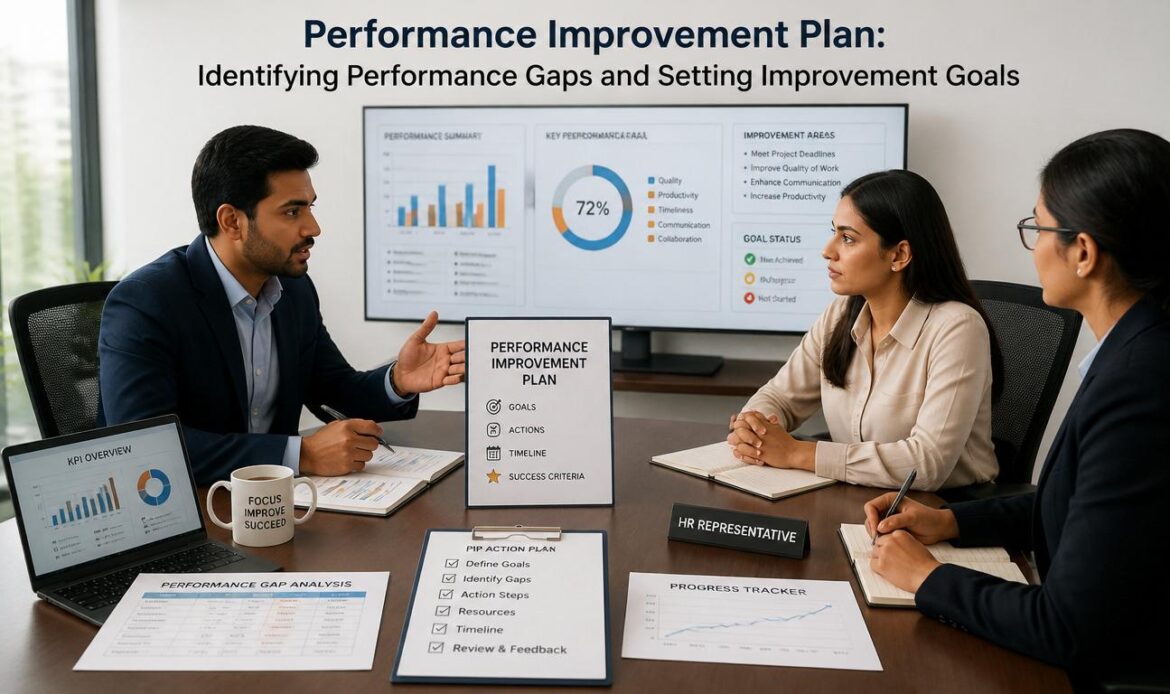
The PIP should allow flexibility. All tailored PIPs must include well defined objectives, measurable evaluation standards, review timetable and documented expectations, regardless of format.
One policy structure allows managers to use a customised PIP jointly developed by the employee and manager where the standard format is not useful. The tailored PIP should align with the Company’s framework for performance management, and should be capable to evaluate.
This is practical because different roles require different performance measures. A sales PIP may focus on closures, pipeline, client meetings and follow-ups. A technology PIP may focus on sprint completion, defect rates and code quality. A legal or advisory role may focus on turnaround time, drafting quality, research accuracy, responsiveness and client communication.
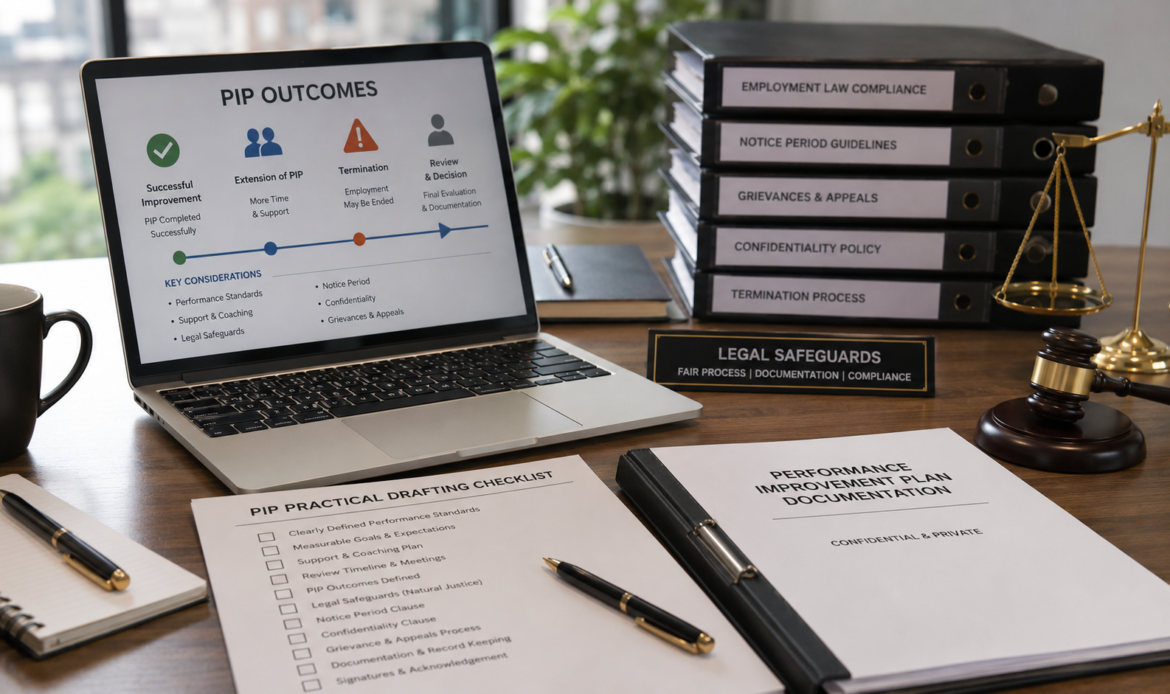
Outcomes at the End of PIP
The policy should define possible outcomes clearly. This decision will be based upon written work performance records, review, logs and unbiased review relating to stated PIP standards.
All decision will be informed to the worker through written form with definite explanation as well as citation regarding the PIP work output standards.
At the end of the PIP, if the employee demonstrates satisfactory improvement, the employee may be moved out of the PIP and return to regular performance assessment. If improvement is insufficient, the employee may be subject to further performance improvement actions or termination in accordance with the employment agreement.
A formal capability framework may also provide three possible outcomes: performance standards have been met and no further action will be taken; performance standards have not been met and the matter will be progressed to the next formal stage; or progress has been made but standards have not been fully achieved, in which case the review period may be extended or other options considered.
This structure gives the company flexibility while keeping the outcome documented.
Legal Safeguard and Risk Management
A PIP mechanism designed and executed correctly which reflect bona fide and fair process before initiating any action and terminations since it records the lapse in output. The termination, if it happens, is based on a process and not on an arbitrary or on a punitive fashion. Not following a correct framework of a PIP leaves the company open to claims of wrongful termination, unfair labor practices, and retaliation. It may also show the violation of the natural justice principles.
PIP and Termination
The policy should clarify that termination may follow if performance does not improve.
In case of insufficient performance, the company may have the right to terminate employment in accordance with the employee’s employment agreement.
Another handbook structure treats termination for non-performance as a last resort, after support and space have been provided for the employee to perform and prove ability on the job. It states that if performance does not improve after the PIP, the company may consider termination of employment, as decided by the supervising manager in consultation with the head.
The policy should not promise termination automatically at the end of the PIP. The outcome should depend on performance, records, improvement, business needs, employment documents and applicable internal process.
PIP and Notice Period
If termination follows a PIP, the notice period or salary in lieu should be handled according to the employment agreement and company policy. Subject to relevant employment regulations such as the industrial sector, industrial conflicts law 1947 as well as state shops and workplaces laws wherever enforceable.
The PIP policy should not create a separate termination mechanism that conflicts with the employment agreement. It should simply say that termination, if any, will be in accordance with the employment agreement and applicable company policies. Every separation arising out of a PIP is required to be backed via recorded work, logs, evaluation and records along with the conclusion of the PIP framework to secure systematic justice and validity in law.
This reduces inconsistency and prevents HR from issuing termination communications that do not match contract terms.
Confidentiality of the PIP
The PIP process should be confidential. Private data can be provided only on a access-limited framework in relation to lawful operational HR legal or leadership reasons.
All data and information concerning the PIP should be confidential and shared only with individuals directly involved in the PIP process.
This protects the employee’s dignity and reduces gossip, embarrassment and workplace hostility. PIP information should not be casually shared with unrelated team members, colleagues or external parties. Whatsoever improper release of PIP data can be treated as as a violation against the employer rules and can result in corrective steps.
Restrictions During PIP
A PIP policy may restrict certain employment opportunities during the PIP period. Restrictions on employees must be for the purpose of administration and managing employee performance. It cannot be seen as punishment for disciplinary reasons.
One policy structure provides that an employee on PIP is not eligible for internal transfers, business trips or external training unless it is necessary as part of the PIP.
Restrictions must meet the reasonable necessity test and must be proportionate to the objective of employee performance improvement.
This makes sense because the employee should focus on the improvement plan. However, the restriction should be applied reasonably. If training is necessary for improvement, it should not be denied merely because the employee is on PIP.
Grievances During PIP
Employees should be allowed to raise grievances during the PIP.
The policy should state that employees may raise grievances without fear of retaliation.
This is important because employees may have legitimate concerns regarding unrealistic targets, lack of support, manager bias, unclear expectations, health-related barriers, workload issues or unfair treatment.
HR should review such grievances carefully, because an unresolved grievance can weaken the credibility of the PIP process. However, the continuing pendency of a grievance will not on its own pause or void the PIP process unless the objection representation impacts the fairness or legality of the work review.
Capability Meetings and Formal Stages
For a more mature organisation, PIP can be integrated with a broader capability policy.
A capability meeting may aim to set out required standards, review evidence, give the employee an opportunity to ask questions and present evidence, establish causes of underperformance, identify additional training or supervision, agree targets and timescales, and consider appropriate alternatives before dismissal is contemplated.
Formal stages may include a first improvement notice, final improvement notice and a further capability hearing where performance does not improve sufficiently.
This structure may be useful for companies that want a more formal performance management process.
Appeals
A capability policy may also provide an appeal right where the employee believes that a decision on poor performance is wrong or unjust. The representation system must be aligned in line with standards of basic equity securing unbiased review and objective examination.
The appeal process should identify the timeline, person to whom the appeal must be submitted and the grounds that should be provided. If dismissal has already taken effect, the policy may also clarify whether the appeal affects the effective date of dismissal and what happens if the appeal succeeds.
Not every company will structure PIPs with a formal appeal stage, but where a multi-stage capability policy exists, appeal language should be clear. The ruling of the appeal body must be ultimate and mandatory in the entity governed under relevant legal provisions.
Sample PIP Policy Clause
The Company may place an employee on a Performance Improvement Plan where the employee’s performance falls below the standards expected for the employee’s role. The Company shall not place an employee on a PIP without records or documents evidencing performance deficiencies.
The PIP must be carried out under fair faith as a job management system and not as a conduct-based or penal steps.
Before initiating a PIP, the reporting manager should discuss the performance concerns, improvement areas and training needs with the employee, unless the circumstances require immediate action under another Company policy.
The PIP shall specify the performance issues identified, standards expected, measurable improvement targets, review period, support to be provided, review meeting schedule and possible consequences if the required improvement is not achieved.
The work output review under the PIP must be determined upon unbiased measurable and position-based standards as well as not based on opinion-based factors.
The employee shall cooperate with the PIP process, attend review meetings, work on the improvement areas, complete assigned actions and proactively seek feedback from the reporting manager.
The reporting manager shall provide constructive feedback, coaching and guidance, conduct periodic review meetings and document progress during the PIP. HR may review the PIP process to ensure fairness, consistency, procedural compliance and adequate documentation.
No adverse work steps will be imposed merely on the ground relating to the initiation of a PIP lacking conclusion of the system as well as due review of productivity within the assessment cycle.
At the end of the PIP, the Company may determine that the employee has successfully improved, that the review period should be extended, that further performance improvement action is required, or that employment should be terminated in accordance with the employment agreement and Company policy.
All information relating to the PIP shall be treated confidentially and shared only with persons directly involved in the process.
Sample PIP Notice
Dear [Employee Name],
This is to inform you that the Company is placing you on a Performance Improvement Plan with effect from [date], based on the performance concerns identified in relation to your role.
The following performance issues have been identified:
- [Performance Issue 1]
- [Performance Issue 2]
- [Performance Issue 3]
During the PIP period, you are expected to achieve the following improvement standards:
- [Improvement Target 1]
- [Improvement Target 2]
- [Improvement Target 3]
The PIP will continue for [number] days, from [start date] to [end date]. Review meetings will be conducted on [review dates/frequency]. During this period, the Company will provide the following support:
- [Support/Training/Guidance 1]
- [Support/Training/Guidance 2]
- [Support/Training/Guidance 3]
You are expected to cooperate with the process, attend review meetings, work on the improvement areas and proactively seek feedback from your reporting manager.
At the end of the PIP period, the Company may decide that you have successfully completed the PIP, that the PIP should be extended, that further performance improvement action is required, or that employment related action may be taken in accordance with your employment agreement and Company policy.
All information relating to this PIP will be treated confidentially.
Regards,
[Authorised Signatory]
Sample PIP Outcome Letter: Successful Completion
Dear [Employee Name],
This is with reference to the Performance Improvement Plan issued to you on [date].
Based on the review of your performance during the PIP period, the Company is pleased to note that you have demonstrated the required level of improvement in the areas identified under the PIP.
Accordingly, you are being moved removed from the PIP process with effect from [date]. Your performance will continue to be reviewed as part of the Company’s regular performance assessment process.
You are expected to continue maintaining the required performance standards.
Regards,
[Authorised Signatory]
Sample PIP Outcome Letter: Extension
Dear [Employee Name],
This is with reference to the Performance Improvement Plan issued to you on [date].
Based on the review of your performance during the PIP period, the Company notes that pratical progress has been made in certain areas. However, the required performance standards have not been fully achieved.
Accordingly, the Company has decided based on performance review, to extend the PIP for a further period of [number] days, from [start date] to [end date].
During the extended PIP period, you are expected to focus on the following areas:
- [Improvement Area 1]
- [Improvement Area 2]
- [Improvement Area 3]
Review meetings will continue to be conducted and documented during the extended period. At the end of the extended PIP, the Company may take an appropriate decision in accordance with your employment agreement and Company policy.
Regards,
[Authorised Signatory]
Practical Drafting Checklist
- Define the purpose of the PIP.
- State that PIP applies only to performance deficiencies.
- Distinguish PIP from misconduct.
- Require documentation evidencing performance gaps.
- Require manager discussion before PIP.
- Require HR intimation or review.
- Define the PIP duration.
- Define the review meeting frequency.
- Set measurable improvement targets.
- Identify support and training.
- Define manager responsibilities.
- Define employee responsibilities.
- Allow employee grievances without retaliation.
- Maintain strict confidentiality of the PIP process.
- Restrict internal transfers or external training where appropriate.
- Define possible outcomes.
- Link termination with the employment agreement.
- Maintain records of all reviews.
- Provide appeal rights where the capability framework provides for it .
Common Drafting Mistakes
- The first mistake is using PIP as a pre-decided termination route.
- The second mistake is issuing a PIP without evidence of performance deficiencies.
- The third mistake is confusing misconduct with performance issues.
- The fourth mistake is setting vague targets.
- The fifth mistake is not providing support or coaching.
- The sixth mistake is not holding review meetings.
- The seventh mistake is not documenting progress.
- The eighth mistake is ignoring employee grievances during the PIP.
- The ninth mistake is sharing PIP information with unrelated employees.
- The tenth mistake is terminating employment without checking the employment agreement.
- Commencing a PIP lacking beforehand work output meetings or in writing notice of issues.
FAQs
What is a Performance Improvement Plan?
A Performance Improvement Plan is a formal document that outlines a plan for an employee to improve performance where performance is below expectations. It should define the performance gaps, improvement targets, support, review period and possible outcomes.
Can an employee be placed on PIP without evidence?
A well-drafted PIP policy should state that no employee will be placed on a PIP without documentation evidencing performance deficiencies.
How long should a PIP last?
The duration depends on the company policy and role. One policy structure provides for a 60-day PIP with review meetings once every 15 days.
Should the manager conduct review meetings during PIP?
Yes. The manager should conduct regular review meetings, provide feedback and document progress during the PIP period.
Can an employee raise a grievance during PIP?
Yes. A PIP policy should allow employees to raise grievances during the PIP without fear of retaliation.
Can employment be terminated after an unsuccessful PIP?
Yes, if performance remains below the required standards and the employment agreement and company policy permit termination. The termination should be handled in accordance with the employee’s employment documents and internal process.
Should PIP information be confidential?
Yes. Information concerning the PIP should be confidential and shared only with individuals directly involved in the PIP process.
Corrida Legal Note
A PIP policy should be drafted as a fair performance correction mechanism, not as a termination template. It should require evidence, measurable goals, manager support, periodic reviews, confidentiality, employee participation and documented outcomes. A properly run PIP protects the company because it shows process, and it protects the employee because it gives a structured opportunity to improve.