


Reviewed and Validated by: Kartavya Ostwal, Advocate
The Weekly off and holiday policy is not just Schedule of None working days; it is an important regulatory tool and operational checklist for Indian companies – determining work cycle, human resource planning, employee attendance and business continuity. In the absence of a well-defined policy, both employees and management tend to view weekly offs, public holidays, optional holidays, time-off and work-on-nonworking days in a divergent manner, causing payroll errors, bottlenecks in employee attendance and labour disputes.
A comprehensive weekly off and holidays policy should, therefore, clearly specify organization’s working days, weekly offs, holidays, optional holidays, approval mechanisms of change to weekly offs, treatment to holidays falling during leave period, rules of working on holidays/weekly off and scope of applicability of compensatory off/PF/Payment wherever applicable, etc; should be linked with attendance systems, leave process, work scheduling, payroll, overtime and operation requirements. A weekly off or holiday is not only a HR calendar matter but its appropriate decision has bearing impacts on peoples’ working, projects, shifting, systems, customer commitments & efficiencies.
Purpose of a Weekly Off and Holiday Policy
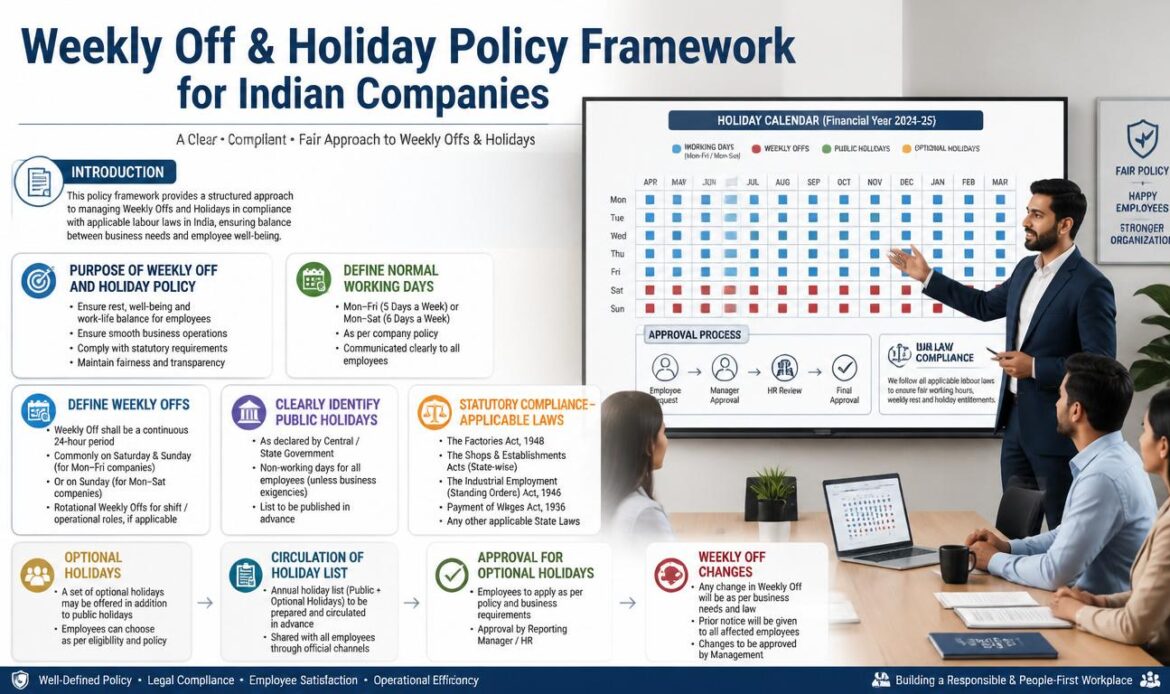
The purpose of the policy is to define when employees are ordinarily not required to work and how exceptions will be handled.
A well-drafted policy should clearly specify :
- Employees’ normal working days.
- The designated weekly off or weekly offs applicable to employees
- The annual holiday list.
- The distinction between compulsory public holidays and optional holidays.
- The approval process and eligibility conditions for availing optional holidays.
- The recording process for working on a weekly off or holiday.
- The treatment of compensatory off or payment where applicable.
- The interaction between leave, weekly offs and holidays.
- The policy should help employees plan personal time and help the company plan staffing without confusion.
Define Normal Working Days
The policy should first define the company’s normal working days.
One policy structure provides that working days are Monday to Friday, with Saturdays and Sundays as weekly offs, while certain business teams follow six working days based on business needs.
Another policy structure provides that workdays are Monday to Saturday, while Sunday is observed as the weekly off.
This shows why the policy should avoid vague language. Different businesses may follow different working models, and even within the same company, sales, operations, customer success, warehouse, support or project teams may need different work schedules.
The policy should also guarantee working arrangements that are compatible with legislation governing working time, rest periods and weekly days off.
Define Weekly Offs Clearly
The weekly off section should state the exact weekly off applicable to employees.
If the company follows a five-day workweek, the policy should say whether both Saturday and Sunday are weekly offs. If the company follows a six-day workweek, the policy should identify the weekly off. If the weekly off differs by team, shift, location or business unit, that distinction should be recorded.
The policy should also clarify whether weekly offs can be changed by the company based on business needs, roster requirements or manager approval. Any variation to the number of rest days or working shifts will be notified in advance when reasonably possible.
Read another article: Remote Work Policy Indian Companies: Practical Drafting Guide for Employers
Identify Public Holidays
The holiday policy should identify how public or gazetted holidays are determined.
One policy structure provides that employees are entitled to a defined number of gazetted holidays in a calendar year and that the holiday list will be circulated by HR every year in advance.
This is a clean drafting approach. The policy need not reproduce a permanent holiday list because holiday dates change every year. Instead, the policy can say that HR will circulate the holiday calendar annually.
Statutory Compliance
Annual Leave Allowance is given subject to the terms as agreed upon between the management and the employee while joining the organisation. Local Laws The local employment laws, as and where applicable, including the provisions under Shops and Establishments Act or Factories Act, as may be applicable will be adhered. Rest days and recognized holidays shall also be granted.
Applicable Laws
The policy framework of a holiday shall be in accordance with labour and employment laws including Shops and Establishments Act of the respective State, the Factories Act, 1948, the Industrial Employment (Standing Orders) Act, 1946 and other state specific regulations.
The organisation should accordingly ensure weekly rest period, alternate rest days, compensatory leave rights are administered and enforced in compliance with legal requirements applicable to the concerned entity line of business category of workers.
Optional Holidays
Optional holidays should be separately addressed.
One policy model allows employees to take optional holidays on a pro-rata basis and provides that the list of optional holidays will be circulated along with the annual holiday list. Employees may take optional holidays by seeking prior permission as per the leave application process. consent for elective holidays may be determined by similar staffing, business continuity and functional requirements.
Another policy structure distinguishes between compulsory public holidays and optional holidays, allowing employees to take up to two optional holidays.
This helps employees celebrate festivals or personal observances that may not be part of the compulsory holiday list, while still allowing HR to plan attendance. The holiday policy framework should be carried out on a uniform non-discriminatory basis between employees under similar circumstances based upon business needs and Company Policy.
Circulation of Holiday List
The holiday list should be circulated in advance.
A practical policy should state that HR will circulate the annual holiday list before the commencement of the calendar year or at the beginning of the relevant holiday cycle. The list should identify compulsory holidays and optional holidays separately. All adjustments will be communicated through established channels to ensure that everyone remains well-informed throughout the calendar year.This avoids last-minute uncertainty and helps employees plan leave, travel, festivals and personal events.
The holiday list should ideally be available on the HR portal, intranet or other internal platform. How the holiday calendar is to be disseminated and managed should do so in a way that is available and predictable to all employees, work locations and business units.
Approval for Optional Holidays
Optional holidays should not be taken without approval.
The policy should require employees to apply through the leave application process or HRMSand obtain approval from the designated authority.
The policy should also specify whether optional holidays can be refused due to business needs. any action relating to permission or rejection of elective holidays should be made fairly and consistently in conformity with company guideline. Since optional holidays are chosen by employees from a list, approval controls are important for teams that need minimum staffing.
Weekly Off Changes
A weekly off change should be approved and documented.
One leave and attendance policy states that the sanction or approval of leave, on-duty work, work from home or weekly off is at the discretion of the HOD and management.
This is important because employees should not unilaterally exchange weekly offs. If swaps are permitted, the policy should state whether they require manager approval, HR intimation, roster update or attendance regularisation. Any alteration about weekly off/shift pattern should be properly reflected in workforce management systems may be to reduce/eliminate salary processing, leave administration records and adherence to labour legislation.
Holidays and Weekly Offs During Leave
The policy should explain how holidays and weekly offs falling during leave will be treated.
One drafting approach provides that holidays or weekly offs falling during the leave of absence period, or prefixed or suffixed to leave, will not be counted as leave, but where an employee is on leave or absent for more than a specified number of days, prefixed or suffixed holidays or weekly offs may be counted as leave of absence.
Another structure states that weekly offs or holidays falling during the leave period are not counted against leave time.
The company should choose its position clearly. If exceptions apply for long absences, the policy must say so in plain language. Treating of holidays/weeklies off while on leave will be accordingly done as per applicable leave policy and legal requirements.
Prefix and Suffix Rules
Prefix and suffix rules should be drafted carefully.
Employees often combine leave with weekends or holidays to extend time away from work. A policy may permit prefixing and suffixing of weekends or holidays with leave, but it should define the consequences where the absence becomes long, unapproved or disruptive.
For maternity leave or other continuous leave categories, a separate rule may apply. One policy structure provides that weekends or statutory holidays prefixed or suffixed with maternity leave may be considered as leave days.
This is why the holiday policy should align with the leave policy. Different leave categories may require different treatment. Further, this updated policy outlines specific definitions for prefixes and suffixes to avoid potential confusion or conflict when interpreting leave entitlements, attendance tracking or compensation.
Working on Weekly Offs or Holidays
The policy should state that employees should not work on weekly offs or holidays without approval. No more compensation shall arise merely because work has been done on weekly off and/or holidays unless specially permitted by the Management.
One policy structure requires employees working on off days to take prior permission from the HOD and inform HR by email. Final authority will be granted only through email correspondence.
Another structure provides that a fixed amount may be paid to employees working on compulsory public holidays or weekends, subject to lead approval and management discretion. It also requires confirmation of the working status and reason for working on a declared holiday. This helps the company avoid informal holiday work claims and ensures that holiday work is properly approved and documented.
Compensatory Off
If compensatory off is allowed, the policy should define the conditions. leave in lieu is not to be an inherent claim until validly sanctioned.
One policy provides that compensatory off for work on off days can be availed only be taken within one month.
Another policy provides that employees who do not opt for payout may take compensatory off, but it must be availed within 30 days of the extra working day, and failure to do so will result in lapse. Unused compensatory off leaves of absence beyond the stipulated period shall automatically lapse and not under any circumstance be claimed. The comp off can be applied through the ESS or HRMS portal once the lead grants it.
This is useful drafting. It prevents compensatory off from accumulating indefinitely and ensures that it is linked to approved work. The permission shall be recognized only if maintained by means of HR portal / HR system or documented consent.
Payout for Holiday or Weekend Work
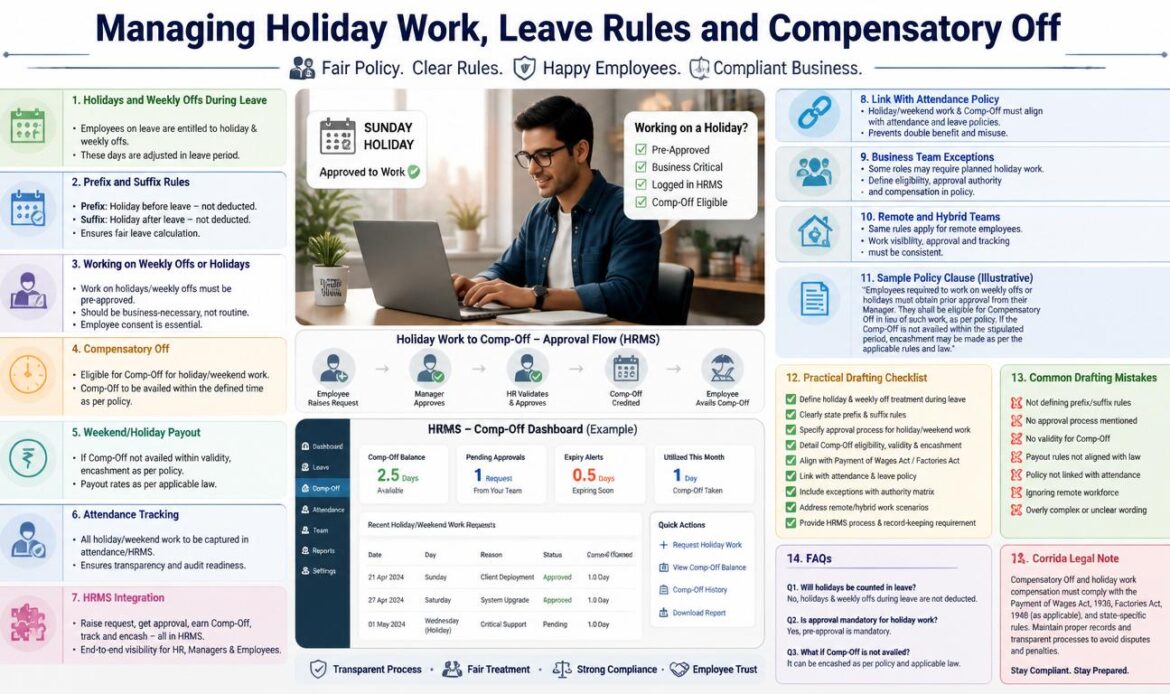
If the company permits payment instead of compensatory off, the policy should define when payout is available.
A policy may provide a fixed amount for employees working on compulsory public holidays or weekends, subject to approval by the respective leads and management discretion.
The policy should also clarify whether employees can choose between payout and compensatory off, whether payout applies only to specific categories of employees, and whether partial-day work receives different treatment. Workers cannot be permitted to receive at the same time payment or leave in lieu of work in respect of the same work.
Approval and Evidence
- The policy shall require approval and evidence for holiday or weekly off work.
- At minimum, the employee’s lead or manager should confirm:
- The employee actually worked.
- The date corresponds to a declared holiday, weekly off or weekend.
- The number of hours worked.
- The reason for the work.
- Whether the work was required by a project, client, business need or management instruction.
- Whether the employee is claiming compensatory off or payout.
- This reduces disputes and supports payroll or HRMS processing.
- Oral permission cannot be accepted unless later recorded.
- Nothing in the aforesaid shall be construed as an approval and shall be explicitly noted.
Link With Attendance Policy
Holiday and weekly off rules shall be linked with attendance.
Employees who are working on off days shall be required to mark attendance, submit an on-duty request, send HR notification or record work in the relevant HRMS or attendance system. One attendance policy requires official visits and out-of-office activities to be recorded on the employee tracking system and requires prior intimation for tours.
Similarly, work on holidays or weekly offs should not remain unrecorded . It should be recorded so that comp off or payout can be processed properly. Attendance not recorded will not be paid or considered for a compensatory benefit for verification process HRMS is the primary record.
Business Teams May Need Exceptions
Not every employee may follow the same weekly off structure.
Some policies recognise exceptions for sales, operations or customer-facing teams where six-day workweeks or shift schedules may apply based on business needs.
This should be expressly stated. A uniform policy may not work for companies with corporate offices, warehouses, retail teams, call centre teams, customer success teams, field sales teams or client support teams. These exceptions shall not in addition give rise to an automatic entitlement to work overtime or have other benefits other than that limited in the policy.
Remote and Hybrid Teams
For remote and hybrid teams, weekly off and holiday rules should still be clear.
Employees working remotely may incorrectly assume that they can adjust weekly offs or work on holidays without approval. The policy should state that flexible working does not change the holiday calendar, weekly off structure or approval requirement for additional work.
If remote employees work on weekends or public holidays due to client or project requirements, the approval, comp off and payout rules should apply in the same structured manner.
Sample Weekly Off and Holiday Policy Clause
The Company shall notify the normal working days, weekly offs and holiday calendar applicable to employees from time to time. The weekly off may vary based on location, role, shift, team, business unit, customer requirement or operational need. Entire decisions and determinations that affects weekly off, holiday and shift allocation is required to be decisive and binding governed by company discretion.
The Company shall circulate the annual holiday list in advance. The holiday list may identify compulsory public holidays and optional holidays separately. Employees who wish to avail optional holidays must apply through the Company’s leave application process or HRMS and obtain prior approval from the reporting manager or other authorised person. The approval shall be valid if in writing or recording it in the HRMS system and Retrospective approval will not be taken into account unless explicitly allowed.
Employees shall not change, exchange or substitute weekly offs without prior approval. Any approval for leave, on-duty work, work from home or weekly off change shall be subject to business requirements, team requirements and approval by the designated authority.
Employees shall not work on weekly offs, weekends or declared holidays unless prior approval has been obtained from the reporting manager, HOD or another authorised person. The employee’s manager or lead must confirm the date of work, the reason for work, the number of hours worked and whether the employee is eligible for compensatory off or payout in accordance with Company policy.
Any compensatory leave arising from approved work on a weekly off or holiday must be applied for through the HRMS or designated process and must be availed within the period specified by the Company. If compensatory off is not availed within the prescribed period, it may lapse.
No clause in this policy shall establish an implied or vested rights to a comp-off benefit, payment or any other benefit. Provided that, duly authorised.
Holidays and weekly offs falling during a leave period shall be treated in accordance with the Company’s leave policy. Any unauthorised absence before or after holidays or weekly offs may be treated as leave, leave without pay or unauthorised absence, depending on the facts and Company policy.
Practical Drafting Checklist
- Define normal working days.
- Define weekly off or weekly offs.
- State whether weekly offs differ by team, shift or location.
- Provide for annual circulation of the holiday list.
- Separate compulsory public holidays and optional holidays.
- Define approval process for optional holidays.
- State whether optional holidays are pro-rated.
- Define whether weekly off changes are allowed.
- Require approval for working on weekly offs or holidays.
- Require manager or lead confirmation of work.
- Define compensatory off rules.
- Define payout rules, if any.
- State when comp off lapses.
- Link holiday work with attendance records.
- Define treatment of holidays during leave.
- Define prefix and suffix rules.
- Address remote and hybrid employees.
- Preserve business need exceptions.
Common Drafting Mistakes
- The first mistake is not defining weekly offs clearly.
- The second mistake is circulating a holiday list but not explaining optional holidays.
- The third mistake is allowing employees to change weekly offs informally.
- The fourth mistake is not defining how holidays during leave will be treated.
- The fifth mistake is not addressing prefix and suffix leave around holidays.
- The sixth mistake is allowing work on weekly offs without approval.
- The seventh mistake is not defining compensatory off.
- The eighth mistake is allowing comp off to accumulate without a lapse period.
- The ninth mistake is not linking holiday work with attendance or HRMS records.
- The tenth mistake is applying one weekly off model to all teams despite business differences.
FAQs
What should a weekly off and holiday policy include?
It shall include working days, weekly offs, annual holiday list, compulsory holidays, optional holidays, approval process, weekly off changes, treatment of holidays during leave, work on holidays and compensatory off or payout rules.
Should the annual holiday list be circulated in advance?
Yes. A practical policy should state that HR will circulate the holiday list every year in advance, including compulsory holidays and optional holidays.
Can employees choose optional holidays?
Yes, if the company permits optional holidays. Employees should apply in accordance with the leave application process and obtain prior approval.
Can weekly offs differ between teams?
Yes. Some teams may follow a five-day workweek while sales, operations, customer success or other business teams may follow different working days based on business needs.
Are holidays or weekly offs counted as leave?
This depends on company policy. Some policies state that holidays and weekly offs during leave are not counted as leave, while exceptions may apply for extended periods of absence or specific leave categories.
Can employees work on weekly offs or holidays?
Employees should work on weekly offs or holidays only with prior approval from the HOD, reporting manager, lead or another authorised person.
When should compensatory off be availed?
A policy may require compensatory off to be availed within one month or 30 days from the extra working day, failing which it may lapse.
Corrida Legal Note
A weekly off and holiday policy should be simple, specific and operational. It should tell employees when they are not expected to work, tell managers when exceptions can be approved, and tell HR how to process optional holidays, weekly off changes, compensatory off and payout. Most disputes arise not because the company has no holiday list, but because the policy does not explain what happens around exceptions.