

Reviewed and Validated by: Shubham, Associate
“Life is not mere living but living in health. Health is not the absence of illness but a glowing vitality the feeling of wholeness with a capacity for continuous intellectual and spiritual growth. Physical, social, spiritual and psychological well being is intrinsically inter-woven into the fabric of life. According to Indian philosophy that which is born must die. Death is the only certain thing in life.”
Meaning and Concept of Fundamental Rights
To get into the core issues related to the waiver of fundamental rights in various forms, it is important to understand the basic concept of fundamental rights.
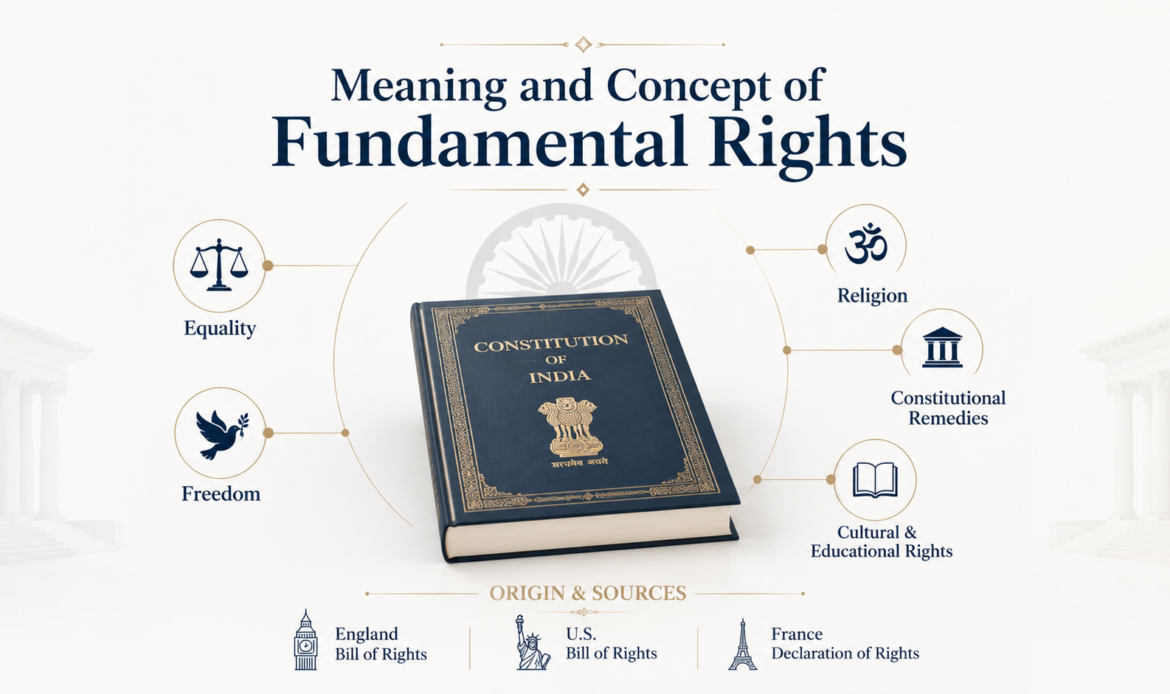
Rights which are essential or fundamental for the well-being of a person are called Fundamental Rights. The Fundamental Rights in India enshrined in the Part III of the Constitution of India guarantee civil liberties such that all Indians can lead their lives in peace and harmony as citizens of India. These include individual rights common to most liberal democracies, such as equality before law, freedom of speech and expression, freedom of association and peaceful assembly, freedom to practice religion, and the right to constitutional remedies for the protection of civil rights by means of writs such as habeas corpus. Violations of these rights result in punishments as prescribed in the Indian Penal Code, subject to discretion of the judiciary.[2] The Fundamental Rights are defined as basic human freedoms which every Indian citizen has the right to enjoy for a proper and harmonious development of personality. These rights universally apply to all citizens, irrespective of race, place of birth, religion, caste, creed, colour or sex. They are enforceable by the courts, subject to certain restrictions.
Read another article: Subsequent changes in Registration and the Drawbacks of Non-registration of a Firm
Origin and Sources of Fundamental Rights
The Rights have their origins in many sources, including England’s Bill of Rights, the United States Bill of Rights and France’s Declaration of the Rights of Man
The six fundamental rights are:
- Right to equality
- Right to freedom
- Right against exploitation
- Right to freedom of religion
- Cultural and educational rights
- Right to constitutional remedies
Nature and Scope of Fundamental Rights
Rights literally mean those freedoms which are essential for personal good as well as the good of the community. The rights guaranteed under the Constitution of India are fundamental as they have been incorporated into the Fundamental Law of the Land and are enforceable in a court of law. However, this does not mean that they are absolute or that they are immune from Constitutional amendment.
Doctrine of Waiver
The doctrine of waiver explains that a person, entitled to a right or privilege, is free to waive that right or privilege. It is voluntary relinquishment or abandonment of a known existing legal right or privilege. Once a person has so waived his right, he would not be allowed to claim it afterwards.
Applicability of Waiver to Fundamental Rights
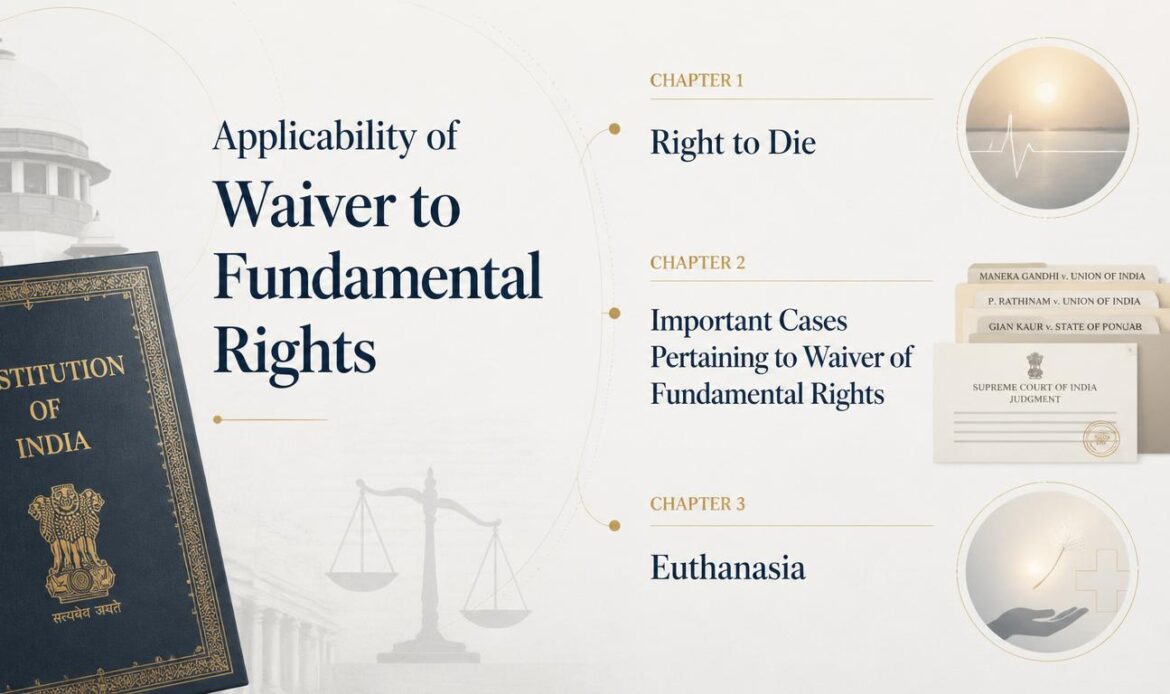
The question arises as to whether the doctrine of waiver is applicable to fundamental rights also. In Muthiah v. CIT, The Court held that, it is not open to a citizen to waive any of the fundamental rights conferred by part III of the Constitution. These rights are not merely for the benefit of the individual but as a matter of public policy for the benefit of the general public.
Chapter – 1 Right To Die
Concept and Emotional Perspective of Right to Die
In my project I do not intend to give only the legal side of the right to die. I want to probe into the emotional side too. All the fundamental rights guaranteed to the citizens of India reflects our needs, our aspirations, our right to be able to do something and by defining its boundaries this right is curtailed which in turn curtails our desires.
No country’s Constitution can be an enduring Constitution if it does not take into cognizance the interest of the people for whom this Constitution has been framed. And so there are various arguments given by people who believe that one should have the right to die. Though I would like to mention that I am writing this argument as an expression of what I feel the arguments can be which are in the favour of right to die. The arguments go as follows:
Right to Life Includes Right to Die
Arguments in Favour of Right to Die
C.A. Thomas, 86-year-old retired school teacher of Thrissur, who was the first one in India to demand the right for voluntary death, had argued that Article 21 indeed bestowed on every citizen a right to life and method of death. Our Constitution guarantees the right to life. The right to life is incomplete without the right to death. The karma of life is a wheel that is completed only when birth is complemented by death. The right to die is built into the right to live.[11]
Supreme Court’s View in Gian Kaur v. State of Punjab
Supreme Court in Gian Kaur v. State of Punjab, said that it is well settled that the right to life guaranteed by Article 21 of the Constitution does not include the right to die. The Court held that Article 21 is a provision guaranteeing protection of life and personal liberty and by no stretch of the imagination can extinction of life be read into it.
To give meaning and content to the word ‘life’ in Article 21, it has been construed as life with human dignity. Any aspect of life which makes it dignified may be read into it but not that which extinguishes it and is, therefore, inconsistent with the continued existence of life resulting in effacing the right itself.
Right to Die with Dignity
The ‘right to life’ including the right to live with human dignity would mean the existence of such a right up to the end of natural life. This also includes the right to a dignified life up to the point of death including a dignified procedure of death.
In other words, this may include the right of a dying man to also die with dignity when his life is ebbing out. But the ‘right to die’ with dignity at the end of life is not to be confused or equalled with the ‘right to die’ an un-natural death curtailing the natural span of life.
Right to Privacy and Self-Determination
It is argued that right to die respects the individual’s right to self-determination or his right of privacy. Interference with that right can only be justified if it is to protect essential social values, which is not the case where patients suffering unbearably at the end of their lives request to die when no alternatives exist.
Not allowing the right to die would come down to forcing people to suffer against their will, which would be cruel and a negation of their human rights and dignity. Every person has a right to live with at least a minimum dignity and when the state of his existence falls below even that minimum level then he must be allowed to end such tortuous existence.
In such cases relief from suffering (rather than preserving life) should be the primary objective.
Liberty to Die under Article 21
At this juncture it would not be out of place to mention that the liberty to die, if not right strictu sensu, may be read as part of the right to life guaranteed by Article 21 of the Constitution of India.
True that the Supreme Court has held that such an interpretation of Article 21 is incorrect, but it is submitted that one may try to read the freedom to die as flowing from the rights of privacy, autonomy and self-determination, which is what has been done by the Courts of United State and England.
The Constitution states certain unalienable rights to life, liberty, and the pursuit of happiness. Since we have this right to life, it is our right to decide what we want to do with our lives. And people should be free to live their lives as they themselves think best.
Right to Die in Cases of Incurable Diseases
Religious and Spiritual Justifications
Our religion supports a person who wants to die. Thomas a Christian, quoted the Gita and Ramayana to prove that “vanavas”, the ancient Indian tradition of merging with the Supreme was the most honourable system. “It is the western jurisprudence we now follow without thinking that considers taking one’s own life a crime”.
In his argument he said that Jain priests after reaching a certain age starved themselves to death and the rishis and munis of those times also wilfully ended their lives after attaining enlightenment.
Fear of Death and Mental Agony
Desire for a Peaceful Death
I fear death and the pain that will come with it, I want to have a sound sleep. Thomas believed that death would be a pleasant experience if one were to die at an advanced age on his own volition with some medical help once he or she thought had fulfilled all possible duties of life.
Most of the old people today spend their lives fretting about their death and that causes a lot of mental agony and suffering. Guaranteeing a person the right to die would dismiss the fear of death and mourning now prevalent in people.
Organ Donation and Right to Die
Organ Donation Before Death
I want to donate my organs before the disease affects it.
Venkatesh, a 25-year-old muscular dystrophic patient, wanted to be granted the right to die. He sought to enforce the right so that he could donate organs before they were affected by his illness.
The plea was rejected a day before his death by the Andhra Pradesh High Court. The court ruled that the petition sought to violate the Transplantation of Human Organs Act, 1995, which had no provisions that allowed individuals to donate organs before they were brain dead.
The court’s caution in this case is understandable considering the implications of easing restrictions in organ transplant. However, the order indirectly reiterated the stated legal position that an individual had no right to end his life voluntarily.
This is not the only case where someone of their free will wanted to donate their organs, to serve a noble cause and wasn’t allowed to do so. Otherwise in our country illegal trade of human body parts and organs is taking place at a massive rate and when a person approaches law and seeks its help, he is denied the same.
Chapter – 2 Important Cases Pertaining To Waiver Of Fundamental Rights
Judicial Approach Towards Fundamental Rights
In my paper I would like to discuss a few important cases before the honourable courts of India, the right to die with a special emphasis from my individual thinking on the subject and euthanasia.
Ours is a nascent democracy and situated as we are, socially, economically, educationally and politically, it is the sacred duty of the Supreme Court to safeguard the fundamental rights.[14]
Basheshar Nath v. CIT
The question arose before the court the Supreme Court in Basheshar Nath v. CIT[15].
The petitioner whose case was referred to the Investigation Commission under section 5(1) of the Taxation on Income (Investigation Commission) Act, 1947, was found to have concealed his income to the tune of Rs. 4,47,915.
With a view to escape heavier penalty, he agreed to pay Rs.3,50,000 by instalments of Rs.5000 per month, by way of arrears of tax and penalty. This agreement was reached in May,1954 under section 8-A of the said Act. The petitioner paid a number of instalments.
Constitutional Validity and Waiver Issue
In the meanwhile, the Supreme Court in Suraj Mall Mehto[16] v. A.V. Visvanath Sastri followed by Muthiah v. Commissioner of Income Tax,[17] held section 5(1) of the Act inconsistent with Article 14 of the Constitution.
On this the petitioner stopped paying further instalment and challenged the settlement between him and the Investigation Commission.
The petitioner contended that when section 5(1) of the Investigation Act had been held unconstitutional, the settlement under section 8A could not be enforced, for the foundation of the proceedings under section 8 was reference under section 5(1) and the foundation having crumbled down, the superstructure must fall with it.
On the other hand, the respondent raised the plea of waiver and argued that even if section 5(1) was invalid, the petitioner, by voluntarily entering into a settlement, must be taken to have waived his fundamental right guaranteed under Article 14.
The Supreme Court however, upheld the contention of the petitioner and held that the fundamental rights could not be waived.[18]
Views of the Majority
The majority of the court expounded the following views:
- It is not open to a citizen to waive his fundamental rights conferred by Part 3 of the Constitution. The Supreme Court is the bulwark of the fundamental rights which have been for the first time enacted in the Constitution and it would be a sacrilege to whittle down these rights.
- Whatever be the position in America, no distinction can be drawn here, as has been attempted in the United States of America, between the fundamental rights which may be said to have been enacted for the benefit of the individual and those enacted in public interest or on grounds of public policy.[19]
Chapter – 3 Euthanasia
Euthanasia is basically the intentional killing by act or omission of a dependent human being for his or her alleged benefit. The key word here is “intentional”. If death is not intended, it is not an act of euthanasia.
Types of Euthanasia
Euthanasia is of several types. Some of the types for the sake of brevity in explanation have been listed here.
Voluntary Euthanasia
When the person who is killed has requested to be killed. But it is of essential importance that the person himself without any external influence has consented to it.
Non-Voluntary Euthanasia
When the person who is killed made no request and gave no consent.
Involuntary Euthanasia
When the person who is killed made an expressed wish to the contrary.
Assisted Suicide
Someone provides an individual with the information, guidance, and means to take his or her own life with the intention that they will be used for this purpose. When it is a doctor who helps another person to kill themselves it is called “physician assisted suicide.”
Euthanasia by Action
Intentionally causing a person’s death by performing an action such as by giving a lethal injection.
Euthanasia by Omission
Intentionally causing death by not providing necessary and ordinary (usual and customary) care or food and water.
However there is no euthanasia unless the death is intentionally caused by what was done or not done.
Thus, some medical actions that are often labelled “passive euthanasia” are no form of euthanasia, since the intention to take life is lacking.
These acts include not commencing treatment that would not provide a benefit to the patient, withdrawing treatment that has been shown to be ineffective, too burdensome or is unwanted, and the giving of high doses of pain-killers that may endanger life, when they have been shown to be necessary.
All those are part of good medical practice, endorsed by law, when they are properly carried out.
Arguments for Euthanasia
- It provides a way to relieve extreme pain
- It provides a way of relief when a person’s quality of life is low
- Frees up medical funds to help other people
- It is another case of freedom of choice
Arguments Against Euthanasia
- Euthanasia devalues human life
- Euthanasia can become a means of health care cost containment
- Physicians and other medical care people should not be involved in directly causing death
- There is a “slippery slope” effect that has occurred where euthanasia has first been legalized for only the terminally ill and later laws are changed to allow it for other people or to be done non-voluntarily.