


Communication, acceptance, and revocation of proposals
The communication of proposals, the acceptance of proposals, and the revocations, respectively, are deemed to be made by any act or omission of the party proposing, accepting, or revoking, by which he intends to communicate such proposal, acceptance or revocation, or which has the effect of communicating it.
The communication of a proposal is complete when it comes to the knowledge of the person to whom it is made. The communication of an acceptance is complete, as against the proposer, when it is put in a course of transmission to him, so as to be out of the power of the acceptor; as against the acceptor, when it comes to the knowledge of the proposer.
When is a communication aid to be complete?
The communication of a revocation is complete, as against the person who makes it, when it is put into a course of transmission to the person to whom it is made, so as to be out of the power of the person who makes it; as against the person to whom it is made when it comes to his knowledge. As the law is stated, during the time that the letter of acceptance is on its way to the proposer, he us bound by his promise, while the acceptor is bound by his acceptance.
Revocation of Proposals and acceptances
A proposal may be revoked at any time before the communication of its. acceptance is complete as against the proposer, but not afterwards. An acceptance may be revoked at any time before the communication of the acceptance is complete as against the acceptor, but not afterwards.
Read another article: Waiver Of Fundamental Rights
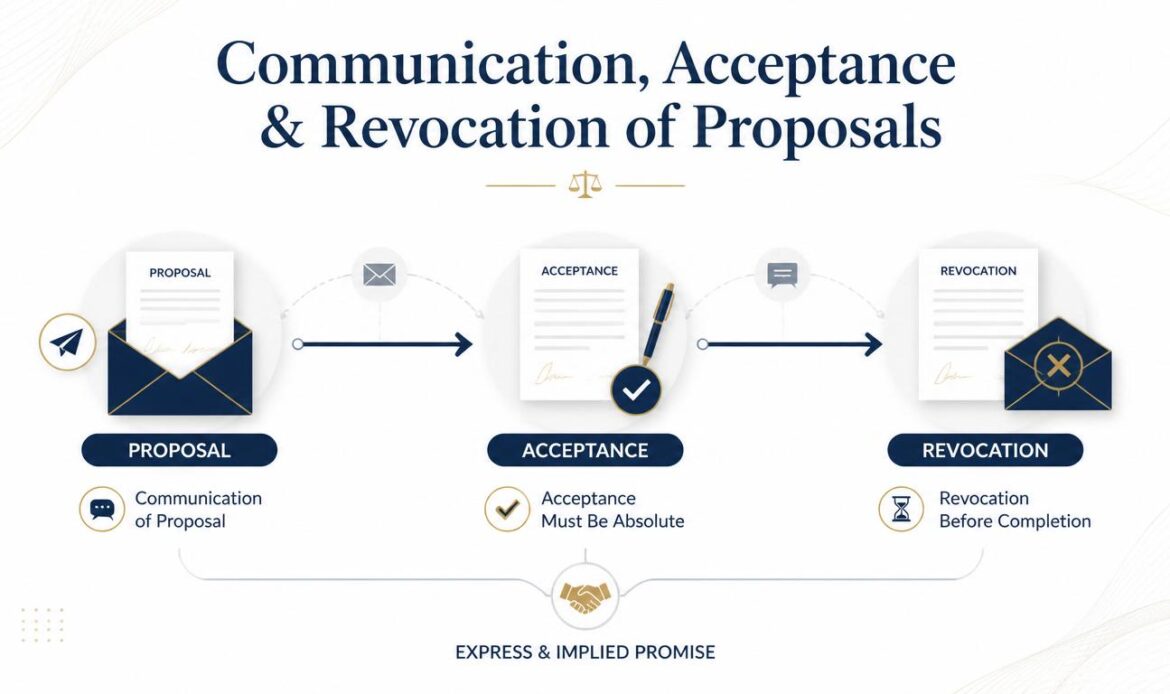
How is a proposal revoked?
A proposal is revoked :
- by the communication of notice of revocation by the proposer to the other party;
- by the lapse of the time prescribed in such proposal for its acceptance, or, if no time is so prescribed by the lapse of a reason. able time without communication of the acceptance;
- by the failure of the acceptor to fulfill a condition precedent to acceptance; or
- by the death or insanity of the proposer, if the fact of his death or insanity comes to the knowledge of the acceptor before acceptance.
In the Civil Law a proposal is held to be revoked by the proposer withdrawing his offer, or by his death or insanity, at any time before acceptance of the proposal by the acceptor; whether or not the latter be aware of the proposer’s change of intention, or death, or insanity. The reason given is, that the proposal is not continuing at the time of the acceptance, and the conclusion is correct on the definition of a contract given by the Civilians. Practically, however, the rule laid down in this Act will probably work more fairly than the opposite rule.
Acceptance must be absolute
In order to convert a proposal into a promise the acceptance must
- be absolute and unqualified;
- be expressed in some usual and reasonable manner, unless the proposal prescribes the manner in which it is to be accepted. If the proposal prescribes a manner in which it is to be accepted, and the acceptance is not made in such manner, the proposer may, within a reasonable time after the acceptance is communicated to him, insist that his proposal shall be accepted in the prescribed manner, and not otherwise; but, if he fails to do so, he accepts the acceptance.
Acceptance by performing conditions, or receiving consideration
Performance of the conditions of a proposal, or the acceptance of any consideration for a reciprocal promise which may be offered with a proposal, is an acceptance of the proposal. In so far as the proposal or acceptance of the proposal.
Promises should be express or implied
In so far as the proposal or acceptance of any promise is said to be express. In so far as such proposal or acceptance is made otherwise than in words, the promise is said to be implied.
