


Reviewed and Validated by: Shubham, Associate
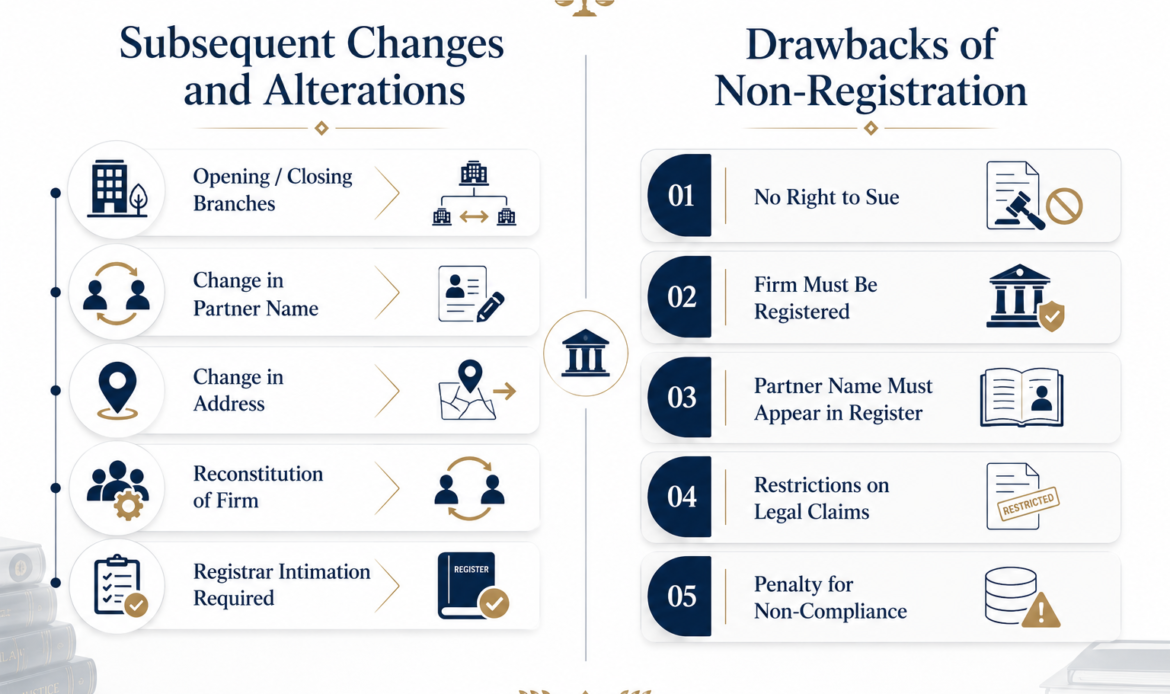
Subsequent Changes and Alterations
S.61 – Noting of closing and opening of branches
When a registered firm discontinues business at any place or begins to carry on business at any place, such place not being its principal place of business, any partner or agent of the firm may send intimation thereof to the Registrar, who shall make a note of such intimation in the entry relating to the firm in the Register of firms, and shall file the intimation along with the statement relating to the firm.
S.62-Noting of changes in names and addresses of partners
When any partners in a registered firm alters his name or permanent address, an intimation of the alteration may be sent by any partner or agent of the firm to the Registrar, who shall deal with it in the manner provided in Section 61.
Read another article: Intoxication as a Defence
Sharad Vasant Kotak Vs. RamniklalMohanlalChawda
- There was a change in the constitution of a registered partnership firm, due to the death of one partner and introduction of a new partner in his place.
- After a conjoint reading of Sections 58 –63, the court held that by such a change, the registration of the firm had not ceased, & there was no need for fresh registration of the firm.
- Information regarding the change in the constitution of the firm had to be given to the registrar.
- Failure to comply attracts penalty & the person whose name is not added in the register, may suffer some disabilities.
Drawbacks of Non Registration
S.69 – Effect of non-registration
No suit to enforce a right arising from a contract of or conferred by this Act shall be instituted in any court by or on behalf of any person suing as a partner in a firm against the firm or any person alleged to be or to have been a partner in the firm unless the firm is registered and the person suing is or has been shown in the Register of firms as a partner in the firm. 2) No suit to enforce a right arising from a contract shall be instituted in any court by or on behalf of a firm against any third party unless the firm is registered and the person suing are or have been shown in the Register of firm as partners in the firm.
- The firm can be called to be “registered” when the entry of the statement is recorded in the Register of Firms by the registrar.
- This provision bars a suit between partners or between partners and the firm if the firm is unregistered.
- Even if the firm is registered, only such partners can sue whose names appear in the Register of the Firm.
- Fulfilment of 2 conditions is necessary before a suit can be instituted against a third party:
- The firm must be a registered firm; and
- The person suing must be shown in the Register of Firms as partners of the firm.
- The court is of the view that a person who was not shown in the Register of Firms, by induction after reconstitution of firm, even though the firm was registered, could not file a suit for dissolution or accounts. This, however, did not mean that the registration given to the firm earlier, would cease.
