


Reviewed and Validated by: Kartavya Ostwal, Advocate
A gifts, favours and entertainment policy helps a company protect the integrity of business decisions. It should regulate what employees may offer, give, seek, accept or receive from customers, vendors, suppliers, consultants, agents, distributors, contractors, government-facing intermediaries, potential business partners and other third parties.
The core principle is simple. Business decisions must be made on merit, not because an employee received a gift, meal, favour, discount, payment, entertainment, travel benefit, hospitality, service or personal advantage. Accepting or offering such benefits can undermine credibility and create an impression that business decisions are influenced by factors other than merit.
Purpose of a Gifts, Favours and Entertainment Policy
The purpose of the policy is to prevent gifts, hospitality, entertainment and favours from influencing, or appearing to influence, business judgment. A code of conduct framework recognises that accepting gifts and entertainment from business partners or offering such favours can make a company vulnerable to accusations that business decisions are influenced by factors other than merit.
This is the central point. The company does not need to prove that a bribe was paid in every case. If the gift or hospitality is large, frequent, unusual or connected with a business decision, it may create a serious governance issue even before actual wrongdoing is proved.
Policy Should Cover Both Giving and Receiving
The policy should cover both sides of the transaction. Employees should not offer, make, seek or accept gifts, payments, entertainment or services from actual or potential business partners where such benefit may reasonably be believed to influence a business transaction, falls outside customary business hospitality or is prohibited by applicable law.
This means the policy should not only restrict employees from accepting gifts. It should also restrict employees from giving gifts, entertainment or favours to others to influence decisions, secure business, retain business, obtain approvals or gain preferential treatment.
Link With Conflict of Interest Policy
Gifts and entertainment should be treated as a conflict of interest issue. A conflict of interest policy may expressly identify gifts, favours and entertainment that may influence business decisions as a conflict concern.
This is why the gifts policy should be linked with the conflict policy. Even if the benefit is not a direct bribe, it may still compromise, or appear to compromise, the employee’s objectivity. An employee who receives hospitality from a vendor may later be involved in vendor selection, contract renewal, invoice approval or dispute handling. That creates an obvious conflict risk.
Link With Anti-Bribery and Anti-Corruption Controls
The gifts policy should also be linked with anti-bribery controls. A code of conduct framework states that employees must not offer, promise or give, demand or accept improper payments or undue advantage when acting on behalf of the company. It also flags warning signs in commercial agency arrangements, including unusual payment requests, split payments, promotional funds, payment in a different currency or payment in a location or address different from what is appropriate.
This matters because gifts and entertainment can sometimes be used as a softer route to the same improper outcome. A benefit need not be called a “bribe” to create risk. It may be labelled as hospitality, sponsorship, promotional support, facilitation, business development, travel support, festival gift, discount, personal service or relationship management.
What Should the Policy Cover?
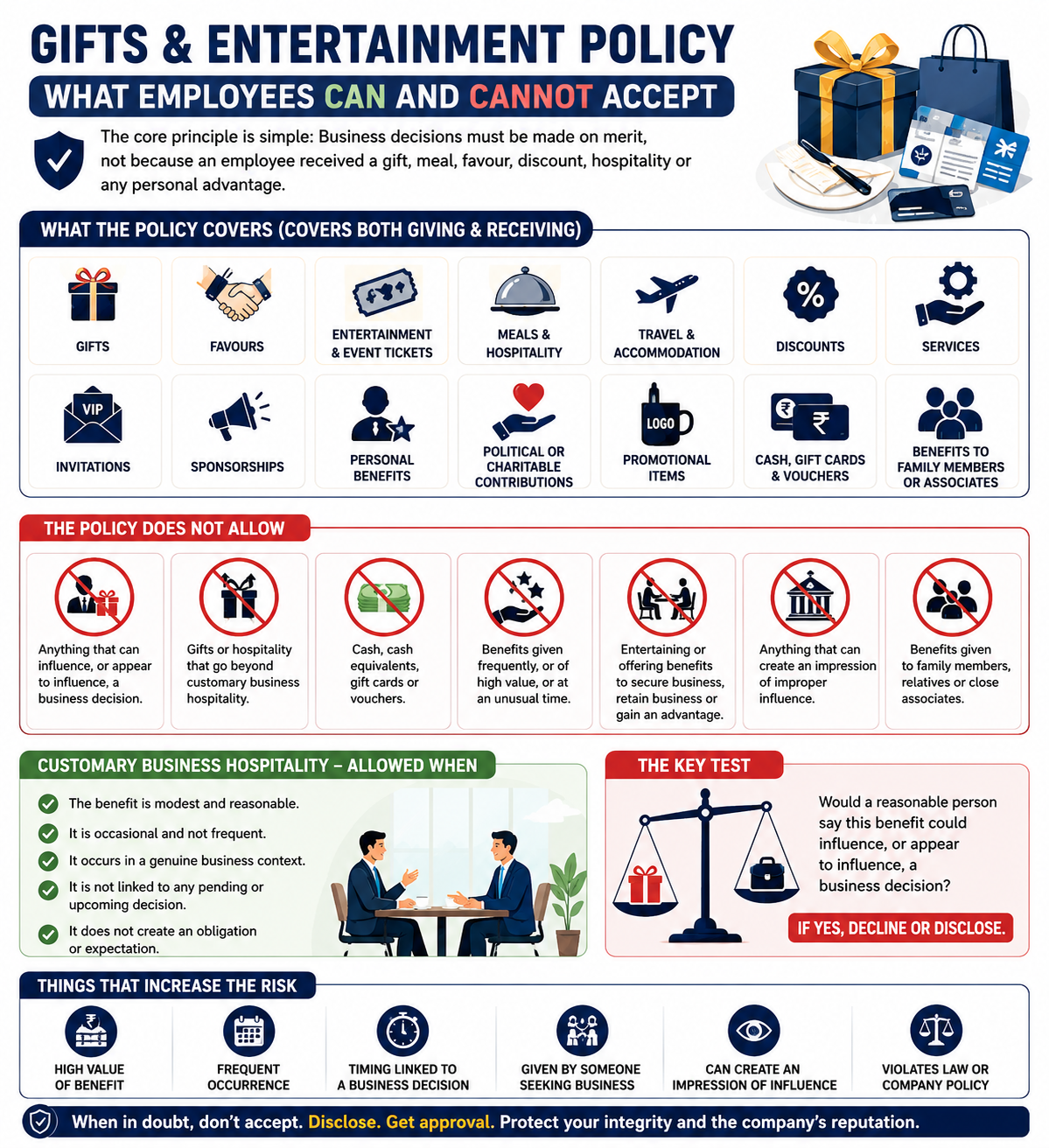
The policy should define covered benefits broadly.
It should cover:
- Gifts.
- Favours.
- Entertainment.
- Meals.
- Hospitality.
- Travel.
- Accommodation.
- Discounts.
- Services.
- Event invitations.
- Tickets.
- Sponsorships.
- Personal benefits.
- Political or charitable contributions linked to business decisions.
- Promotional items.
- Cash and cash equivalents.
- Vouchers and gift cards.
- Benefits given to family members or close associates.
The policy should also cover benefits given directly or indirectly. A vendor giving a gift to an employee’s spouse, relative or close friend can still raise a conflict concern.
Actual and Potential Business Partners
The policy should apply to actual and potential business partners. The gifts and entertainment restriction should cover actual and potential business partners, not only current vendors or customers.
This is important because improper influence often occurs before a relationship is formally created. For example, gifts may be offered before vendor onboarding, before bid submission, before contract renewal, before purchase order approval, before customer negotiation or before dispute settlement.
Customary Business Hospitality
The policy may allow modest customary hospitality.
A code of conduct framework recognises that, in certain circumstances, giving and receiving modest gifts and entertainment may be acceptable. A business meal, for example, can provide a relaxed way of exchanging information.
This is a practical point. The policy should not be unrealistic. A complete ban on all business meals or token gifts may be difficult to implement. However, the policy should define what is modest, customary, occasional, transparent and connected with legitimate business.
The Key Test: Reward or Preferential Treatment
The most important test is whether the gift or entertainment could be intended, or reasonably interpreted, as a reward or encouragement for a favour or preferential treatment.
If the answer is yes, it should be prohibited.
This is the test that HR and compliance teams should use in doubtful cases. The question is not only, “Was the employee actually influenced?” The question is also, “Could this reasonably look like influence, reward, encouragement or preferential treatment?”
Size, Frequency and Circumstances Matter
The policy should state that context matters.
Even where a gift or meal appears modest in isolation, it may become problematic depending on size, frequency and surrounding circumstances. A code of conduct framework recognises that gifts and entertainment may, depending on their size, frequency and circumstances, constitute bribes, political payments or undue influence.
For example, one business lunch may be acceptable. Weekly expensive meals from the same vendor during a tender process may not be acceptable. A small branded diary may be acceptable. A high-value electronic item before contract renewal may not be acceptable.
Prohibited Benefits
The policy should clearly prohibit certain benefits.
The following should normally be prohibited:
- Cash.
- Cash equivalents.
- Gift cards.
- Personal loans.
- Personal services.
- Travel or hotel stays paid by a vendor without approval.
- Expensive entertainment.
- Secret commissions.
- Benefits linked to contract award, renewal or approval.
- Benefits during tender, negotiation or dispute.
- Gifts to family members.
- Benefits that violate law or company policy.
- Benefits that must be concealed.
- Benefits that make the employee uncomfortable.
- Benefits that may create reputational risk if publicly known.
This gives employees practical clarity.
Cash and Cash Equivalents
Cash and cash equivalents should generally be prohibited. Cash, vouchers, prepaid cards, gift cards, digital wallet transfers, personal bank transfers, jewellery, high-value electronic items and similar benefits carry high risk because they are easily treated as personal advantage rather than customary hospitality.
The policy should state that employees must not accept or offer cash or cash equivalents from or to any business partner.
Read another article: Performance Appraisal Policy for Indian Companies: Practical Drafting Guide for Employers
Festival Gifts
Festival gifts should be addressed specifically. In India, festival gifting is common. The policy should not ignore this reality. It should state whether low-value festive gifts, sweets, dry fruits, diaries, calendars or branded items are permitted within approved thresholds, provided they are occasional, modest, transparent, not cash or cash equivalent and not connected with a pending business decision.
The company may also require declaration of all festival gifts above a certain value, and may direct employees to return, share, donate or deposit gifts with HR.
Meals and Business Entertainment
Business meals and entertainment should be regulated. A modest business meal may be acceptable where it is occasional, reasonable, attended by the relevant business persons, for a legitimate business purpose and not linked with improper influence.
However, expensive dining, luxury entertainment, exclusive clubs, sporting event tickets, travel-linked hospitality or hospitality extended to family members should require prior approval or be prohibited.
Travel and Accommodation
Travel and accommodation benefits should be treated as high-risk. If a vendor, supplier, customer or potential business partner offers to pay for flights, hotel stay, local travel, leisure activities or personal expenses, the employee should not accept without prior written approval.
Where travel is genuinely necessary for business, the company should ordinarily pay for its own employee’s travel and accommodation. This reduces dependency and influence risk.
Government Officials and Public Sector Interface
The policy should be stricter where government officials, public sector entities or regulatory-facing interactions are involved.
A code of conduct framework expressly prohibits use of company funds to make payment, directly or indirectly, in money, property, services or any other form to a government official, political party or candidate for political office to induce influence, retain business or obtain improper advantage.
The policy should therefore require employees to seek legal, compliance or senior management approval before offering any gift, hospitality, sponsorship, travel support or entertainment in government-facing contexts.
Agents, Consultants and Intermediaries
The policy should cover third-party intermediaries. Agency and intermediary arrangements can be used as covers for bribery. Warning signs may include unusual payment requests, split payments, promotional funds, payment in different currency, payment in a different location or payment to an inappropriate address.
The gifts policy should therefore apply not only to employees but also to consultants, agents, contractors, distributors, suppliers and other persons dealing on behalf of the company, through contractual arrangements where possible. A code of conduct framework expects consultants, agents, contractors and suppliers to comply with the code in their dealings with or on behalf of the company.
Approval and Disclosure Mechanism
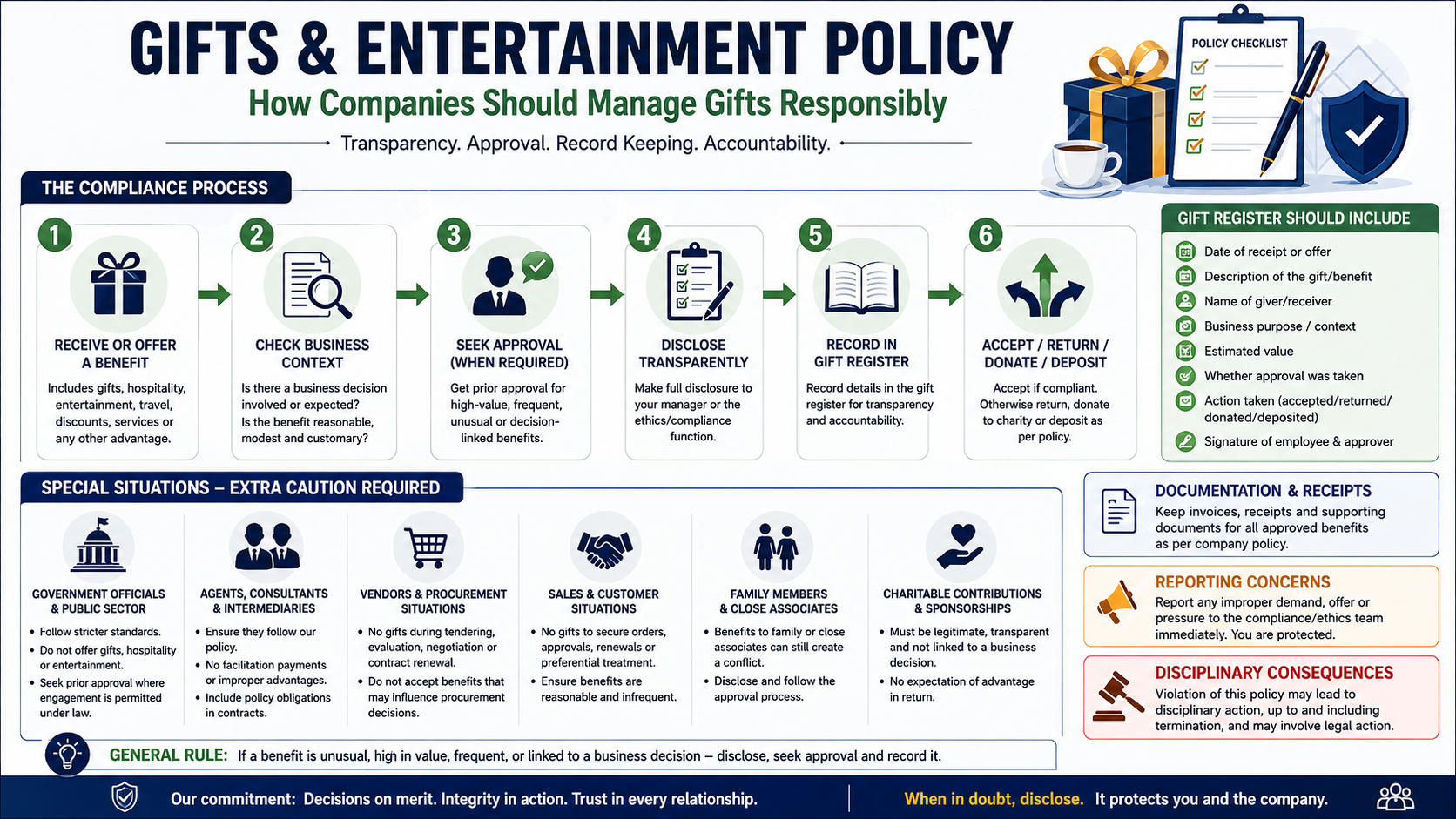
The policy should create a clear approval and disclosure mechanism. Employees should disclose gifts, hospitality, entertainment or favours that exceed permitted thresholds, are unusual, are repeated, are offered during a decision process, involve a government-facing party, involve travel or accommodation, or may create a perception of influence.
The disclosure should be made to HR, compliance, legal or the reporting manager, depending on the company structure. The policy should state that when in doubt, the employee must disclose before accepting or offering the benefit.
Gift Register
The company should maintain a gift register.
The gift register may record:
- Date of offer or receipt.
- Name of employee.
- Name of giver or recipient.
- Organisation involved.
- Nature of gift or hospitality.
- Estimated value.
- Business context.
- Whether approval was sought.
- Decision taken.
- Whether gift was retained, returned, donated, shared or deposited.
This is a practical control. It helps the company identify patterns, repeated vendors, high-risk departments and possible procurement or sales influence.
Return, Donation or Deposit of Gifts
The policy should provide options where a gift cannot be accepted. The company may require the employee to return the gift politely, deposit it with HR, donate it to charity, share it among team members or use it for company purposes, depending on the nature of the gift and the circumstances.
Where return is culturally sensitive or impractical, the company may decide how the gift should be handled.
Personal Discounts and Special Benefits
The policy should cover personal discounts and special benefits. A discount offered to all employees under a formal company-approved benefit arrangement may be acceptable. A personal discount offered only to the employee handling vendor approval, contract renewal or invoice clearance may be problematic.
The policy should prohibit employees from seeking or accepting special personal benefits from business partners unless approved under a transparent company arrangement.
Benefits to Family Members
The policy should cover benefits offered to family members and close associates. A gift or favour given to an employee’s spouse, parent, sibling, child, partner, friend or associate may still be a business influence issue if it is connected to the employee’s role.
The policy should require employees to disclose such benefits and prohibit indirect acceptance through family or associates.
Charitable Contributions and Sponsorships
Charitable contributions and sponsorships can also create risk. If a vendor, customer or intermediary offers to make a donation to a charity connected with an employee, or asks the company to sponsor an event linked to a decision-maker, the matter should be reviewed carefully.
The policy should state that charitable giving and sponsorships must not be used to secure business advantage, reward a person, influence a decision or conceal improper payment.
Political Contributions
Political contributions should be restricted. A code of conduct framework recognises that payments to political parties or candidates for political office to induce influence or obtain improper advantage are prohibited.
The policy should state that employees cannot make political contributions or offer political support on behalf of the company unless expressly authorised under company policy and applicable approval processes.
Vendor and Procurement Situations
Procurement teams should be subject to strict controls. Employees involved in vendor selection, tendering, contract negotiation, invoice approval, quality approval, purchase orders, vendor onboarding or dispute handling should not accept gifts or hospitality from concerned vendors during active decision periods.
Even modest gifts may be problematic where the employee is making or influencing a commercial decision.
Sales and Customer Situations
Sales teams also require guidance. Reasonable business meals or customary hospitality may be part of relationship management. However, employees should not offer gifts, entertainment, travel or favours to customers in a manner that may be seen as inducing a purchase, contract renewal, approval, release of payment or favourable treatment.
The policy should clearly distinguish legitimate business courtesy from improper influence.
Documentation and Receipts
Where gifts or hospitality are approved, documentation should be maintained. Employees should preserve invitation emails, approvals, estimated values, attendee details, purpose and expense records. Where the company gives gifts or hospitality, expenses should be recorded properly.
A code of conduct framework requires records to give a true and fair view of business affairs, financial transactions to be properly recorded, and disbursements to be properly and promptly recorded. This prevents gifts and entertainment from being hidden under vague expense heads.
Expense Claims for Gifts and Entertainment
The expense policy should align with the gifts policy. Employees should not claim reimbursement for gifts, entertainment or hospitality that violates the gifts policy. Any business entertainment expense should be supported by a legitimate business purpose, attendee details, bills and approvals.
Incorrect expense claims may also become a books and records issue if they conceal improper benefits.
Reporting Concerns
Employees should report suspected violations. A code of conduct framework states that employees who become aware of conduct violating law, code, policies or standards have a responsibility to report it through prescribed reporting mechanisms.
This should include suspected bribery, improper gifts, unusual hospitality, vendor influence, hidden commissions, personal benefits, fake expense claims or suspicious intermediaries.
Questions and Grey Areas
The policy should encourage employees to ask questions. A code of conduct framework recognises that grey areas may exist and encourages open discussion. It advises employees to speak with a supervisor or other point of contact if unsure what to do.
This is important because gifts and hospitality situations are often context-based. Employees should not be expected to make difficult judgment calls alone.
Disciplinary Consequences
The policy should specify consequences for breach.
A code of conduct framework states that any employee violating the law, code of conduct or company policies may face disciplinary action, up to and including dismissal.
The policy should preserve the company’s right to take disciplinary action, recover losses, terminate employment, report criminal offences or take legal action where the gift, entertainment or favour is linked with bribery, fraud, conflict of interest, records manipulation or business harm.
Read another article: Performance Appraisal Policy for Indian Companies: Practical Drafting Guide for Employers
Sample Gifts, Favours and Entertainment Policy Clause
The Company is committed to conducting business with integrity, transparency and fairness. Employees must ensure that gifts, favours, entertainment, hospitality, services, travel, discounts or other benefits do not influence, or appear to influence, business decisions.
Employees shall not offer, give, seek, accept or receive any gift, favour, payment, entertainment, hospitality, service, travel benefit, accommodation, personal discount or other benefit from or to any actual or potential customer, vendor, supplier, consultant, contractor, agent, distributor, government official, business partner or third party where such benefit may reasonably be believed to influence a business transaction, is outside customary business hospitality or is prohibited by law or company policy.
Modest and customary business hospitality may be permitted where it is occasional, reasonable, transparent, for a legitimate business purpose, not cash or cash equivalent, not intended to influence any decision and not capable of being reasonably interpreted as a reward or encouragement for preferential treatment.
Employees must not accept or offer cash, cash equivalents, gift cards, personal loans, secret commissions, expensive entertainment, travel, accommodation, personal services or benefits to family members or close associates, unless expressly permitted under company policy and approved in writing.
Employees must disclose to HR, compliance or the reporting manager any gift, hospitality or entertainment that exceeds permitted limits, is unusual, repeated, offered during a tender, negotiation, renewal, dispute or approval process, involves government-facing parties, involves travel or accommodation, or may create an actual, potential or perceived conflict of interest.
The Company may direct that a gift be returned, deposited with HR, donated, shared or otherwise handled in a manner determined by the Company. Employees must ensure that all gifts, hospitality and entertainment expenses are accurately recorded and supported by appropriate bills, approvals and business purpose.
Violation of this Policy may invite disciplinary action, including warning, suspension, termination, recovery, legal action or reporting to authorities, depending on the facts and applicable company policy.
Sample Gift Declaration Form
Employee Name: ___________________________
Designation: ___________________________
Department: ___________________________
Reporting Manager: ___________________________
Date of Declaration: ___________________________
1. Nature of Benefit
[Gift / meal / entertainment / travel / accommodation / discount / service / event invitation / other]
2. Offered By / Received From
[Name, designation, organisation and relationship with Company]
3. Given To / Received By
[Employee / family member / team / Company / other]
4. Date of Offer or Receipt
[Insert date]
5. Estimated Value
[Insert estimated value]
6. Business Context
[Tender / vendor selection / contract negotiation / renewal / ordinary business meeting / festival gift / event / other]
7. Whether Any Business Decision Is Pending
[Yes / No. If yes, provide details]
8. Whether Similar Benefit Has Been Offered Earlier
[Yes / No. If yes, provide details]
9. Employee Recommendation
[Accept / return / deposit with HR / donate / share / seek further approval]
10. Employee Declaration
I confirm that the above information is true and complete. I confirm that I have not accepted or offered the benefit for the purpose of influencing any business decision or obtaining preferential treatment.
Employee Signature: ___________________________
Date: ___________________________
Sample Approval or Rejection Communication
Dear [Employee Name],
This is with reference to your gift / hospitality declaration dated [date].
The Company has reviewed the declaration based on the nature of the benefit, estimated value, business context, frequency, parties involved and potential conflict of interest.
Based on the review, the Company has decided as follows:
[The benefit may be accepted / The benefit must be returned / The benefit must be deposited with HR / The benefit may be shared with the team / The benefit may be donated / Further information is required / Approval is denied]
You are required to comply with the above decision and maintain appropriate records.
Regards,
HR / Compliance Department
Sample Refusal Message to Vendor
Dear [Name],
Thank you for your kind gesture.
As a matter of company policy, we are unable to accept gifts, hospitality or benefits that may create, or appear to create, a conflict of interest or influence business decisions.
We value our professional relationship and look forward to continuing all business discussions on a transparent and merit-based basis.
Regards,
[Employee Name]
Practical Drafting Checklist
- Define gifts, favours and entertainment broadly.
- Cover both giving and receiving.
- Cover actual and potential business partners.
- Cover vendors, suppliers, customers, agents, consultants and contractors.
- Cover government-facing interactions.
- Prohibit cash and cash equivalents.
- Regulate meals and entertainment.
- Regulate travel and accommodation.
- Address festival gifts.
- Address personal discounts.
- Address gifts to family members.
- Address charitable contributions and sponsorships.
- Address political contributions.
- Create approval and disclosure mechanism.
- Maintain a gift register.
- Set modest hospitality principles.
- Use the reward or preferential treatment test.
- Require accurate expense recording.
- Link the policy with conflict of interest.
- Link the policy with anti-bribery controls.
- Link the policy with books and records.
- Require reporting of suspected violations.
- Define disciplinary consequences.
Common Drafting Mistakes
- The first mistake is restricting only gifts received and not gifts offered.
- The second mistake is not covering entertainment, travel, services and discounts.
- The third mistake is not covering family members.
- The fourth mistake is allowing “customary hospitality” without defining limits.
- The fifth mistake is ignoring festival gifts.
- The sixth mistake is not creating a disclosure process.
- The seventh mistake is not maintaining a gift register.
- The eighth mistake is not linking gifts with conflict of interest.
- The ninth mistake is not linking gifts with anti-bribery controls.
- The tenth mistake is not requiring accurate expense records.
FAQs
What is a gifts and entertainment policy?
A gifts and entertainment policy regulates what employees may offer, give, seek, accept or receive from business partners, vendors, customers, suppliers, agents, consultants, contractors and other third parties.
Why does a company need a gifts policy?
A company needs a gifts policy because accepting or offering gifts and entertainment can undermine credibility and create an impression that business decisions are influenced by factors other than merit.
Are all business meals prohibited?
No. Modest and customary business meals may be acceptable where they are reasonable, occasional, transparent and for a legitimate business purpose. However, size, frequency and circumstances matter.
What is the key test for gifts and entertainment?
The key test is whether the gift or entertainment could be intended, or reasonably interpreted, as a reward or encouragement for a favour or preferential treatment. If yes, it should be prohibited.
Can employees accept festival gifts?
A company may allow low-value, customary festival gifts within approved limits, but cash, cash equivalents, expensive gifts or gifts linked with business decisions should be prohibited or require disclosure.
Should gifts from vendors be disclosed?
Yes. Gifts from vendors should be disclosed where they exceed permitted limits, are repeated, unusual, offered during a decision process or may create an actual, potential or perceived conflict of interest.
Can gifts policy breach lead to termination?
Yes. Violation of law, code of conduct or company policies may lead to disciplinary action up to and including dismissal, depending on the facts.
Should gifts and entertainment expenses be recorded?
Yes. Business expenses, gifts and hospitality should be accurately recorded with proper approvals, bills and business purpose. Records should give a true and fair view of business affairs and financial transactions should be properly recorded.
Corrida Legal Note
A gifts, favours and entertainment policy should not be drafted as a generic anti-bribery paragraph. It should give employees a practical decision-making framework. The best policies define what is prohibited, allow only modest and transparent hospitality, require disclosure in doubtful cases, maintain a gift register, restrict benefits during business decisions and connect gifts with conflict of interest, anti-bribery, books and records, expense and disciplinary policies.