

Reviewed and Validated by: Srijan Jha, Associate | Can an employer hold relieving letter in India
Relieving letter plays a vital role in the exit process for both the employer and employee. It sets out key terms such as the last working day, no dues and other key obligations which are applicable to both parties. Given the nature of the document, the relieving letter often gets withheld or delayed despite the employee serving the entire notice period and completing all the relevant exit obligations. This may stem from the negligence of a party, an unresolved full and final settlement, pending disputes, or similar concerns. Practically, this creates difficulty for the employee as they are now required to prove their exit from previous employment through email communication and other relevant documents.
With the importance of the relieving letter established above, can an employer deny its issuance? Well, the answer is not a simple yes or no, but depends on the case. An employer may withhold it in typical scenarios involving a failure to comply with exit obligations such as the notice period or handover, or for other lawful reasons. In certain circumstances, the delay may stem purely from internal discussions and negligence of either party. That’s why it’s essential to know your options and rights with respect to the relieving letter in all scenarios.
Let’s understand why this document matters.
The importance of the relieving letter arises from the following scenario:
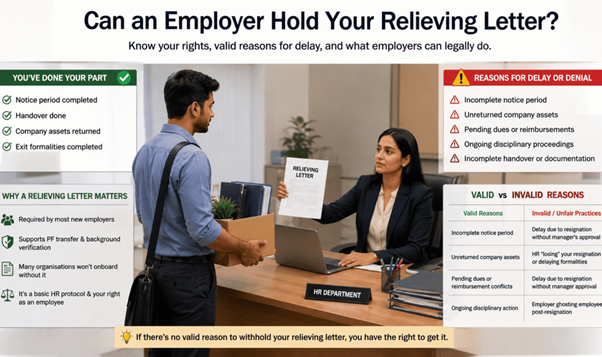
- It is a crucial document during background verification, informing the prospective employer that there are no dues pending with your previous employer and that your exit from previous employment has been duly accepted.
- It supports provident fund transfer and other aspects of your background verification processes.
- In many organisations, the relieving letter is mandatory for establishing your experience, and without the letter, the offer from prospective employers may be kept on hold or revoked in its entirety.
- It is a basic HR protocol, and not issuing one is seen as unprofessional and even exploitative. It also raises concerns about the employee’s conduct during their tenure with the previous employer.
Whilst there are certain instances where the relieving letter can be withheld on legal grounds by the employer, employees can seek legal remedies in instances where the employer withholds it without valid grounds. This article aims to provide employees with insight into the rights and remedies which are available to them with respect to the withholding of the relieving letter.
Joining a new job without a relieving letter is allowed, but it depends on the company’s internal policies and practices. Some companies may let you join with a resignation acceptance letter or an affidavit. But others might require strict documentation. Practically, it is always advisable for employees to communicate with their previous employers with respect to their relieving letter to ensure that their interests are protected.
In the event that a relieving letter is vital to future employment or other requirements, it is always advisable for employees to seek out legal remedies available to them.
What is a Relieving Letter, and Why Does It Matter
A relieving letter, by definition, is a document which serves as evidence of the conclusion of employment and typically establishes the exit terms applicable to such an exit, including the date of conclusion of employment and no pending dues. A relieving letter is one of those documents that doesn’t seem important until you’re in a situation where you need it. Most employees don’t give it much thought until the day their new HR department asks for it, and they don’t have it. And suddenly, the joining process gets delayed.
Definition and Purpose of a Relieving Letter
A relieving letter is a formal document issued by your previous employer at the conclusion of employment. It confirms that:
- You have officially resigned or your employment has been terminated.
- You have completed your notice period or received payment in lieu thereof.
- All exit formalities, including handovers and clearances, are done.
- You are relieved of your duties from a specific date and outlines your performance during your tenure.
It is proof that you left the organisation on agreed terms. There’s no law that says every company must issue it, but it’s part of standard HR practice across India. Most relieving letter rules India follows this informal understanding, and yet some employers don’t bother issuing it until pushed. However, from both the employer’s and employee’s perspectives, the issuance of a relieving letter is not only a procedural formality, but also a document which protects the interests of both parties from future liabilities and risks.
Why It’s Crucial for Your Next Job
Why Relieving Letter Matters & Can Employer Hold It
New employers usually ask for this letter during background checks or before onboarding. Thus, the relieving letter is not only part of your exit process requirements, but also plays a role in future employment process. It helps prospective employers ensure there are no legal or compliance issues with your exit as well as any other pending obligations with your previous employer, such as restrictive covenants. If your previous employer withholds it, things get complicated as the prospective employer may deny you employment to avoid potential risk.
Thus, where an employee resigns after completing all exit obligations, such as the notice period and asset handover, receiving a relieving letter is a matter of right, and any withholding of such a letter is a violation of exit protocols and the rights of the employee.
Key Reasons Why a Relieving Letter Matters
- It’s required by most HR departments before onboarding.
- Joining a new job without a relieving letter may not be possible or may cause operational delay.
- PF transfer and experience verification often get held up without it.
- Some firms use it as leverage during F&F disputes or compliance checks, creating concerns for employees with respect to exit documents and reducing their negotiating power.
Can an Employer Deny It? What the Law Says
While legally employers are strictly barred from withholding the relieving letter, doing so without a probable and reasonable cause may create unavoidable legal complexities. Understanding the proper timing and procedure for requesting the relieving document is essential to determine whether there has been an unfair delay in providing such documents. Employees must ensure clear communication with respect to their relieving letter and ensure that they are able to secure the same prior to leaving the organization, or have clear communication pertaining to the delay and its cause. Because later, chasing it becomes stressful, and by then, you might not even be able to get in touch with your manager or HR.
Watch Out for These Common Issues
One of the common issues that is faced by employees is that certain organisations do not have a mechanism for automatically issuing a relieving letter or that certain organisations do not have a mechanism for issuing a leaving letter in its entirety. Because of this, employees must ensure that they deliberately plan in advance as to the documents that are being requested prior to their exit from the company. Documents such as a relieving letter play a vital role in the background verification of the employee and thereby hold much weight as compared to other documents of the employee.
Can an Employer Hold Back a Relieving Letter?
This is one of the most common concerns that employees face in India, whereby they are constantly wondering whether they are entitled to receive a relieving letter from their present organisation. Thus the question remains:: Can an employer just hold back your relieving letter because they feel like it?
The short answer is that there’s no specific statute that forces an employer to issue a relieving letter. But that doesn’t mean they’re free to misuse that gap in the law.
Is It Legal to Hold a Relieving Letter?
Labour laws lack the explicit provision which mandates the issuance of a relieving letter by your previous organisation; however, from the practices that have been established, it has become an industrial norm and a principle of fairness to issue a relieving letter.
The Industrial Employment (Standing Orders) Act, 1946 (now under the Industrial Relations Code, 2020), implies that employees should be given service records or documents upon separation, but the Act itself doesn’t directly enforce this across all industries.
That’s where the confusion begins. The conundrum remains, whereby employees are unaware whether they hold the right to issue a relieving letter or whether such a document can be requested as a right from the employer.
So, can an employer hold a relieving letter in India? Yes, they can, but only under specific and valid circumstances.
Valid Reasons for Delay or Denial
Here are a few acceptable grounds under which an employer may delay or deny issuing the relieving letter:
- You haven’t completed your notice period.
- You didn’t submit your formal resignation properly or in compliance with the company’s internal procedures.
- There are pending dues or asset returns (laptop, ID card, etc.).
- Ongoing disciplinary proceedings or allegations of misconduct which impact the nature of your relieving letter.
- Incomplete handover or documentation or knowledge transfer.
If any of these exist, an employer might hold the letter temporarily until those issues are resolved. But the hold must be reasonable, not punitive.
When It’s Unfair or Misused
With the importance that a relieving letter plays in prospective employment of the employee by way of either joining requirements or background verification, certain HR departments exploit the legal loophole of non-issuance of a relieving letter to unfairly pressurise the employee into agreeing to terms which are beneficial to them. In certain cases, companies have policies which allow such a company to stall the issuance of full and final settlement or any other exit document to penalise employees for a contentious resignation.
It is important for an employee to know their rights regarding exit documents. In the event that an employee has completed all the exit formalities in accordance with the company’s policies and practices, they have a legal right to be issued the exit documents, and the non-issuance of the same can be challenged before the honourable court.
Here’s a comparison of valid vs. invalid reasons:
Valid Reasons | Invalid or Unfair Practices |
Incomplete notice period | Delay due to resignation without manager’s approval |
Unreturned company assets | Delay due to resignation without manager approval |
Pending dues or reimbursement conflicts | HR “losing” the resignation or delaying formalities |
Ongoing disciplinary action | Employer ghosting the employee post-resignation |
Mistakes Made by Employees
The failure of issuance of the relieving letter is not always the default of the company. In certain circumstances, it is witnessed that the employee has failed to adhere to the company’s policies and practices, due to which there has been a procedural lapse in the issuance of the relieving letter. A few of the industry examples of such procedural lapses have been mentioned hereinbelow:
- Resigning from informal communication methods such as chats or calls.
- Not getting written acceptance from HR or the manager.
- Leaving without completing the asset return or documentation.
- Assuming exit processes are automatic.
One of the common misconceptions that arises is that a relieving letter does not play a vital role in joining the next organisation. However, a relieving letter acts as a crucial document in background verification and can delay or even lead to the cancellation of an offer by the prospective employer.
What Happens When It’s Held Unfairly?
In the event that the issuance of the relieving letter is delayed unjustly, and that the previous employer does not have a valid reason for withholding the same, you have the right to challenge such a decision of your previous employer before the competent authority as well as by issuing a legal notice. Prior to taking any escalation, an employee must ensure that they have completed all the procedures and practices which have been provided under their company’s internal policies, and that there are no obligations remaining on their part.
Employers might not say it directly, but sometimes the hold is simply to make things difficult for the employee. Especially if the departure wasn’t smooth. This kind of behaviour—it’s not only wrong, it’s actionable.
Legal Remedies if the Relieving Letter is Withheld
Legal Remedies & Joining New Company Without Relieving Letter
In the event that you have your professional duties, that is, you have resigned formally, serve the notice period provided in your employment contract, completed all the handovers and cleared all the outstanding dues, and that there is no pending proceeding or internal investigation against you. You have certain rights to legally see out your relieving letter from the present employer.
Let’s break down the steps you can take to assert your employee rights, write a letter, and get what’s legally due to you.
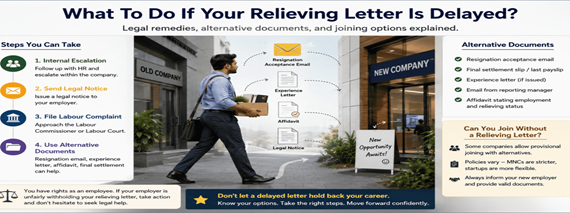
Step 1 – Start with Internal Escalation
Before you jump into legal action, always try to resolve the issue within the company. You can:
- Follow up formally with the HR over email (never rely on verbal chats).
- Mark your reporting manager or department head.
- Escalate to the HR head or ethics/internal compliance committee.
- Document every communication (email trail is important).
Many times, HR delays are due to process gaps, and a polite but persistent follow-up often works. However, if it becomes clear that the delay is intentional, you need to act. This also ensures that post-exit from the company, there is a positive relationship between the past employer and the employee and that the same is not affected by going through legal proceedings.
Step 2 – Serve a Legal Notice
A strongly worded legal notice can often shake up inactive HR departments. Hire a labour lawyer, explain the situation, and have them draft a professional notice.
Include these in the notice:
- Copy of your resignation.
- Acknowledgement of notice period served.
- Any final settlement proof (if paid).
- A timeline for the employer to respond.
This alone helps in most cases. Employers don’t want legal trouble over paperwork. Furthermore, a legal notice clearly establishes the facts and circumstances pertaining to a dispute, and by clearly establishing a timeline for the response to such a claim, it acts as a tool which expedites the process for both parties.
Step 3 – File a Complaint with Labour Authorities
If the notice goes ignored, and your legal remedy for relieving letter delay is still pending, your next option is to approach the Labour Commissioner.
You can file a complaint with:
- The Labour Commissioner’s office in your city.
- The Labour Court, if you want to take it further.
- The local employment office, especially in public sector cases.
Authority | How to Approach | Expected Outcome |
Labour Commissioner | File a case via a lawyer | Legal order for the employer to respond |
Labour Court (if required) | Raise an internal grievance | Legal order for employer to respond |
HR Ethics Committee (internal) | Investigation and warning to the employer | Internal review and HR direction |
One thing to remember is that these processes can take time. But in many cases, the threat of formal escalation itself brings results, typically in the form of mutual settlement. Employees must ensure that prior to filing any complaint, they have all the relevant documents and facts that pertain to the issuance of the relieving letter, and that the same have been incorporated into the complaint.
Step 4 – Use Other Documents as Backup
While there are no relieving letter rules in India, other documents can be used to substantiate your claim. If you’re stuck, these may help you join a new job:
- Resignation acceptance email.
- Copy of final settlement proof.
- Experience letter (if already issued).
- Bank statement showing last salary credited.
- An affidavit stating your employment details.
This works especially when you’re facing a joining new job without relieving letter problem. Some companies may allow provisional joining with a written explanation or undertaking.
Why Employees Avoid Taking Legal Action
In certain cases, taking legal action often causes anxiety for exiting employees, who fear that legal action may be detrimental to their future career and prospects in terms of background verification. They are concerned that the previous employer may give poor feedback to the prospective employer. While these concerns are understandable, the unjust withholding of exit documents is an issue in itself which can be explained to the prospective employer. Thereby, an employee, by taking action to retrieve the relieving letter, ensures that the relieving letter is not withheld either for any professional negligence or due to any other reason by the previous employer.
That’s why, if you’re wondering if an employer can hold a relieving letter in India without reason, the answer is no, not indefinitely. You may not have a statute to quote, but you do have rights.
Practical Tips for Employees to Avoid This Issue
A relieving letter is typically thought of as the final document by employees prior to them leaving their previous employer. This creates situations where employees themselves, through a little negligence, fail to ask for the relieving letter, causing difficulties in their prospective employment with other organisations. This can be avoided by the employee maintaining a list of documents which have to be requested from HR prior to exiting the organisation.
Below are a few things every employee should do before the last working day, especially if they want to avoid trouble with joining a new job without a relieving letter later.
What You Can Do Before Resigning
- Always submit your resignation in writing, preferably by email. Avoid informal chats.
- Get acknowledgement from your manager or HR in writing. That’s your first proof.
- Don’t just “assume” HR will take care of exit formalities as they usually don’t unless you ask.
- Complete your handover properly. Include emails, passwords, files, and checklists.
- Return all company property: laptop, ID cards, swipe access, and SIM card if given.
- Ask for a written confirmation of your last working day.
After Your Notice Period Begins
Once your notice period is underway, these steps become equally important:
- Keep a written log of all tasks completed during handover.
- Confirm your full and final settlement status.
- Request a list of exit formalities (if HR hasn’t shared already).
- If you feel that HR is delaying or not responding, escalate early.
- Never depend on just verbal closure, even if your manager says “it’s all good”.
Some employees also forget to save copies of communication, and this is a big mistake. Don’t let yourself be the person who realizes too late that there’s no documentation. These communications play a vital role. Once there is a dispute regarding the exit documents, maintaining a copy of the same ensures that while filing a complaint or issuing a legal notice, the employee has all the relevant communications to substantiate the claim.
If you take the right steps, you probably won’t even need to ask whether an employer can hold a relieving letter in India, because it’ll be done properly. But if not, you’ll need a backup plan, and we’ll get to that next.
Can You Join Another Company Without a Relieving Letter?
Let’s be honest, not all job transitions are smooth. Sometimes you leave in a hurry, sometimes the HR is uncooperative, and other times you just don’t want to wait. So you might wonder if it is possible to get hired at a new job if your relieving letter hasn’t been issued yet?
While there is no single answer to the same, as it is largely dependent on the employer and their internal policies and practices, the communications and relieving letter available with the employee play a role in substantiating that they have been relieved from their previous employment, serving as proof of employment and confirming that there are no outstanding dues or claims against them.
What Can You Use as an Alternative?
Many Indian companies, especially startups or smaller firms, accept the following if you’re missing the relieving letter:
- Resignation acceptance email (with clear dates).
- Final settlement slip or payslip of the last month.
- Experience letter, if already issued.
- An email from your reporting manager confirming your exit.
- Signed affidavit declaring your employment and relieving status.
These can sometimes help in situations where a legal remedy for relieving letter delay is still ongoing.
Can You Join Without a Relieving Letter?
Employer Type | Policy Likely to Be | Alternative Documents Accepted |
MNC or Large IT Firms | A relieving letter usually mandatory | Rarely accept alternatives |
Mid-size Indian Companies | Case-by-case basis | May accept resignation email, final slip |
Startups / Early-Stage Firms | Flexible | Usually accept an affidavit or an experience letter |
Govt./Public Sector | Extremely strict | A relieving letter is usually mandatory |
What Happens if You Still Don’t Get It?
If your new employer needs the document and the old company is unresponsive, you have two options:
- Escalate legally through your lawyer or the labour office.
- Ask your new employer for a provisional joining or an extended timeline.
Some companies even allow onboarding with an undertaking that you’ll submit it within a certain period. Again, this varies. Thereby, it is best advised to ensure that both options are undertaken simultaneously to guarantee a speedy redressal of the disputes and points of concern, while ensuring that prospective employment is not hampered due to a lapse in timelines for submitting such documents.
But keep in mind that joining without proper paperwork can create compliance risks later. Especially if your background check fails or the PF transfer is rejected. That’s why it’s always better to try and follow proper relieving letter rules in India early on.
Frequently Asked Questions (FAQs)
- Can an employer deny a relieving letter after the full notice period is served?
Upon completion of the notice period, the employer cannot withhold the relieving letter unless the employee has failed to complete other exit formalities as governed by the company’s internal policies and practices, or if there is a pending proceeding against such employee. If there is no probable cause or legal basis for withholding such exit documents, then non-issuance can be challenged before the relevant authority.
- What to do if HR is ignoring my emails for a relieving letter?
In the event that the HR has failed to respond to your request for the issuance of the relieving letter, it is best advised to first escalate the matter before the department head or the HR lead. In the event that you do not receive any further communication from the company, escalations can be made before the relevant authority.
- Is a relieving letter mandatory for joining a new company?
While the submission of a relieving letter is not legally mandatory for joining a new organisation, the requirement is largely subject to the prospective employer’s internal practices and the specific documents they require for background verification.
- Can I legally force my employer to issue the letter?
While there’s no specific law that mandates it, denying a relieving letter without a reason goes against employee rights and relieving letter standards. You can approach the labour department or issue a legal notice.
- What are valid reasons for not issuing a relieving letter?
An employer typically withholding the issuance of a relieving letter usually occurs when the employee does not complete the notice period as described in their employment contract, fails to return all company assets, or if there are pending investigations against such employee. However, under each of these circumstances, withholding the relieving letter must be on justifiable grounds and cannot be done out of personal bias.
- Can I join a government job without a relieving letter?
Almost always no. Most public sector employers require a relieving letter or NOC. In such cases, not having one can stall your entire onboarding till they receive the relieving letter from their previous employer.
- Is it okay if I only have the resignation email but no letter?
This is largely governed by the employer’s onboarding policies. In certain circumstances, employers allow an employee to join using their resignation acceptance email and payslips as proof of exiting the previous organization. However, the prospective employer may still require a formal relieving letter for a specific declaration of no pending dues or restrictive covenants.
- What if my previous employer says they “lost” the records?
Ask them to issue a fresh copy based on your resignation and handover documents. If they refuse, gather all your proofs and take legal steps. This could fall under legal remedy for relieving letter delay if the delay seems intentional.
- Can I file a labour complaint for a missing relieving letter?
Yes, the employee can file a written complaint before the Labour Commissioner by providing the evidence necessary to establish their valid resignation from the employer. This evidence includes documents such as the resignation letter, proof of completion of the notice period, and any other relevant communications demonstrating that the employee has completed all exit formalities.
- Is it possible to join a new job and submit the letter later?
Yes, some companies offer provisional joining and ask you to submit the relieving letter within 30/60 days. You can explain your situation formally. But don’t assume every firm will allow that, as some of them don’t want to risk their audit process.
Conclusion
Many employees complete their entire exit requirements in accordance with the company’s internal policies and practices, only to discover that their relieving letter has been withheld for reasons that do not constitute probable cause. In such circumstances, employees find themselves concerned about their future career prospects, background verification, and other relevant career factors. This creates significant stress, particularly when prospective employers require these exit documents as mandatory background verification requisites.
Can an employer hold a relieving letter in India legally? The law doesn’t clearly state that every employer must issue one. But if the employee has served notice, completed handover, and fulfilled obligations, holding back a relieving letter is usually seen as an unfair labour practice.
The absence of an explicit statutory provision does not mean that an employee cannot seek remedies for the issuance of exit documents. In India, the issuance of exit documents is largely governed by employment contracts, HR policies, and standard industry practices rather than direct legislation. Still, not every company follows those practices. In such cases, the employee may have to take action to protect their interests.
Here are the key steps to avoid this problem:
- Submit a formal resignation by email, not verbally.
- Ensure HR or the reporting manager acknowledges it in writing.
- Complete all assigned handovers and return company assets.
- Follow up regularly during the notice period for exit formalities.
- Collect alternative documents if a delay is expected.
- Prepare for joining a new job without a relieving letter using backups like resignation acceptance or affidavit.
- Take legal remedy for relieving letter delay if necessary, starting with internal escalation and then legal notice.
Failure to secure this letter can disrupt background checks, PF transfers, and job verification. HR may not deny it openly, but the delays themselves become a form of passive denial. In many companies, they don’t even bother unless reminded multiple times.
A relieving letter might seem like just another HR formality, but it’s a key closure document. When exit processes aren’t respected, it raises questions about workplace ethics and fairness. Employees should treat it as essential, just like the offer letter at the beginning of their job.
Every exit deserves to be dignified and documented. Without that, moving forward can become harder than it needs to be.