

Reviewed and Validated by: Srijan Jha, Associate | What is full and final settlement
Introduction
In India, employment comes to an end by way of the mechanisms which have been enshrined in the contract of employment. These mechanisms can be resignation, termination of employment, reaching the age of retirement, or the end of the specific term mentioned under the contract of employment. Upon termination, both the employer and employee must ensure that they have completed the required exit mechanism which has been stated in the contract of employment and the company’s internal policies. These processes may include the completion of the notice period, clearing of pending dues, and handover of the company’s assets. The last step to all these processes is the issuance of exit documents and the full and final settlement. The full and final settlement does not act solely as an HR practice, but for financial audits as well as for the clearance of all dues from both sides.
However, the scope and the definition of full and final settlement are not clear not only to the employee, but in certain circumstances, to the employer as well. This causes delays in the clearing of the full and final settlement and may lead to potential legal and financial risks for both the parties. This is why the understanding of the final settlement and the process for the issuance of the same play a vital role for both the employer and the employee.
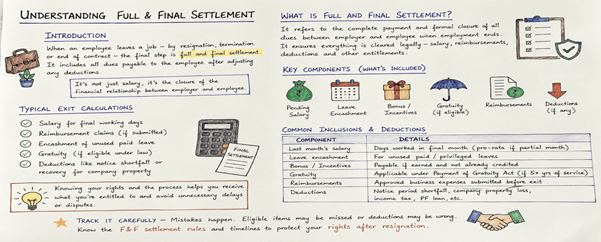
At the time of exit of an employee from an organisation, both the employee and employer must ensure that the following are properly accounted for and paid:
- Any unpaid earned salary which shall be payable on a pro-rated basis for the exact number of active days worked by the employee.
- Reimbursement business-related expense claims which have been submitted in accordance with the employer’s policies and practices.
- Encashment of unused paid leave calculated as per the employer’s polices and the applicable laws.
- Gratuity payment if the employee is eligible under the applicable law.
- Deductions like notice shortfall or recovery for company property
The above-mentioned components hold true when considering an employee’s exit and the full and final settlement of such an employee. These components and aspects remain the same irrespective of the nature of the organisation, whether a private, public, or government organisation. However, concerns arise when the final settlement is not conducted in the manner prescribed under the policies and applicable laws, or worse, when such a full and final settlement has been issued in an incorrect manner.
Unawareness of an employee leads to unjustified delays or the miscalculation of the full and final settlement by the employer. Therefore, it is important for an employee to be well-versed with the components of the final settlement to better enforce their rights to the financial dues entitled to them, as well as to ensure the smooth completion of the final settlement process.
What is Full and Final Settlement?
What is Full and Final Settlement
The full and final settlement acts as a point where both parties confirm that there are no continuing liabilities and that all amounts which are payable to the employee have been cleared as on the last working day of the said employee. The process is specifically mandatory as it is a legal requirement and acts as evidence towards the clearance of all obligations arising out of salary, reimbursements, deductions, and any other entitlements.
By understanding the scope of the full and final settlement, both the employer and employee can avoid confusion and ensure that all pending obligations between the parties are cleared at the time of exit of the employee from the organisation, ensuring that there is no further follow-up or communication between the parties regarding the same.
Common Inclusions and Deductions
Component | Details |
Last month’s salary | Days worked in final month, the calculation will be on apro-rata basis if the employee has worked for the partial month. |
Leave encashment | Applicable under the Shops and Establishment Act or any other applicable laws |
Bonus/Incentives | Payable if earned and not already credited |
Gratuity | Applicable under Code on Social Security, 2020) |
Reimbursements | Approved business expenses submitted before exit in accordance with the employer’s practices and policies. |
Deductions | Notice period shortfall, company property loss, income tax, PF loan, etc. |
Why It Matters to Track This Carefully
Knowledge of the full and final settlement and its components is essential because it allows the employee to be aware of their rights with respect to the financials owed to them at the time of exit. This ensures that the employee is able to not only assist the HR during the exit process, but also review the numbers quoted by the HR of the organisation. By doing so, the employee is able to not only obtain their financial entitlements, but also mitigate future litigation between the employer and employee.
This is why knowing the entitlements and the practices followed by the employer is essential to ensure that the rights of the employee are not hampered. Companies, through their internal mechanisms, have various timelines; while some employers may transfer the full and final settlement within seven days, others may take 45 days or more.
Delays beyond this point can become problematic. If your dues are not settled, you might struggle with joining formalities elsewhere, especially if you’re asked for proof of full and final payment after resignation.
Understanding your employee rights after resignation in India gives you the clarity and tools needed to question or escalate in case of incorrect settlement. Knowing what to expect also reduces the chances of the employer manipulating final payouts.
In most situations, HR teams won’t cheat deliberately, but that doesn’t mean errors won’t happen. It’s your money, and tracking it properly should never be an afterthought.
Full and Final Settlement Process in India
Full and Final Settlement Process in India
The full and final settlement largely is governed by the same formal steps as in any organisation, with slight variations which depend on the internal policies of the organisation. Furthermore, the entitlements in the full and final settlement also depend on the components being offered to the employee and the eligible statutory entitlements under applicable laws.
The timeline pertaining to the full and final settlement is largely governed by the applicable policies and the internal practices followed by the HR, which are also subject to applicable laws. Furthermore, in most circumstances, this timeline is delayed due to delays in the calculation of the full and final settlement, human error, or other factors.
Understanding this process helps prevent frustration and misunderstandings during the final phase of employment. If an employee doesn’t know what to expect, delays feel personal, even when they’re just due to procedural gaps.
Step-by-Step Flow of the F&F Process
The full and final settlement usually contains the following steps in India:
- Exit formalities completed (resignation accepted and final working day confirmed).
- Handover and clearance form filled by the employee.
- HR cross-verifies documents, notice period, and asset return.
- The finance department calculates pending salary, leave encashment, and reimbursements.
- Gratuity eligibility checked (if applicable).
- Final settlement sheet prepared and shared with the employee.
- Deductions applied, including tax, PF loan, notice buyout, etc.
- Payment processed and credited via payroll or NEFT.
- F&F acknowledgement collected from the employee.
Timeline Expectations
Timelines for the clearance of the full final settlement depends on the following factors:
- Type of organisation (MNCs, startups, public sector)
- Department response speed (HR, Finance, Admin)
- Exit time of year (end-of-quarter delays are common)
- Whether assets or documents are still pending
Many times, the completion of the full and final settlement is delayed on account of human delay arising out of the negligence of the HR or due to some pending obligations of the employee.
Common Delays and What Causes Them
Stage of Delay | What Usually Causes It |
Handover Completion | Manager unavailable, form not signed off |
Finance Approval | Year-end processing backlog, new payroll system errors |
Asset Verification | No follow-up, resignation not marked in the system |
HR Communication | Employee crosses 5 years just before exit, requires an extra check i.e. Gratuity |
Gratuity Processing | Employee crosses 5 years just before exit, requires extra check i.e. Gratuity |
Why This Process Breaks Down in Some Cases
Having clear procedures and policies implemented in the company with respect to the issuance of the full and final settlement helps transfer the full and final settlement in a compliant and timely manner. However, due to the presence of various departments and the concerns arising out of various approvals, the issuance of the full and final settlement may get delayed.
Each approval, obligation, or engagement of a different department acts as a hindrance in the timely issuance of the full and final settlement. For example, if you fail to raise any claim in the manner prescribed by the employer, the same may create a hindrance to the calculation of your full and final settlement.
Here are a few reasons full and final Settlement gets delayed or miscalculated:
- No automated system to trigger F&F request after last working day.
- HR exits are not being updated in the backend.
- Confusion around notice period length or waivers.
- Amount calculated on outdated data (e.g., older salary structure used).
- Bonuses or incentives are not approved in the system but are earned by the employee.
These delays aren’t always intentional, but when there is a lack of communication, a trust deficit starts to creep in. In some cases, that leads to escalation.
What Employees Should Do During This Phase
To avoid problems during this stage, employees should:
- Keep email proof of resignation, approval, and the last day.
- Ask for the F&F breakup sheet to verify items mentioned in the calculation be it entitlement or deductions.
- Confirm with HR if and when the file was sent to finance.
- Return all hardware, ID cards, and documents before the last day and provide any support as deemed relevant as per the employment agreement and the employer’s policies.
- Ask for a written timeline for full and final payment after resignation.
Summary: What the Law Says vs. What Happens
The Code on Wages, 2019 mandates that an employer must pay wages due to an employee within two working days from the date of their resignation. However, the specific timeline for whether the entire full and final settlement is required to be cleared within that stipulated period has not been provided under the applicable law. Thereby, any other components pertaining to the full and final settlement may be processed and paid to the employee in accordance with the applicable company policies.
Accordingly, an employee may seek the payment of wages as per the Code on Wages under the applicable laws for any delay in the issuance of wages that are due post-termination. However, any delay beyond a 60-day period without any reasonable cause is ground for seeking remedies before the appropriate authority, provided the employee has complied with all the relevant formalities.
What’s Included in Full and Final Payment?
The full and final settlement comprises more than just basic wages of the employee and also includes several other financial dues which may be payable to the employee during the course of their employment, such as remuneration for their leaves, reimbursement of any expenses, or any other similar financial dues.
Thus, every employee must be aware of the full and final settlement components which are applicable to them. This can be ensured by having a comprehensive document which defines each of the components that comprise the full and final settlement. Such a document must also include the relevant payouts and deductions.
If a full and final settlement is not handled properly, the employee may not receive the rightful amount due to them. Understanding the components ensures that after resignation, all dues pending between the company and the employee are completely resolved.
Key Inclusions in a Full and Final Settlement
Here’s what’s generally included:
- Unpaid salary up to the last working day (including any adjustments)
- Leave encashment (privileged/earned leaves only)
- Bonus or variable pay, if accrued and approved
- Gratuity, if the employee has completed 5 years of continuous service
- Reimbursement claims submitted and approved before the last day
- Notice period pay, if waived or bought out by either party
While components such as remuneration and other deductions (such as training costs) are covered by the internal policies of the employer, other components such as gratuity are subject to the applicable laws in India. Therefore, any full and final settlement must be governed by taking into consideration all of these factors.
Common Deductions in F&F
The deductions are common and sometimes disputed. The F&F includes:
- Unserved notice period (if not waived).
- Outstanding loans (PF loans or salary advances).
- Recovery of company assets, if not returned or damaged.
- Income tax, TDS as per the salary slab.
- Other penalties if mentioned in the employment agreement.
Employee should carefully review all deductions made to their full and final settlement, particularly where any amount has not been accounted for. This ensures that the transfer of the full and final settlement takes place in a timely manner. From the perspective of the employer, the employer should ideally provide a proper breakdown of the deductions to ensure that the communication is easy to understand and comprehend.
Where F&F Often Goes Wrong
Issuing full and final (F&F) settlement statements manually is prone to human error, administrative delays, and statutory non-compliance. Moving from a manual spreadsheet system to an automated HRMS (Human Resources Management System) mitigates these operational risks.
That’s why understanding the F&F settlement rules for employees is critical. You’re not being “difficult” by double-checking but you’re protecting your financial closure. While most of the time it goes fine, when it doesn’t, you need to know exactly what should’ve been included.
Employee Rights After Resignation in India
The termination of employment is not the end of the relationship between the employer and the employee. After the termination of employment, the employee and employer must discuss and clear all pending exit formalities, transfer the full and final settlement, and issue all relevant exit documents.
An employee may face certain issues after resignation, such as delayed salary payments, failure to receive a relieving letter or payslips, or unaccounted-for deductions in their full and final settlement that lack any rational basis. An employee must be aware of the applicable legal requirements and terms that govern their employment to ensure the mitigation of financial and legal risks.
Rights Related to Full and Final Settlement
Employees are entitled to a timely and transparent closure of employment. This includes:
- Full payment of dues (salary, leave, reimbursements)
- Final payslip with a clear breakup
- Relieving letter and experience letter
- Settlement summary or sheet
- Form 16 or final TDS slip (for tax purposes)
What the Employer Must Provide Post-Exit
Document/Item | Legally or Contractually Required? | Timeline (Best Practice) |
Final Payment | Yes (under employment law and contract) | Within 30 to 45 days |
Experience Letter | Contractual/Policy-based | Within 15 days (or on request) |
Relieving Letter | HR/Industry practice (not statutory) | Usually by last working day |
Final Payslip | Required for record-keeping | With full and final settlement |
Form 16 | As per Income Tax compliance | By May/June of following year |
Legal Rights If Payment Is Delayed
If the full and final payment after resignation is not made within a reasonable period, the employee has legal remedies. These include:
- Filing a written complaint to the HR or Compliance department
- Sending a legal notice through a labour lawyer
- Approaching the Labour Commissioner in your jurisdiction
- Filing a case in Labour Court if the dues exceed the threshold
- Escalating the matter through the state’s online labour grievance portal
Under the Code on Wages, 2019, wages due to an employee upon resignation, dismissal or retrenchment must generally be paid within two working days. However, this statutory timeline applies specifically to “wages” covered under the Code, while other components of a full and final settlement may be governed by separate legal requirements, employment terms or applicable company policies.
Still, many HRs are not following these timelines, and employees don’t know how to respond.
Key Rights Employees Often Don’t Realise They Have
- Right to ask for a breakup of full and final settlement
- Right to delay signing if calculations look incorrect
- Right to receive payment even during dispute (the company can’t withhold salary)
- Right to refuse last-minute deductions without legal justification
- Right to receive PF and gratuity separately, even if the company is delaying F&F
These protections fall under F&F settlement rules for employees. They aren’t optional—they’re backed by labour guidelines and court precedents.
Mistakes Employees Make After Resignation
There are instances where employees lose out not because of the law, but because of a lack of action. For example:
- Not documenting resignation or final communication.
- Assuming the employer will “automatically” handle F&F.
- No follow-ups made for the dues.
- Accepting a partial settlement without questioning.
- Not verifying deductions or leave balance.
Even if the employer is at fault, employees who don’t speak up or send reminders weaken their case. If legal action becomes a necessity, proof is everything to make a legally sound case.
Final Thought
The employee rights after resignation in India aren’t just formalities since they are meant to protect workers from unfair treatment during the most vulnerable stage of their employment journey i.e., the exit. Whether it’s a small company or an MNC, every organisation is expected to comply with fair employment standards.
Common Delays & Mistakes in F&F Process
Even in a well-structured and operational organization, the final settlement may face difficulties due to delays arising out of the carelessness of either party. In any event, the employee suffers from such delays, which may lead to financial distress and delays in background verification with a prospective employer..
Where Mistakes Commonly Happen
Area | What Goes Wrong |
Resignation Process | Not sent via official email, or the manager forgets to acknowledge |
Handover Checklist | Incomplete or submitted late |
Exit Interview | Not scheduled or skipped, affecting closure |
Asset Return | Partial return or no IT verification |
Finance Clearance | Wrong salary inputs, pending bonus approvals |
Document Gaps | Missing PAN/Aadhar, tax forms, or prior loan statement |
Mistakes Employees Make That Add to the Delay
- Leaving without collecting a formal resignation acceptance.
- Trusting HR to “automatically handle” everything.
- Not tracking handover status with the manager.
- Failing to send written reminders about dues.
- Accepting verbal promises instead of documented follow-up.
Major concerns arise when employees, while receiving the settlement sheet, do not even go through the particulars mentioned and simply sign the document and acknowledge the amount mentioned therein. This causes concern as the employee may have missed certain financial benefits that may be liable to be paid by the company and have not been mentioned in the settlement sheet, or the employer has wrongly charged deductions on the employee’s full and final settlement.
How to Avoid These Issues
- Ask for an F&F breakup before signing anything.
- Keep a checklist and send polite follow-ups.
- Maintain email proof of every step.
- Check if your gratuity, leave balance, and bonuses are included.
- Push HR for timelines and do not assume that they’re on top of it.
Legal Remedies for F&F Delay
If repeated reminders do not lead to payment or a meaningful response, the employee may consider formal remedies. Where amounts remain unpaid beyond the applicable statutory timeline, the employee can escalate the matter internally, approach the appropriate labour authority, or pursue other remedies available under applicable employment laws.
Internal Escalation First
Before reaching out to legal channels, always try escalating internally. This includes:
- Emailing the HR head or senior manager directly.
- Marking the Finance head in the communication trail.
- Sending a final warning email requesting the F&F settlement sheet.
- Sharing resignation letter, exit clearance, and other proof.
In many companies, this triggers quick action because nobody wants a legal notice in their inbox.
When to Send a Legal Notice
A legal notice can be issued once the employee has exhausted all the options available to them, which include, but are not limited to, email, telephonic communication, and follow-ups. A legal notice must be prepared by a legal professional to substantially communicate all of the factors relevant to the employee’s full and final settlement.
The legal notice should include:
- Date of resignation and last working day
- List of dues pending (salary, bonus, etc.)
- Attachments: resignation acceptance, clearance proof
- Deadline (7–10 days) for the employer to settle
Labour Department Intervention
In the event that the employer fails to respond to the legal notice issued by the employee, the employee has the right to approach the appropriate forum for seeking legal remedies and the remaining amount due to them. This is especially effective if the employer falls within the scope of any of the labor courts, including the Code on Wages and the Shops and Establishments Act.
You can:
- File a written complaint with supporting documents
- Submit forms via the local labour portal (in most Indian states)
- Appear for the conciliation hearing if called
- Request payment as per the applicable labour law
In some cases, unpaid F&F becomes a matter for the labour court, especially if the F&F settlement rules for employees were violated or ignored after documentation was submitted.
When to Go Legal, Red Flags to Watch
- No response for over 30–45 days post-resignation.
- HR says it’s done, but no credit received.
- The settlement sheet was shared, but the deductions were unexplained.
- Employer denies resignation or backdates acceptance.
- Gratuity or bonus blocked without a legal basis.
FAQ
1: What is considered a full and final settlement in India?
Full and final settlement includes salary, unused leaves, reimbursement, bonus and gratuity of the employee. It also includes any benefits which is being offered by the employer through its policies.
2: How long does full and final settlement usually take?
While the Code on Wages, 2019 mandates the payment of wages within two working days from the date of an employee’s resignation or termination, the remaining non-wage components can be remitted in accordance with applicable policies and governing laws.
3: Is F&F payment legally required in India?
Yes, employers are required to pay the pending dues that are payable to the employees. These payment requirements also arise from the Code on Wages, 2019, as well as the Shops and Establishments Act.
4: Can the company just delay my F&F?
The company can withhold the full and final settlement in the event of any non-compliance with exit formalities, which include the notice period or the handover of company assets. However, in the event that the company withholds the salary of an employee for a period beyond reasonable cause, the employee can seek legal remedies.
5: What if the amount in my F&F looks wrong?
The employee can seek out the breakup of the full and final settlement from the employer. The employee may thereafter cross-reference the deductions and the payouts and reach out to the employer if there is any discrepancy.
6: Is it okay not to sign the F&F statement if I find issues?
Signing of the F&F statement is an acknowledgment of the amount mentioned therein as the full and final dues payable by the company to the employee. Therefore, if the employee feels that there is any discrepancy in such amount, they must refrain from signing the document and reach out to the concerned individual in the organization to ensure that all pending dues are properly accounted for.
7: What if my company didn’t give a relieving or experience letter after F&F?
The release of the relieving letter and the experience letter is separate from the issuance of the full and final settlement, and thereby, the employee is entitled to such exit documents irrespective of the status of the full and final settlement.
8: Is gratuity always part of the final settlement?
In the event that you have completed the requirements to be eligible for gratuity under the Code on Social Security, 2020, you shall be entitled to the payment of gratuity as a part of your full and final settlement, as it forms part of your statutory benefits.
9: What should I do if they’re just not responding even after exit?
In the event that the employer does not respond to you regarding your full and final settlement after your exit, you may continue to follow up with them. Alternatively, you may issue a legal notice to the employer seeking the clearance of your dues. As a last resort, you can also file a complaint before the appropriate authorities.
Conclusion: Know Your Exit Rights Clearly
The full and final settlement forms a crucial part of the employment cycle for any employee with a given employer. The full and final settlement comprises salary, leave encashment, bonuses, incentives, gratuity, and any other benefits offered by the company to the employee. Given the financial nature of the exit procedure, there have been numerous unjustified deductions made to the full and final settlement of employees. To avoid such unjustified deductions, an employee must maintain a written record of all payouts and deductions applicable to their full and final settlement.
To ensure that they have everything in writing, the employee can cross-reference these documents while signing the full and final settlement calculation sheet. Furthermore, by maintaining proper supporting documents, the employee can seek escalation for any wrongful deductions made by the employer to the full and final settlement.