


Reviewed and Validated by: Aamna Munaima, Associate | New Wage Code Salary Structure
Introduction: New wage code salary structure
- The recently implemented Code on Wages, 2019 (“CoW”) is going to change the way of structuring the salary in India with a revised definition of “wages” implementing the 50% threshold rule for the wages.
- It is essential for both employers and employees to understand that the revised definition of wages impacts the various components that contribute to salary, including base pay, allowances, and deductions. In practice, employers may have to revisit the benefits and proportion of such benefits being offered to ensure compliance with compliance with the CoW.
- This law strives to maintain standardisation in the salary structure, which will in turn ensure compliance with the CoW across businesses. The revised definition allows clarity and ease of compliance with the other applicable provision including but not limited to provident fund calculation, maternity benefits and full and final settlement.
- In this article, we will cover:
- Changing the definition of wages and its relevance to the current salary structure of an employee;
- Important salary elements and the relevance of such element in the wage code restructuring;
- How will the changes affect take-home salary and EPF/ESIC contribution of any employee and the potential financial impact of such restructuring; and
- What the updated framework means for businesses and their compliance calls and the relevant call for action for such entities.
Overview of the Code on Wages, 2019
The CoW is a landmark reform towards simplifying and harmonising wage-related laws in India which consolidates four existing labour laws and creates a blanket definition of wage across all laws and is applicable to all industries. The main aim is to establish uniformity in salary calculations, ensure better compliance, and enhance social security benefits to the employees. Practically, the code ensures that employers are unable to avoid their statutory obligations by reducing the base salary of the employee below the 50% of their total renumeration.
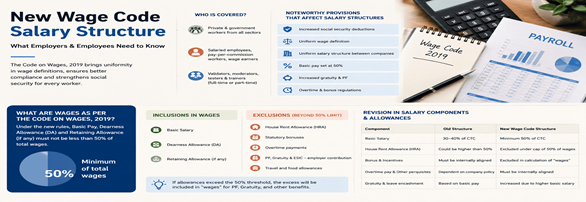
New Wage Code Framework & Salary Structure Changes
Who is covered under the New Wage Code?
The CoW is a comprehensive law which is applicable to the following:
- Private and government workers from all sectors.
- Salaried employees, pay-per-commission workers, wage earners.
- Validators, moderators, testers, and trainers, full-time or part-time.
Now, as per the wage code, employers must restructure the payroll to comply with the salary components. This process involves employee wise review of the CTC structure to determine the inclusion or exclusion of the salary components.
Noteworthy provisions that affect salary structures
Provision | Increased Social Security deductions |
Uniform wage definition | Uniform salary structure between companies |
Basic pay set at 50% | Increased social security deductions |
Increased gratuity & PF | More deductions, less money in paycheck |
Overtime & bonus regulations | employers should re-adjust salary packages. |
For organisations, the implementation of the new definition of wage triggers a new compliance requirement and mandates that the employer undertakes the restructuring of payroll for its current employees to ensure that compliance with the labour code is not only less taxing on it financially, but also improves the benefits for the employees.
What are wages as per the New Code on wages?
Under the new labour code, the legal definition of wages has now been restructured to include basic pay, dearness allowance, and retaining allowance. The code further mandates that these three components of the wage of the employee make up at least 50% of the total remuneration of the employee. This restructuring is crucial because this definition of wage is now used for all statutory benefits.
Inclusions in wages
- Basic Salary
- Dearness Allowance (DA)
- Retaining Allowance (if any)
Wages (Exclusions beyond the limit of 50%)
- House Rent Allowance (HRA)
- Statutory bonuses
- Overtime payments
- PF, gratuity, and ESIC – employer contribution
- Travel and food allowances
When the exclusions exceed 50% of an employee’s total remuneration, the surplus amount must be added back to the wage base that is defined under the code. This revised wage amount is then used for the calculation of statutory obligations and benefits such as the Provident Fund, gratuity, and ESI.
What is the effect of the New Wage code on the salary?
- The revision allows for the basic pay to be revised in a manner that decreases the take-home salary of the employee and increases the statutory benefits applicable to such employees.
- By way of restructuring of wages, the employer may witness a certain financial burden due to contributions towards statutory benefits.
- Excluded compensation components must constitute less than 50% of the total renumeration.
This is a guide to salary restructuring under the new wage code.
Salary component | Old structure | New Wage Code structure |
Basic salary | ₹20,000 (40% of CTC) | ₹25,000 (50% of CTC) |
Allowances | ₹30,000 | ₹25,000 (Max 50%) |
Provident fund (12%) | ₹2,400 | ₹3,000 |
Gratuity (4.81%) | ₹962 | ₹1,202 |
Net take-home | Higher | Lower due to higher deductions |
While the amendment to the salary structure does not guarantee financial benefit to the employees, it is a step towards compliance with the Code on Wages by the employer.
Now with Wages Code impact salary calculation, the businesses and HR teams need to carefully revise the Salary structure for employees on how to balance both employee benefits and compliance aspects.
Revisions in salary components & allowances
The Code on Wages specifically defines the definition of wage, thereby dictating the framework for the internal divisions of the compensation components. This fundamentally changes the net earnings calculation and thereby, to maintain regulatory compliance, the employer must revisit the current component structure and allowances to align them in accordance with the new code and the guidelines issued by the labour authorities.
Important changes in components of salary
Component | Old structure | New Wage Code |
Basic Salary | 30-40% of CTC | Minimum 50% of CTC |
House Rent Allowance (HRA) | Could be higher than 50% | Excluded under caps of 50 percent of wages |
Bonus & Incentives | Must be internally aligned with the new wage structure | Excluded in the calculation of “wages” |
Overtime pay & Other perquisites | Dependent on company policy | Must be internally aligned with new wage structure |
Gratuity & leave encashment | Based on basic pay | Increased due to an increase in basic salary |
Adopting such change, salary components as per wage code will need to be realigned to ensure compliance and employee benefit optimization.
Effects on employee take-home pay and deductions
Under the Code on Wages, 2019, a shift in net take-home salary represents one of the primary concerns that arise from the restructuring of salaries. The new definition of wages ensures that the basic pay of an employee constitutes 50% of the total remuneration while increasing the statutory benefits of the employee (which reduces the take-home salary). The restructuring of the wage also constitutes an operational cost for the employer, as they face a larger financial impact from the payment of gratuity.
Major impacts on employee salary
- Higher Provident Fund (PF) Deductions: As the basic salary increases, PF deductions (12%) will also go up, which may reduce take-home pay.
- Higher gratuity is payable: Employees will receive more gratuity as they will be calculated on higher basic pay.
- Effect on taxable income: As allowances are defined, tax-saving opportunities via exemption (such as HRA) may be limited.
New salary sheet framework
Salary component | Old salary (₹) | New Wage Code (₹) |
Basic salary (50% of CTC) | 30,000 | 40,000 |
HRA | 15,000 | 10,000 |
PF deduction (12%) | 3,600 | 4,800 |
Gratuity (4.81%) | 1,443 | 1,924 |
Net take-home | Higher | Lower (due to higher deductions) |
Though this will create better financial security in the long term, employees will have to re-calibrate their financial planning considering these, and other, changes.
Payroll adjustments & employer compliance
To effectively manage the operational and financial impact of India’s new Wage Code, organisations must realign salary structures and update internal compliance practices. Adapting to these regulations requires employers to navigate several critical structural and operational changes.
- Payroll processing & salary structuring: Employers will have to re-compute salaries to comply with the 50% basic wage rule, ensuring wages are forming part of 50% of the total renumeration.
- Statutory contributions & Tax deduction: Higher PF & gratuity will cost companies.
- Total cost-to-company (CTC) calculations will rise: Given the increase in employer obligations, the total cost-to-company for most employees is set to rise.
- Amendments in employment contracts & salary agreements: Companies need to revise the employment contracts to achieve the compliance of wage code.
How should employers prepare?
- Realign salary ranges to ensure competitive compensation;
- PF, ESIC, and bonus compliance;
- Prepare HR and payroll teams for the wage code implementation; and
- communicate changes to employees.
We offer wage structuring services for organisations to ensure compliance with the Code on Wages on an employee-by-employee basis, ensuring that the employer complies with the codes while reducing the financial burden on the employer.
The new salary structure: Challenges & benefits
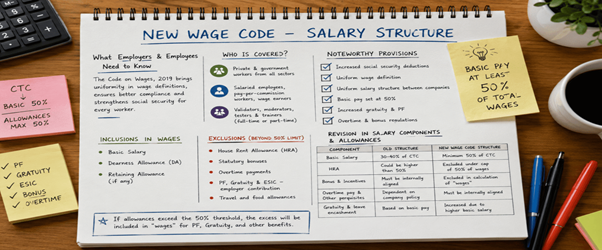
Impact on Employees & Employers
While standardising compensation allows for greater clarity for employees, building trust, it simultaneously mandates that leadership review the payment structure and absorb the higher compliance costs incurred due to such restructuring.
Challenges for businesses
- The New Wage Code Salary Structure presents several challenges for businesses, such as the need to modify payroll systems to align with the updated definition of “wages.” Companies must also contend with rising compliance costs stemming from more stringent regulations, and there is a risk of employee dissatisfaction if pay adjustments are not managed effectively. Additionally, businesses will need to address regional differences in wage implementation and may encounter cash flow difficulties due to the requirement for timely wage payments, particularly affecting smaller enterprises. Higher compliance burden – Employers have to reconfigure salary components to comply with the Wage Code Salary Calculation prescription that requires at least 50% of CTC to be paid as basic pay.
- Due to higher PF and gratuity contributions, the total employee cost for companies may increase.
- Payroll teams need to re-evaluate compensation structures for contract-based and gig workers based on the New Wage Code India latest update.
- Businesses will need to review employment contracts, payroll deductions and existing compliance processes to ensure alignment with the new requirements. This will also require HR teams to assess current compensation structures and clearly communicate any resulting changes to employees.
Benefits for employees
- Higher long-term savings — More PF and gratuity contributions lead to employees building a better pension.
- Improved financial stability – The revised salary components under the wage code also guarantee equitable pay and legal protection.
- More openness in salary calculation – The wage code standardizes wage structures, not allowing for adjustment in allowances.
- Just pay minimum wages – The new salary definition guarantees that all sectors are equally subject to minimum wage regulations.
- Stronger overtime and leave policies – Overtime and leave policies will be strengthened
- Timely payment of wages – Employees will receive their wages on time
- Gratuity for fixed-term employees – Employees will be eligible for gratuity after one year of service.
How HR & payroll groups should get ready?
- Make sure to conduct salary audits to ensure the new salary structure is being followed.
- Inform employees about the impact on take-home salary and benefits.
- Rethink CTC Scaffolding to balance employer costs and employee benefits
- Update payroll software as per the impact of the New Wage Code on salary.
FAQs on the New Wage Code salary structure
- What are the components of wage and salary?
Under the new code, the wage includes basic pay, dearness allowance, and retaining allowance, whereas the salary components also include HRA, bonus, overtime, and provident fund.
- What are the 4 wage codes?
There are four wage codes are Code on Wages, 2019, Industrial Relations Code, 2020, Occupational Safety, Health & Working Conditions Code, 2020 and Social Security Code, 2020.
- What are the components of wages?
The New Wage Code India latest update defines wage to be all emoluments — basic salary, DA, HRA, conveyance, special allowances, and bonuses. Nevertheless, allowances cannot be more than 50% of total wages, so basic pay is the main part.
- What is meant by wages under the Code of Wages?
Wages comprise basic pay, dearness allowance, and retaining allowance, while explicitly excluding components like overtime, HRA, and statutory bonus. It mandates that the total excluded allowances do not exceed 50% of overall remuneration.
- What is section 26 of the Code on Wages?
Section 26 of the Code on Wages states every employee earning wages up to a threshold prescribed by the appropriate government and having worked for at least 30 days in an accounting year is legally entitled to a minimum annual bonus of 8.33% of their wage.
Conclusion
The Code on Wages, 2019 is expected to significantly change the way employee compensation is structured in India, with implications for both statutory deductions and employee benefits. By requiring wages to account for at least 50% of total remuneration, it may increase the amount considered for calculating provident fund contributions, gratuity and certain tax-related liabilities.