

Reviewed and Validated by: Shubham Dwivedi, Advocate
Introduction: Bharatiya Nagarik Suraksha Sanhita, 2023
The Bharatiya Nagarik Suraksha Sanhita 2023 Bare Act PDF (“BNSS, 2023”) is one of the three new criminal law statutes enacted as part of India’s historic legal reforms of 2023. Alongside the Bharatiya Nyaya Sanhita, 2023 (replacing the IPC) and the Bharatiya Sakshya Adhiniyam, 2023 (replacing the Evidence Act), the BNSS repeals and replaces the Code of Criminal Procedure, 1973 (CrPC) — a law that had governed criminal procedure in India for nearly five decades.
The BNSS was passed by Parliament in December 2023 and came into effect in July 2024. Its primary aim is to modernise India’s criminal justice process by introducing technology-driven procedures, reducing delays, strengthening victim rights, and ensuring greater accountability in law enforcement.
Why the BNSS, 2023 was enacted:
- To replace the colonial-era CrPC, 1973 with a law reflecting present-day realities.
- To streamline investigation, trial, and appeal processes with strict timelines.
- To incorporate digital-first mechanisms such as e-FIRs, video-conference hearings, and electronic summons.
- To expand victim participation and protect citizen rights during investigation and trial.
- To improve transparency and accountability of police and prosecution.
For lawyers, compliance professionals, and citizens, the Bharatiya Nagarik Suraksha Sanhita 2023 Executive Summary PDF prepared by Corrida Legal offers a quick yet comprehensive understanding of the statute. A copy of the Bharatiya Nagarik Suraksha Sanhita 2023 PDF Corrida Legal is also available in our resources section for direct download.
What is the Bharatiya Nagarik Suraksha Sanhita, 2023?
The Bharatiya Nagarik Suraksha Sanhita 2023 Bare Act PDF (BNSS, 2023) is the new procedural law governing investigation, arrest, bail, trial, and appeal in criminal matters across India. It repeals the Code of Criminal Procedure, 1973 (CrPC), which had been in force for over 50 years. With the enactment of BNSS, India has replaced a colonial-era framework with a modern, citizen-centric, and technology-driven system of criminal justice.
The BNSS, 2023 was enacted alongside two other major statutes — the Bharatiya Nyaya Sanhita, 2023 (substituting the IPC) and the Bharatiya Sakshya Adhiniyam, 2023 (substituting the Evidence Act). Together, these three laws form the foundation of India’s reformed criminal law framework,
effective from 1 July 2024.
Purpose and scope in the Bharatiya Nagarik Suraksha Sanhita 2023
The Bharatiya Nagarik Suraksha Sanhita 2023 Executive Summary PDF highlights the following objectives:
- Replacing outdated law: modernise and replace CrPC, 1973 to meet present-day needs.
- Technology integration: enable e-FIRs, digital records, video-conference hearings, and electronic summons.
- Victim-centric approach: ensure greater participation of victims in criminal proceedings.
- Time-bound procedures: set deadlines for investigation, filing of charge-sheets, and conclusion of trials.
- Police accountability: mandatory audio-video recording of searches, seizures, and statements.
- Uniform application: extend across all states and union territories, except where specific exemptions are notified.
This makes the BNSS, 2023 both a continuity of India’s procedural framework and a progressive step toward reform.
Consolidation and innovations in the Bharatiya Nagarik Suraksha Sanhita 2023
Corrida Legal’s analysis of the Bharatiya Nagarik Suraksha Sanhita 2023 PDF Corrida Legal notes that while the BNSS retains much of the structure of the CrPC, it introduces several new features and innovations:
- E-FIRs: first information reports can now be registered electronically, including by audio- visual means.
- Forensic evidence: mandatory forensic investigation in serious offences.
- Witness protection: provisions for examination through video-conferencing and relocation in sensitive cases.
- Custody periods: modified rules for detention, with safeguards against arbitrary arrest.
- Speedy trials: stricter limits on adjournments and compulsory disposal of bail applications within set timelines.
- Digital processes: electronic service of summons, warrants, and judgments. These reforms align criminal procedure with India’s push toward digital governance.
Uniformity and clarity in the Bare Act PDF Bharatiya Nagarik Suraksha Sanhita
The Bare Act PDF Bharatiya Nagarik Suraksha Sanhita 2023 Download reflects the legislature’s intent to make criminal procedure uniform, efficient, and accessible.
Salient features include:
- jurisdiction, powers, and functions of criminal courts remain largely intact, but timelines are tightened,
- procedures for arrest, bail, and trial are restructured to ensure citizen rights are respected,
- police procedures are brought under stricter oversight to prevent misuse,
- technology-driven processes reduce reliance on physical paperwork and delays.
This ensures that the BNSS delivers both continuity and change, retaining familiar structures while embedding modern reforms.
Scope & Applicability of the Bharatiya Nagarik Suraksha Sanhita, 2023
The Bharatiya Nagarik Suraksha Sanhita 2023 Bare Act PDF extends to the entire country and governs all aspects of criminal procedure, from investigation and arrest to trial, sentencing, and appeal. It replaces the CrPC, 1973 in its entirety, while retaining the overall structure of criminal procedure law. The scope of the BNSS is deliberately broad, ensuring uniform application across
states and union territories, with only limited exceptions where special local laws or rules may prevail.
Coverage explained in the Bharatiya Nagarik Suraksha Sanhita 2023
The Bharatiya Nagarik Suraksha Sanhita 2023 Executive Summary PDF highlights the wide applicability of the law:
- Geographic scope: applicable throughout India (including Jammu & Kashmir, unless specifically exempted).
- Subject matter: governs the procedures of criminal courts, powers of police, and rights of citizens in criminal proceedings.
- Types of cases covered: applies to all cognizable and non-cognizable offences, from investigation through final appeal.
- Institutions bound: criminal courts, police, prosecution agencies, forensic bodies, and correctional institutions.
- Technology coverage: applies to digital processes such as e-FIRs, electronic summons, video conferencing, and forensic integration.
This makes the BNSS a comprehensive framework for criminal justice administration in India.
Corrida Legal’s analysis in the Bharatiya Nagarik Suraksha Sanhita 2023 PDF Corrida Legal
Corrida Legal’s review of the Bharatiya Nagarik Suraksha Sanhita 2023 PDF Corrida Legal underlines that the applicability of the BNSS goes beyond traditional boundaries of the CrPC.
Practical implications include:
- Corporates and employers: obligations during investigation, especially in cybercrime, fraud, and workplace-related offences.
- Citizens: protection of rights during arrest, investigation, and trial under the new framework.
- Police and prosecutors: greater accountability due to mandatory recording and reporting obligations.
- Judiciary: bound by stricter timelines for trial, bail hearings, and case management.
- Victims: stronger participation rights, including access to information and presence during trial proceedings.
This broad applicability ensures that all stakeholders in the justice system are directly impacted by the BNSS.
Enforcement clarity in the Bare Act PDF Bharatiya Nagarik Suraksha Sanhita
The Bare Act PDF Bharatiya Nagarik Suraksha Sanhita 2023 Download makes it clear that the Sanhita has overriding effect over prior criminal procedure laws.
Key enforcement aspects include:
- BNSS is the sole governing statute for criminal procedure in India post-2024.
- Powers of arrest, investigation, search, and seizure derive exclusively from BNSS.
- Procedures for bail, trial, and appeal are governed entirely by BNSS provisions.
- Local or state amendments are permissible only where expressly authorised.
- Any inconsistency with prior laws is resolved in favour of BNSS.
Thus, the Sanhita functions as the definitive law of criminal procedure for India.
Major Procedural Reforms Introduced under the Bharatiya Nagarik Suraksha Sanhita, 2023
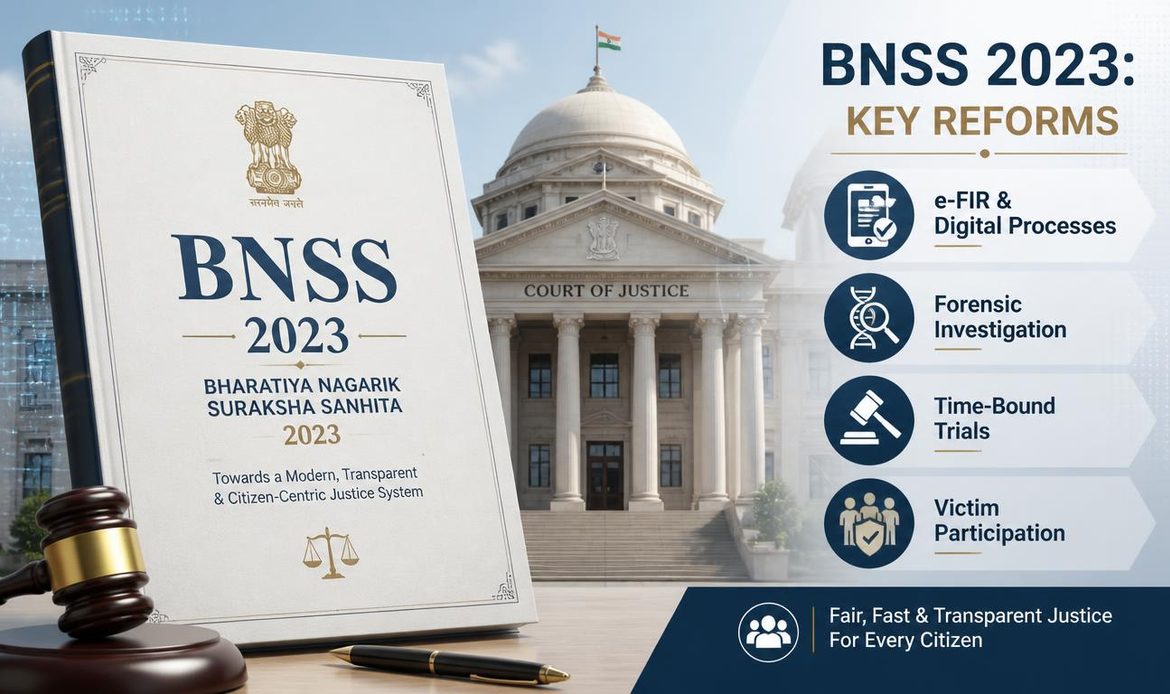
The Bharatiya Nagarik Suraksha Sanhita 2023 Bare Act PDF brings forward some of the most significant procedural reforms in India’s criminal justice system in over five decades. While much of the structure of the CrPC, 1973 has been retained for continuity, the BNSS introduces modern mechanisms to address delays, strengthen citizen rights, and integrate technology into the justice process. These reforms reflect a decisive shift toward transparency, accountability, and efficiency.
Highlights from the Bharatiya Nagarik Suraksha Sanhita 2023 Executive Summary PDF
The Bharatiya Nagarik Suraksha Sanhita 2023 Executive Summary PDF lists the following key procedural reforms:
- Electronic FIRs: FIRs can now be registered online, including via audio-visual means, making access easier for citizens.
- Mandatory forensic investigation: offences punishable with imprisonment of seven years or more require forensic experts to be involved.
- Video recording of processes: searches, seizures, and certain confessions must be audio- video recorded.
- Digital case management: electronic service of summons, warrants, and notices.
- Witness examination by video conferencing: reduces delays and protects sensitive witnesses.
- Timelines for investigation and trial: stricter deadlines for filing charge-sheets, completing investigation, and disposing of bail applications.
- Limits on adjournments: courts cannot grant unlimited adjournments, ensuring trials move faster.
- Summary trials for minor offences: quicker disposal of petty cases to reduce case backlog.
- Victim participation: victims entitled to copies of FIR, progress reports, and opportunities to be heard during trial.
These features aim to make criminal procedure more citizen-friendly and less prone to abuse.
Corrida Legal’s analysis in the Bharatiya Nagarik Suraksha Sanhita 2023 PDF Corrida Legal
Corrida Legal’s review of the Bharatiya Nagarik Suraksha Sanhita 2023 PDF Corrida Legal emphasises that the BNSS reforms are not cosmetic but structural.
Practical implications include:
- Police: accountability increases with mandatory recording and forensic reliance.
- Courts: greater responsibility to manage timelines and restrict adjournments.
- Victims: improved access to justice and greater involvement in proceedings.
- Accused persons: procedural safeguards such as information of arrest grounds and timely bail hearings strengthened.
- Corporates & employers: implications for compliance in cybercrime, financial fraud, and workplace-related criminal cases.
These reforms bring India closer to global standards in procedural justice.
Enforcement clarity in the Bare Act PDF Bharatiya Nagarik Suraksha Sanhita 2023 Download
The Bare Act PDF Bharatiya Nagarik Suraksha Sanhita 2023 Download reflects the enforceability of these reforms through statutory provisions:
Enforcement mechanisms include:
- deadlines for investigation (e.g., 90 or 180 days depending on offence) codified into law,
- electronic case tracking systems mandated for courts and police,
- penalties for non-compliance with procedural safeguards,
- binding effect of forensic and video evidence,
- appellate oversight where procedures are not followed.
This ensures reforms are not merely aspirational but enforceable obligations.
Rights of Citizens under the Bharatiya Nagarik Suraksha Sanhita, 2023
The Bharatiya Nagarik Suraksha Sanhita 2023 Bare Act PDF strengthens and codifies the rights of citizens in the criminal justice process. While the CrPC, 1973 contained several safeguards, the BNSS expands these protections by introducing clearer procedures, stricter timelines, and greater use of technology. The focus is to balance the powers of police and prosecution with enforceable rights for individuals, ensuring fairness and accountability.
Citizen rights explained in the Bharatiya Nagarik Suraksha Sanhita 2023 Executive Summary PDF
The Bharatiya Nagarik Suraksha Sanhita 2023 Executive Summary PDF outlines the following rights of citizens:
- Right to legal aid: every accused person has the right to consult a lawyer and access free legal aid where eligible.
- Right to be informed: an arrested person must be told the grounds of arrest and shown a copy of the FIR.
- Protection against arbitrary arrest: safeguards limit detention without proper authorisation.
- Right to bail hearing: bail applications must be disposed of within seven days of filing.
- Right to fair trial: cases must be conducted within time-bound schedules, reducing prolonged detention.
- Right to information for victims: victims have access to FIR copies, investigation updates, and trial participation.
- Right to speedy justice: strict limits on adjournments and mandatory deadlines for investigations and charge-sheets.
- Right to dignity during investigation: mandatory video recording of searches and interrogations to prevent abuse.
These protections aim to make the criminal justice system more transparent and citizen-friendly.
Corrida Legal’s analysis in the Bharatiya Nagarik Suraksha Sanhita 2023 PDF Corrida Legal
According to Corrida Legal’s commentary on the Bharatiya Nagarik Suraksha Sanhita 2023 PDF Corrida Legal, the rights granted under the BNSS go beyond those in the CrPC.
Key practical points include:
- Victim-centric justice: greater role for victims in the investigative and trial process.
- Arrest safeguards: mandatory communication of arrest details to relatives or nominated persons.
- Digital access: FIRs and summons can be shared electronically, reducing barriers for citizens.
- Bail reforms: time-bound hearings reduce unnecessary incarceration.
- Transparency: mandatory audio-video recording of processes creates verifiable records for courts.
For citizens, this means stronger protection against misuse of police powers and faster access to justice.
Enforcement under the Bare Act PDF Bharatiya Nagarik Suraksha Sanhita 2023 Download
The Bare Act PDF Bharatiya Nagarik Suraksha Sanhita 2023 Download provides enforceable mechanisms to uphold these rights:
Enforcement aspects include:
- courts empowered to release persons where investigation timelines are violated,
- police liable to disciplinary and legal consequences for unlawful arrest or detention,
- failure to provide bail hearing within the prescribed time can be challenged before higher courts,
- victims may approach courts for enforcement of their participatory rights,
- recorded evidence ensures accountability in cases of custodial misconduct.
This ensures that citizen rights under the BNSS are not merely declaratory but legally enforceable.
Police powers highlighted in the Bharatiya Nagarik Suraksha Sanhita 2023 Executive Summary PDF
The Bharatiya Nagarik Suraksha Sanhita 2023 Executive Summary PDF outlines the following core powers of the police under the new law:
- Registration of FIRs: introduction of e-FIRs and audio-visual reporting of complaints.
- Investigation powers: power to collect evidence, conduct searches and seizures, and interrogate suspects, now subject to mandatory video recording.
- Forensic involvement: police must involve forensic experts in cases punishable with seven years or more.
- Custody of accused: revised provisions on detention periods, balancing investigation needs with safeguards against arbitrary arrest.
- Cybercrime jurisdiction: expanded powers to investigate digital and cyber-related offences across state boundaries.
- Electronic summons and warrants: power to issue and serve summons, warrants, and notices electronically.
- Use of technology: police empowered to rely on digital records, electronic evidence, and video conferencing.
These powers equip law enforcement agencies to handle modern challenges more effectively.
Corrida Legal’s analysis in the Bharatiya Nagarik Suraksha Sanhita 2023 PDF Corrida Legal
Corrida Legal’s review of the Bharatiya Nagarik Suraksha Sanhita 2023 PDF Corrida Legal points out that while police powers have been expanded, so have the corresponding checks and balances.
Practical implications include:
- Accountability: all searches, seizures, and interrogations must be recorded, preventing misuse of power.
- Transparency: mandatory sharing of FIR copies and investigation reports with victims.
- Forensic reliance: reduces dependence on confessions, making investigations more evidence-driven.
- Speedy disposal: time limits for investigations mean police must act efficiently, avoiding prolonged detentions.
- Interstate jurisdiction: allows police to respond swiftly in cyber and cross-border offences without procedural hurdles.
For lawyers and compliance officers, this means closer scrutiny of police action in light of statutory safeguards.
Enforcement under the Bare Act PDF Bharatiya Nagarik Suraksha Sanhita 2023 Download
The Bare Act PDF Bharatiya Nagarik Suraksha Sanhita 2023 Download provides detailed provisions on how police powers are to be exercised and monitored:
Key enforcement aspects include:
- FIR registration cannot be denied where a cognizable offence is disclosed.
- Custody beyond prescribed periods requires judicial authorisation.
- Digital records of investigation can be produced as admissible evidence.
- Inspector-cum-supervisory officers accountable for ensuring compliance with recording obligations.
- Courts empowered to quash proceedings if police act outside statutory limits. This makes the exercise of police powers more transparent and subject to legal oversight.
Judicial Reforms & Courts under the Bharatiya Nagarik Suraksha Sanhita, 2023
The Bharatiya Nagarik Suraksha Sanhita 2023 Bare Act PDF not only restructures police powers but also introduces critical reforms for India’s criminal courts. The BNSS recognises that one of the biggest challenges in the justice system is the delay in trials, and accordingly, it sets out strict timelines and streamlined procedures for bail, adjournments, and case management. These reforms aim to make criminal trials faster, more efficient, and fairer to both victims and accused persons.
Judicial reforms in the Bharatiya Nagarik Suraksha Sanhita 2023 Executive Summary PDF
The Bharatiya Nagarik Suraksha Sanhita 2023 Executive Summary PDF highlights the following reforms relating to courts:
- Timelines for bail applications: bail applications must be disposed of within seven days of filing.
- Limits on adjournments: courts cannot grant unlimited adjournments; restrictions are imposed to ensure steady trial progress.
- Time-bound trials: mandatory deadlines for completing investigation, framing of charges, and conclusion of trials.
- Summary trials for minor offences: quick disposal of petty cases to reduce backlog.
- Video conferencing: use of technology for examination of witnesses and case hearings.
- Victim participation: victims allowed to be present and heard during key stages of trial.
- Case management: courts encouraged to adopt electronic records and scheduling tools for efficient docket control.
These provisions make judicial proceedings more predictable and less prone to delay tactics.
Corrida Legal’s analysis in the Bharatiya Nagarik Suraksha Sanhita 2023 PDF Corrida Legal
Corrida Legal’s commentary on the Bharatiya Nagarik Suraksha Sanhita 2023 PDF Corrida Legal notes that judicial reforms under the BNSS will significantly impact how lawyers and litigants approach criminal trials.
Practical implications include:
- For defence lawyers: faster bail hearings demand quicker preparation and strategy.
- For prosecutors: stricter timelines mean efficient case presentation and reliance on forensic evidence.
- For victims: improved access to proceedings and reduced trial duration enhances faith in justice.
- For courts: digital case management systems will gradually become mandatory to track compliance with deadlines.
- For corporates: quicker disposal of criminal complaints against officers or companies reduces prolonged uncertainty.
These changes push the criminal justice system toward greater efficiency and accountability.
Enforcement clarity in the Bare Act PDF Bharatiya Nagarik Suraksha Sanhita 2023 Download
The Bare Act PDF Bharatiya Nagarik Suraksha Sanhita 2023 Download ensures that judicial reforms are binding and enforceable, not merely advisory.
Key enforcement aspects include:
- statutory timelines written directly into the law,
- appellate courts empowered to review compliance with deadlines,
- adjournments capped, with reasons required to be recorded in writing,
- electronic filing and records admissible in court proceedings,
- accountability of judges and court staff to adhere to case schedules.
This marks a significant shift in how trials are conducted, moving from discretionary timelines to structured, statutory ones.
Technology & Digital Integration under the Bharatiya Nagarik Suraksha Sanhita, 2023
The Bharatiya Nagarik Suraksha Sanhita 2023 Bare Act PDF marks a decisive shift towards a digital- first criminal justice system. Recognising the challenges of manual processes, delays, and lack of transparency under the CrPC, 1973, the BNSS introduces multiple technology-driven measures to make the justice system faster, more accountable, and more accessible to citizens. From the stage of registering an FIR to trial proceedings, technology is now embedded in criminal procedure as a
statutory mandate rather than an optional tool.
Digital provisions in the Bharatiya Nagarik Suraksha Sanhita 2023 Executive Summary PDF
The Bharatiya Nagarik Suraksha Sanhita 2023 Executive Summary PDF highlights the following key digital reforms:
communication.
- Electronic summons & warrants: courts and police can issue summons, warrants, and notices in digital format.
- Video conferencing: examination of witnesses, hearings, and even recording of evidence can be conducted online.
- Digital records: mandatory electronic maintenance of case records, registers, and filings.
- Forensic technology: compulsory use of forensic experts and laboratories for serious offences.
- Service of process: electronic delivery of summons, bail orders, and judgments to reduce delays.
- Case management: digital docket systems to track progress, monitor deadlines, and reduce pendency.
These reforms are designed to integrate India’s criminal procedure into the era of e-governance.
Corrida Legal’s analysis in the Bharatiya Nagarik Suraksha Sanhita 2023 PDF Corrida Legal
Corrida Legal’s review of the Bharatiya Nagarik Suraksha Sanhita 2023 PDF Corrida Legal underscores that the integration of technology is more than a convenience — it fundamentally changes how justice will be delivered.
Practical implications include:
- For police: greater reliance on digital evidence and mandatory use of audio-video recording ensures accountability.
- For courts: electronic summons and case management systems will reduce adjournments and improve efficiency.
- For citizens: easier access to register complaints, obtain documents, and track case progress digitally.
- For victims: access to FIRs, charge-sheets, and hearing dates online enhances participation and transparency.
- For lawyers: reliance on video-conferencing and digital filings requires updated practice methods and technological readiness.
Digitalisation thus creates both opportunities and compliance obligations for all stakeholders.
Enforcement clarity in the Bare Act PDF Bharatiya Nagarik Suraksha Sanhita 2023 Download
The Bare Act PDF Bharatiya Nagarik Suraksha Sanhita 2023 Download makes digital integration a statutory requirement, not just an administrative option.
Enforcement aspects include:
- FIRs and statements recorded electronically have the same legal validity as physical records.
- Electronic service of summons/warrants is binding on recipients.
- Video-recorded evidence is admissible in courts.
- Non-compliance with digital mandates (such as failure to video-record searches) may affect admissibility of evidence.
- Governments required to set up digital infrastructure and forensic facilities to support the BNSS.
This ensures that technology is not an optional reform but a legally enforceable obligation.
Comparison with CrPC, 1973 under the BNSS, 2023
The Bharatiya Nagarik Suraksha Sanhita 2023 Bare Act PDF retains much of the structure of the Code of Criminal Procedure, 1973 (CrPC) but introduces critical reforms that align criminal procedure with modern governance. While continuity was preserved to avoid disruption in practice, the BNSS 2023 embeds technology, victim rights, and stricter timelines that were missing in the CrPC framework.
This comparison is crucial for lawyers, compliance officers, and citizens who need to understand how the procedural landscape has changed.
Key differences highlighted in the Bharatiya Nagarik Suraksha Sanhita 2023 Executive Summary PDF
The Bharatiya Nagarik Suraksha Sanhita 2023 Executive Summary PDF identifies several departures from the CrPC:
- Mandatory e-FIRs and digital complaint registration.
- Forensic involvement in serious offences.
- Video recording of search, seizure, and confessions.
- Time-bound bail and trial procedures.
- Victim participation in proceedings.
- Electronic summons and warrants.
- Limits on adjournments to prevent trial delays.
Corrida Legal’s analysis in the Bharatiya Nagarik Suraksha Sanhita 2023 PDF Corrida Legal
Corrida Legal’s review emphasises that the BNSS is a continuity-plus-change model:
- It continues the CrPC’s procedural backbone but embeds reforms through technology and accountability.
- By imposing statutory timelines, it tackles one of India’s biggest challenges — judicial delay.
- For corporates, new reliance on digital evidence and forensic records changes compliance obligations.
- For citizens, protections against arbitrary arrest and the right to speedy bail mark significant progress
Impact on Law Enforcement & Citizens under the BNSS, 2023
The Bharatiya Nagarik Suraksha Sanhita 2023 Bare Act PDF brings far-reaching consequences for both law enforcement agencies and citizens. By embedding technology, stricter timelines, and enhanced accountability into criminal procedure, the BNSS alters how policing, trials, and citizen rights operate on the ground. For police, it creates stronger obligations with digital evidence and forensic reliance; for citizens, it offers greater protections and faster access to justice.
Impact on law enforcement in the Bharatiya Nagarik Suraksha Sanhita 2023 Executive Summary PDF
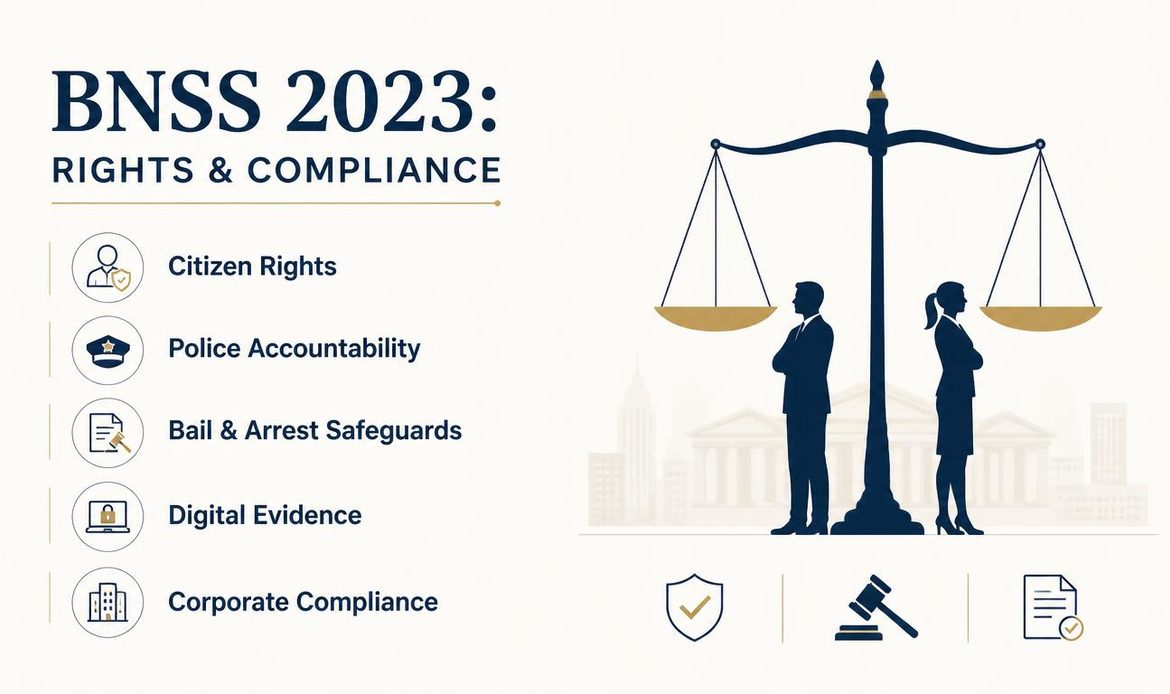
The Bharatiya Nagarik Suraksha Sanhita 2023 Executive Summary PDF identifies several changes in how police and prosecutors must now function:
- Mandatory e-FIRs: ensures accessibility but also increases accountability for police in recording complaints.
- Forensic reliance: reduces dependence on confessions, requiring better training and infrastructure.
- Video recording: police searches and interrogations now subject to digital scrutiny.
- Case timelines: investigation deadlines enforce efficiency and discipline in police work.
- Transparency: digital tracking of cases makes actions verifiable by courts and citizens. These changes place pressure on law enforcement to modernise practices and infrastructure.
Impact on citizens in the Bharatiya Nagarik Suraksha Sanhita 2023 PDF Corrida Legal
Corrida Legal’s review of the Bharatiya Nagarik Suraksha Sanhita 2023 PDF Corrida Legal shows that citizens stand to benefit from stronger rights and improved transparency.
Key benefits for citizens include:
- Right to e-access: complaints can be filed online, reducing dependency on physical visits to police stations.
- Faster bail: mandatory timelines for bail disposal prevent unnecessary pre-trial detention.
- Victim participation: victims gain access to FIR copies, charge-sheets, and hearings.
- Protection against abuse: video-recorded searches and interrogations safeguard dignity.
- Speedier trials: strict timelines reduce pendency and improve access to justice.
For citizens, these reforms represent a step towards a justice system that is faster, fairer, and more accountable.
Enforcement clarity in the Bare Act PDF Bharatiya Nagarik Suraksha Sanhita 2023 Download
The Bare Act PDF Bharatiya Nagarik Suraksha Sanhita 2023 Download ensures that these impacts are enforceable through binding provisions:
Key enforcement mechanisms include:
- penalties and disciplinary action for police who fail to register FIRs or follow procedures,
- courts empowered to quash proceedings or release accused where timelines are violated,
- admissibility of digital evidence and video recordings as statutory proof,
- right of citizens to challenge unlawful arrests or detentions,
- government duty to set up forensic and digital infrastructure nationwide. This ensures that the BNSS has real-world impact, not just legislative ambition.
Employer & Corporate Compliance Perspective under the BNSS, 2023
The Bharatiya Nagarik Suraksha Sanhita 2023 Bare Act PDF is not limited to individual rights and policing reforms — it also has direct implications for businesses, employers, and corporate officers. In today’s economy, where cybercrime, financial fraud, workplace offences, and regulatory breaches are increasingly common, the BNSS reshapes how companies must prepare for criminal law compliance.
For corporates, the new framework means greater accountability, stricter timelines during investigations, and stronger reliance on digital and forensic evidence. This makes proactive compliance a governance necessity rather than a choice.
Corporate implications in the Bharatiya Nagarik Suraksha Sanhita 2023 Executive Summary PDF
The Bharatiya Nagarik Suraksha Sanhita 2023 Executive Summary PDF identifies several areas where employers and corporate leaders may be impacted:
- Cybercrime investigations: police have wider powers to investigate digital offences across jurisdictions.
- Financial fraud & white-collar crime: forensic audits and digital trails gain greater evidentiary value.
- Workplace offences: companies must ensure compliance with labour and safety laws to avoid criminal liability.
- Corporate officers’ liability: directors and senior management can be held responsible for company defaults in criminal cases.
- Timelines: quicker investigations and trials mean corporates must respond faster to notices, summons, and digital evidence requirements.
This creates a compliance-heavy environment requiring preparedness in both legal and operational processes.
Corrida Legal’s analysis in the Bharatiya Nagarik Suraksha Sanhita 2023 PDF Corrida Legal
According to Corrida Legal’s review of the Bharatiya Nagarik Suraksha Sanhita 2023 PDF Corrida Legal, the BNSS will significantly alter corporate risk management strategies.
Practical steps for employers and compliance teams include:
- establishing internal legal response protocols for e-FIRs, summons, and electronic notices,
- strengthening cybersecurity measures to reduce exposure to criminal liability,
- maintaining digital and forensic-ready records for financial and operational activities,
- training HR and compliance officers on handling police inquiries and investigations,
- aligning whistle-blower and grievance redressal mechanisms with statutory protections.
This alignment ensures companies can demonstrate due diligence and avoid reputational or legal setbacks.
Enforcement under the Bare Act PDF Bharatiya Nagarik Suraksha Sanhita 2023 Download
The Bare Act PDF Bharatiya Nagarik Suraksha Sanhita 2023 Download gives statutory teeth to these obligations by creating binding duties during investigations:
Enforcement aspects include:
- mandatory cooperation with electronic summons and video-conference hearings,
- admissibility of digital records as primary evidence, requiring corporates to maintain compliant systems,
- quicker timelines for police to seek information from companies during investigation,
- accountability of directors and managers where company defaults are deliberate or negligent,
- penalties and sanctions for obstruction of investigation or destruction of electronic evidence. This ensures corporate actors cannot evade responsibility through procedural loopholes.
Executive Summary of Bharatiya Nagarik Suraksha Sanhita, 2023
The Bharatiya Nagarik Suraksha Sanhita 2023 Bare Act PDF replaces the Code of Criminal Procedure, 1973, introducing a modern, technology-driven criminal procedure framework for India. Passed in December 2023 and effective from July 2024, it forms part of the new criminal law trilogy along with the Bharatiya Nyaya Sanhita, 2023 and the Bharatiya Sakshya Adhiniyam, 2023.
Key highlights include:
- Repeal & replacement: BNSS, 2023 repeals the CrPC, 1973 and serves as India’s new code of criminal procedure.
- E-FIRs introduced: complaints can be filed electronically, including through audio-visual means.
- Forensic evidence mandate: compulsory forensic involvement in offences punishable with seven years or more.
- Digital integration: electronic summons, warrants, case records, and video conferencing for hearings and witness examination.
- Victim participation: victims entitled to FIR copies, progress reports, and opportunities to be heard during trial.
- Time-bound procedures: statutory deadlines for investigation, bail hearings, and trial completion.
- Restrictions on adjournments: courts limited in granting repeated delays during trial.
- Witness protection: testimony can be recorded via video conferencing; identity protection available in sensitive cases.
- Bail reforms: bail applications must be disposed of within seven days.
- Police accountability: mandatory video recording of searches, seizures, and custodial procedures.
- Summary trials: minor offences to be disposed of quickly through summary procedures.
- Citizen safeguards: rights against arbitrary arrest, right to legal aid, and dignity during investigation reinforced.
Conclusion
The Bharatiya Nagarik Suraksha Sanhita 2023 Bare Act PDF is a landmark reform that replaces the Code of Criminal Procedure, 1973 with a modern, digital-first, and citizen-centric framework for criminal procedure. It demonstrates India’s commitment to building a justice system that is faster, more transparent, and more inclusive of victim rights, while ensuring accountability of law enforcement agencies.
Key concluding points:
- Repeals the CrPC, 1973 and establishes BNSS as India’s new code of criminal procedure.
- Embeds technology at every stage: e-FIRs, electronic summons, video conferencing, and digital records.
- Strengthens victim rights, ensuring access to information and trial participation.
- Enforces time-bound investigations, bail hearings, and trials, reducing judicial delays.
- Expands forensic evidence requirements, reducing reliance on confessions.
- Enhances police accountability with mandatory video recording of procedures.
- Improves citizen safeguards, including protection from arbitrary arrest and expanded access to legal aid.