


Reviewed and Validated by: Jefrin Johny, Advocate
Introduction to the Limited Liability Partnership Act in India
The Limited Liability Partnership Act, 2008 (enforced in 2009) marked a major reform in India’s business law framework. Before its enactment, entrepreneurs had to choose between traditional partnership firms, which offered flexibility but unlimited liability, and private companies, which provided limited liability but involved heavy compliance requirements. There was a visible gap for a business model that could combine the advantages of both. The LLP Act filled this gap by introducing a structure that protects partners’ liability while keeping compliance simple.
Why was the LLP Act introduced?

The government recognised the growing demand for a modern and globally recognised structure for small and medium enterprises, professionals, and startups. Some of the main reasons for introducing the law were:
- Hybrid structure – combining features of partnership and company law.
- Global alignment – LLPs were already common in countries like the UK, Singapore, and the US.
- Ease of doing business – encouraging entrepreneurship by reducing regulatory burdens.
- Investor confidence – providing partners with limited liability protection similar to shareholders in a company.
This shift was crucial in making India’s business environment more competitive. Many professionals today
rely on resources such as the LLP Act 2008 PDF file to understand how the framework works in practice.
Advantages of LLPs over traditional models
LLPs became popular because they solved issues faced by earlier structures:
- Limited liability – unlike partnerships, the liability of each partner is restricted to their contribution.
- Separate legal entity – the LLP has its own identity, independent of the partners.
- Continuity – the entity is not affected by changes in partners, unlike traditional partnerships.
- Lower compliance – compared to private companies, LLPs face fewer statutory filings and governance requirements.
These features made LLPs especially attractive to law firms, consultancy firms, and startups. For quick reference, professionals often consult the Limited Liability Partnership Act bare act download before forming or advising on an LLP.
Importance of accessible resources
Since LLPs are still a relatively new business form in India, authentic reference material is critical. For lawyers, compliance officers, and students, the LLP Act bare act Corrida Legal provides both the official text and an easy-to-read executive summary. This combination ensures that users understand not just the black letter of the law but also its practical application.
Scope and Applicability of the LLP Act, 2008
The Limited Liability Partnership Act, 2008 was enacted to establish a flexible but legally sound business framework in India. This Act is distinct from the Companies Act or the Indian Partnership Act in that it was specifically designed to grant an option for securing partners against unlimited liability while giving them the liberty of internal management. With time, the LLP structure has emerged as a popular choice for professionals, entrepreneurs, and service providers.
Who can incorporate an LLP in India?
Any two or more persons who enter into a legal agreement to conduct a business for profit can incorporate an LLP. Some of the key requirements are:
- Minimum partners – a minimum of two partners must incorporate an LLP.
- Designated partners – there should be at least two designated partners in each LLP, who will ensure compliance, of whom at least one should be an Indian resident.
- Flexibility of partners – individuals, companies, or even other LLPs are eligible to be partners in an LLP.
These qualifying conditions are easy in comparison with the company law incorporation requirements. For detailed procedural compliance, professionals often refer to the LLP Act 2008 PDF document.
Residency and legal requirements
For ensuring accountability, the Act prescribes that at least one of the designated partners should be resident in India. This ensures regulatory control and makes sure that the LLP is not entirely controlled from overseas. The law also provides for partners signing a formal LLP agreement, which regulates profit sharing, management roles, and duties.
Industries in which LLPs are commonly applied
LLPs are most sought after in industries where professional skill is an essential requirement. Certain usual instances are:
- Law firms and consultancy firms.
- Start-ups that require limited liability but do not wish for cumbersome compliance, such as private companies.
- Accounting firms, architecture firms, and design firms, where managerial flexibility matters.
- Joint ventures, wherein two or more firms desire to work in unison without establishing a conventional company.
This real-world application illustrates that the Limited Liability Partnership Act bare act download facilitates a broad spectrum of industries by providing a hybrid model.
Practical coverage and reference use
The scope of the Act is not just theoretical; it extends to day-to-day business practices. From incorporation to compliance, dissolution, and conversion from other entities, the Act provides a complete framework. For legal professionals, compliance officers, and students, the LLP Act bare act Corrida Legal has become a go-to source because it combines authentic text with explanatory notes that make the law easier to apply in practice.
Objectives of the Limited Liability Partnership Act, 2008
The Limited Liability Partnership Act, 2008, was brought to bring India’s business law system up to date and offer entrepreneurs a more flexible alternative. Small businesses and professionals, before enactment, were either forced to register as old-fashioned partnerships, leaving them to unlimited liability, or to register as companies, which entailed onerous compliance burdens. The LLP law was designed to find a middle ground between the two.
Promoting entrepreneurship with limited liability
One of the key aims of the Act is to encourage entrepreneurship through the provision of limited liability protection to partners. This means that individual partners are not held personally responsible for the business’s debts above their specified contribution. For most startups and service providers, such protection has rendered LLPs a popular option over conventional partnerships.
Management structure flexibility
The Act permits partners to determine their own house rules through an LLP agreement. In contrast to companies that have to adhere to strict governance formats, LLPs grant flexibility to partners to structure their management, profit-sharing, and decision-making processes. Professionals frequently refer to the LLP
Act 2008 PDF document to know the legislative framework to construct such agreements.
Transparency and compliance
Another objective of the Act is to improve transparency without creating unnecessary compliance burdens. LLPs are required to maintain proper books of accounts, file annual returns, and prepare a Statement of Accounts & Solvency. However, the compliance requirements are still lighter compared to companies, making LLPs a practical option for smaller businesses. The Limited Liability Partnership Act bare act download provides detailed provisions on these reporting obligations.
Promoting LLPs as a global structure
LLPs were already well-established in jurisdictions like the UK, Singapore, and the US. By introducing this law, India aligned itself with global practices, giving local businesses a structure that is recognised internationally. This move has not only boosted investor confidence but also made it easier for Indian firms to collaborate with foreign partners.
Practical use of the LLP Act summary
For lawyers, HR managers, compliance officers, and students, the Limited Liability Partnership Act summary is a valuable resource. It distils complex provisions into an accessible format, saving time while ensuring that users understand the law’s intent and objectives.
Structure of the Limited Liability Partnership Act Bare Act
The Limited Liability Partnership Act, 2008 was drafted as a self-contained legislation to regulate LLPs in India. Its structure is comprehensive, covering incorporation, management, financial disclosures, conversion of existing entities into LLPs, and provisions for winding up. By dividing the law into parts, chapters, and sections, lawmakers ensured that the statute could serve as a one-stop reference for professionals and businesses.
Number of chapters and sections
The Act is organised into multiple chapters and more than 80 sections. Each chapter deals with a distinct aspect of LLPs, starting from definitions and incorporation to partners’ rights, accounts, investigations, and dissolution. This systematic arrangement makes it easier to navigate. For example, incorporation procedures are set out early in the Act, while winding up provisions appear towards the end. Lawyers and compliance officers regularly use the LLP Act 2008 PDF file to locate relevant chapters quickly.
Key definitions under the Act
Like all statutes, the LLP Act begins with definitions that form the foundation of interpretation. Some of the most important definitions include:
- Partner – a person who has entered into a partnership with other partners in an LLP.
- Designated partner – partners with specific responsibility for compliance.
- Limited liability partnership – a body corporate formed under this Act.
- Entity – clarifying that the LLP has a separate legal personality, distinct from its partners.
These definitions ensure clarity in the application of the law. Without them, the rights and obligations of partners could be open to dispute. For students and professionals, the Limited Liability Partnership Act summary often highlights these terms for easier understanding.
Rules formulated by the Central Government
Besides the skeletal provisions of the Act, the Central Government has the power to formulate rules for implementation. These are:
- Incorporation rules – laying down forms and filings to be made with the Registrar of Companies (RoC).
- Accounts and audit rules – determining thresholds for audit on a compulsory basis.
- Conversion rules – directing the process of conversion of partnership firms or companies to LLPs.
- Winding up rules – describing voluntary and compulsory winding up processes.
These regulations make the Act more flexible and provide that procedural matters can change without modifying the statute itself. For genuine reference, practitioners use the Limited Liability Partnership Act bare act download, which will typically have the Act along with current rules.
Key Features of LLP in India Law
The Limited Liability Partnership Act, 2008 created a business structure that combines the flexibility of a partnership with the legal security of a company. Over time, LLPs have become a popular choice among entrepreneurs, professionals, and service providers. Their features make them particularly suited for businesses that need legal recognition but do not want to be weighed down by the heavy compliance burden of companies.
Separate legal entity
One of the most important features is that an LLP is a separate legal entity distinct from its partners. This means the LLP can own property, enter into contracts, and sue or be sued in its own name. Even if partners change, the LLP continues to exist. This distinction offers businesses long-term stability, a feature well explained in the LLP Act 2008 PDF file.
Perpetual succession
An LLP enjoys perpetual succession, meaning its existence is not affected by the death, retirement, or insolvency of partners. New partners can be admitted, and old partners can leave without disrupting the continuity of the entity. This is a major advantage compared to traditional partnerships, where the firm may dissolve on a partner’s exit. The Limited Liability Partnership Act summary highlights this benefit clearly for students and professionals.
Limited liability of partners
One of the characteristic features of LLPs is that they have limited liability protection for partners. Their liabilities are confined to the level of their contribution to the LLP. In contrast to ordinary partnerships, a partner is not personally accountable for the negligence or misconduct of another partner. This protection stimulates more individuals to become entrepreneurs without worrying about jeopardizing personal property. Due to this, most professionals base their practice on the Limited Liability Partnership Act bare act download to guarantee consistency on provisions of liability.
Management flexibility
Unlike firms that are subject to strict norms under the Companies Act, LLPs permit partners to choose how they wish to conduct their internal matters. Via the LLP agreement, partners may establish rules for sharing of profits, decision-making, and duties. This is why LLPs are best suited for professional service firms. For ready reference, lawyers and compliance officers regularly refer to the LLP Act bare act Corrida Legal.
Lower compliance burden
Another appealing aspect is the lighter compliance burden in comparison to private limited companies. LLPs need to submit only some annual statements and have basic financial disclosures. For small and medium businesses, this amounts to substantial cost reduction as well as less administrative strain.
Incorporation of an LLP
The Limited Liability Partnership Act, 2008 lays down a clear procedure for the incorporation of LLPs in
India. This process was designed to be simpler than incorporating a private company, while still ensuring legal recognition and compliance. For entrepreneurs, professionals, and startups, this balance of flexibility and protection has made LLPs a widely used structure.
Process of incorporation
The incorporation of an LLP begins with an application to the Registrar of Companies (RoC). The partners must agree to carry on a lawful business with a view to profit. The application is made in prescribed forms and includes details about partners, the proposed business, and registered office. Unlike traditional partnerships, the LLP comes into existence only after it is registered under the Act, as explained in the LLP Act 2008 PDF file.
Required documents
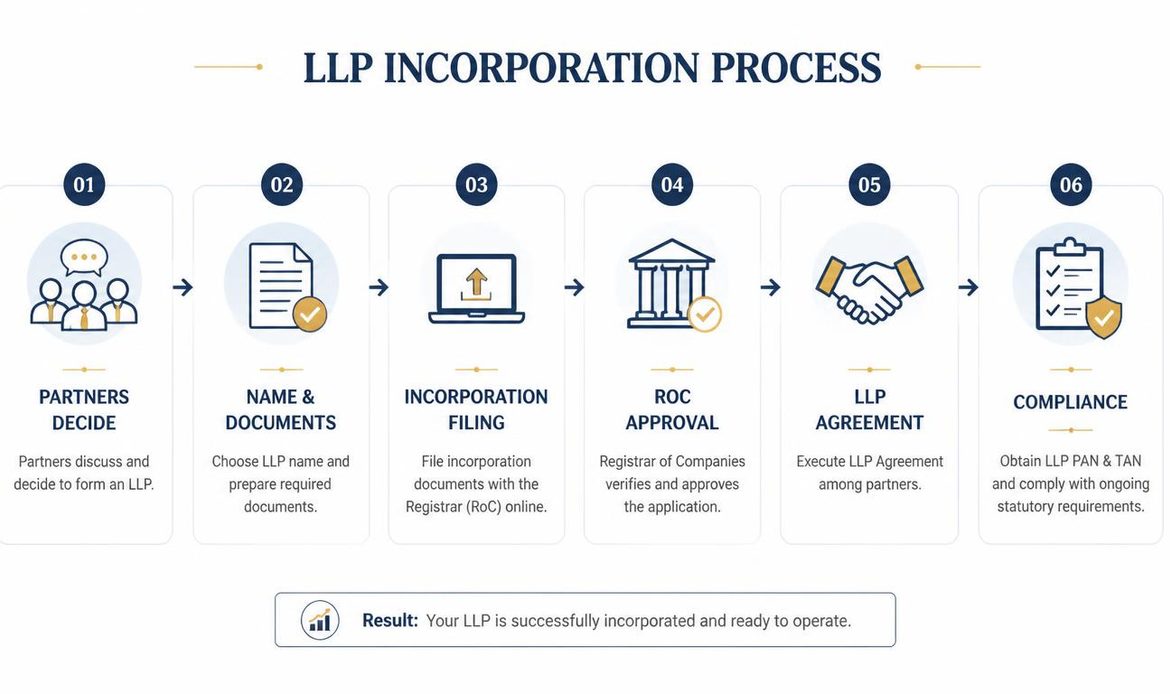
The incorporation process requires submission of specific documents to the RoC:
- Incorporation document containing the name of the LLP, details of partners, and registered office.
- Consent of partners, confirming their willingness to join the LLP.
- Proof of address for the registered office.
- Identity and address proof of partners (PAN, Aadhaar, passport, etc.).
- LLP agreement, which governs rights, duties, and responsibilities among partners.
These requirements ensure transparency and provide a record of the LLP’s internal structure. Summaries
such as the Limited Liability Partnership Act summary often highlight these essentials for quick reference.
Role of Registrar of Companies (RoC)
The RoC plays a central role in incorporating LLPs. Its responsibilities include:
- Scrutinising incorporation documents and verifying compliance with the Act.
- Issuing the Certificate of Incorporation, which gives legal recognition to the LLP.
- Maintaining public records of LLPs for transparency.
Once the certificate is issued, the LLP becomes a separate legal entity, distinct from its partners. This is why businesses often refer to the Limited Liability Partnership Act bare act download to confirm statutory requirements before filing with the RoC.
Digital Signature and DPIN
Modernisation of the incorporation process has made digital tools mandatory:
- Digital Signature Certificate (DSC) is required for filing documents electronically.
- Designated Partner Identification Number (DPIN) must be obtained by all designated partners to track their compliance history.
These steps streamline the registration process and ensure accountability of those managing the LLP. For compliance officers and professionals, the LLP Act bare act Corrida Legal offers practical guidance on how these requirements are implemented in practice.
Rights and Duties of Partners under LLP Act
The Limited Liability Partnership Act, 2008 sets out a framework for regulating the rights and duties of partners in an LLP. Unlike companies that follow a rigid governance model, LLPs give partners freedom to define their relationship through an LLP agreement. At the same time, the Act provides default rules to ensure fairness and accountability where no agreement exists.
Mutual rights of partners
Partners in an LLP enjoy flexibility in organising their internal affairs. Their mutual rights and duties are usually defined in the LLP agreement, which is binding on all partners. These rights typically include:
- Right to participate in management and decision-making.
- Right to share profits and losses in proportion to contribution or as agreed.
- Right to access books and records for transparency.
- Right to express opinions and vote on major issues.
For practitioners, the LLP Act 2008 PDF file provides clarity on how these rights operate when no specific agreement is in place.
Fiduciary duties and disclosure obligations
Even with flexibility, partners owe fiduciary duties to the LLP and to each other. These include:
- Duty of good faith in business decisions.
- Duty to disclose material facts that may affect the LLP.
- Duty not to compete with the LLP’s business without consent.
- Duty to account for any personal profit derived from business opportunities belonging to the LLP.
The Limited Liability Partnership Act summary often highlights these fiduciary duties, as they safeguard trust and prevent misuse of authority.
Liability of partners
A major advantage of LLPs is limited liability. Partners are not personally liable for the wrongful acts or negligence of other partners. Their liability is restricted to the extent of their agreed contribution. However:
- Partners remain liable for their own wrongful acts or omissions.
- Fraudulent conduct can remove the shield of limited liability.
These provisions strike a balance between protecting individuals and ensuring accountability. For reference, professionals rely on the Limited Liability Partnership Act bare act download to understand these liability limits.
Expulsion and retirement of partners
The Act also covers situations where partners exit an LLP.
- Retirement can take place as per the LLP agreement or by giving notice.
- Expulsion is allowed only when expressly provided in the LLP agreement.
- Retired or expelled partners retain rights to profits up to the date of exit.
For practical application, resources like the LLP Act bare act Corrida Legal provide examples and
explanatory notes on how retirement and expulsion provisions work in practice.
Designated Partners and Their Responsibilities
The Limited Liability Partnership Act, 2008 introduced the concept of designated partners to ensure accountability in LLPs. While all partners may share profits and participate in management, designated partners carry specific legal responsibilities. They act as the primary point of contact between the LLP and regulatory authorities, making their role central to the smooth functioning of the entity.
Minimum requirement of designated partners
Every LLP must have at least two designated partners, and at least one of them must be a resident of India. This residency requirement ensures that there is always someone within the country who can be held accountable for compliance. These partners must obtain a Designated Partner Identification Number (DPIN), which allows regulators to track their responsibilities across different LLPs. Professionals often refer to the LLP Act 2008 PDF file to confirm these statutory requirements.
Core duties of designated partners
The law places specific obligations on designated partners, which include:
- Filing of documents with the Registrar of Companies (RoC) on time.
- Maintenance of books of account and ensuring the Statement of Accounts & Solvency is prepared annually.
- Filing of annual returns within prescribed deadlines.
- Compliance with disclosure norms, including changes in partners, registered office, or agreements.
The Limited Liability Partnership Act summary highlights these duties as they are essential for maintaining transparency and legal standing of the LLP.
Accountability and liability
Although all partners enjoy limited liability, designated partners face additional accountability for compliance failures. For instance:
- Late filing of returns may attract fines directly imposed on designated partners.
- False statements or concealment of material facts can lead to both monetary penalties and prosecution.
- Fraudulent conduct by designated partners can remove the protection of limited liability.
These provisions underline the seriousness of the role. For clarity, practitioners often consult the Limited Liability Partnership Act bare act download to review penalty clauses in detail.
Practical significance
In practice, designated partners ensure that LLPs function smoothly without attracting penalties or legal disputes. Their responsibilities make them similar to directors of companies, though with fewer compliance burdens. Law firms, startups, and professional services often rely on the LLP Act bare act Corrida Legal to guide designated partners in meeting their responsibilities effectively.
Key Takeaways from the Limited Liability Partnership Act Summary
The Limited Liability Partnership Act, 2008 was enacted to fill a clear gap in India’s business framework. It offered a modern, globally recognised structure that combines the benefits of partnerships and companies. Over the years, it has become a preferred model for professionals, service firms, and startups. The Act’s summary highlights the principles that make LLPs both practical and legally secure.
Balance between flexibility and liability protection
One of the most important takeaways is the balance between flexibility and limited liability. Unlike traditional partnerships, the liability of partners is restricted to their agreed contribution. At the same time, LLPs allow freedom in drafting agreements and organising internal management. This mix makes LLPs particularly attractive to small and medium enterprises. The LLP Act 2008 PDF file is often used by professionals to confirm liability provisions.
Lower compliance burden
Another key feature is the lower compliance burden compared to private companies. LLPs are required to file basic annual returns and maintain financial statements, but they are not bound by complex governance rules under the Companies Act. This has made LLPs popular among entrepreneurs who want to focus on business growth without heavy administrative costs. Summaries such as the Limited Liability Partnership Act summary are helpful in quickly identifying these compliance benefits.
Global recognition of LLPs
LLPs are recognised across major jurisdictions like the UK, Singapore, and the US. By adopting this model, India aligned its laws with international practices. This global acceptance makes it easier for Indian LLPs to collaborate with foreign partners or expand abroad. For businesses exploring cross-border opportunities, the Limited Liability Partnership Act bare act download provides an authentic reference for statutory provisions.
Reliable reference material
For practical use, accessible legal resources are essential. Lawyers, compliance officers, and students often turn to the LLP Act bare act Corrida Legal, which combines the official statute with explanatory notes. This ensures not only accuracy but also a clearer understanding of how the law works in practice.
Key highlights in brief
- LLPs offer limited liability protection while maintaining flexibility.
- Compliance requirements are simpler than those for companies.
- The structure is globally recognised, aiding international collaboration.
- Authentic resources like Corrida Legal’s summaries help professionals save time.
Conclusion
The Limited Liability Partnership Act, 2008 has established LLPs as a modern, flexible, and secure business structure in India. By combining the advantages of partnerships with the legal protection of companies, it has provided entrepreneurs, professionals, and startups with a framework that encourages growth while ensuring accountability.
Over the years, LLPs have gained popularity due to their limited liability protection, lower compliance costs, and global recognition. These features make them a practical choice for service firms, law practices, and small to medium enterprises. For business owners and professionals, the LLP Act 2008 PDF file and the Limited Liability Partnership Act bare act download serve as essential tools to understand compliance requirements and operational rules.
At the same time, resources like the Limited Liability Partnership Act summary and the LLP Act bare act Corrida Legal ensure that the law is accessible beyond legal practitioners, helping students, HR managers,
and compliance officers grasp the essentials quickly.
In short, the Act has created a time-saving, practical, and forward-looking legal framework that balances flexibility with statutory safeguards. For anyone looking to start or manage an LLP in India, this law remains the cornerstone of understanding rights, duties, and compliance obligations.