


Reviewed and Validated by: Shubham Dwivedi, Advocate
Introduction
The Code on Occupational Safety, Health and Working Conditions, 2020 Bare Act PDF (“OSHWC Code”) was enacted as part of the labour reforms intended to consolidate and simplify India’s fragmented regulatory framework. It replaces thirteen legislations including the Factories Act, 1948, the Mines Act, 1952, the Dock Workers (Safety, Health and Welfare) Act, 1986, the Contract Labour (Regulation and Abolition) Act, 1970, and the Inter-State Migrant Workmen Act, 1979.
The central objective is to provide a single framework governing registration of establishments, duties of employers, rights of employees, and matters relating to safety, health, and working conditions. For the first time, uniform provisions are extended across factories, mines, docks, construction, plantations, motor transport, and other notified establishments.
1. Purpose of the OSHWC Code 2020 Executive Summary PDF
The OSHWC Code 2020 Executive Summary PDF is not a substitute for the statute, but a practical guide. It highlights in short points:
- definitions that affect coverage (such as “worker”, “employer”, “establishment”),
- obligations of employers regarding health, safety, and welfare,
- provisions on working hours, rest intervals and leave,
- penalties for non-compliance.
This enables compliance teams and HR managers to quickly identify the applicable provisions before consulting the full Bare Act.
2. Corrida Legal’s reading of the Occupational Safety Health Working Conditions Act 2020
In Corrida Legal’s commentary on the Occupational Safety Health Working Conditions Act 2020 PDF Corrida Legal, the emphasis remains on applicability and compliance. Our analysis focuses on:
- thresholds for registration and licensing,
- mandatory welfare facilities such as canteens, restrooms, and crèches,
- rules relating to employment of women and inter-State migrant workers,
- inspection and digital filing mechanisms.
This perspective is intended for employers who must implement the provisions in day-to-day operations.
3. Bare Act PDF OSHWC Code 2020 Download and reference value
Access to the text itself remains essential. The Bare Act PDF OSHWC Code 2020 Download allows practitioners, students, and HR officers to refer to the exact statutory wording. It ensures:
- uniform understanding of definitions and obligations,
- correct citation in notices, policies, and training materials,
- consistency in legal interpretation across different establishments.
4. Executive Summary of Code on Occupational Safety Health and Working Conditions
The Executive Summary of Code on Occupational Safety Health and Working Conditions captures the operative portions of the Code. In particular:
- registration and licensing procedures,
- duties of employers,
- rights of employees, inspection framework,
- penalties and compounding.
The summary enables quick orientation without reading the full statute.
5. OSHWC Code 2020 Compliance Guide PDF as a practical tool
Finally, the OSHWC Code 2020 Compliance Guide PDF sets out compliance steps in a checklist form. It includes:
- registers and records to be maintained,
- digital filings and timelines,
- safety and welfare measures to be provided,
- inspection readiness for establishments.
This is intended to help employers move from statutory text to practical implementation.
What is the Code on Occupational Safety, Health and Working Conditions, 2020?
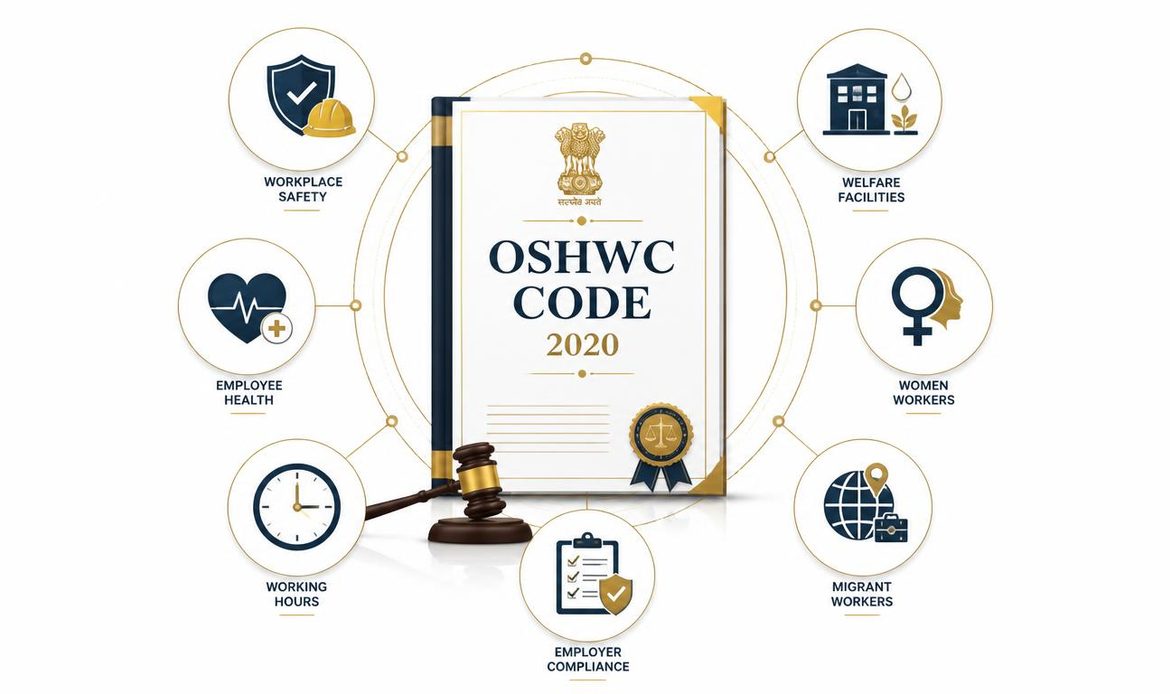
The Code on Occupational Safety Health and Working Conditions 2020 Bare Act PDF was enacted with the purpose of creating a single, comprehensive statute governing health, safety, and working conditions in India. Earlier, provisions were scattered across numerous laws with overlapping requirements. The Code seeks to:
- standardise welfare measures across industries,
- ensure safer working environments,
- clarify duties of employers and rights of workers, and
- promote ease of doing business by reducing the compliance burden.
By consolidating these principles, the Code improves transparency for employers and strengthens protection for employees.
Consolidation Explained in OSHWC Code 2020
As seen in the OSHWC Code 2020 Executive Summary PDF, the statute repeals and merges thirteen earlier enactments. These included the Factories Act, 1948, the Mines Act, 1952, the Dock Workers (Safety, Health and Welfare) Act, 1986, the Contract Labour Act, 1970, and several others relating to journalists, cine workers, and sales promotion employees.
The consolidation is significant because it:
- removes duplication across laws,
- creates common definitions applicable to all establishments,
- introduces one licensing mechanism for contract labour and migrant workers, and
- ensures that compliance can be monitored through a unified digital system.
Simplification of Compliance in the Occupational Safety Health Working Conditions Act 2020
Corrida Legal’s review of the Occupational Safety Health Working Conditions Act 2020 PDF Corrida Legal notes that the Code simplifies compliance for employers by reducing multiple registrations, filings, and inspections into one integrated framework.
Key simplifications include:
- a single registration for every establishment covered by the Code,
- online filing of returns and maintenance of records,
- appointment of an “inspector-cum-facilitator” instead of multiple inspectors, and
- provision for compounding of offences to reduce litigation.
This unified approach aligns with the Government’s objective of rationalising labour laws while ensuring that worker safety and welfare remain protected.
Applicability of the Code on Occupational Safety, Health and Working Conditions, 2020
The Code on Occupational Safety Health and Working Conditions 2020 Bare Act PDF applies to every establishment and class of workers that meet the prescribed thresholds. Broadly, the Code extends to:
- factories employing ten or more workers,
- mines and docks, irrespective of the number of workers,
- motor transport undertakings, plantations, and construction where the threshold is met,contract labour and inter-State migrant workers engaged through contractors, and
- any other establishment or class of establishments notified by the appropriate government.
This wide coverage ensures that both traditional and emerging workplaces fall under the regulatory framework.
Specific thresholds as highlighted in OSHWC Code 2020 Executive Summary PDF
The OSHWC Code 2020 Executive Summary PDF makes clear that applicability is determined by numerical thresholds and sector-specific conditions. Examples include:
- Factories: at least 10 workers with power, or 20 without power, engaged in manufacturing.
- Contract Labour: establishments or contractors engaging 50 or more contract workers.
- Inter-State Migrant Workers: establishments employing 10 or more inter-State migrant workers.
- Plantations: plantations with 10 or more workers.
These thresholds reflect an attempt to balance worker protection with administrative feasibility.
Sectoral reach of the Occupational Safety Health Working Conditions Act 2020
In Corrida Legal’s review of the Occupational Safety Health Working Conditions Act 2020 PDF Corrida Legal, the
Code’s applicability is mapped across multiple sectors:
- Mining and docks, which have historically been governed by specialised laws.
- Motor transport undertakings and construction projects, often overlooked in earlier statutes.
- Cine workers, sales promotion employees, and journalists, brought into a unified framework.
The statute thus extends far beyond conventional industrial settings, creating a common regulatory spine for diverse occupations.
Employer Obligations under the Code on Occupational Safety, Health and Working Conditions, 2020
The Code on Occupational Safety Health and Working Conditions 2020 Bare Act PDF imposes clear obligations on employers to secure the health, safety, and welfare of workers. Employers are required to:
- register their establishments and obtain the necessary licences;
- provide a workplace free from hazards that could cause injury or occupational disease;
- maintain safe plant, machinery, and systems of work;ensure adequate ventilation, lighting, drinking water, and sanitation facilities; and
- provide training and supervision to promote safe practices.
Failure to fulfil these duties can attract penalties under the Code, including fines and imprisonment.
Core responsibilities explained in OSHWC Code 2020 Executive Summary PDF
As detailed in the OSHWC Code 2020 Executive Summary PDF, the employer’s obligations extend beyond physical
safety and cover welfare measures as well. Key responsibilities include:
- establishing canteens, restrooms, and crèches where worker numbers meet prescribed thresholds;
- ensuring first-aid and medical facilities are available;
- providing appropriate protective equipment in hazardous processes; maintaining working hours, rest intervals, and overtime in line with statutory limits;
- furnishing annual and half-yearly returns electronically to the appropriate authority.
These duties ensure that employee welfare is embedded into the operational fabric of every establishment.
Practical obligations under the Occupational Safety Health Working Conditions Act 2020
Corrida Legal’s review of the Occupational Safety Health Working Conditions Act 2020 PDF Corrida Legal notes that compliance is both statutory and operational. Employers must adopt a structured approach:
- Policy level: prepare internal health and safety policies in line with the Code.
- Documentation: maintain statutory registers (accidents, working hours, leave) in prescribed formats.
- Inspections: cooperate with the inspector-cum-facilitator, and rectify non-compliances noted during inspections.
- Special categories: provide secure transport and safety measures for women working night shifts; pay journey and displacement allowances for inter-State migrant workers.
For most organisations, this translates into re-aligning HR manuals, safety protocols, and contractor agreements with the provisions of the Code.
Employee Rights & Protections under the Code on Occupational Safety, Health and Working Conditions, 2020
The Code on Occupational Safety Health and Working Conditions 2020 Bare Act PDF secures fundamental rights for workers across industries. It codifies the right to a safe and healthy work environment, while also extending protections in relation to working hours, leave, and welfare facilities. These provisions are intended to reduce workplace accidents and ensure humane conditions of employment.
Key rights under the Bare Act include:
- right to adequate health and safety measures at the workplace,
- right to access clean drinking water, sanitation, and canteen facilities,
- entitlement to annual leave with wages,protection against arbitrary or excessive working hours, and
- right to medical facilities and first aid.
Safeguards explained in the OSHWC Code 2020 Executive Summary PDF
The OSHWC Code 2020 Executive Summary PDF further highlights the safeguards granted to workers, ensuring that statutory rights are translated into everyday protections. The Code makes specific provisions for vulnerable categories such as women employees, inter-State migrant workers, and contract labour.
Illustrative protections include:
- regulation of working hours with limits on daily and weekly work;
- prohibition of child labour;
- special measures for the employment of women, including safe transport and security during night shifts;equal treatment and facilities for inter-State migrant workers, along with displacement and journey allowances;
- access to crèches and welfare amenities where establishments cross prescribed thresholds.
These protections not only standardise employee rights across sectors but also impose a higher level of accountability on employers.
Worker protections under the Occupational Safety Health Working Conditions Act 2020
Corrida Legal’s commentary on the Occupational Safety Health Working Conditions Act 2020 PDF Corrida Legal stresses that the rights of employees are enforceable through statutory mechanisms. The inspector-cum-facilitator is empowered to monitor compliance, and workers are entitled to raise concerns in cases of unsafe or unlawful practices.
In practical terms, employees benefit through:
- enforceable limits on working hours and mandatory rest intervals,
- statutory entitlements to overtime wages when extra work is performed,
- protection against employment in hazardous processes without adequate safety equipment,
- improved transparency in engagement of contract and migrant workers, and
- access to grievance redressal and inspection-based remedies.
By embedding these rights into a single Code, the legislature has sought to create a uniform level of protection across industries, balancing the needs of economic growth with the welfare of workers.
Working Hours & Leave Provisions under the Code on Occupational Safety, Health and Working Conditions, 2020
The Code on Occupational Safety Health and Working Conditions 2020 Bare Act PDF introduces a structured framework on working time, rest intervals, overtime, and leave. The aim is to safeguard employees from excessive working hours while giving employers clarity on permissible schedules.
Key provisions include:
- daily working hours not to exceed eight,
- maximum of forty-eight hours of work in a week,
- mandatory rest interval after five hours of continuous work,overtime wages at twice the normal rate, and
- weekly rest day for every worker.
These measures bring uniformity across establishments and sectors, ensuring predictable standards for both employers and workers.
Leave entitlements in OSHWC Code 2020 Executive Summary PDF
The OSHWC Code 2020 Executive Summary PDF emphasises the statutory leave entitlements available to employees. The provisions cover both annual leave with wages and other rest-related rights.
Main entitlements are:
- annual leave with wages for workers who have worked at least 180 days in a year,
- calculation of leave based on days of work performed (generally one day for every twenty days worked),
- carry-forward of unavailed leave to the following year, subject to limits,
- encashment of leave in cases where the worker ceases employment.
By codifying these entitlements, the law ensures that workers receive proper rest and employers have clear obligations in scheduling and payroll.
Practical compliance under the Occupational Safety Health Working Conditions Act 2020
Corrida Legal’s analysis of the Occupational Safety Health Working Conditions Act 2020 PDF Corrida Legal highlights the practical side of implementing working hours and leave provisions. Employers must carefully adjust internal HR policies, attendance systems, and shift arrangements to ensure conformity with the Code.
Compliance points for employers include:
- updating HR manuals to reflect the daily and weekly limits,
- tracking overtime hours separately and paying at the prescribed rate,
- maintaining statutory registers of working hours and leave in digital form where possible,ensuring women employees working night shifts receive proper intervals and safety arrangements,
- aligning contractor agreements to mirror statutory entitlements.
Failure to follow these requirements may result in penalties, while consistent compliance will improve employee productivity and reduce disputes.
Health, Safety, and Welfare Provisions under the Code on Occupational Safety, Health and Working Conditions, 2020
The Code on Occupational Safety Health and Working Conditions 2020 Bare Act PDF lays down an extensive set of health, safety, and welfare measures to be provided by employers. These provisions are central to the Code, reflecting its focus on preventive care and humane working conditions.
Health and safety measures include:
- adequate ventilation, temperature control, and lighting in workplaces;
- safe drinking water, sanitation, and washing facilities;
- first-aid appliances and arrangements for medical examinations; periodic monitoring of hazardous processes and substances; protective equipment and clothing for workers in risky environments;
- reporting and investigation of accidents and occupational diseases.
These are not optional benefits but mandatory obligations enforceable by the inspector-cum-facilitator. The law recognises that safe conditions directly affect productivity and worker morale.
Welfare requirements explained in OSHWC Code 2020
The OSHWC Code 2020 Executive Summary PDF also captures the welfare requirements which extend beyond safety to ensure dignity and basic facilities for workers. Welfare obligations are tied to thresholds, meaning that once an establishment employs a specified number of workers, additional facilities must be provided.
Illustrative welfare provisions include:
- Canteens: to be established in factories and other notified establishments once the workforce exceeds the prescribed number.
- Rest rooms and shelters: mandatory in workplaces where workers are required to stay during intervals.Crèches: establishments with a certain strength of women employees must provide crèche facilities.
- Uniforms and protective gear: to be supplied in occupations involving dust, heat, or hazardous material.
- Welfare officers: appointment required in larger establishments for oversight of welfare measures.
These requirements demonstrate the Code’s shift towards integrating welfare into the daily functioning of industrial and commercial establishments.
Practical implementation in the Occupational Safety Health Working Conditions Act 2020
Corrida Legal’s review of the Occupational Safety Health Working Conditions Act 2020 PDF Corrida Legal highlights that the challenge for employers lies not in understanding the statutory text, but in implementing these provisions consistently across units and contractors.
Practical compliance steps include:
- conducting workplace audits to identify gaps in sanitation, ventilation, and medical facilities;
- maintaining records of periodic health check-ups, particularly in hazardous industries;
- ensuring contractors also provide safety gear and welfare amenities to their workers;setting up committees or safety officers to monitor ongoing compliance;
- training supervisors and workers on safety protocols, use of protective equipment, and emergency response.
Corrida Legal advises that welfare and safety should be budgeted as recurring expenses, not one-time compliance measures. Inconsistent implementation can lead to inspections, penalties, and even closure of operations in extreme cases.
Special Provisions for Women and Inter-State Migrant Workers under the Code on Occupational Safety, Health and Working Conditions, 2020
The Code on Occupational Safety Health and Working Conditions 2020 Bare Act PDF introduces progressive measures relating to the employment of women. Unlike earlier laws, which restricted women from working in certain occupations or during night shifts, the Code permits their employment in all establishments and sectors, subject to prescribed safety conditions. This is a deliberate shift towards gender equality while balancing concerns of security and welfare.
Employers are required to provide adequate safeguards when women are engaged, particularly for night shifts, including:
- safe transport facilities to and from the workplace,
- sufficient lighting and security within the premises,
- proper restrooms, changing rooms, and sanitation facilities, and
- strict prohibition of harassment or discriminatory practices.
By widening the scope of employment opportunities for women while mandating employer responsibilities, the Code signals a policy intent to enhance female workforce participation in India’s growing economy.
Rights of migrant workers under the OSHWC Code 2020 Executive Summary PDF
The OSHWC Code 2020 Executive Summary PDF dedicates important provisions to the protection of inter-State migrant workers, a category often subject to neglect and exploitation. The Code establishes parity of treatment, ensuring that migrant workers enjoy the same rights and benefits as other workers in the establishment. This includes equal access to wages, safety measures, and welfare facilities.
In addition, the Code recognises the unique vulnerabilities of migrant workers and provides for:
- a journey allowance, payable by the employer to cover the cost of travel back to the home state once in a year;
- a displacement allowance, to be paid at the time of recruitment, in addition to wages;
- entitlement to suitable residential accommodation where workers are required to stay near the establishment;
- registration of migrant workers to enable tracking, welfare support, and policy benefits.
These provisions bring inter-State migrant workers into the mainstream of labour protection, correcting the gaps that existed under earlier fragmented legislations.
Practical implications in the Occupational Safety Health Working Conditions Act 2020
Corrida Legal’s commentary on the Occupational Safety Health Working Conditions Act 2020 PDF Corrida Legal highlights that the obligations concerning women employees and inter-State migrant workers cannot be treated as box-ticking exercises. They require active planning, budgetary allocation, and monitoring. Employers must anticipate inspections that will specifically focus on these categories, given the heightened emphasis by lawmakers.
Practical compliance measures include:
- amending HR policies to reflect equal employment opportunities for women across all roles, including those previously restricted,
- entering into agreements with transport vendors to provide safe conveyance for women on night shifts,
- keeping a separate register for migrant workers to document allowances, journey entitlements, and benefits,
- ensuring that contractors supplying migrant labour also meet these statutory requirements, and
- periodic training of supervisors on issues of gender sensitivity, workplace safety, and migrant worker welfare.
In practice, these obligations demand coordination between management, HR, and operations teams. Establishments that ignore or under-implement such provisions face not only penalties but also reputational risks, as issues concerning women’s safety and migrant workers’ rights attract heightened scrutiny from regulators and the public alike.
Compliance Framework under the Code on Occupational Safety, Health and Working Conditions, 2020
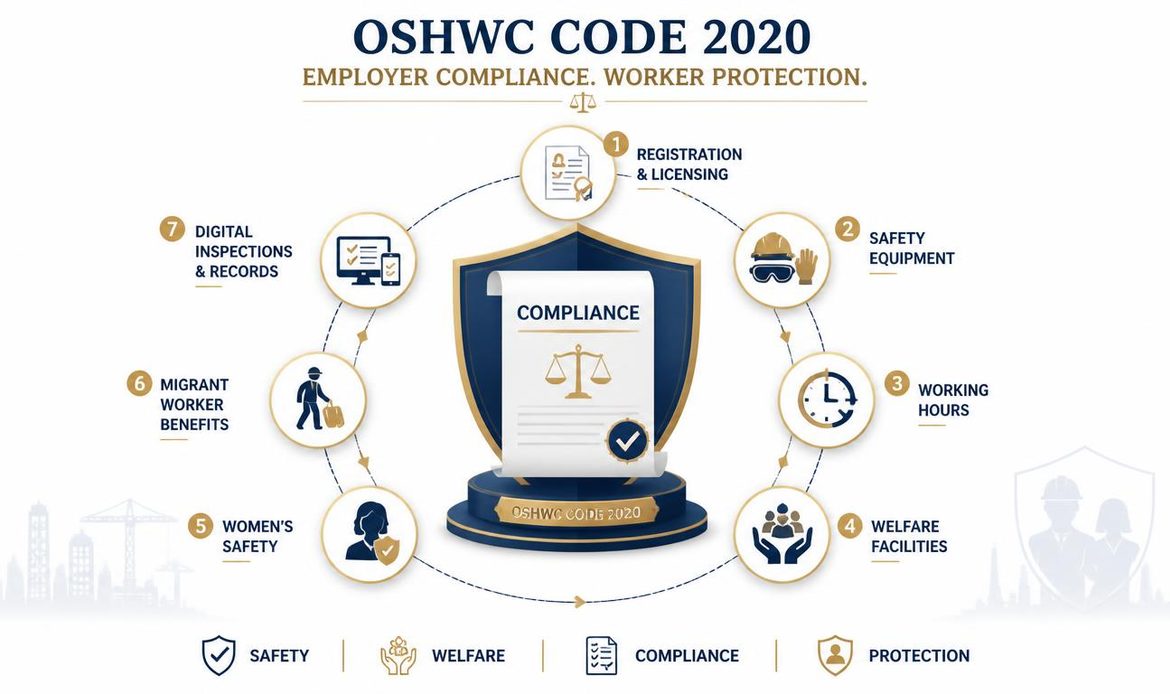
The Code on Occupational Safety Health and Working Conditions 2020 Bare Act PDF prescribes a structured registration and licensing system for establishments. Every employer falling within the scope of the Code must register the establishment with the appropriate government within the prescribed timelines. Certain categories of activities, such as employing contract labour or engaging inter-State migrant workers, require a licence in addition to registration.
This framework seeks to reduce the multiplicity of earlier registrations under different enactments and replace them with a single consolidated system. Employers are expected to:
- file registration applications electronically,
- obtain one licence covering multiple categories of work (contract labour, migrant workers, staffing agencies),
- renew such licences periodically, and
- display registration and licensing details prominently at the workplace.
The move towards a unified registration process is intended to improve transparency and reduce administrative burdens, while giving regulators a centralised database of establishments.
Inspections and filings under the OSHWC Code 2020 Executive Summary PDF
The OSHWC Code 2020 Executive Summary PDF emphasises the transition from traditional inspection methods to a web-based, risk-oriented inspection scheme. Inspectors are now designated as “inspectors-cum-facilitators”, with a dual role of monitoring compliance and guiding establishments. This marks a shift from a purely adversarial approach to one that promotes compliance through cooperation.
Key features include:
- electronic filing of annual and half-yearly returns,
- maintenance of statutory registers in prescribed digital formats,
- randomised inspection scheduling through an online system to reduce arbitrariness,
- publication of inspection reports electronically for greater transparency.
Employers must therefore adapt their internal compliance systems to align with digital filings and inspection readiness. Non-compliance in submissions or discrepancies in records can trigger closer scrutiny.
Practical approach to compliance in the Occupational Safety Health Working Conditions Act 2020 PDF Corrida Legal
Corrida Legal’s analysis of the Occupational Safety Health Working Conditions Act 2020 PDF Corrida Legal notes that compliance is not merely a procedural task but a continuing responsibility. Employers should anticipate that inspectors will verify both documentary compliance and ground-level implementation.
Practical steps for employers include:
- appointing internal compliance officers or committees responsible for health, safety, and welfare,
- conducting periodic internal audits to verify registers, filings, and welfare facilities,
- training supervisors on their statutory duties towards workers,ensuring contractors also maintain proper records of workers and benefits provided,
- developing digital systems for attendance, overtime, and leave tracking to generate statutory data accurately.
For many establishments, compliance under the OSHWC Code requires a cultural shift, from reactive, inspection- focused practices to proactive, systems-driven monitoring. Corrida Legal recommends that businesses integrate compliance tasks into daily HR and operational routines, thereby reducing risks of penalties and improving workforce trust.
Penalties for Non-Compliance under the Code on Occupational Safety, Health and Working Conditions, 2020
The Code on Occupational Safety Health and Working Conditions 2020 Bare Act PDF sets out a comprehensive penalty regime designed to ensure adherence to its provisions. Unlike older legislations where punishments were scattered, the Code centralises offences and penalties in one place. This helps both regulators and employers to understand the consequences of non-compliance clearly.
Key statutory provisions include:
- general penalty of fines up to two lakh rupees for contraventions where no specific penalty is prescribed,
- enhanced fines and possible imprisonment for repeated or serious violations,
- liability of directors, managers, and officers in default when offences are committed by companies,
- compounding of certain offences to allow quicker resolution without prolonged litigation.
The legislative intent is deterrence: employers must treat compliance not as an option but as an operational requirement.
Enforcement provisions in the OSHWC Code 2020 Executive Summary PDF
The OSHWC Code 2020 Executive Summary PDF stresses that penalties extend beyond financial liability to reputational consequences. Inspectors-cum-facilitators have the power to initiate prosecutions, and courts may impose fines, imprisonment, or both, depending on the nature of the breach.
Illustrative categories of penalties include:
- violation of duties relating to health and safety, especially in hazardous processes,
- failure to provide welfare amenities such as canteens, crèches, or restrooms when required,
- excessive working hours or denial of leave entitlements,employment of women without prescribed safety measures in night shifts,
- non-payment of allowances and benefits to inter-State migrant workers.
This wider scope ensures that penalties address not only administrative defaults but also substantive breaches affecting worker welfare.
Practical implications in the Occupational Safety Health Working Conditions Act 2020 PDF Corrida Legal
Corrida Legal’s review of the Occupational Safety Health Working Conditions Act 2020 PDF Corrida Legal highlights that enforcement under the Code will increasingly rely on documentation and digital filings. An establishment that fails to maintain accurate records or submits inconsistent returns may be deemed non-compliant even without an on-site accident.
Practical implications for employers include:
- need to budget for compliance costs, since penalties can exceed the savings from neglecting obligations,
- greater personal liability for senior management, particularly directors responsible for operations,
- reputational risk where prosecutions become public, affecting investor and employee confidence,importance of preventive audits and training programmes to avoid violations,
- opportunity to resolve minor breaches through compounding, provided timely corrective action is taken.
In practice, penalties under the OSHWC Code are meant to push employers towards building compliance into routine operations rather than waiting for inspections or disputes. Corrida Legal recommends proactive self-assessment and internal monitoring to reduce exposure.
Impact on Businesses & HR Departments under the Code on Occupational Safety, Health and Working Conditions, 2020
The Code on Occupational Safety Health and Working Conditions 2020 Bare Act PDF has far-reaching consequences for businesses. By merging thirteen laws into one statute, it eliminates overlapping requirements but also demands greater accountability. Companies now have to view compliance not as fragmented filings under separate Acts, but as an integrated responsibility covering safety, health, and working conditions.
Key business impacts include:
- need to restructure compliance functions to handle a centralised registration and reporting system,
- alignment of contracts with contractors and staffing agencies to reflect statutory obligations,
- additional investments in welfare infrastructure such as crèches, canteens, and sanitation facilities,
- higher exposure to penalties and reputational risks in case of non-compliance,
- potential improvement in employee productivity and retention through better working conditions.
Businesses that treat compliance as a core operational function rather than an administrative formality will be better positioned to adapt.
HR responsibilities in the OSHWC Code 2020
The OSHWC Code 2020 Executive Summary PDF underscores the role of human resources departments in implementing the Code. Since the provisions touch directly on working hours, leave entitlements, safety standards, and welfare facilities, HR professionals must play a proactive role in ensuring conformity.
HR responsibilities include:
- drafting and updating workplace policies to reflect statutory working hour limits and leave entitlements,
- maintaining accurate registers of attendance, overtime, and leave, preferably in digital formats,
- coordinating with facility management to ensure welfare provisions like crèches, restrooms, and canteens meet statutory thresholds,
- developing training programmes on occupational safety, especially for supervisors and line managers,
- integrating statutory compliance checks into routine HR audits and employee feedback mechanisms.
In short, HR is no longer just an administrative wing; under the OSHWC Code it becomes a frontline function for statutory compliance.
Corrida Legal’s perspective in the Occupational Safety Health Working Conditions Act 2020
Corrida Legal’s commentary on the Occupational Safety Health Working Conditions Act 2020 PDF Corrida Legal highlights that the impact of the Code extends beyond legal compliance into corporate governance. Boards and senior management must recognise occupational safety and welfare as governance issues, not merely operational matters.
Recent Notifications & Amendments under the Code on Occupational Safety, Health and Working Conditions, 2020
The Code on Occupational Safety Health and Working Conditions 2020 Bare Act PDF was enacted in September 2020, but its full implementation depends on the framing of rules by both the Central Government and the State Governments. While the Code consolidates thirteen different labour laws, it expressly provides that the detailed procedures, forms, and thresholds will be operationalised through subordinate legislation.
Since labour is a subject in the Concurrent List, both levels of government are empowered to notify rules. The Central Government has already released draft rules covering aspects such as registration, licensing, safety standards, and filing requirements. However, the Code cannot come into force fully until the states also notify their respective rules. This dual process has delayed enforcement, though several states have now issued draft notifications for public consultation.
Draft rule highlights in the OSHWC Code 2020
The OSHWC Code 2020 Executive Summary PDF points out that the draft rules issued by the Central Government are aimed at streamlining compliance. These drafts indicate the shape of the regulatory framework that employers must prepare for.
Key highlights from the draft rules include:
- online registration of establishments and electronic filing of returns,
- uniform licensing for contractors, staffing agencies, and inter-State migrant workers,
- detailed requirements for welfare amenities such as crèches, canteens, and restrooms,record-keeping in prescribed formats to be maintained digitally,
- rules for inspection protocols, including risk-based scheduling.
Employers should not wait for final rules to be published before acting. Instead, they should begin aligning internal systems with these draft provisions, as final rules are unlikely to deviate significantly from the drafts.
Practical business response in the Occupational Safety Health Working Conditions Act 2020
Corrida Legal’s analysis of the Occupational Safety Health Working Conditions Act 2020 PDF Corrida Legal stresses that businesses must view these draft rules as a compliance roadmap rather than a future obligation. Waiting until formal enforcement begins may expose organisations to non-compliance risks, especially where inspections are carried out once the Code is notified in full.
Practical steps businesses should take now include:
- conducting a compliance gap analysis against the draft rules,
- upgrading HR and payroll systems to capture attendance, overtime, and leave in prescribed formats,
- ensuring welfare amenities meet the draft standards in anticipation of enforcement,training compliance teams and HR officers on the new inspection and filing protocols,
- tracking notifications issued by both the Central and State Governments.
For multi-state organisations, the challenge lies in harmonising compliance across different jurisdictions, as state rules may introduce variations. Corrida Legal advises clients to prepare state-wise compliance calendars to ensure readiness once notifications are finalised.
Conclusion
The Code on Occupational Safety, Health and Working Conditions, 2020 Bare Act PDF represents one of the most significant steps in India’s labour law reforms. By consolidating thirteen separate enactments into a single framework, the Code simplifies procedures but simultaneously imposes a higher level of accountability on employers. Its focus on health, safety, and welfare reflects a legislative intent to align India’s labour standards with modern workplace practices.
From an employer’s perspective, the Code is not just about compliance filings; it requires real investment in worker welfare, transparent systems, and stronger HR policies. For employees, it guarantees greater clarity of rights, enforceable safeguards, and parity of treatment across industries.
Key concluding points:
- The Code merges multiple fragmented statutes into one, ensuring consistency and uniformity in obligations.
- Businesses must prepare for digital compliance through online registration, filings, and inspection-readiness.
- Special provisions for women and inter-State migrant workers reflect the social dimension of the reforms.Penalties for non-compliance are stricter, making preventive audits and proactive compliance critical.
- For HR and compliance officers, the Code provides a framework that must be embedded into day-to-day processes, not left to ad hoc inspections.
Ultimately, the OSHWC Code signals a cultural shift in India’s labour law landscape. By mandating health, safety, and welfare as non-negotiable obligations, it places the responsibility squarely on employers to create safer, more equitable workplaces.