


Reviewed and Validated by: Shubham Dwivedi, Advocate
Introduction: Indian Contract Act, 1872 – Bare Act PDF
The Indian Contract Act 1872 Bare Act PDF (“Contract Act”) is the cornerstone of Indian commercial law. Enacted during the colonial period, it came into force on 1 September 1872 and has since provided the statutory foundation for agreements, obligations, and enforceability of promises in India. Though more than a century old, the Act continues to be one of the most relied upon statutes in both personal and corporate legal frameworks.
The Act originally dealt with contracts, contracts relating to partnerships, contracts relating to contracts of contracts (including contracts relating to contracts of contracts such as contracts relating to partnership, contracts of contracts relating to contracts of contracts like contracts of contracts of partnership, and contracts relating to contracts of contracts of agency). Over time, many provisions were carved out into separate legislations, such as the Indian Partnership Act, 1932, and the Indian Contract relating to contracts relating to contracts of contracts of contracts, but the Contract Act still governs the general principles of the law of contract and special contracts such as indemnity, guarantee, bailment, pledge, and agency.
Why the Indian Contract Act, 1872, remains vital:
- It sets the framework for valid contracts, including offer, acceptance, consideration, and consent.
- It defines the rights and obligations of parties, ensuring certainty in commercial transactions.
- It provides remedies for breach of contract, including damages, injunctions, and specific performance.
- It balances business needs with fairness and enforceability in personal and corporate dealings.
- It remains the guiding statute for students, lawyers, entrepreneurs, and businesses entering into contracts in India.
For modern businesses, the Act is not merely a legal relic but a practical compliance guide that underpins everything from employment contracts to international trade agreements. Corrida Legal’s Indian Contract Act 1872 Executive Summary PDF distils these principles for easy understanding, while the Indian Contract Act 1872 PDF Corrida Legal resource provides direct access to the bare act for professionals and students.
What is the Indian Contract Act, 1872?
The Indian Contract Act 1872 Bare Act PDF is the primary legislation governing contracts in India. It defines the principles under which agreements become legally enforceable contracts and lays down the rights, duties, and remedies of parties entering into such agreements. Enacted in 1872, this Act has stood the test of time, continuing to regulate commercial and civil transactions in India even in today’s complex business environment.
Originally, the Act was a comprehensive piece of legislation covering contracts, contracts relating to partnerships, contracts relating to contracts of contracts such as contracts of contracts of partnership and contracts relating to contracts of contracts relating to contracts of contracts of contracts. Over time, several parts were repealed and enacted separately — for instance, the Indian Partnership Act, 1932 and the Indian Contract relating to contracts relating to agency laws. What remains today is the general law of contracts and certain categories of special contracts such as indemnity, guarantee, bailment, pledge, and agency.
Purpose and scope in the Indian Contract Act 1872 Executive Summary PDF
The Indian Contract Act 1872 Executive Summary PDF identifies the Act’s main objectives:
- Provide certainty: ensure promises made in agreements are legally enforceable.
- Define essentials of valid contracts: including offer, acceptance, consideration, free consent, and lawful object.
- Establish rights and duties: set out the obligations of parties to a contract.
- Provide remedies for breach: such as damages, specific performance, and injunctions.
- Regulate special contracts: indemnity, guarantee, bailment, pledge, and agency.
- Promote fairness in commerce: balance contractual freedom with enforceability and justice. This makes the Act equally relevant to personal agreements and corporate transactions.
Key aspects explained in the Indian Contract Act 1872 PDF Corrida Legal
Corrida Legal’s review of the Indian Contract Act 1872 PDF Corrida Legal highlights that the statute operates on the principle that “all agreements are contracts if they are made with free consent of competent parties, for a lawful consideration and with a lawful object, and are not expressly declared void.”
Practical implications include:
- All business agreements, from employment contracts to cross-border deals, must follow the Act’s essentials.
- Contracts that lack free consent or lawful object may be declared void or voidable.
- Courts in India rely heavily on this Act for deciding disputes, with case law shaping its application.
- The Act remains flexible enough to apply to modern transactions, including e-contracts and digital agreements.
Salient features in the Bare Act PDF Indian Contract Act 1872 Download
The Bare Act PDF Indian Contract Act 1872 Download shows that the Act has two broad parts:
- General Principles relating to the Law of Contract – applicable to all contracts (Sections 1 to 75).
- Special kinds of Contracts – indemnity, guarantee, bailment, pledge, and agency. Together, these provisions form the backbone of contractual law in India.
Structure of the Indian Contract Act, 1872
The Indian Contract Act 1872 Bare Act PDF was originally enacted as a comprehensive code covering all branches of contract law. Over time, however, several parts of the Act were repealed and re-enacted as independent legislations, leaving behind the core principles of contract law and special types of contracts. Despite these changes, the Act continues to be the bedrock of contractual obligations in India, shaping both personal agreements and business transactions.
Coverage in the Indian Contract Act 1872 Executive Summary PDF
The Indian Contract Act 1872 Executive Summary PDF highlights that the Act is broadly divided into two parts:
1. General Principles relating to the Law of Contract (Sections 1–75):
- Formation of contracts.
- Essentials of a valid agreement (offer, acceptance, consideration, capacity, free consent, lawful object).
- Void and voidable contracts.Performance of contracts.
- Breach of contract and remedies.
2. Special Kinds of Contracts:
- Contracts of Indemnity and Guarantee.
- Contracts relating to Bailment and Pledge.
- Contracts of Agency.
This structure ensures that the Act covers both universal rules and specific relationships recognised under Indian law.
Corrida Legal’s analysis in the Indian Contract Act 1872 PDF Corrida Legal
Corrida Legal’s review of the Indian Contract Act 1872 PDF Corrida Legal notes that many provisions of the original Act were carved out into separate legislations for clarity and specialisation.
Examples include:
- Indian Partnership Act, 1932 – governing partnerships.
- Indian Contract relating to Contracts of Contract (repealed parts).
- Indian Trusts Act, 1882 – covering trusts.
- Sale of Goods Act, 1930 – dealing with contracts of sale.
- Negotiable Instruments Act, 1881 – covering promissory notes, bills of exchange, and cheques.
This process left the Contract Act with its core provisions, ensuring it remains focused on general principles and special contracts.
Key Definitions under the Indian Contract Act, 1872
The Indian Contract Act 1872 Bare Act PDF provides a clear framework of definitions that form the foundation of Indian contract law. These definitions help determine what constitutes a valid agreement, how obligations are created, and when such obligations become legally enforceable contracts. Courts in India continue to rely heavily on these statutory terms to resolve disputes, making them central to both legal practice and business transactions.
Important terms in the Indian Contract Act 1872 Executive Summary PDF
The Indian Contract Act 1872 Executive Summary PDF identifies the following key definitions:
- Contract (Section 2(h)): An agreement enforceable by law. This highlights that not all agreements are contracts — only those backed by legal enforceability.
- Agreement (Section 2(e)): Every promise or set of promises forming consideration for each other. Agreement is the broader concept from which contracts are derived.
- Proposal/Offer (Section 2(a)): When one person signifies willingness to do or abstain from doing something with a view to obtaining assent of the other.
- Acceptance (Section 2(b)): When the person to whom the proposal is made signifies assent, the proposal becomes accepted and transforms into a promise.
- Consideration (Section 2(d)): Something of value given by the promisee or any other person at the desire of the promisor. Consideration is the backbone of a contract.
- Free Consent (Section 13): Consent is free when it is not caused by coercion, undue influence, fraud, misrepresentation, or mistake.
- Void Contract (Section 2(j)): A contract that ceases to be enforceable by law.
- Voidable Contract (Section 2(i)): A contract enforceable at the option of one party but not the other (e.g., where consent is obtained by coercion or fraud).
- Competency of Parties (Section 11): A person must be of majority age, of sound mind, and not disqualified by law to enter into a contract.
Corrida Legal’s analysis in the Indian Contract Act 1872 PDF Corrida Legal
According to Corrida Legal’s review of the Indian Contract Act 1872 PDF Corrida Legal, these definitions continue to be the bedrock of contract law, influencing both judicial interpretation and business drafting practices.
Practical implications include:
- Contracts without consideration or free consent may be declared void or voidable.
- Businesses must ensure contracts are signed by competent parties to avoid future disputes.
- Courts strictly interpret whether an offer and acceptance are clear and unambiguous.
- Defective agreements (uncertain terms, unlawful objects) are unenforceable under Section 29 and Section 23.
This ensures that contracts are not only voluntary but also legally sound.
Relevance in the Bare Act PDF Indian Contract Act 1872 Download
The Bare Act PDF Indian Contract Act 1872 Download makes it clear that these statutory definitions are not just theoretical, they guide everyday transactions, from commercial contracts to personal agreements.
Key benefits of statutory definitions:
- Certainty: ensures clarity in drafting and interpretation of contracts.
- Fairness: prevents exploitation through doctrines like free consent and lawful consideration.
- Predictability: businesses can structure contracts knowing how courts will interpret core terms.
- Flexibility: definitions are broad enough to apply to modern forms of agreements, including digital contracts.
Essentials of a Valid Contract under the Indian Contract Act, 1872
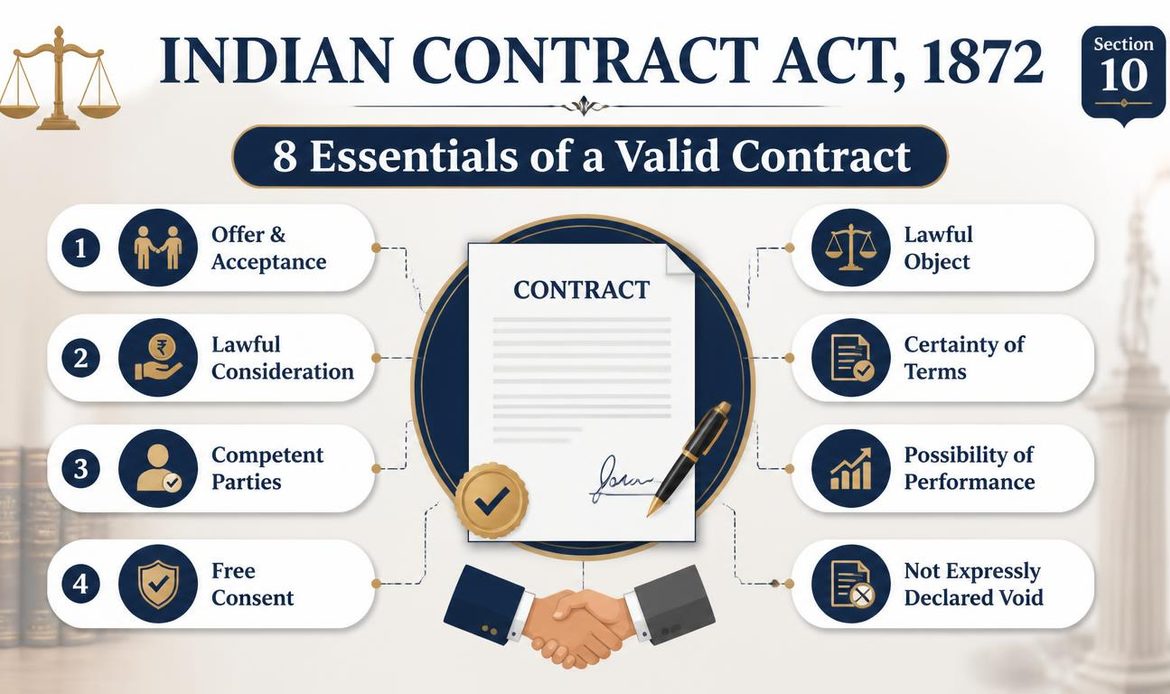
The Indian Contract Act 1872 Bare Act PDF lays down the foundation for determining what agreements qualify as contracts enforceable by law. According to Section 10 of the Act, “All agreements are contracts if they are made by the free consent of parties competent to contract, for a lawful consideration and with a lawful object, and are not hereby expressly declared to be void.” This provision captures the essence of Indian contract law and is consistently relied upon by courts to assess the validity of agreements.
A contract that does not meet these essentials may be void or voidable, depending on the circumstances. Businesses, individuals, and legal professionals must ensure these conditions are met when drafting or entering into contracts.
Essentials listed in the Indian Contract Act 1872
The Indian Contract Act 1872 Executive Summary PDF identifies the following essentials of a valid contract:
1. Offer and Acceptance:
- There must be a lawful offer by one party and lawful acceptance by the other.
- The offer and acceptance must be absolute, unqualified, and communicated clearly.
2. Lawful Consideration:
- Something of value must be exchanged between the parties.
- Consideration must be lawful and not forbidden by law.
3. Competency of Parties:
- Parties must be of the age of majority, of sound mind, and not disqualified by law (Section 11).
4. Free Consent:
- Consent must not be obtained by coercion, undue influence, fraud, misrepresentation, or mistake (Sections 13–19).
5. Lawful Object:
- The object of the agreement must not be illegal, immoral, or opposed to public policy (Section 23).
6. Certainty and Possibility of Performance:
- The terms of the contract must be clear, definite, and capable of being performed (Section 29).
7. Intention to Create Legal Relations:
- The parties must intend for the agreement to create legal obligations, particularly in commercial contexts.
8. Not Expressly Declared Void:
- Agreements expressly void under the Act (such as wagering contracts, agreements in restraint of trade, or agreements with uncertain terms) cannot be enforced.
Corrida Legal’s analysis in the Indian Contract Act 1872 PDF Corrida Legal
Corrida Legal’s review of the Indian Contract Act 1872 PDF Corrida Legal emphasises that these essentials are not just academic concepts, they serve as compliance checkpoints in practice.
Practical applications include:
- Commercial contracts must be reviewed for free consent to avoid challenges of fraud or misrepresentation.
- Startups and corporates must ensure clear and lawful consideration when structuring investments or agreements.
- Contracts with minors or disqualified persons are void ab initio, leading to unenforceability.
- Vague contracts (uncertain terms, incomplete obligations) may be declared void under Section 29.
- Digital and e-contracts are enforceable if they satisfy these essentials, showing the Act’s adaptability to modern transactions.
Role in the Bare Act PDF Indian Contract Act 1872 Download
The Bare Act PDF Indian Contract Act 1872 Download shows that essentials of a valid contract form the backbone of enforceability:
- Courts consistently examine whether contracts meet Section 10 requirements before enforcing them.
- Case law, such as Mohori Bibee v. Dharmodas Ghose (1903) and Lalman Shukla v. Gauri Dutt (1913), illustrates how the absence of essentials can make contracts void or voidable.
- This ensures a predictable framework for businesses and individuals to structure agreements.
Types of Contracts Recognised under the Indian Contract Act, 1872
The Indian Contract Act 1872 Bare Act PDF classifies contracts into different categories based on their validity, enforceability, formation, and performance. This classification helps courts, businesses, and individuals understand the legal effect of agreements and how disputes should be resolved. The categorisation also clarifies which contracts are binding, which are void, and which create limited rights for the parties involved.
Classifications in the Indian Contract Act 1872
The Indian Contract Act 1872 Executive Summary PDF identifies the following main types of contracts:
1. Valid Contracts
- Contracts fulfilling all essentials under Section 10 of the Act.
- Example: A contract with lawful offer, acceptance, consideration, and free consent.
2. Void Contracts (Section 2(j))
- Agreements that are not enforceable by law.
- Example: A contract with an unlawful object, or a contract with a minor.
3. Voidable Contracts (Section 2(i))
- Enforceable at the option of one party but not the other.
- Example: A contract signed under coercion or misrepresentation.
4. Illegal Contracts
- Contracts forbidden by law or opposed to public policy.
- Example: Contracts for gambling, trafficking, or other unlawful purposes.
5. Unenforceable Contracts
- Valid in substance but unenforceable due to technical defects, such as lack of stamp duty or registration.
6. Contingent Contracts (Section 31)
- Contracts dependent on the happening or non-happening of a future uncertain event.
- Example: Insurance contracts.
7. Quasi-Contracts (Sections 68–72)
- Not actual contracts but obligations imposed by law to prevent unjust enrichment.
- Example: A person receiving money by mistake is bound to repay it.
Corrida Legal’s analysis in the Indian Contract Act 1872 PDF Corrida Legal
Corrida Legal’s review of the Indian Contract Act 1872 PDF Corrida Legal highlights that these classifications are not merely academic but directly impact enforcement in practice.
Practical implications include:
- Valid contracts are binding and enforceable in courts.
- Void contracts create no rights or obligations, protecting parties from unlawful arrangements.
- Voidable contracts safeguard parties whose consent was not free, allowing them to rescind or affirm the contract.
- Contingent contracts are crucial in areas like insurance, construction, and financial services.
- Quasi-contracts ensure fairness, especially in situations where no express agreement exists but justice requires compensation.
This classification enables businesses and individuals to structure agreements with greater legal certainty.
Relevance in the Bare Act PDF Indian Contract Act 1872 Download
The Bare Act PDF Indian Contract Act 1872 Download illustrates how courts apply these categories to real disputes:
- Courts test the validity of a contract against Section 10 essentials.
- If consent is defective, the agreement may become voidable.
- If the object or consideration is unlawful, the agreement is void or illegal.
- Quasi-contractual obligations are enforced even without an express agreement to prevent unjust enrichment.
Performance of Contracts under the Indian Contract Act, 1872
The Indian Contract Act 1872 Bare Act PDF provides a detailed framework for the performance of contracts, which means carrying out the obligations undertaken by the parties. Performance is central to contract law because a contract is not merely an agreement, it is a promise enforceable by law. Once a contract is formed, the parties must perform their respective duties within the agreed time and manner, unless excused under law.
Failure to perform contractual obligations leads to breach, triggering remedies such as damages, specific performance, or injunctions. Thus, performance is the stage where the promises made in a contract are tested in practice.
Rules on performance in the Indian Contract Act 1872
The Indian Contract Act 1872 Executive Summary PDF outlines the key rules governing performance of contracts:
1. By parties themselves (Section 37):
- Promises must be performed by the promisor or their authorised agent, unless personal skill or qualification is involved.
2. By representatives:
- On the death of a promisor, their representatives are bound to perform contractual obligations, unless the contract is personal in nature.
3. Joint promises (Sections 42–45):
- When two or more persons make a joint promise, all are jointly responsible.
- A promisee may compel performance by any one of the promisors.
- Promisors can claim contribution from co-promisors.
4. Time and place of performance (Sections 46–50):
- If no time is specified, performance must be within a reasonable time.
- If a time is fixed, the promisor must perform on or before that date.
- Performance must be at the place agreed upon or in a reasonable location.
5. Reciprocal promises (Sections 51–54):
- Where performance depends on prior performance by the other party, obligations are sequential.
- Contracts involving reciprocal promises may be simultaneous or dependent in nature.
6. Appropriation of payments (Sections 59–61):
- Rules apply when a debtor owes several debts to a creditor and makes payment without specifying which debt is being discharged.
Corrida Legal’s analysis in the Indian Contract Act 1872 PDF Corrida Legal
Corrida Legal’s commentary on the Indian Contract Act 1872 PDF Corrida Legal notes that performance rules protect both business certainty and fairness.
Practical insights include:
- Joint liability ensures that creditors are not left uncompensated where multiple parties are involved.
- Rules on reciprocal promises are critical in construction, supply, and service contracts.
- Time-bound obligations are especially relevant in commercial agreements, where delay can amount to breach.
- Appropriation of payments provides clarity in debtor–creditor relationships, reducing disputes. This makes the performance framework vital for day-to-day commercial transactions.
Relevance in the Bare Act PDF Indian Contract Act 1872 Download
The Bare Act PDF Indian Contract Act 1872 Download provides statutory certainty to businesses and individuals by codifying performance obligations.
Key aspects include:
- Courts can compel performance where obligations are clear and certain.
- Non-performance gives rise to legal remedies, protecting the innocent party.
- Contract law distinguishes between substantial performance and non-performance, ensuring fairness in enforcement.
Discharge of Contracts under the Indian Contract Act, 1872
The Indian Contract Act 1872 Bare Act PDF not only governs the creation and performance of contracts but also sets out the circumstances under which contracts come to an end. This termination of contractual obligations is referred to as the discharge of contract. Once discharged, neither party is bound to perform further duties under the agreement.
Understanding discharge is crucial for businesses and individuals alike, as it defines when parties are legally free of obligations and when remedies may be sought for breach.
Modes of discharge in the Indian Contract Act 1872
The Indian Contract Act 1872 Executive Summary PDF identifies the following key modes of discharge:
1. By performance (Section 37):
- When both parties fulfill their respective obligations, the contract naturally comes to an end.
2. By mutual agreement (Sections 62–63):
- A contract may be discharged through novation (substitution of a new contract), rescission (cancellation), or alteration (change in terms).
3. By impossibility of performance (Section 56):
- Known as doctrine of frustration. If performance becomes impossible or unlawful, the contract is void.
- Example: Contracts frustrated due to natural disasters or changes in law.
4. By lapse of time (Limitation Act, 1963):
- If claims are not brought within the prescribed limitation period, contractual rights are extinguished.
5. By breach of contract:
- If one party refuses or fails to perform, the other party may treat the contract as discharged and claim remedies.
6. By operation of law:
- Insolvency, merger of rights, or material alteration of the contract can discharge obligations.
Corrida Legal’s analysis in the Indian Contract Act 1872
Corrida Legal’s review of the Indian Contract Act 1872 PDF Corrida Legal underlines that discharge doctrines balance certainty with flexibility:
- Parties are encouraged to perform but may be relieved when performance becomes impossible or unlawful.
- Mutual discharge (novation or alteration) allows businesses to adapt to changing circumstances without litigation.
- Courts carefully apply the doctrine of frustration to prevent misuse while ensuring fairness.
- Breach-triggered discharge ensures that innocent parties are not bound to unfulfilled promises.
For businesses, understanding discharge provisions helps in drafting exit clauses, force majeure clauses, and limitation terms.
Relevance in the Bare Act PDF Indian Contract Act 1872 Download
The Bare Act PDF Indian Contract Act 1872 Download provides statutory certainty for termination of obligations:
- Courts enforce contracts strictly unless valid grounds for discharge are proven.
- Case law, such as Satyabrata Ghose v. Mugneeram Bangur & Co. (1954), illustrates how impossibility and frustration doctrines are applied.
- The Act recognises both voluntary discharge (performance, mutual agreement) and involuntary discharge (impossibility, breach, operation of law).
Breach of Contract and Remedies under the Indian Contract Act, 1872
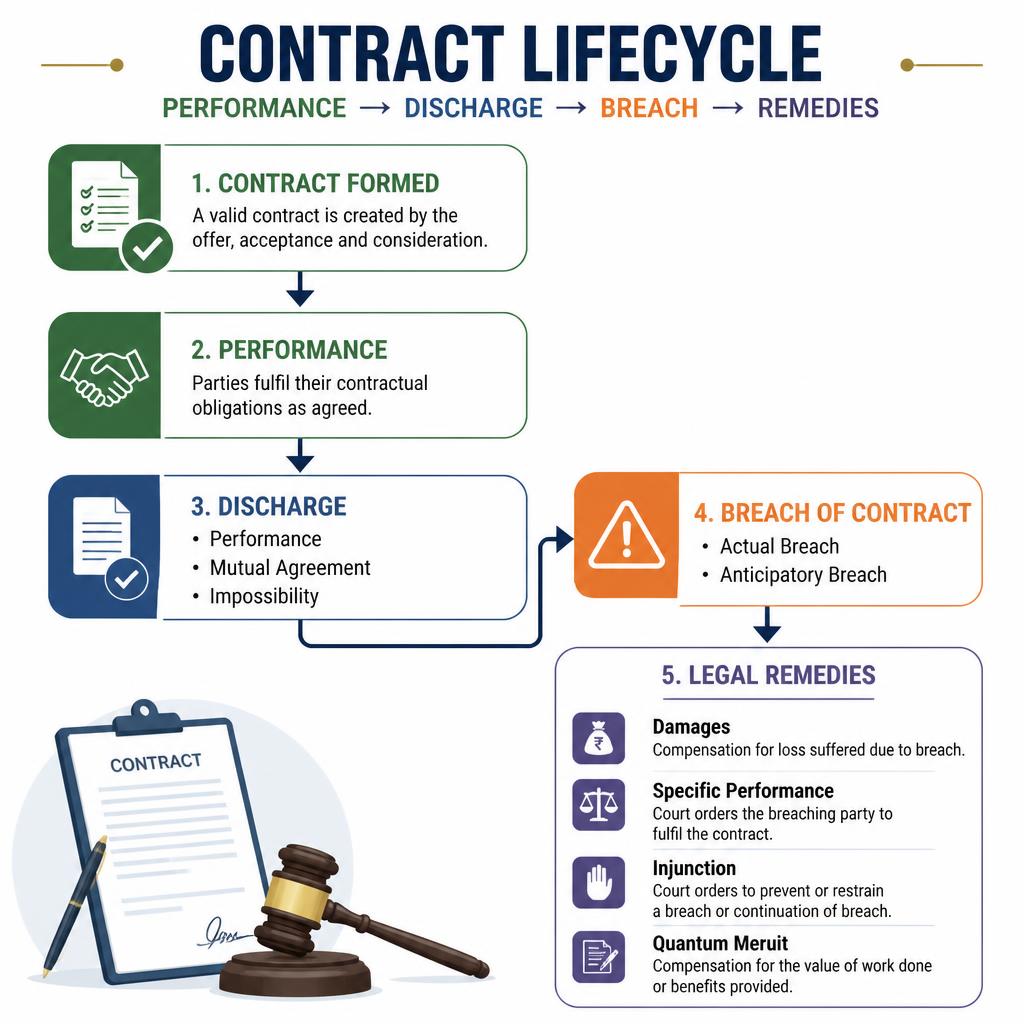
The Indian Contract Act 1872 Bare Act PDF recognises that not all contracts are performed as promised. When one party fails to perform their obligations or expresses unwillingness to do so, a breach of contract occurs. A breach may be actual (failure at the time of performance) or anticipatory (a declaration in advance that performance will not be carried out).
The Act provides various remedies for breach, ensuring that the innocent party is protected and compensated. These remedies are crucial for maintaining confidence in commercial and personal transactions.
Types of breach in the Indian Contract Act 1872
The Indian Contract Act 1872 Executive Summary PDF categorises breach of contract as:
1. Actual Breach:
- Occurs when a party refuses or fails to perform obligations when performance is due.
- Example: A supplier fails to deliver goods on the agreed date.
2. Anticipatory Breach:
- Occurs when a party declares before the due date that they will not perform.
- Example: A contractor informs the client in advance that work will not be completed.
Remedies for breach in the Indian Contract Act 1872
Corrida Legal’s review of the Indian Contract Act 1872 PDF Corrida Legal highlights the statutory remedies available to an aggrieved party:
1. Damages:
- Compensatory damages: to put the injured party in the position they would have been if the contract was performed.
- Special damages: awarded for losses arising from special circumstances communicated at the time of contract (as per Hadley v. Baxendale).
- Liquidated damages: pre-agreed sum payable on breach, provided it is reasonable.
- Nominal damages: token compensation where no substantial loss is proved.
2. Specific Performance (Specific Relief Act, 1963):
- Court orders the defaulting party to perform contractual obligations, often in cases of unique goods or immovable property.
3. Injunction:
- A court order restraining a party from doing something that breaches the contract.
4. Quantum Meruit (Sections 70–72):
- “As much as earned” — allows a party to claim payment for partial performance or benefits conferred where a contract is void or unenforceable.
Enforcement under the Bare Act PDF Indian Contract Act 1872 Download
The Bare Act PDF Indian Contract Act 1872 Download ensures that remedies are legally enforceable through courts:
- Courts assess whether loss is direct, proximate, and foreseeable.
- Damages are not meant to punish but to compensate (Koufos v. Czarnikow Ltd principle).
- Specific performance is granted where damages are inadequate (e.g., sale of land).
- Injunctions are used to restrain breaches in sensitive contracts (e.g., employment, IP rights).
- Quantum meruit claims prevent unjust enrichment in incomplete contracts.
Special Categories of Contracts under the Indian Contract Act, 1872
The Indian Contract Act 1872 Bare Act PDF not only lays down general principles of contract law but also deals with certain special categories of contracts that are integral to commercial and personal dealings. These contracts involve specific relationships and obligations beyond ordinary agreements and continue to play a critical role in modern business, trade, and banking transactions.
Special contracts in the Indian Contract Act 1872 Executive Summary PDF
The Indian Contract Act 1872 Executive Summary PDF highlights the following key categories:
1. Contracts of Indemnity (Sections 124–125):
- A contract by which one party promises to save the other from loss caused by the conduct of the promisor or another person.
- Example: An insurance contract where the insurer indemnifies the insured for specified losses.
2. Contracts of Guarantee (Sections 126–147):
- A contract where a surety undertakes to discharge the liability of a third party in case of default.
- Involves three parties: principal debtor, creditor, and surety.
- Example: A bank guarantee for a loan.
3. Contracts of Bailment (Sections 148–181):
- Delivery of goods by one person (bailor) to another (bailee) for a purpose, upon a contract that the goods shall be returned.
- Example: Leaving clothes at a dry cleaner.
4. Contracts of Pledge (Sections 172–181):
- A type of bailment where goods are delivered as security for repayment of a debt or performance of a promise.
- Example: Pledging gold with a bank to secure a loan.
5. Contracts of Agency (Sections 182–238):
- A relationship where an agent is authorised to act on behalf of the principal and create contractual relations with third parties.
- Example: A real estate broker negotiating a property sale on behalf of the owner.
Corrida Legal’s analysis in the Indian Contract Act 1872 PDF Corrida Legal
Corrida Legal’s review of the Indian Contract Act 1872 PDF Corrida Legal emphasises that these
contracts remain essential in today’s business environment:
- Indemnity & Guarantee contracts are the backbone of banking, insurance, and financial services.
- Bailment & Pledge govern everyday transactions like warehousing, logistics, and secured loans.
- Agency contracts are fundamental for corporate operations, from appointing distributors to engaging agents for negotiations.
Their statutory recognition ensures predictability and fairness in complex commercial relationships.
Enforcement under the Bare Act PDF Indian Contract Act 1872 Download
The Bare Act PDF Indian Contract Act 1872 Download provides legal enforceability to these categories:
- Rights and duties of indemnifiers, sureties, bailors, bailees, pledgors, and agents are clearly defined.
- Courts consistently uphold the validity of special contracts, subject to essentials of consent, consideration, and lawful object.
- Disputes often centre on scope of authority (agency), liability of sureties (guarantee), or rights of lien and return (bailment and pledge).
Landmark Case Laws under the Indian Contract Act, 1872
The Indian Contract Act 1872 Bare Act PDF has been extensively interpreted by Indian and English courts for over 150 years. Landmark judgments have clarified the meaning of consent, consideration, breach, and enforceability, shaping the way contracts operate in practice. These cases remain essential for law students, practitioners, and businesses relying on contractual frameworks.
Notable cases in the Indian Contract Act 1872 Executive Summary PDF
The Indian Contract Act 1872 Executive Summary PDF highlights the following landmark judgments:
1. Carlill v. Carbolic Smoke Ball Co. (1893):
- Established the principle that a unilateral offer to the public can become binding if accepted through conduct.
2. Mohori Bibee v. Dharmodas Ghose (1903):
- Held that a minor’s contract is void ab initio; minors are not competent to contract under Section 11.
3. Hadley v. Baxendale (1854):
- Defined the rule for damages: losses must be foreseeable and flow naturally from the breach.
4. Lalman Shukla v. Gauri Dutt (1913):
- Established that acceptance of an offer requires knowledge of the offer; mere performance without awareness does not constitute acceptance.
5. Central Inland Water Transport Corporation v. Brojo Nath Ganguly (1986):
- Reinforced the principle that contracts with unfair or unconscionable terms may be struck down as opposed to public policy.
Corrida Legal’s analysis in the Indian Contract Act 1872 PDF Corrida Legal
Corrida Legal’s review of the Indian Contract Act 1872 PDF Corrida Legal notes that these cases are not just historic but practically relevant today:
- Businesses must draft contracts with fairness to avoid challenges under public policy.
- Parties should clearly define terms to avoid disputes on consent or consideration.
- Courts continue to apply Hadley v. Baxendale when awarding damages in breach of contract claims.
- Contracts with minors or legally incompetent parties remain void, ensuring protection for vulnerable individuals.
Impact on Businesses and Commerce under the Indian Contract Act, 1872
The Indian Contract Act 1872 Bare Act PDF remains one of the most critical pieces of legislation for Indian businesses, even after more than a century since its enactment. Every commercial transaction, whether it is the supply of goods, provision of services, employment relationships, financial agreements, or cross-border trade, operates within the framework of this Act. By laying down the essentials of valid contracts, remedies for breach, and rules for special contracts, the Act provides the legal certainty and predictability needed for commerce to thrive.
Business relevance in the Indian Contract Act 1872
The Indian Contract Act 1872 Executive Summary PDF highlights the following areas where the Act directly impacts business and commerce:
- Corporate transactions: contracts form the backbone of mergers, acquisitions, shareholder agreements, and joint ventures.
- Employment law: appointment letters, non-disclosure agreements (NDAs), and non-compete clauses are governed by contract principles.
- Banking and finance: contracts of indemnity and guarantee are integral to lending, securities, and insurance.
- Logistics and trade: bailment and pledge provisions apply to warehousing, transport, and secured loans.
- Digital commerce: e-contracts, online terms of service, and clickwrap/shrinkwrap agreements are enforceable if they satisfy essentials of Section 10.
Corrida Legal’s analysis in the Indian Contract Act 1872
Corrida Legal’s review of the Indian Contract Act 1872 PDF Corrida Legal notes that businesses must carefully align their practices with statutory principles to avoid disputes.
Practical implications include:
- Drafting contracts with certainty, lawful consideration, and free consent to ensure enforceability.
- Incorporating clear dispute resolution clauses (arbitration/mediation) to reduce litigation risk.
- Ensuring compliance with doctrine of public policy, so that unfair terms are not struck down.
- Recognising enforceability of digital and cross-border contracts, subject to Indian jurisdiction rules.
- Using special contracts (guarantee, agency, pledge) strategically in financial and trade dealings.
Importance in the Bare Act PDF Indian Contract Act 1872 Download
The Bare Act PDF Indian Contract Act 1872 Download makes it clear that businesses cannot function without relying on its provisions.
- The Act provides legal remedies in case of breach, ensuring commercial confidence.
- It protects businesses from fraud, misrepresentation, and coercion in contractual dealings.
- Courts interpret contracts strictly based on statutory provisions, creating a predictable framework for commerce.
- Even modern practices like smart contracts and digital signatures are tested against the essentials under this Act.
Practical Checklist for Drafting Valid Contracts under the Indian Contract Act, 1872
The Indian Contract Act 1872 Bare Act PDF lays down clear essentials for valid contracts, but in practice, businesses and individuals often overlook key elements that later lead to disputes. A practical checklist ensures that contracts meet statutory requirements and remain enforceable in Indian courts. This is particularly important for startups, corporates, and professionals who routinely engage in contractual arrangements.
Checklist in the Indian Contract Act 1872
The Indian Contract Act 1872 Executive Summary PDF highlights the following points to be verified before finalising a contract:
1. Lawful Offer and Acceptance
- Ensure the contract has a clear proposal and absolute acceptance.
- Avoid vague or conditional acceptance, as it may invalidate the contract.
2. Consideration
- Verify that the agreement involves lawful consideration (something of value exchanged).
- Ensure consideration is not prohibited by law or public policy.
3. Competency of Parties
- Confirm that all parties are above 18 years, of sound mind, and not disqualified under law.
- Contracts with minors or disqualified persons are void ab initio.
4. Free Consent
- Ensure consent is not obtained through coercion, fraud, undue influence, or misrepresentation.
- Insert representations and warranties in commercial contracts to reduce risks.
5. Lawful Object
- Confirm that the object of the contract is legal, moral, and not against public policy.
- Avoid clauses that may be struck down as unconscionable.
6. Certainty of Terms
- Draft terms with clarity regarding rights, duties, timelines, and obligations.
- Avoid ambiguous or uncertain language (Section 29).
7. Possibility of Performance
- Ensure the obligations can be legally and physically performed.
- Impracticable contracts may be declared void for impossibility.
8. Not Expressly Declared Void
- Verify that the agreement is not of a type expressly void under the Act (e.g., wagering, restraint of trade).
9. Compliance with Formalities
- Where required, ensure contracts are in writing, stamped, and registered.
- For e-contracts, ensure compliance with the Information Technology Act, 2000.
10. Dispute Resolution Clause
- Include arbitration/mediation clauses to reduce litigation risk.
- Specify jurisdiction for resolving disputes.
Executive Summary of the Indian Contract Act, 1872
The Indian Contract Act 1872 Bare Act PDF forms the bedrock of Indian commercial and civil law, governing how agreements become legally enforceable contracts. Enacted on 1 September 1872, it continues to regulate both personal and business transactions with clarity and predictability.
Key highlights include:
- Foundation of contract law: Defines the essentials of valid contracts — offer, acceptance, consideration, free consent, lawful object, and competent parties.
- General principles: Sections 1–75 govern all contracts, from formation to performance, breach, and remedies.
- Special contracts: Covers indemnity, guarantee, bailment, pledge, and agency — vital in finance, trade, and logistics.
- Classifications: Recognises valid, void, voidable, contingent, quasi-contracts, and illegal contracts.
- Performance rules: Sets obligations for joint promises, reciprocal promises, and time/place of performance.
- Discharge of contracts: Contracts may end by performance, mutual agreement, impossibility, lapse of time, or breach.
- Breach & remedies: Provides remedies such as damages, specific performance, injunctions, and quantum meruit.
- Competency of parties: Excludes minors, persons of unsound mind, and those disqualified by law (e.g., Mohori Bibee v. Dharmodas Ghose).
- Case law foundations: Key judgments like Carlill v. Carbolic Smoke Ball, Hadley v. Baxendale, and Lalman Shukla v. Gauri Dutt continue to guide interpretation.
- Commercial impact: Applies to employment, corporate transactions, e-contracts, and digital commerce, ensuring enforceability in modern contexts.
- Fairness doctrine: Courts may strike down unconscionable contracts as opposed to public policy.
- Enduring relevance: Even after 150 years, the Act remains the central framework for enforceable promises in India.
Conclusion
The Indian Contract Act 1872 Bare Act PDF continues to serve as the cornerstone of Indian commercial and civil law, despite being enacted over 150 years ago. By defining what makes an agreement a legally enforceable contract, the Act provides the certainty and predictability required for trade, business, and personal transactions. Its dual framework of general principles and special contracts ensures that the law remains broad enough to cover diverse situations while detailed enough to govern specific relationships such as indemnity, guarantee, bailment, pledge, and agency.
Over the years, courts have enriched the Act through landmark judgments, clarifying doctrines such as free consent, lawful consideration, foreseeability of damages, and public policy. This judicial interpretation has allowed the Act to adapt to modern contexts, including digital agreements, e-commerce, and international trade contracts, without losing its foundational relevance.
Key takeaways:
- The Act establishes the essentials of valid contracts and provides remedies for breach.
- It governs special contractual relationships critical to finance, trade, and commerce.
- Judicial precedents ensure the law evolves with contemporary business practices.
- Even in the digital age, the Act applies to electronic contracts and online transactions.
- Corrida Legal’s Indian Contract Act 1872 Executive Summary PDF distils these principles for businesses, students, and professionals.