


Reviewed and Validated by: Shubham Dwivedi, Advocate
Introduction to the POSH Act, 2013
Workplaces are meant to be spaces of growth, opportunity, and professional engagement. Yet, for a long time in India, there was no clear legislation that specifically addressed the issue of sexual harassment of women at work. The turning point came with the landmark judgment in Vishaka v. State of Rajasthan (1997), where the Supreme Court laid down guidelines to ensure dignity and safety for women at workplaces. These guidelines eventually formed the foundation of the Sexual Harassment of Women at Workplace Act 2013 bare act PDF, a comprehensive statute that provides a strong legal framework for prevention, prohibition, and redressal of workplace harassment.
Historical context
The Vishaka Guidelines were significant because they recognised sexual harassment as a violation of fundamental rights under Articles 14, 15, and 21 of the Constitution. However, since they were judicial directions, their implementation varied across sectors. With increasing participation of women in the workforce, the absence of a statutory mechanism became more visible. This gap made it necessary to bring a dedicated law, the POSH Act, 2013—to create safer work environments across industries and regions.
Overview of the Act and its scope
The POSH Act applies widely, covering:
- Public and private organisations, including MNCs and start-ups.
- Government bodies, NGOs, educational institutions, and hospitals.
- The unorganised sector, such as domestic workers and daily wage earners.
By adopting such a wide definition of “workplace,” the Act ensures that protection is not restricted to formal offices but extends to all professional spaces. This expansive coverage makes the Prevention of sexual harassment at workplace law in India one of the most progressive frameworks in the country.
Importance of the Act
The introduction of the POSH Act was more than a legal reform; it was a social step forward. Its importance can be understood in three broad ways:
- Promoting equality: Women can participate in the workforce without fear of harassment.
- Encouraging accountability: Employers are mandated to set up complaint mechanisms and awareness programmes.
- Strengthening redressal: Victims have a defined process for filing complaints and seeking justice.
In sum, the POSH Act represents a commitment to safeguarding dignity, ensuring fairness, and building trust in workplace environments across India.
Objectives and Scope of the POSH Act, 2013
The POSH Act 2013 summary and compliance guide makes it clear that the law was introduced not just to respond to complaints of sexual harassment but also to prevent them. Its primary aim is to create workplaces where women feel safe, respected, and empowered to participate equally. By embedding preventive measures, accountability mechanisms, and redressal procedures, the Act sets out a holistic approach that goes beyond punishment to promote long-term cultural change.
Core objectives of the Act
The Act was designed with several interlinked objectives that reflect both constitutional guarantees and international commitments:
- Prevention – to stop incidents of harassment through awareness, training, and workplace sensitisation.
- Prohibition – to make sexual harassment a recognised violation of law and workplace ethics.
- Redressal – to provide a clear, time-bound mechanism for addressing complaints.
- Accountability – to hold employers responsible for creating and maintaining safe workplaces.
These objectives collectively ensure that the Prevention of sexual harassment at workplace law in India is not limited to legal remedies but works as a framework for building inclusive organisations.
Wide scope of application
One of the strengths of the POSH Act lies in its wide scope. Unlike earlier guidelines, the Act extends protection to almost every sector and work arrangement. It applies to:
- Government offices, public sector enterprises, and private companies.
- Educational institutions, training centres, and research organisations.
- Hospitals, nursing homes, and other healthcare facilities.
- The unorganised sector, including domestic workers and agricultural labour.
By covering such a broad spectrum, the Act ensures that women in both formal and informal employment can rely on the law for protection. This wide application is one reason why organisations often turn to the Employer duties under POSH Act Corrida Legal to interpret compliance obligations in varied settings.
Why scope matters
The expansive reach of the law acknowledges the diverse nature of workplaces in India. From large multinational corporations to households employing domestic workers, the Act ensures that no professional space is left out. This inclusivity strengthens trust and encourages women to come forward, knowing that their rights are safeguarded regardless of where they work.
In short, the POSH Act’s objectives and scope work together to create a framework that prioritises safety, equality, and accountability across all workplaces.
Key Definitions under the POSH Act, 2013
For any legislation to be effective, its key terms must be clear and inclusive. The Sexual Harassment of Women at Workplace Act 2013 bare act PDF lays down precise definitions to ensure that both employers and employees understand the scope of the law. These definitions expand the traditional understanding of workplace harassment and make the Act applicable to a wide range of circumstances.
Definition of sexual harassment
At the heart of the Act is the definition of “sexual harassment.” It includes not just physical contact but also verbal, non-verbal, or written conduct that is unwelcome and creates a hostile work environment. Examples include:
- Demands or requests for sexual favours.
- Unwelcome physical contact and advances.
- Sexually coloured remarks or jokes.
- Showing pornography or offensive material.
- Any other conduct that interferes with a woman’s work.
This broad definition ensures that the Prevention of sexual harassment at workplace law in India protects women from subtle as well as overt forms of misconduct.
Definition of “workplace”
The Act interprets “workplace” expansively. It covers traditional offices but goes further to include:
- Educational institutions, hospitals, and sports facilities.
- Transportation provided by an employer.
- Places visited by employees during work-related activities.
- Households employing domestic workers.
By adopting such a wide meaning, the law ensures that protection is not restricted to formal office settings. This scope is particularly relevant in a country like India, where informal and unorganised sectors employ a large percentage of women.
Definition of “aggrieved woman”
The term “aggrieved woman” is defined inclusively to cover:
- Women working in the organised and unorganised sector.
- Temporary, part-time, or contractual employees.
- Visitors or clients who may be present in a workplace.
Such inclusivity ensures that no woman is denied protection merely because of the nature of her employment. Employers often rely on the POSH Act 2013 summary and compliance guide to interpret these definitions correctly and align internal policies with the law.
Why definitions matter
Clear definitions help eliminate ambiguity, making compliance easier for employers and empowering women to assert their rights with confidence. They also provide a foundation for the functioning of Internal Complaints Committees (ICC) and Local Complaints Committees (LCC), ensuring consistent enforcement.
Establishment of Internal Complaints Committee (ICC)
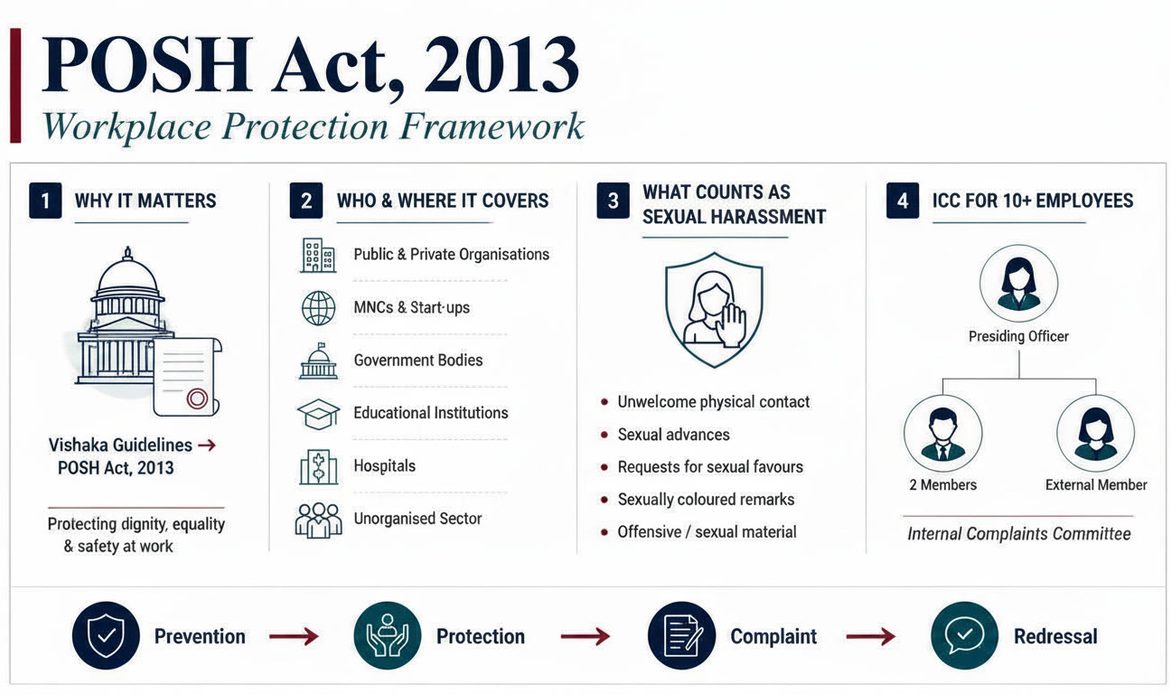
The POSH Act 2013 summary and compliance guide makes the constitution of an Internal Complaints Committee (ICC) mandatory in every organisation with 10 or more employees. This provision ensures that women have an accessible, impartial, and effective forum within their workplace to address grievances of sexual harassment. The ICC is not only a statutory requirement but also a symbol of an employer’s commitment to building a safe and respectful work culture.
Composition of the ICC
The Act lays down specific rules regarding the composition of the ICC, ensuring independence and fairness in its functioning. The committee must consist of:
- Presiding Officer – a senior woman employee in the organisation.
- Two members – preferably committed to women’s rights or with knowledge of social issues.
- External member – from an NGO or association dedicated to women’s causes.
This structure guarantees diversity of perspective and prevents internal bias. Many organisations rely on Internal Complaints Committee ICC responsibilities handbooks to implement these requirements correctly.
Powers and responsibilities
The ICC has wide-ranging responsibilities under the Act. Its duties include:
- Receiving complaints of sexual harassment in writing.
- Conducting inquiries in a fair, confidential, and timely manner.
- Recommending appropriate action against the respondent if misconduct is proved.
- Suggesting interim relief for the aggrieved woman during the pendency of the inquiry.
- Preparing annual reports on the number of cases received and resolved.
The Prevention of sexual harassment at workplace law in India empowers the ICC with quasi-judicial authority, ensuring its findings and recommendations carry weight with the employer.
Ensuring accountability
The Act places a strong emphasis on employer accountability. Failure to establish an ICC can result in monetary penalties and, in the case of repeat non-compliance, cancellation of business licences. This provision highlights the importance of institutional mechanisms in addressing workplace harassment. Employers often seek clarity from resources like the Employer duties under POSH Act Corrida Legal, which explain both the legal obligations and the practical steps required for compliance.
Building trust among employees
The presence of a functional ICC reassures employees that complaints will be heard fairly and without fear of retaliation. It creates a culture of transparency and trust, encouraging women to participate more fully in the workforce.
Duties of Employers under the POSH Act
The success of the Prevention of sexual harassment at workplace law in India depends largely on how seriously employers implement its provisions. The POSH Act makes it mandatory for every employer to create a safe, transparent, and respectful work environment by adopting preventive measures and setting up institutional mechanisms for redressal. Compliance is not optional; it is a legal and ethical responsibility.
Key responsibilities of employers
The Employer duties under POSH Act Corrida Legal highlight several important obligations that organisations must fulfil, such as:
- Constitution of ICC – Every organisation with 10 or more employees must establish an Internal Complaints Committee.
- Awareness programmes – Employers must organise regular workshops and training sessions to sensitise employees.
- Display of information – Posters or notices outlining the penalties for harassment and the procedure for filing complaints must be displayed prominently.
- Support during inquiry – Employers are required to assist the ICC in conducting inquiries, including providing access to documents or witnesses.
- Annual compliance – Submission of reports to the district officer regarding the number of complaints received and action taken.
These responsibilities ensure that the POSH Act 2013 summary and compliance guide is not merely a document but a practical tool shaping workplace behaviour.
Accountability through penalties
The law provides for strict penalties if employers fail to comply with these duties. Non-compliance can result in fines up to ₹50,000, and repeat offences may lead to higher penalties or even cancellation of business licences. This enforcement mechanism ensures that employers cannot ignore their obligations under the POSH Act penalties and redressal mechanism PDF.
Importance of proactive compliance
Beyond legal compulsion, proactive compliance benefits organisations in several ways:
- Reputation management – Companies with robust POSH policies are seen as progressive and trustworthy.
- Employee retention – A safe workplace increases morale and reduces attrition.
- Risk mitigation – Proper compliance reduces exposure to legal disputes and penalties.
Employers who adopt these practices not only meet statutory requirements but also build a culture of respect and equality at work.
Building a culture of trust
Ultimately, the role of the employer is not limited to fulfilling formalities. The real measure of compliance lies in creating an environment where women feel empowered to report harassment without fear of stigma or retaliation. Resources like the Employer duties under POSH Act Corrida Legal help employers translate legal provisions into effective workplace policies.
Complaint and Inquiry Process under the POSH Act
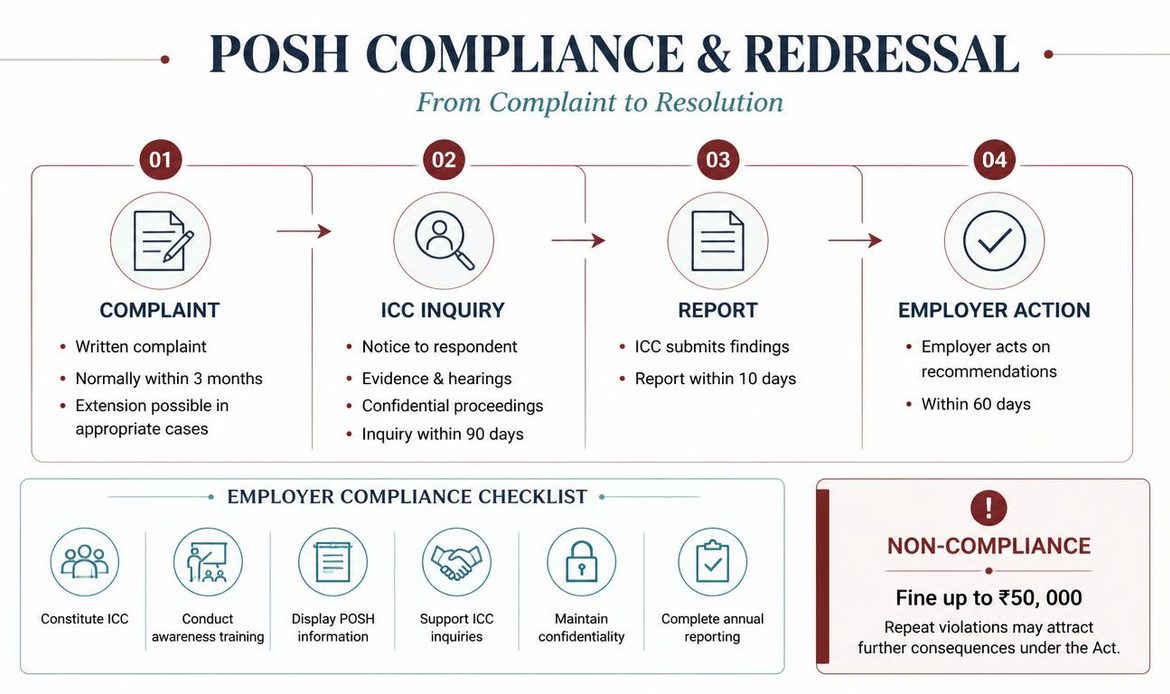
The POSH Act 2013 summary and compliance guide provides a structured and time-bound mechanism for dealing with complaints of sexual harassment at the workplace. This ensures that grievances are addressed fairly, confidentially, and without unnecessary delay. The complaint and inquiry process is one of the most significant features of the Act, as it empowers women to seek redressal while ensuring accountability on the part of the employer and the Internal Complaints Committee (ICC).
Filing of a complaint
The first step is the filing of a written complaint by the aggrieved woman. Key points include:
- The complaint must be filed within three months of the incident.
- In cases of a series of incidents, the three-month limit is counted from the last occurrence.
- The ICC or Local Complaints Committee (LCC) may extend the time limit by another three months if justified.
- Assistance is available for women who are unable to file a written complaint.
This provision ensures that the Prevention of sexual harassment at workplace law in India remains accessible even to those who may not have formal legal knowledge.
Inquiry by the ICC
Once a complaint is filed, the ICC conducts a fair and impartial inquiry. Its powers are similar to those of a civil court in respect of summoning witnesses and requiring the production of documents. The inquiry process generally includes:
- Notice to the respondent with details of the allegations.
- Hearings where both parties can present evidence.
- Confidential proceedings to protect the dignity of the complainant.
- Completion of inquiry within 90 days.
These responsibilities are detailed in resources like the Internal Complaints Committee ICC responsibilities guide, which employers and HR teams often rely upon.
Recommendations and action
Following the inquiry, the ICC submits its report to the employer within 10 days. Based on the findings, the ICC may recommend:
- Written apology, warning, or reprimand.
- Deduction from salary as compensation to the aggrieved woman.
- Termination or other disciplinary action against the respondent.
- Steps to prevent recurrence of harassment.
Employers are legally bound to act on these recommendations within 60 days. Failure to do so can attract penalties under the POSH Act penalties and redressal mechanism PDF, reinforcing the seriousness of compliance.
Ensuring fairness and dignity
The structured process balances the rights of both parties while safeguarding the dignity of the complainant. By setting timelines and clear responsibilities, the Act avoids unnecessary delays and ensures swift justice. The Employer duties under POSH Act Corrida Legal highlight that employers must not only support the ICC but also create an environment where complaints are handled sensitively and without bias.
Redressal Mechanism and Penalties under the POSH Act
One of the strengths of the POSH Act 2013 summary and compliance guide is its clear redressal mechanism. The Act ensures that every complaint of sexual harassment is addressed through a structured, fair, and time- bound process. Alongside, it prescribes penalties to guarantee compliance and discourage both harassment and organisational negligence.
Remedies for the aggrieved woman
The redressal process is designed to protect the dignity of the complainant and provide immediate relief. The Internal Complaints Committee (ICC) may recommend:
- Written apology or reprimand from the respondent.
- Deduction from salary or wages to compensate the aggrieved woman.
- Termination or suspension of the respondent in serious cases.
- Counselling or community service, depending on the circumstances.
These remedies underline that the Prevention of sexual harassment at workplace law in India focuses on justice, accountability, and prevention of recurrence rather than punishment alone.
Penalties for non-compliance
The law imposes strict penalties on employers who fail to comply with their obligations. Examples include:
- Fine of up to ₹50,000 for not constituting an ICC.
- Higher penalties for repeat violations.
- Cancellation or withdrawal of business licence in extreme cases.
Such provisions highlight the seriousness of the statute and are often discussed in resources like the POSH Act penalties and redressal mechanism PDF, which guide HR professionals and compliance officers.
Employer accountability
Employers are also responsible for implementing ICC recommendations within 60 days. Failure to do so can result in penalties and reputational harm. Additionally, employers must include details of complaints and actions taken in their annual reports, ensuring transparency and compliance. The Employer duties under POSH Act Corrida Legal emphasise that these obligations are not merely procedural but reflect an organisation’s culture and commitment to equality.
Significance of penalties
The penalties under the Act serve three critical purposes:
- Deterrence – discouraging potential offenders.
- Compliance – ensuring organisations establish robust mechanisms.
- Trust-building – reassuring employees that violations will be taken seriously.
By combining remedies for victims with strict sanctions for non-compliance, the POSH Act creates a balanced framework where workplace safety is prioritised at every level.
Role of Local Complaints Committee (LCC)
While larger organisations are required to establish an Internal Complaints Committee (ICC), not all workplaces meet this threshold. To ensure protection for women in smaller establishments and in the unorganised sector, the Prevention of sexual harassment at workplace law in India mandates the formation of Local Complaints Committees (LCCs). This provision extends the protection of the POSH Act to every working woman, regardless of the size or nature of her workplace.
Purpose of LCCs
The Local Complaints Committee acts as a safeguard for women working in establishments with fewer than ten employees, where the creation of an ICC is not legally required. It also provides recourse when the employer is the respondent. This ensures that women are not left without remedies due to the limitations of workplace size or hierarchy.
Structure and composition
To function effectively, the LCC is designed with representation from various stakeholders. As outlined in the POSH Act 2013 summary and compliance guide, the LCC generally includes:
- Chairperson – a woman active in social work and committed to women’s causes.
- One member from amongst women working in the block, taluka, or district.
- Two members from NGOs or associations working for women’s rights.
- Ex officio member – a representative from the district office.
This structure helps bring independence, sensitivity, and local context into the redressal process.
Functions of the LCC
The Internal Complaints Committee ICC responsibilities and those of the LCC are broadly similar. Key duties of the LCC include:
- Receiving and addressing complaints of sexual harassment.
- Conducting inquiries with powers similar to those of a civil court.
- Recommending action to the employer or district officer.
- Submitting annual reports on the number of cases handled.
By fulfilling these roles, the LCC ensures that women in remote or small-scale workplaces receive the same protection as those in large corporations.
Importance for unorganised sectors
Many women in India are employed as domestic workers, daily wagers, or agricultural labourers. For them, the LCC provides the only formal platform for complaint and redressal. The Employer duties under POSH Act Corrida Legal often highlight that employers in such sectors must cooperate with LCCs to fulfil statutory compliance.
Broader significance
The inclusion of LCCs in the POSH framework demonstrates the law’s commitment to inclusivity. It bridges gaps left by workplace diversity and ensures that justice is not restricted to urban or corporate environments.
Employer Best Practices for POSH Compliance
Legal compliance under the POSH Act is the minimum requirement, but progressive employers understand that going beyond statutory obligations creates safer and more productive workplaces. The Employer duties under POSH Act Corrida Legal highlight that best practices should focus not only on addressing complaints but also on preventing them. These practices reflect an organisation’s culture and values, ensuring long-term compliance and employee trust.
Creating awareness and training
One of the most effective strategies is consistent education and sensitisation. Employers should:
- Organise periodic workshops for all employees, including contractual staff.
- Provide specialised training for Internal Complaints Committee (ICC) members.
- Use real-life case studies to explain what constitutes harassment.
This proactive approach aligns with the POSH Act 2013 summary and compliance guide, which emphasises awareness as the foundation of compliance.
Building transparent policies
Employers should frame policies that clearly define sexual harassment, outline complaint mechanisms, and explain consequences for violations. Best practices include:
- Publishing the policy on the organisation’s website and intranet.
- Displaying posters in prominent places, as mandated by the Act.
- Ensuring employees acknowledge the policy at the time of joining.
These steps are in line with the Prevention of sexual harassment at workplace law in India, which stresses visibility and accessibility of redressal mechanisms.
Independent audits and monitoring
To build credibility, organisations often conduct third-party audits of their POSH compliance. Independent monitoring ensures that ICCs are functioning effectively and that employees are aware of their rights. Such practices also demonstrate a commitment to continuous improvement rather than mere formality.
Encouraging reporting and protecting whistleblowers
A major challenge in addressing harassment is under-reporting due to fear of stigma or retaliation. Employers can overcome this by:
- Establishing anonymous reporting channels.
- Reassuring employees that confidentiality will be maintained.
- Protecting whistleblowers from retaliation.
These steps reflect the guidance often found in the POSH Act penalties and redressal mechanism PDF, which highlights the importance of encouraging genuine complaints.
Creating a culture of respect
Beyond compliance, organisations must foster values of dignity, respect, and inclusivity. This involves leadership commitment, employee engagement, and zero tolerance for misconduct. A respectful environment reduces the likelihood of incidents and enhances the reputation of the organisation.
Landmark Case Laws on Sexual Harassment
The development of the Prevention of sexual harassment at workplace law in India has been shaped significantly by judicial intervention. Landmark case laws have not only highlighted the gaps in the legal system but also laid the foundation for stronger statutory protections. Understanding these cases is essential to appreciate the intent and evolution of the Sexual Harassment of Women at Workplace Act 2013 bare act PDF.
Vishaka v. State of Rajasthan (1997)
This case is widely regarded as the starting point for workplace harassment jurisprudence in India. The Supreme Court, while dealing with the gang rape of a social worker in Rajasthan, recognised sexual harassment as a violation of fundamental rights under Articles 14, 15, and 21 of the Constitution. The Court framed the Vishaka Guidelines, which served as a blueprint until the enactment of the POSH Act in 2013. This judgment remains the cornerstone for understanding the POSH Act 2013 summary and compliance guide.
Medha Kotwal Lele v. Union of India (2013)
In this case, the Supreme Court emphasised the need for effective implementation of the Vishaka Guidelines. The Court directed state governments and employers to set up complaints committees and ensure compliance. The judgment played a crucial role in bridging the gap between the guidelines and the statute, paving the way for the enactment of the POSH Act.
Apparel Export Promotion Council v. A.K. Chopra (1999)
Here, the Supreme Court upheld the dismissal of a senior officer who attempted to sexually harass a subordinate. The Court clarified that physical contact is not the only criterion for harassment—unwelcome behaviour that creates discomfort or hostility is also covered. This interpretation aligned with the broader
definition of harassment later codified in the Act, ensuring consistency with the POSH Act penalties and redressal mechanism PDF.
Other notable cases
- Shanta Kumar v. Council of Scientific & Industrial Research (2015) – The Court clarified that harassment must involve unwelcome sexual behaviour and cannot be confused with ordinary workplace interactions.
- Dr. Punita K. Sodhi v. Union of India (2010) – The case highlighted the importance of fairness and confidentiality during inquiry proceedings.
Significance of case laws
These judgments reflect the judiciary’s proactive role in shaping workplace equality. They also underline the importance of compliance by employers, reinforcing guidance such as the Employer duties under POSH Act Corrida Legal. By studying these precedents, organisations can better align their policies with the spirit of the law.
Challenges in Implementation of POSH Act
Although the POSH Act 2013 summary and compliance guide sets out a clear framework for the prevention and redressal of sexual harassment at the workplace, its implementation has not been without challenges. Several gaps in awareness, infrastructure, and enforcement make compliance uneven across different sectors. These challenges highlight the need for stronger efforts by employers, regulators, and civil society to realise the full potential of the law.
Lack of awareness and training
A significant hurdle is the limited awareness among employees and employers alike. Many workers, particularly in smaller organisations and the unorganised sector, are unaware of their rights or the mechanisms available to them. Similarly, employers often see compliance as a formality rather than an opportunity to create safer workplaces. Regular sensitisation programmes, as mandated by the Prevention of sexual harassment at workplace law in India, are not consistently carried out.
Weak functioning of ICCs and LCCs
While the law requires every organisation with 10 or more employees to establish an Internal Complaints Committee (ICC), in practice many workplaces either do not constitute these committees or fail to staff them properly. Even where committees exist, members are often inadequately trained, leading to procedural lapses. At the district level, Local Complaints Committees (LCCs) also face issues such as poor funding and lack of resources. The Internal Complaints Committee ICC responsibilities framework is clear, but gaps in implementation persist.
Fear of stigma and retaliation
Another challenge is under-reporting of cases due to fear of social stigma, victim-blaming, or retaliation at work. Women may hesitate to file complaints against superiors or colleagues, fearing damage to their career prospects. Employers need to do more than meet legal obligations, they must build an environment where complaints can be made without fear. This is an area where the Employer duties under POSH Act Corrida Legal provide valuable guidance for organisations.
Need for cultural change
Beyond legal compliance, there is a need for a broader cultural shift in how organisations perceive gender equality. Unless respect and dignity are embedded into workplace values, the effectiveness of the POSH Act penalties and redressal mechanism PDF will remain limited to paper.
Conclusion
The POSH Act 2013 summary and compliance guide represents a landmark step in India’s journey towards creating safe and inclusive workplaces. By codifying the Vishaka Guidelines and introducing clear procedures for prevention, prohibition, and redressal of sexual harassment, the Act has filled a long-standing gap in the country’s legal framework. Its scope, covering organised and unorganised sectors, contractual workers, visitors, and even domestic workers, shows the intent to provide comprehensive protection across all layers of employment.
For employers, the law goes beyond compliance. It imposes a duty to foster environments that reflect dignity, fairness, and accountability. Establishing Internal Complaints Committees (ICCs), cooperating with Local Complaints Committees (LCCs), and ensuring awareness programmes are not just legal obligations but essential steps in building a culture of trust. Many businesses now consult resources such as Employer duties under POSH Act Corrida Legal to translate legal requirements into effective workplace policies.
For employees, the statute offers accessible remedies and empowers them to speak up without fear of retaliation. The structured inquiry process, coupled with confidentiality protections, provides reassurance that grievances will be handled fairly. The POSH Act penalties and redressal mechanism PDF reinforces this by prescribing strict sanctions for non-compliance, ensuring that employers cannot ignore their obligations.