

Reviewed and Validated by: Jefrin Johny, Advocate
Introduction
“Motherhood and childhood are entitled to special care and assistance. All children whether born in, or out of, wedlock, shall enjoy the same social protection.”
If a woman employed in any establishment becomes pregnant then that woman also finds herself unable to work in the establishment for some time. If, on the principle of “No work no wages” the employer refuses to pay the wages to that woman then the condition of income interruption arises before that woman and she feels herself insecure.
Lord Beveridge has written in his ‘Social Security’ that maternity is also a kind of contingency in which the condition of income interruption arises before a working woman and she feels herself insecure. So assistance or security to be given in such a condition will be called “social security.”
Article 42 of the Constitution of India imposes obligation upon the State to make provision for securing “just and human conditions of work and for maternity relief.”
In view of this constitutional obligation the Parliament has passed the Maternity Benefit Act, 1961 to regulate the employment of women in specified Organisation/institution/establishment for certain period before and after childbirth and to provide for maternity and other benefit.
“Performance of the biological role of childbearing necessarily involves withdrawal of a woman from the workforce for some period. During this period she not only cannot work for her living but needs extra income for her medical expenses. To enable the woman worker to subsist during this period and to preserve her health, the law makes a provision for maternity benefit so that the woman can play both her productive and reproductive roles efficiently.”
In interpreting provisions of a beneficial piece of legislation which is intended to achieve the object of doing social justice to women workers employed in the plantations, and which squarely fall within the purview of Art. 42 of the Constitution, the beneficial rule of construction which would enable the women workers not only to subsist but also to make up her dissipated energy, nurse her child, preserve her efficiency as a worker and maintain the level of her previous efficiency and output has to be adopted by the Court [B. Shah v Labour Court Coimbatore AIR 1978 SC 12].
Statement of Objects and Reasons
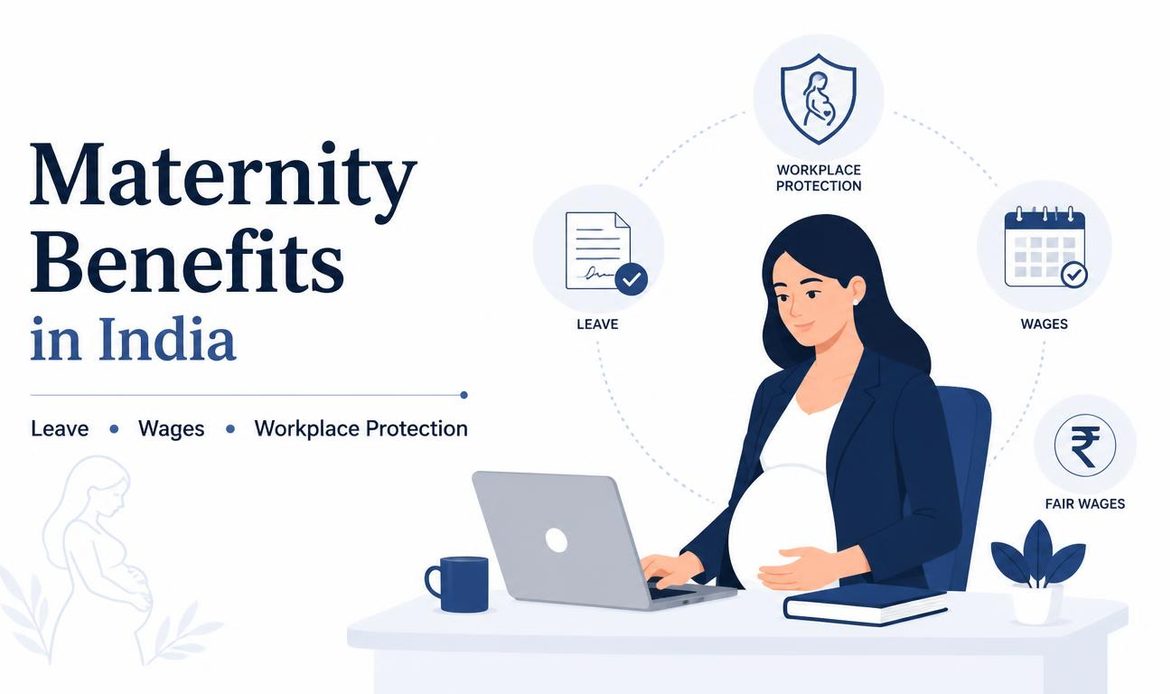
Preamble: “An Act to regulate the employment of women in certain establishments for certain periods before and after childbirth and to provide for maternity benefit and certain other benefits.”
The Maternity Benefit Act was passed with a view to reduce disparities under the existing Maternity Benefit Acts enacted by the Centre and different State Governments and bring uniformity with regard to rights, qualifying conditions and duration of maternity benefits. The Act, thus, repeals the Mines Maternity Benefit Act, 1941, the Bombay Maternity Benefit Act, 1929, and all other provincial enactments covering the same field. However, the Act does not provide for maternity benefit to women covered under the Employees’ State Insurance Act, 1948 applies.
Though the central government has also enacted the provisions related to maternity benefit under the Employees’ State Insurance Act, 1948 but the scope and coverage of this Act is found very limited. In such condition an attempt was made to provide maternity benefit to women employees working in different establishments (factories, mines, plantations, etc.) of the country under the Maternity Benefit Act. So this Act is considered as a gift for women in the field of social security.
The Object of the Act is:
- to provide for maternity benefit to women workers in certain establishments;
- to regulate the employment of women workers in such establishments for a certain period before and after childbirth.
The Act thus promotes welfare of working women. It also provides for maternity leave and payment of certain monetary benefits to women workers during the period when they are out of employment because of their pregnancy. Further, the services of a woman worker cannot be terminated during the period of her absence on account of pregnancy, except for gross misconduct.
Scope of the Act
The Act extends to the whole of India. It applies in the first instance:
- to every establishment being a factory, a mine or plantation, including any such establishment belonging to the Government and to every establishment wherein persons are employed for the exhibition of equestrian, acrobatic and other performances,
- to every shop or establishment in a State, in which 10 or more persons are employed.
The State Government is empowered to extend all or any of the provisions of the Act to any other establishment or class of establishments, industrial, commercial, agricultural or otherwise, with the approval of the Central Government.
Save as otherwise provided in Secs. 5A and 5B, nothing contained in this Act shall apply to any factory or other establishment to which the provisions of the Employees’ State Insurance Act, 1948, apply for the time being.
Read our Bare Act about: The Payment of Bonus Act, 1965 – Bare Act PDF
Salient Features (Scheme) of the Act
The Maternity Benefit Act, 1961, set the groundwork for establishing maternity leave eligibility, requirements, and benefits for women employees in India.
- Application of the Act: Applies to all women employed in factories, mines, plantations, and other establishments with 10 or more employees (including the private sectors) except the employees who are covered under the Employees’ State Insurance Act, 1948.
- Eligibility: All women who are pregnant, adopting a child, or experiencing a miscarriage or who are surrogate or commissioning mothers are eligible for maternity leave in India.
- Prerequisite for proof of work: A woman (to be eligible under the Act) should have worked with her employer for at least 80 days in the 12 months preceding the date of her expected delivery.
- Restrictions on employer: No employer should knowingly employ a woman during the period of 6 weeks immediately following the day of her delivery, miscarriage or medical termination of pregnancy. Further, the employer should not require a pregnant woman employee to do arduous work involving long hours of standing or any work which is likely to interfere with her pregnancy or cause miscarriage, during the period of 1 month preceding the period of 6 weeks before the date of her expected delivery.
- Duration of maternity leave: A woman shall be entitled to maternity benefit for a maximum period of 26 weeks. Of this, 8 weeks must be taken before the date of delivery of the child and 18 weeks immediately following that date. The extended benefit of 26 weeks is limited to “woman up to 2 children.” They shall continue to be entitled to 12 weeks of paid maternity leave, i.e., 6 weeks pre- and 6 weeks post-expected date of delivery, for the third child and onwards.
- Benefit for Adopting and Commissioning mothers: A woman who legally adopts a child below the age of 3 months or a commissioning (surrogate) mother shall be entitled to maternity benefit for a period of 12 weeks from the date the child is handed over to such mother.
- Option to work from home: In cases where the nature of work assigned to a woman is such that she may work from home, the employer may allow her to do so.
- Provision for crèche facility: Every establishment with 50 or more employees shall provide crèche facilities within a prescribed distance. The woman will be allowed four visits to the crèche in a day.
- Restrictions on discharge/dismissal of a woman: When a woman absents herself from work in accordance with the provisions of the Act. It shall be unlawful for her employer to discharge or dismiss her during or on account of such absence. The employer can do so only if there is gross misconduct on the part of the woman employee while working in the company.
- Time for payment of maternity benefit: The amount of maternity benefit for the period preceding the date of her expected delivery shall be paid in advance to the woman on production of proof that the woman is pregnant and the amount due for the subsequent period shall be paid to the woman within 48 hours of production of proof that the woman has been delivered of a child.
- Right to bonus: A woman entitled to maternity benefit under the Act shall also be entitled to receive from her employer a medical bonus, if no prenatal confinement and postnatal care is provided for by the employer free of charge.
- Entitlement in case of miscarriage or illness: In case of miscarriage, a woman shall be entitled to leave with wages for a period of 6 weeks after the day of her miscarriage. In cases of illness arising out of pregnancy, delivery, premature birth or miscarriage, a woman employee can take ‘extra’ leave up to one month.
- Maternity benefit in case woman dies: If a woman entitled to maternity benefit dies before receiving such benefit, the employer shall pay such benefit to the person nominated by the woman and, in case there is no such nominee, to her legal representative.
- Forfeiture: Forfeiture of maternity benefit may happen in case of violation of the conditions of the Act.
- Penalty for contravention: Any employer who fails to pay any amount of maternity benefit or discharges/dismisses a woman in contravention of the Act shall be punishable with imprisonment of 3 months to 1 year and/or fine (₹2,000–₹5,000).
Increased Paid Maternity Leave
The Amendment Act has increased the duration of ‘paid maternity leave’ available for women employees from the existing 12 weeks to 26 weeks. This benefit could be availed by women for a period extending up to a maximum of 8 weeks before the expected delivery date and the remaining time (i.e. 18 weeks) can be availed after childbirth. This provision is limited to “woman having less than two surviving children.” For women who are having two or more children, the duration of paid maternity leave shall continue to be 12 weeks (i.e. six weeks before and six weeks after expected date of delivery).
Maternity leave for adoptive and commissioning mothers
Maternity leave of 12 weeks to be available to mothers adopting a child below the age of 3 months from the date of adoption as well as to “commissioning mothers.” The commissioning mother has been defined as a biological mother who uses her egg to create an embryo planted in any other woman.
Work from Home option for nursing mothers
The Amendment Act has also introduced an enabling provision relating to “work from home” for women, which may be exercised after the expiry of the 26-week leave period. Depending upon the nature of work, women employees may be able to avail this benefit on terms that are mutually agreed upon with the employer.
Crèche facility
The Amendment Act makes crèche facility mandatory for every establishment employing 50 or more employees. Women employees would be permitted to visit the crèche four times during the day (including rest intervals).
Mandatory information for women employees
The Amendment Act makes it mandatory for employers to educate women about the maternity benefits available to them at the time of their appointment.
Definitions
A “woman” means a woman employed, whether directly or through any agency, for wages in any establishment. “Child” includes a still born child.
“Wages” for the purpose of this Act means all remuneration paid or payable in cash to a woman, and includes such cash allowances (including dearness allowance, and house-rent allowance) as a woman is for the time being entitled to; incentive bonus; and the money value of the concessional supply of food grains and other articles. However, the term “wages” does not include any bonus other than incentive bonus, overtime earnings, and any deduction or payment made on account of fines; any contribution paid or payable by the employer to any pension/provident fund; and any gratuity payable on the termination of service.
Major Provisions of the Act
Restriction on Employment of Pregnant Woman [Sec. 4]
No employer should knowingly employ woman during the period of 6 weeks immediately following the day of her delivery or miscarriage or medical termination of pregnancy. Besides, no woman should work in any establishment during the said period of 6 weeks.
Further, the employer should not require a pregnant woman employee to do an arduous work involving long hours of standing or any work which is likely to interfere with her pregnancy or cause miscarriage or adversely affect her health, during the period of 1 month preceding the period of 6 weeks before the date of her expected delivery, and any period during the said period of 6 weeks for which she does not avail of the leave as provided for in Section 6 of the Act.
Thus, under the provisions of Sec. 4, a pregnant woman has been given protection in order to protect her health as well as to avoid any interference which may be detrimental to the sound development of the unborn child. It may be noted that even on a request from a pregnant woman, she shall not be given any work which is likely to cause interference with her pregnancy, etc. Thus effective safeguards have been provided for sound development of the child and the maintenance of health of the mother.
Right to Payment of Maternity Benefit [Sec. 5]
Section 5(1) of the Act provides that every woman is entitled to the payment of maternity benefit at the rate of the average daily wage⁴ for the period of her actual absence i.e. the period immediately preceding the day of her delivery, the day of her delivery and any period immediately following that day.
Before the amendment of 2017, the maximum period for which any woman shall be entitled to maternity benefit was 12 weeks i.e. six weeks up to and including the day of her delivery and six weeks immediately following the day [Sec. 5(3)]. Now, after the amendment, a woman shall be entitled to maternity benefit for a maximum period of 26 weeks. Of this, 8 weeks must be taken prior to the date of her expected delivery and 18 weeks immediately following that date. It was felt that the period of leave of 12 weeks was insufficient, for example, in case of ‘delivery by operation’, which can become very common in urban areas.
The proviso added by the 2017 amendment provides that the extended benefit of 26 weeks i.e. 8 weeks pre and 18 weeks post expected date of delivery, is limited to cases of “woman up to 2 children.” They shall continue to be entitled to 12 weeks of paid maternity leave i.e. 6 weeks prior to and 6 weeks post expected date of delivery for the third child onwards.
Section 5(2) provides that no woman shall be entitled to maternity benefit unless she has worked in an establishment for a period not less than 80 days in the 12 months immediately preceding the date of her expected delivery.⁵
Provided that where a woman dies during this period, the maternity benefits shall be payable only for the days up to and including the day of her death. Where a woman, having been delivered of a child, dies during her delivery or during the period immediately following the date of her delivery for which she is entitled for the maternity benefit, leaving behind in either case the child, the employer shall be liable for the maternity benefit for that entire period but if the child also dies during the said period, then, for the days up to and including the date of the death of the child.
The computation of maternity benefit is to be made for the entire period of the women workers’ actual absence i.e. for all the days including Sundays which may be wage less holiday falling within that period, and not only for intermittent periods of six days thereby excluding Sundays falling within that period. Again the word “period” emphasises the continuous running of time and recurrence of the cycle of seven days. These computations confirm that the woman worker gets for the said period not only 100% of the wages but also benefits for Sundays and rest days [B. Shah v Labour Court Coimbatore AIR 1978 SC 12].
Section 5(4) added by the 2017 amendment provides that a woman who legally adopts a child below the age of three months or a commissioning mother⁶ shall be entitled to maternity benefit for a period of 12 weeks from the date the child is handed over to the adopting mother or the commissioning mother.
Further, Sec. 5(5) added by the 2017 amendment provides that in case where the nature of work assigned to a woman is of such nature that she may work from home, the employer may allow her to do so after availing the maternity benefit for such period and on such conditions as the employer and the woman may mutually agree.
Continuance of payment of maternity benefit in certain cases
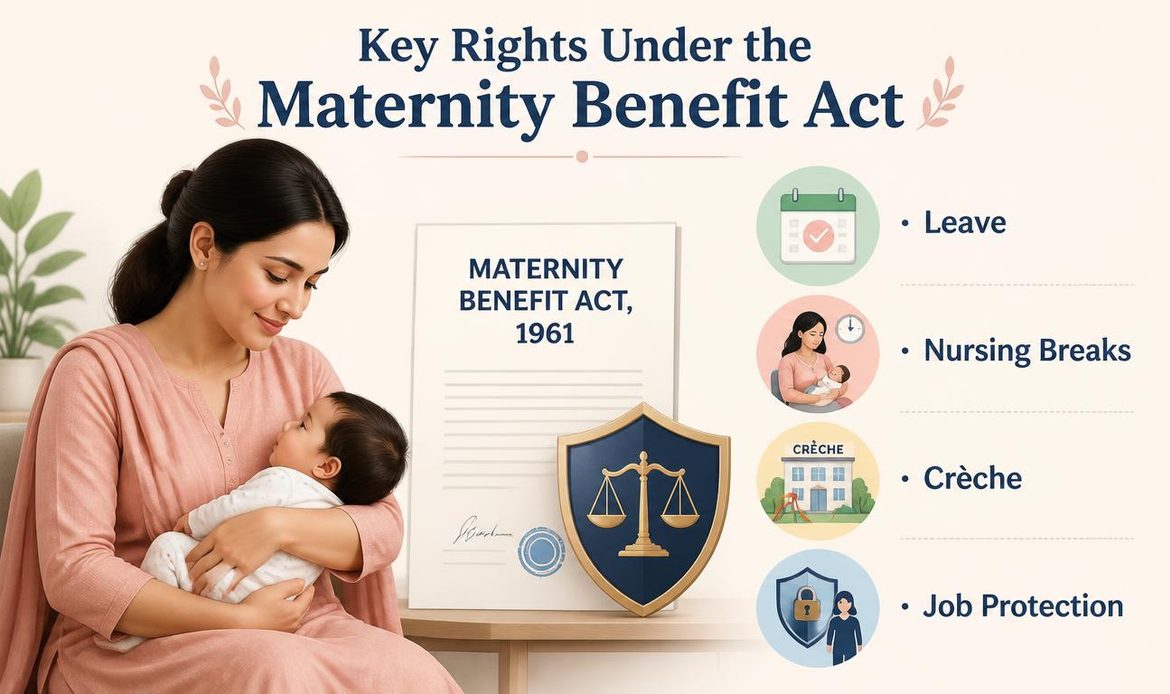
Under Sec. 5-A, every woman entitled to the payment of maternity benefit under this Act shall, notwithstanding the application of the Employees’ State Insurance Act, 1948 to the factory or other establishment in which she is employed, continue to be so entitled until she becomes qualified to claim maternity benefit under Section 50 of the 1948 Act if that Act is applicable to the establishment in which she is working.
It may be noted that the provision of maternity benefit is also available under the Employees’ State Insurance Act, 1948.
Procedure to Claim Benefit [Secs. 6-7]
A woman employee entitled to maternity benefit may give a notice in writing (in the prescribed form) to her employer, stating as follows:
- that her maternity benefit may be paid to her or to her nominee –
- that she will not work in any establishment during the period for which she receives maternity benefit, and (iii) that she will be absent from work from such date (to be specified by her), which shall not be earlier than 6 weeks before the date of her expected delivery.
The notice may be given during the pregnancy or as soon as possible after the delivery. On receipt of the notice, the employer shall permit such woman to absent herself from work until 6 weeks after the day of her delivery. The failure to give notice, however, does not disentitle the woman to benefits under the Act. But in such a case, she has to make an application to the Inspector for the purpose. The Inspector is authorised to pass orders for payment of maternity benefit or any other amount to which she is entitled on such application.
The employer is liable to pay the amount of maternity benefit for the period preceding the date of expected delivery, in advance to the woman employee on production of the proof of pregnancy. The balance of the amount due for the subsequent period should be paid within 48 hours of the production of proof of delivery.
In case of the death of a woman-employee entitled to maternity benefit, the employer shall pay the amount of benefit to her nominee or legal representative, as the case may be (Sec. 7).
Leave for miscarriage, etc.
In case of miscarriage or medical termination of pregnancy, a woman shall be entitled to leave with wages at the rate of maternity benefit, for a period of 6 weeks immediately following the day of her miscarriage or medical termination of pregnancy (Sec. 9).
Leave for Tubectomy Operation
In case of tubectomy operation, a woman shall be entitled to leave with wages at the rate of maternity benefit for a period of two weeks immediately following the day of operation (Sec. 9A).
Leave for Illness
Leave for a maximum period of one month with wages at the rate of maternity benefit is allowable in case of illness arising out of pregnancy, delivery, premature birth of child, miscarriage or medical termination of pregnancy or tubectomy operation (Sec. 10).
If a woman becomes sick due to infection after delivery, miscarriage, abortion, tubectomy, etc. and she is not in a position to work even after the fixed period of maternity benefit then she shall get extended maternity benefit. That woman shall be given maximum one month leave with wages again by the employer as extended leave.
Payment of Medical Bonus [Sec. 8]
Every woman entitled to maternity benefit under this Act shall also be entitled to receive from her employer a medical bonus of one thousand rupees, if no pre-natal confinement and post-natal care is provided for by the employer free of charge. The Central Government may before every three years, increase the amount of medical bonus subject to the maximum of twenty thousand rupees.
[The Central Government has increased the amount of medical bonus from 1000 to 2500 rupees.]
Medical bonus is given to women to get medical facility. But if medical facility is provided by the employer, in that condition medical bonus shall not be given.
Nursing Breaks /Crèche Facility [Sec. 11]
Every woman who returns to duty after the delivery of child, shall in addition to the interval of rest allowed to her, be allowed in the course of her daily work, two breaks of 15 minutes duration each for nursing the child until the child attains the age of 15 months (Sec. 11).
If a woman returns to duty after such delivery and brings her newly born child with her, then she shall be allowed in the course of her daily work two breaks of the prescribed duration for nursing of the child in addition to the interval of rest.
Sec. 11A, added by the 2017 Amendment, provides:
- Every establishment having 50 or more employees shall have the facility of crèche within the prescribed distance, either separately or along with common facilities:
- Provided that the employer shall allow four visits a day to the crèche by the woman, which shall also include the interval for rest allowed to her.
- Every establishment shall intimate in writing and electronically to every woman at the time of her initial appointment regarding every benefit available under the Act.
Protection against Dismissal/Discharge [Sec. 12]
The employer cannot terminate the service of any woman who is absent from work on account of maternity benefit. The service of the women has been completely protected under the Act. According to Sec. 12(1) when a woman absents herself from work, in accordance with the provisions of the Act, it shall be unlawful for her employer to discharge/dismiss her during or on account of such absence; or to give notice of discharge/dismissal on such a day that notice will expire during such absence; or, to vary to her disadvantage any of the condition of her service.
Section 12(2)(a) guarantees that a working woman who is discharged at any time during her pregnancy but who would otherwise have been eligible for maternity benefits will still have a right to maternity benefits and medical bonus. The only exception to this is if she is discharged for gross misconduct as prescribed under rules. In such a case the employer must notify her in writing that her benefits and bonus will be denied. Women who are not eligible for benefits because they have worked less than the required period of time are also not protected against dismissal/discharge.
Section 12(2)(b) provides that the woman can make an appeal to the appellate authority against the employer for unlawful discharge/dismissal within 60 days. The decision of authority shall apply on both the employer and the woman.
If a woman is entitled for maternity benefit and the employer wants to terminate her service, in that condition the employer shall have to make the payment of total amount of maternity benefit, medical bonus, etc. at the time of the termination of the service of such women.
No Deduction of Wages [Sec. 13]
Section 13 provides that no deduction from the normal and usual daily wages of a woman entitled to maternity benefit shall be made by reasons only: of
- the nature of work assigned to her by virtue of the provisions contained in Sec. 4(3) concerning prohibition of assignment of work of arduous nature, or
- breaks for nursing the child allowed to her under Sec. 11.
Forfeiture of Maternity Benefit [Sec. 18]
If any woman, who has been allowed to go on maternity leave works in any other establishment for any period during the authorised leave, then her claim to the maternity benefit for such period worked, shall be forfeited (Sec. 18).
Enforcement Measures (Role of Inspectors) [Secs. 14–17]
Section 14 of the Act provides that the appropriate Government may, by notification in the Official Gazette, appoint such officers as it thinks fit to be Inspectors for the purposes of this Act. For the implementation of the provisions of the Act, the Inspectors under Sec. 15 have the following powers:
- to enter at all reasonable time any premises/place where women are employed in an establishment for the purposes of examining any registers, records and notices;
- examine any person employed in the establishment;
- require to give information regarding the names and addresses of women employed, payments made to them.
Under Sec. 17, an Inspector can direct certain payment to be made to a woman under this Act. Any woman claiming that maternity benefit or any other amount to which she is entitled under this Act has been wrongfully withheld, may make a complaint to the Inspector. The Inspector may of his own motion or on receipt of a complaint make an enquiry or cause an enquiry to be made and, if satisfied that payment has been wrongfully withheld, may direct the payment to be made. The Inspector if satisfied that any woman has been discharged/dismissed during or on account of her absence from work in accordance with the provisions of this Act, may pass such orders as are just and proper according to the circumstances of the case.
Any person aggrieved by the decision of an Inspector may appeal to the prescribed authority within 30 days. The decision of the prescribed authority shall be final and where no appeal against the decision of the Inspector is made, the decision of the Inspector shall be final. Any amount payable in pursuance of the decision of the Inspector/appellate authority shall be recoverable as an arrear of land revenue.
Offences and Penalties [Sec. 21]
If any employer fails to pay any amount of maternity benefit to a woman entitled under this Act or discharges or dismisses such woman during or on account of her absence from work in accordance with the provisions of the Act, he shall be punishable with imprisonment which shall not be less than 3 months but may extend to one year and with fine which shall not be less than 2000 rupees but which may extend to 5000 rupees. However, on showing sufficient reason the court may, impose a sentence of imprisonment for a lesser term or fine only in lieu of imprisonment (Sec. 21).
Thus, it is the responsibility of the employer of establishment where this Act applies that he should implement the provisions related to maternity benefit and give maternity benefit to women according to that.
Power to Exempt Establishments [Sec. 26]
The appropriate government has been empowered to exempt an establishment or a class of establishments from implementing this Act. But such exemption can be given only when in that establishment the women are given better facility than those which are available to working women under the Act in case of maternity (Sec. 26).
Effect of Laws and Agreements Inconsistent with this Act [Sec. 27]
Under Sec. 27 it has been provided that the provisions of this Act shall have effect notwithstanding anything inconsistent therewith contained in any other law or in the terms of any award, agreement or contract of service, whether made before or after the coming into force of this Act.
Discriminatory Practices by Employers
The law of maternity benefit was enacted to ensure the health and well-being of the working mother and her child. The good intention of the legislators, however, seem to have backfired since employers refuse to employ married women in order to avoid paying the maternity benefit. In some cases ‘marriage’ itself is a disqualification while in some others ‘pregnancy’ acts as a bar to employment. Not only private employers but sometimes even government departments are perpetuators of such derogatory practices.
The Supreme Court in its strong words condemned such practices in Air India v Nargesh Meerza (AIR 1981 SC 1829), a service regulation in the Air-India Corporation which required air hostesses to retire on pregnancy was challenged. The Supreme Court found this provision to be most arbitrary and unreasonable. It ruled: “There was no reason why pregnancy should stand in the way of continuance of service. By making pregnancy a bar to continuance in service of an air hostess the corporation has adopted an unreasonable individualised approach to a woman’s physical capacity to continue to work even after pregnancy.”
The Supreme Court further held: “There is neither any legal or medical authority for this bald proposition. Having taken the appellant in service and after having utilised her services for four years to terminate her service by the management if she becomes pregnant amounts to compelling the poor air hostess not to have any children and thus interferes and diverts the ordinary course of nature. It seems to us that termination of the services of an air hostess under such circumstances is not only callous and cruel but a retrograde act to Indian womanhood – the most sacrosanct and cherished institution. We are constrained to observe that such a course of action is extremely detestable and abhorrent to the notions of a civilised society.
Apart from being grossly unethical, it smacks of a deep-rooted sense of utter selfishness at the cost of all human values. Such a provision is therefore manifestly unreasonable and arbitrary and is clearly violative of Art. 14 of the Constitution.” The decision of the Supreme Court forced the Air India Corporation to delete this rule.
Another case highlighting discriminatory rules came to light in Neera Mathur v LIC (AIR 1992 SC 392). Here a lady was discharged from service during her probationary period, inter alia, on the ground that at the time of her appointment she had in the declaration form furnished incorrect information with regard to the date of her last menstruation period in order to suppress the fact of her pregnancy. The court ordering her reinstatement directed the Life Insurance Corporation to delete those columns in the declaration form which required the woman to disclose her private facts. The Court found the furnishing of such information to be “embarrassing if not humiliating.”
Whether Female Daily Wagers Entitled to Maternity Benefits
Leading Case: MUNICIPAL CORPORATION OF DELHI v FEMALE WORKERS (MUSTER ROLL) (AIR 2000 SC 1275)
[In a judgment of far reaching consequences, the Supreme Court in this case declared that the maternity benefit is applicable to casual workers and daily wage workers also.]
In this case, the question was whether the muster roll employees (which are casual and daily wage employees of the Municipal corporation) are covered by the Maternity Benefit Act. The Supreme Court held:There is nothing in the Maternity Benefit Act which entitles only regular women employees to claim the maternity leave and not to those who are engaged on casual basis or on muster roll on daily wage basis.
The Court observed that the activity of the Delhi Municipal Corporation by which construction work is undertaken or roads are repaired or trenches are dug would fall within the definition of “industry.” The workmen or for that matter, those employed on muster roll for carrying on these activities would, therefore, be “workmen” and the dispute between them and the corporation would have to be tackled as an ‘industrial dispute’ in the light of various statutory provisions of the industrial law, one of which is the Maternity Benefit Act 1961.
The Court observed: Since Art. 42 of the Constitution specifically speak of “just and humane conditions of work” and maternity relief, the validity of an executive or administrative action in denying maternity benefit has to be examined on the anvil of Art. 42 which though not enforceable at law, is nevertheless available for determining the legal efficacy of the action complained of. The provisions of the Act would indicate that they are wholly in consonance with the Directive Principles of State Policy, as set out in Art. 39 and in other Articles, specifically Art. 42. A woman employee, at the time of advanced pregnancy cannot be compelled to undertake hard labour as it would be detrimental to her health and also to the health of the foetus. It is for this reason that it is provided in the Act that she would be entitled to maternity leave for certain periods prior to and after delivery.
The Supreme Court further observed: A just social order can be achieved only when inequalities are obliterated: A just social order can be achieved legally, i.e., when the law is constituted and everyone is provided what is due to them, to be honoured and treated almost half of the segment of our society have to be viewed with compassion and sympathy and should be provided all the facilities to. The Maternity Benefit Act, 1961 aims to achieve this object of the state of motherhood in a dignified manner, so that the woman may overcome the state of motherhood honourably, peacefully, and without having to be victimised for forced absence during the pre and post-natal period.
Therefore, the maternity benefit cannot be denied to the women employees engaged on muster roll, on the ground that they are not regular employees of the corporation. This is a beneficial piece of legislation and is in the interest of a large number of women workers who were till date refused maternity benefit because of the casual and temporary nature of service.
Maternity Leave Not a Ground for Termination of Services
Leading Case: SRI AUROBINDO COLLEGE (EVENING) v MANISHA PRIYADARSHINI [S.L.P.(Civ.) No. 7369 of 2020]
In this case, Manisha Priyadarshini had been working as an ad hoc assistant professor in different colleges of Delhi University. Her contractual agreement was getting renewed every four months with a notional break of one day for the past six years. Her contract was renewed in November 2018 when she was offering her services at Aurobindo College. In January 2019, she sought maternity leave for four months from January 14, 2019 to May 24, 2019 due to complications in her pregnancy. In May when she reported to college, she was informed that her tenure had ended on March 18, 2019 and that she was no longer on the rolls of the college and therefore, there was no question of her joining back on duty or being assigned any work.
This matter was taken up by a Single Bench of the High Court but her plea was dismissed. However, on appeal to a Division Bench of the Delhi High Court, the same was allowed and it was noted by the Court that seeking maternity leave could not be a legitimate ground for denying extension of tenure. The Court held
“Declining leave to a contractual employee due to her pregnancy and confinement would tantamount to penalising a woman for electing to become a mother while still employed and thus pushing her into a choiceless situation as motherhood would be equated with loss of employment. This is violative of the basic principle of equality in the eyes of law. It would also tantamount to depriving her of the protection assured under Article 21 of the Constitution of India of her right to employment and protection of her reproductive rights as a woman. Such a consequence is therefore absolutely unacceptable and goes against the very grain of the equality principles enshrined in Articles 14 and 16.”
The High Court also quashed the termination order issued by the College and directed them to appoint the appellant/petitioner to the post of “Assistant Professor” in the English Department on an ad-hoc basis till such time that the vacant posts are filled up through regular appointment.
The Supreme Court Bench on October 28, 2020 heard a petition through an appeal filed by Aurobindo College against this impugned judgment dated May 1, 2020 of the Delhi High Court. Concurring with the Delhi High Court’s verdict, the top court dismissed the special leave petition filed by the College and upheld all other directions given by the lower court including the decision to impose cost of Rs. 50,000 on the College for removing an ad hoc assistant teacher during her maternity leave.
The Supreme Court expressed grave concern against the conduct of the College and observed that, “Maternity leave cannot be a ground for termination of services. Having a child is no reflection on a woman’s professional ability, whether she is in the Army, Navy, judiciary, teaching or bureaucracy. We will not allow termination on this ground.”
Conslusion
The Maternity Benefit Act, 1961, is useful social security legislation but some shortcomings have been noticed in the working of this Act (though some of the shortcomings have been taken care of by the 2017 Amendment to the Act).
One of the major defects in the Act is that under it entire burden for payment of compensation is on the employers. This has led to a tendency amongst the employers either not to employ married women or to evade the payment of maternity benefit. There is, therefore, a need that the benefit of maternity benefit should also be given on the pattern of Employees’ State Insurance Act by creating an ‘insurance fund.’ The National Commission on Labour has suggested that a ‘National Contribution Fund’ should be constituted for all those industries where this Act is in force, in which the government, employers and employees should contribute and the amount of benefit should be given from this fund as per need.
In this Act, it is mentioned that the payment of wages to women employees in case of maternity shall be made on the basis of their ‘daily average wage’ whereas expenses on nutritious meal, medicine, etc. occurs more in the condition of maternity. In this condition this amount seems very little. So scholars have suggested that the wages to be given in condition of maternity should be increased. For example—double amount of Standard Benefit Rate is given under the Employees’ State Insurance Act, 1948.
The Maternity Benefit Act should be made applicable to all establishments irrespective of size and without any qualifying conditions. With the passage of time, maternity benefit should be covered wholly by Maternity Benefit Act and should be deleted from Employees’ State Insurance Act. This will create uniformity in the area of maternity benefit.
Most of the women workers in India are illiterate and economically backward even today. They have no knowledge of this Act due to their illiteracy. So this Act is not proceeding towards the achievement of its objectives properly. The women workers need to be educated regarding this Act. An attempt should be made to provide the knowledge of provisions of this Act to them so that they may file complaints against their rights.
