

Reviewed and Validated by: Shubham Dwivedi, Advocate
Introduction
The Information Technology Act, 2000 marked a turning point in India’s legal landscape by providing a comprehensive framework to regulate digital activities. Before its enactment, Indian law did not adequately address issues arising from electronic transactions, cyber crimes, or the recognition of digital records. The rise of the internet, e-commerce, and electronic communication created an urgent need for a statute that could establish trust, legitimacy, and accountability in the digital environment. The Indian IT Law 2000 Bare Act PDF was introduced to meet these needs and has since evolved into the backbone of India’s cyber law framework.
The Act was also India’s response to global changes in technology and trade. As businesses moved online and digital transactions became routine, countries worldwide began adopting laws to legitimise electronic records and signatures. For India, aligning with international standards was crucial for fostering cross-border trade and giving legal recognition to e-commerce. The Act thus provided not only a domestic regulatory framework but also a foundation for India’s participation in the global digital economy.
The importance of the IT Act extends across multiple sectors of society. For businesses, it provides enforceability of electronic contracts and a legal structure for data protection and compliance. For individuals, it ensures safeguards against cyber offences such as hacking, identity theft, and misuse of electronic information. For government institutions, it enables electronic governance, the use of digital records in administration, and the regulation of certifying authorities.
Corrida Legal’s edition of the Indian IT Law 2000 Bare Act PDF further simplifies the statute by combining the official text with an executive summary. This format helps readers quickly grasp the essentials of the Act while retaining access to the full legal provisions. Whether for professionals, compliance officers, students, or entrepreneurs, this resource serves as a practical tool for navigating India’s evolving cyber law landscape.
Key aspects highlighted in the introduction include:
- The background and reasons for enacting the IT Act, 2000.
- Evolution of India’s cyber law framework in response to digital growth.
- Importance of the Act for businesses, individuals, and government.
- Corrida Legal’s role in making the Bare Act accessible through its executive summary.
Key Definitions
The Information Technology Act, 2000 lays down several important definitions that form the foundation of India’s cyber law framework. Understanding these terms is essential for interpreting the scope and application of the Act. The Information Technology Act 2000 Bare Act with Executive Summary Corrida Legal explains these technical terms in a simplified manner so that legal professionals, businesses, and students can apply them in practice with greater ease.
Electronic Record
An electronic record refers to data, text, images, sound, or any other form of information generated, sent, received, or stored electronically. This definition ensures that digital information enjoys the same legal recognition as traditional paper records.
Digital Signature
A digital signature is a form of electronic authentication that uses encryption to verify the identity of the sender and the integrity of the information. It provides trust in online transactions and is central to the enforceability of electronic contracts.
Secure Electronic Record
A secure electronic record is one that has been authenticated through a secure digital signature or other approved methods. Such records carry a presumption of authenticity in legal proceedings, making them highly reliable.
Certifying Authority
Certifying authorities are licensed entities authorised to issue digital signature certificates. They are regulated by the Controller of Certifying Authorities to ensure the security and trustworthiness of electronic authentication.
Cyber Security
Cyber security under the Act refers to measures taken to protect information, devices, networks, and programs from unauthorised access, attack, or damage. This definition sets the stage for various compliance obligations imposed on businesses and service providers.
Electronic Governance
The term refers to the use of electronic means for delivering government services, maintaining records, and facilitating interactions with citizens. The recognition of e-governance underscores the government’s commitment to efficiency and transparency in the digital age.
Objectives and Applicability
The Information Technology Act, 2000 was enacted with the clear purpose of establishing a legal framework for electronic governance, digital communication, and cyber security. The law recognises that as India transitioned into a digital economy, new challenges would arise in areas such as online contracts, authentication of digital records, and the prevention of cyber crime. The Information Technology Act 2000 Executive Summary Corrida Legal highlights these objectives in a concise, reader-friendly way, enabling professionals and businesses to understand the law’s broad scope.
Core Objectives of the Act
The primary objectives of the Act can be summarised as follows:
- To grant legal recognition to electronic records and digital signatures.
- To provide a framework for secure electronic transactions and e-commerce.
- To establish a regulatory authority for certifying authorities issuing digital signature certificates.
- To define and penalise cyber offences such as hacking, identity theft, and cyber terrorism.
- To facilitate e-governance by enabling the electronic filing, storage, and transmission of documents.
- To align Indian law with global standards for electronic commerce and cyber security.
These objectives reflect the Act’s dual role of enabling digital growth while protecting the interests of individuals and organisations.
Applicability of the Act
The Act applies to a wide range of digital activities, ensuring that electronic interactions receive legal recognition and protection. Its scope includes:
- All electronic records, communications, and digital transactions.
- Recognition of electronic contracts as valid and enforceable.
- Regulation of certifying authorities and digital signature certificates.
- Investigation and punishment of cyber offences.
- Government use of electronic platforms for administrative functions.
However, the Act specifically excludes certain areas such as negotiable instruments (other than cheques), powers of attorney, wills, and contracts relating to the sale or conveyance of immovable property. These exclusions highlight that while the Act is broad in scope, certain traditional legal instruments continue to require physical execution for greater certainty.
Legal Recognition of Electronic Records
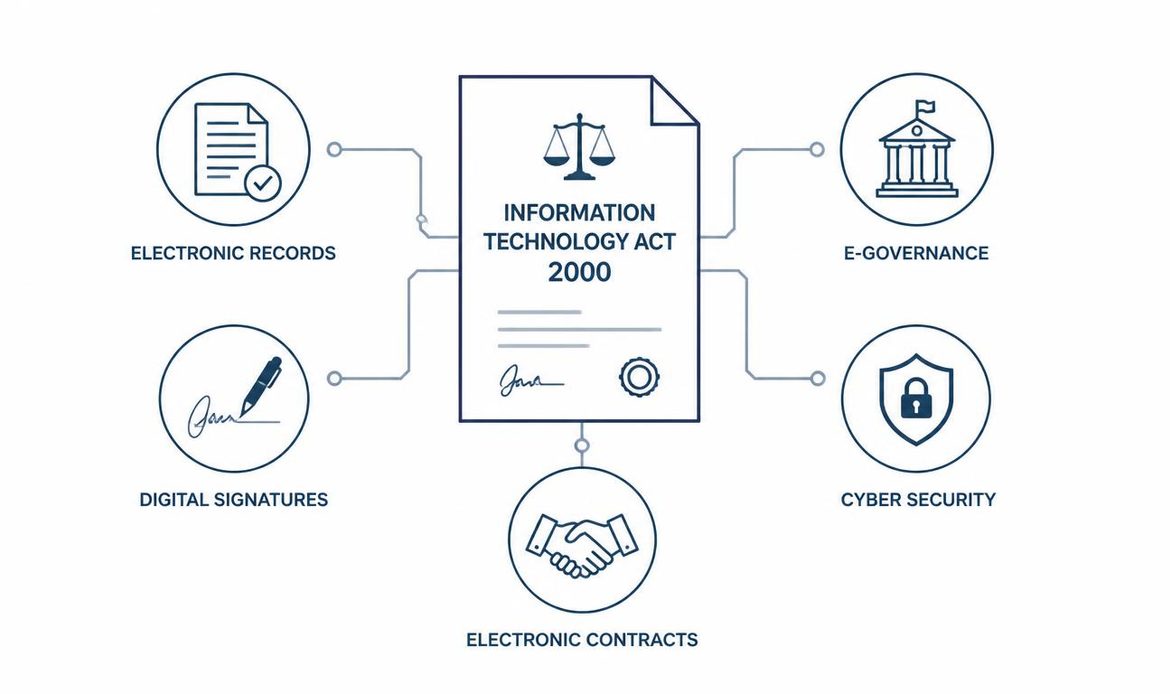
One of the most significant contributions of the Information Technology Act, 2000 is the legal recognition it grants to electronic records. Before this Act, Indian law relied heavily on physical documents, signatures, and traditional methods of communication. The Information Technology Act 2000 Full Text PDF Free ensures that electronic data, contracts, and records are placed on the same legal footing as paper-based documents, making them valid and enforceable in courts of law.
Recognition of Electronic Contracts
The Act confirms that contracts formed electronically carry the same legal validity as those executed in writing. This provision has been critical in facilitating e-commerce, online service agreements, and digital transactions. It assures businesses and consumers that agreements entered through electronic means are enforceable.
Authentication through Digital Signatures
The Act gives legal status to digital signatures, allowing them to be used for authentication of electronic records. By relying on secure cryptographic methods, digital signatures verify both the origin and the integrity of electronic data. This recognition provides confidence in electronic transactions, particularly in sectors such as banking, insurance, and government services.
Admissibility as Evidence
The Act also amends the Indian Evidence Act, 1872 to include electronic records as admissible evidence in courts. This change has transformed the way evidence is presented, enabling emails, digital files, and online records to be used effectively in litigation and enforcement proceedings.
Practical Applications
The recognition of electronic records has had wide-ranging practical benefits:
- Facilitating secure and efficient e-commerce transactions.
- Enabling government departments to shift towards paperless operations.
- Allowing businesses to maintain and rely on digital records for compliance.
- Reducing transaction costs and delays associated with physical paperwork.
The Information Technology Act 2000 Full Text PDF Free thus provides a robust foundation for the digital economy by ensuring that electronic communication and records are legally recognised. This recognition has enabled India’s rapid digital transformation, making it easier for businesses, individuals, and government institutions to engage confidently in electronic transactions.
Electronic Governance
The Information Technology Act, 2000 does more than legitimise private electronic transactions; it also transforms the way government functions. By introducing electronic governance, the law enables public authorities to adopt digital methods for administration, record-keeping, and delivery of services. The Information Technology Act 2000 Key Provisions and Summary PDF highlights how this shift has streamlined governance, reduced dependence on physical paperwork, and enhanced transparency.
Use of Electronic Records in Governance
The Act allows government departments to:
- Accept the filing of forms and applications electronically.
- Issue licences, permits, and certificates in digital format.
- Maintain records, registers, and databases electronically.
- Facilitate communication between citizens and public offices through digital means.
This recognition of electronic methods has made government processes faster, more efficient, and accessible to a wider population.
Legal Framework for Digital Signatures
The Act provides that digital signatures can be used by government authorities to authenticate electronic records. This ensures the authenticity and reliability of documents issued in digital form, such as tax filings, government notifications, and official correspondence.
Advantages of E-Governance
The adoption of electronic governance has had multiple benefits, including:
- Reducing delays and bureaucratic inefficiencies.
- Lowering costs by moving away from paper-based systems.
- Enhancing transparency and accountability in government processes.
- Expanding access to public services for citizens across urban and rural areas.
Foundation for Digital India
The IT Act’s recognition of e-governance has laid the foundation for India’s broader digital transformation initiatives. It paved the way for projects such as Digital India, e-filing of taxes, online grievance redressal systems, and the integration of technology in judicial and administrative frameworks.
Regulation of Certifying Authorities
A central feature of the Information Technology Act, 2000 is the regulation of certifying authorities, which are entities authorised to issue digital signature certificates. These authorities form the backbone of trust in electronic transactions by ensuring the authenticity and security of digital communication. The Indian IT Law 2000 Bare Act PDF outlines the establishment, powers, and responsibilities of certifying authorities in detail, making them a vital component of India’s cyber law framework.
Controller of Certifying Authorities (CCA)
The Act provides for the appointment of a Controller of Certifying Authorities, who supervises and regulates all certifying authorities in India. The Controller is responsible for granting licences, laying down standards, and ensuring compliance with security practices.
Licensing of Certifying Authorities
Entities seeking to issue digital signature certificates must obtain a licence from the Controller. The licensing process involves:
- Demonstrating technical competence and financial stability.
- Ensuring compliance with prescribed security procedures.
- Maintaining adequate infrastructure for issuing and managing digital certificates.
Licensing ensures that only reliable entities are entrusted with the critical task of digital authentication.
Duties and Responsibilities
Certifying authorities have several obligations under the Act, including:
- Issuing digital signature certificates in accordance with prescribed standards.
- Maintaining a secure database of issued certificates.
- Revoking or suspending certificates when required.
- Ensuring protection of private keys and preventing misuse.
These duties help maintain confidence in electronic transactions by safeguarding against fraud and unauthorised use.
Legal Validity of Digital Signature Certificates
Certificates issued by licensed authorities carry legal recognition under the Act. This means that digital signatures verified by such certificates are considered secure and reliable, and they can be used in courts, business agreements, and government processes.
Cyber Crimes and Offences
The digital revolution has opened new opportunities but also introduced new forms of crime. The Information Technology Act, 2000 recognises this challenge and sets out a detailed framework to define, regulate, and penalise cyber offences. The Information Technology Act 2000 Bare Act with Executive Summary Corrida Legal provides clarity on these offences, ensuring that individuals and businesses are protected from misuse of technology while enabling law enforcement to act decisively against wrongdoers.
Categories of Cyber Offences
The Act identifies a wide range of offences that can occur in the digital space. These include:
- Hacking and unauthorised access – breaking into computer systems or networks without permission.
- Identity theft – unlawful use of another person’s digital identity, such as passwords or personal information.
- Cyber terrorism – using digital means to threaten national security, public order, or the sovereignty of India.
- Data theft and alteration – stealing, deleting, or modifying electronic data without authorisation.
- Obscene or offensive content – publishing or transmitting obscene material in electronic form.
- Cheating through digital means – using fraudulent methods online to deceive individuals or businesses.
Liability of Intermediaries
The Act also imposes liability on intermediaries such as internet service providers, social media platforms, and online marketplaces. While they are not directly responsible for user-generated content, they are required to exercise due diligence and remove unlawful material when notified. Failure to comply can expose intermediaries to legal consequences.
Significance for Businesses and Individuals
Cyber offences affect a wide spectrum of stakeholders:
- Individuals face risks like phishing, online scams, and misuse of personal data.
- Businesses suffer losses from data breaches, theft of trade secrets, and disruption of services.
- Government agencies deal with threats to national security and misuse of digital infrastructure.
By clearly defining offences and prescribing penalties, the Act equips law enforcement and the judiciary to respond effectively to cyber threats.
Adjudication and Penalties
The Information Technology Act, 2000 not only defines cyber offences but also establishes mechanisms for adjudicating disputes and imposing penalties. This ensures that violations are dealt with promptly, and victims are compensated fairly. The Information Technology Act 2000 Executive Summary Corrida Legal presents these provisions in simplified form so that individuals, businesses, and compliance officers can understand their rights and obligations clearly.
Adjudicating Officers
The Act empowers adjudicating officers, usually senior government officials, to handle disputes involving contraventions under the Act. These officers have the authority to:
- Conduct inquiries into alleged violations.
- Call for records and evidence.
- Examine parties and witnesses.
- Pass orders awarding compensation or imposing penalties.
This framework provides a faster and less formal remedy compared to regular courts.
Penalties for Contraventions
The Act prescribes monetary penalties for a wide range of contraventions, including failure to protect data, unauthorised access to computer systems, and breach of security practices. The penalties are often calculated based on the nature and extent of damage caused.
Compensation for Victims
Victims of cyber offences or data breaches can seek compensation through the adjudication process. This is particularly important for businesses and individuals whose personal data or digital assets are compromised. The Act provides a mechanism for quantifying losses and awarding financial relief.
Appellate Mechanism
Decisions of adjudicating officers can be appealed to the Cyber Appellate Tribunal, and further appeals may lie before the High Court. This layered mechanism ensures fairness and accountability in the adjudication process.
Significance for Compliance
The adjudication and penalty provisions serve as a reminder to organisations and individuals to maintain high standards of cyber security and data protection. Non-compliance can result not only in financial penalties but also reputational damage.
Amendments and Updates
The Information Technology Act, 2000 has undergone several amendments to keep pace with evolving digital practices and threats. The most significant reform was the IT (Amendment) Act, 2008, which expanded the scope of the law and introduced stricter provisions for cyber security and offences. The Information Technology Act 2000 Key Provisions and Summary PDF explains these updates in a structured manner, making it easier for professionals, students, and businesses to track how the law has adapted over time.
IT (Amendment) Act, 2008
The 2008 amendment modernised the framework by:
- Expanding the definition of cyber offences to include identity theft, phishing, and cyber terrorism.
- Recognising electronic signatures alongside digital signatures for authentication.
- Providing stronger safeguards for data protection and privacy.
- Enhancing the liability framework for intermediaries like internet service providers and online platforms.
The Information Technology Act 2000 Full Text PDF Free shows that these reforms were aimed at addressing the growing complexity of cyber threats and aligning Indian law with global best practices.
Expansion of Offences
The amended Act widened the scope of punishable offences, covering:
- Publishing obscene or sexually explicit material in electronic form.
- Breach of confidentiality and privacy of digital data.
- Cyber frauds involving e-commerce and banking platforms.
- Child pornography and misuse of online platforms for exploitation.
By incorporating these offences, the Indian IT Law 2000 Bare Act PDF reflects the legislature’s recognition of
the need to protect vulnerable groups and strengthen consumer trust in digital platforms.
Data Protection and Privacy
The amendments also introduced obligations for organisations to implement reasonable security practices and protect sensitive personal data. This provision laid the groundwork for future legislation, such as the Digital Personal Data Protection (DPDP) Act, 2023. The Information Technology Act 2000 Bare Act with Executive Summary Corrida Legal explains how these provisions make businesses accountable for protecting user data while ensuring transparency in digital practices.
Relevance for Stakeholders
For businesses and startups, these amendments emphasise the need for compliance with cyber security and data protection obligations. For individuals, they provide stronger remedies against misuse of personal information. The Information Technology Act 2000 Executive Summary Corrida Legal highlights how the amendments improved both preventive and corrective mechanisms within the digital ecosystem.
Relationship with Other Laws
The Information Technology Act, 2000 does not operate in isolation. Instead, it interacts with several other Indian statutes to create a comprehensive legal ecosystem for the digital age. The Information Technology Act 2000 Full Text PDF Free shows how cyber law provisions are harmonised with traditional laws to ensure consistency, enforceability, and clarity in both physical and electronic contexts.
Interaction with Indian Penal Code
Many cyber offences overlap with crimes already recognised under the Indian Penal Code, 1860. For instance:
- Fraud committed online may also qualify as cheating under the IPC.
- Defamation through electronic communication is addressed under both laws.
- Cyber terrorism links directly to provisions on national security.
The Indian IT Law 2000 Bare Act PDF ensures that offences committed in the digital domain are not left unpunished, even where traditional laws already apply.
Relevance under the Indian Evidence Act
The Act amended the Indian Evidence Act, 1872 to explicitly include electronic records and digital signatures as admissible evidence in courts. The Information Technology Act 2000 Bare Act with Executive Summary Corrida Legal explains how this change has modernised litigation practices, making emails, online transactions, and digital contracts legally valid proof.
Linkages with Corporate and Sectoral Laws
Provisions of the IT Act also align with corporate compliance requirements under the Companies Act, 2013 and regulations for financial institutions, e-commerce platforms, and telecom operators. The Information Technology Act 2000 Executive Summary Corrida Legal highlights how businesses must comply with overlapping frameworks covering data protection, fraud prevention, and digital record-keeping.
Influence on Data Protection Regime
The IT Act laid the foundation for India’s broader data protection laws. Its provisions on sensitive personal data directly influenced the later drafting of the Digital Personal Data Protection Act, 2023. The Information Technology Act 2000 Key Provisions and Summary PDF demonstrates how the IT Act has remained central to evolving privacy standards in India.
Relevance for Businesses and Startups
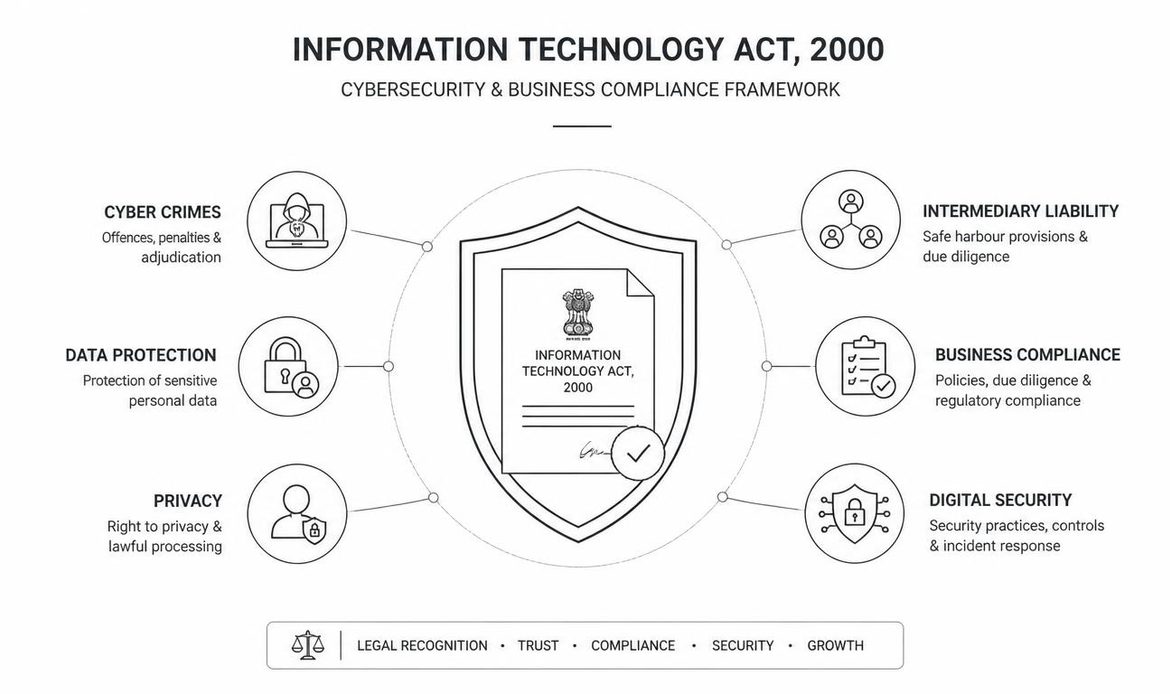
The Information Technology Act, 2000 is not just a regulatory framework; it is also a critical enabler of business and entrepreneurship in the digital era. The Indian IT Law 2000 Bare Act PDF highlights how the Act legitimises electronic transactions, provides security for online communication, and creates accountability in the digital marketplace. These features make it especially important for startups, fintech companies, and e- commerce platforms that rely heavily on digital infrastructure.
E-Commerce and Digital Contracts
The enforceability of electronic contracts under the Act has allowed businesses to operate entirely online. The Information Technology Act 2000 Bare Act with Executive Summary Corrida Legal explains that everything from online service agreements to electronic signatures carries legal validity. This provision has been instrumental in the growth of e-commerce, SaaS businesses, and global outsourcing models.
Compliance for Startups
Startups, particularly those in fintech, healthtech, and edtech, must comply with the Act’s data protection and cyber security obligations. The Information Technology Act 2000 Executive Summary Corrida Legal stresses that failure to maintain reasonable security practices can expose companies to penalties, reputational damage, and loss of consumer trust.
Investor Confidence and Global Standards
The Act also plays an indirect but vital role in boosting investor confidence. By aligning India’s digital law with global standards, the Information Technology Act 2000 Key Provisions and Summary PDF demonstrates that businesses operating under this regime are legally protected and internationally credible. This is especially important for startups seeking foreign investment.
Practical Impact on Businesses
Practical benefits for businesses include:
- Lower transaction costs through paperless operations.
- Faster deal-making with enforceable digital contracts.
- Legal remedies against data theft, hacking, and fraud.
- A structured framework for compliance and due diligence.
The Information Technology Act 2000 Full Text PDF Free ensures that businesses can innovate confidently in a legally secure environment.
Judicial Interpretation
Courts in India have played a critical role in shaping how the Information Technology Act, 2000 is applied in practice. The bare provisions of the law are often technical, and judicial interpretation ensures that they are implemented in a balanced way that protects both digital innovation and constitutional freedoms.
Recognition of Electronic Evidence
One of the earliest contributions of the judiciary was in clarifying that electronic records and digital signatures are admissible as valid evidence in courts. By linking this with the amendments to the Indian Evidence Act, judges reinforced the legal value of electronic contracts, records, and communications. In practice, this strengthened reliance on electronic governance and aligned with the broader objectives highlighted in the Information Technology Act 2000 Executive Summary Corrida Legal.
Liability of Intermediaries
The courts have also clarified how intermediaries such as social media platforms and internet service providers should be treated under the Act. In landmark rulings, it has been held that intermediaries are not directly responsible for all user activity but must remove unlawful content once notified. These rulings connect closely with the compliance duties explained in the Information Technology Act 2000 Bare Act with Executive Summary Corrida Legal.
Data Protection and Privacy
Judicial interpretation has also extended the scope of privacy under the IT Act. Following the Puttaswamy judgment, courts have reinforced that sensitive personal data must be protected under both constitutional law and statutory obligations. This is consistent with the guidance provided in the Information Technology Act 2000 Key Provisions and Summary PDF.
Free Speech and Constitutional Balance
The striking down of Section 66A in Shreya Singhal v. Union of India (2015) highlighted the judiciary’s role in preserving freedom of expression online. While the government sought to regulate offensive content, the Supreme Court ensured that constitutional rights were not compromised. This aspect resonates with the wider digital safeguards explained in the Indian IT Law 2000 Bare Act PDF.
Challenges and Emerging Issues
While the Information Technology Act, 2000 created a strong legal foundation for India’s digital ecosystem, the pace of technological change has given rise to fresh challenges. The Information Technology Act 2000 Key Provisions and Summary PDF shows how the law must constantly adapt to tackle complex issues like data security, online fraud, and the regulation of emerging technologies.
Growing Cyber Threats
India has seen a sharp increase in cyber crimes, ranging from phishing and ransomware to sophisticated state-sponsored attacks. These threats test the limits of existing legal frameworks. Many experts suggest that provisions discussed in the Information Technology Act 2000 Executive Summary Corrida Legal need constant updates to remain effective against evolving digital risks.
Data Protection and Privacy Concerns
The rapid collection and processing of personal data by businesses and governments has raised urgent privacy concerns. The rules on sensitive personal data under the IT Act are seen as a precursor to newer frameworks like the DPDP Act, 2023. For practical compliance, businesses often refer to guidance provided in the Information Technology Act 2000 Bare Act with Executive Summary Corrida Legal.
Regulation of New Technologies
Technologies like artificial intelligence, blockchain, and cryptocurrency present unique legal questions. Current provisions of the Act were not designed with these innovations in mind. For instance, the enforceability of smart contracts or accountability for AI-driven decisions may need clearer legislative guidance. Similar challenges have been discussed in the Indian IT Law 2000 Bare Act PDF, especially around balancing innovation with accountability.
Balancing Free Speech and Accountability
The growth of social media platforms has created tension between protecting free speech and controlling harmful content. While intermediaries are expected to remove unlawful material, excessive regulation could undermine constitutional freedoms. Courts have already struck down provisions like Section 66A, as noted in interpretations alongside the Information Technology Act 2000 Full Text PDF Free.
Conclusion
The Information Technology Act, 2000 has been one of the most significant legislative milestones in India’s journey towards becoming a digitally empowered society. By giving legal recognition to electronic records, digital signatures, and e-governance, it provided a foundation for businesses, individuals, and government agencies to confidently adopt technology in day-to-day operations. The Information Technology Act 2000 Full Text PDF Free also illustrates how the statute continues to evolve in response to new cyber threats and technological advancements.
Over time, amendments such as those in 2008 expanded the scope of the Act to address cyber terrorism, identity theft, and intermediary liability. This ensured that the law remained relevant in a rapidly changing digital environment. Explanations provided in the Information Technology Act 2000 Executive Summary Corrida Legal make it clear that the Act balances two equally important goals: enabling innovation and protecting users from misuse of technology.
For compliance officers and businesses, resources like the Information Technology Act 2000 Key Provisions and Summary PDF offer practical guidance on data protection and digital security obligations. Entrepreneurs and startups benefit from simplified explanations in the Information Technology Act 2000 Bare Act with Executive Summary Corrida Legal, which highlight how to remain compliant while scaling digitally. Legal professionals and researchers often rely on the Indian IT Law 2000 Bare Act PDF to analyse statutory language and interpret its implications in litigation. Finally, for students and general readers, the Information Technology Act 2000 Bare Act PDF Download provides both the original statute and Corrida Legal’s easy-to-follow summary. This dual resource ensures that even complex legal rules can be understood in simple terms and applied effectively in business, governance, or academic context.
