


Reviewed and Validated by: Kartavya Ostwal, Advocate
I. Introduction
Labour inspections form a critical pillar of India’s employment-law enforcement framework. Their objective is not merely regulatory oversight, but to ensure that establishments comply with statutory obligations designed to protect employees and promote fair and dignified workplace practices. For employers, the readiness for such inspections shall not be viewed as a procedural formality, but as a proactive initiative that reinforces transparency, efficiency and credibility in their operation. This guide outlines the preparation for labour inspection in a structured manner, enabling them to remain compliant, organized, and assured when visited by labour authorities.
II. Understanding Labour Inspections in India
Labour inspection is not intended to be perfunctory or adversarial. They are a core mechanism through which the State monitors whether workplaces are meeting prescribed employment standards. All establishments, whether a factory, an IT establishment, or a retail outlet, fall within the inspection jurisdiction of the labour authorities. The applicable inspection framework depends on factors such as the nature of business, location, workforce strength, and the specific labour laws or labour codes governing the establishment.
Who cooperates in labour checks?
Depending on the regulative statute, and which state in which the establishment falls, a labour inspection can be by different authorities. Generally, the inspections are conducted by:
- Labour Inspectors or Inspecting Officers, who are appointed under the State Shops and Establishments Act, oversee compliance by commercial and service establishments.
- Factory Inspectors, Factories Act, 1948 (now subsumed under the Occupational Safety, Health and Working Conditions Code, 2020), who examine compliance with the safety, health, and welfare standards in manufacturing units.
- Regional or Assistant Labour Commissioners, who are authorised to inspect compliance with wages, bonuses, or gratuities under central laws.
- Designated enforcement officers under the specialised statutes governing contract labour, social security, or employee welfare, including inspections relating to contractors and principal employers.
Employers are entitled to verify the identity and authorization of the inspector before permitting access to the premises. Notably, many states have now computerised the inspection system, where randomised selection and online inspection reports have been created to enhance transparency and reduce discretionary intervention.
Important Legislation that Authorizes Inspections
Historically, inspections were conducted under individual labour statutes. With the introduction of the four Labour Codes, these obligations are now largely consolidated. The principal compliance areas include:
- Occupational safety, health, and working conditions, earlier governed by the Factories Act, 1948 and now consolidated under the Occupational Safety, Health and Working Conditions Code, 2020.
- Service conditions nd standing orders, earlier regulated by the Industrial Employment (Standing Orders) Act, 1946, are now subsumed under the Industrial Relations Code, 2020.
- Wage payments, including minimum wages, timely disbursement and equal remuneration and non-discrimination with gender neutral wage obligations, formerly governed by the Minimum Wages Act, 1948 and the Payment of Wages Act, 1936, now consolidated under the Code on Wages, 2019.
- Social security compliances, including provident fund and insurance coverage, earlier regulated under the Employees’ Provident Funds and Miscellaneous Provisions Act, 1952 and the Employees’ State Insurance Act, 1948, now integrated under the Code on Social Security, 2020.
- Contract labour regulation, earlier governed by the Contract Labour (Regulation and Abolition) Act, 1970, now covered under the Occupational Safety, Health and Working Conditions Code, 2020.
The employers are expected to incorporate all these requirements in their internal compliance systems. Effective preparation for inspections ultimately lies in embedding labour law compliance into day-to-day operations, rather than treating it as a reactive exercise triggered only by regulatory scrutiny.
Types of Labour Inspections
Labour inspections in India do not follow a single, standardised format. The nature of inspection largely depends on what triggers it and the objective it seeks to achieve. Broadly, inspections may be categorised as follows:
- Routine Inspections – These inspections are conducted at periodic rates to evaluate overall compliance. In most states, such inspections are normally conducted using internet channels and are communicated to the establishment in advance.
- Complaint-Based Inspections – These inspections are initiated by receiving a complaint from a worker, union representation, or through a whistle-blower mechanism. These scope such inspections are usually concentrated on specific issues raised, such as non-payment of wages, social security lapses, or safety concerns.
- Surprise or Special Inspections – In cases where authorities receive credible information suggesting serious or systemic violations, inspections may be conducted without prior notice. These inspections require cooperation from the employer and full access of the relevant records.
Any of the aforementioned situations can be handled without disruption when establishments follow a structured compliance framework.
III. Preparing for a Labour Inspection: Initial Steps
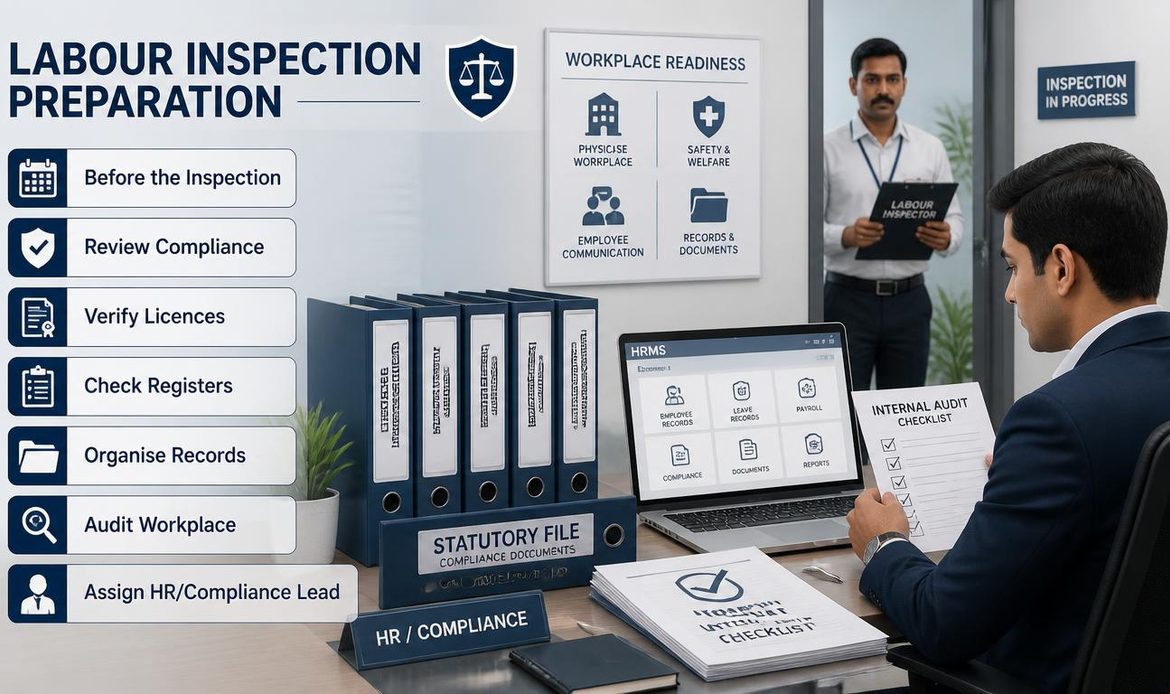
1. Audit Internal Compliance Policies
The first step is an internal review of existing HR policies and compliance practices. Employers should confirm that their policies are aligned with the applicable labour codes. For instance, if the policy provides for one day off per week, attendance and wage records should clearly reflect adherence to that requirement.
2. Identify a Compliance officer or an HR representative
Every organisation is expected to identify a single point of contact to coordinate with labour inspections. This is typically assigned to a senior HR, legal or compliance executive.
Their duties should include:
- Retaining all documents needed for the labour inspection in good condition.
- To attend the visit and answer queries in a definite manner.
- Maintaining a professional interface with the inspecting officer.
- Recording observations and remarks during the inspection.
Having a designated representative helps to avoid confusion and ensures that the establishment presents a consistent and informed position.
3. Inspect New Notifications or Circulars
Notifications issued by the labour departments often influence inspection operations, such as changes in prescribed registers, migration to online compliance portals, or procedural relaxations. Employers should monitor such developments on a regular basis.
Many states have also shifted towards self-certification models and risk-based inspections under the frameworks of the labour code. Where an establishment is eligible for such schemes, it should ensure that you are registered in that scheme and retain documentary proof of enrolment. This ensures that the establishment’s compliance systems are aligned with current regulatory practices.
4. Renewals of licenses and registrations are timely
One of the most common issues associated with the process of inspection includes expired registrations and licences. Employers should periodically verify that:
- Factory licence under the state Shops and Establishment laws or under the Occupational Safety, Health and Working Conditions Code framework.
- Licences obtained by contractors relating to contract labour are now renewed.
- Ancillary statutory approvals that may be examined during inspections such as pollution, fire and local body clearances.
Regular tracking of renewal timelines helps avoid non-compliance observations.
5. Check Statutory Returns and Payments
Employers should confirm whether periodical returns and statutory payments have been completed within the prescribed timelines. Proof of payment, such as challans, should be systematically stored and easily retrievable.
6. Maintain Records, Physical and Digital in an orderly manner
While for most establishments the information may be stored electronically in their HRMS or payroll software, employers will still need to have one physical file per statutory Act. As a best practice, employers should maintain a dedicated physical file for each applicable labour law or labour code, with printed registers, authenticated entries, and signatures where required. Digital records should mirror these physical documents to ensure consistency.
7. Perform a Simulated Internal Audit
It is advisable for employers to conduct a small internal audit with the labour inspection checklist aligned with current laws. This can be done by assigning a co-worker or outsourced consultant to be an inspector. This test run reveals the practical gaps, such as absent entries, unsigned registers, or outdated forms, that may otherwise go unnoticed in routine operations.
8. Prepare the Workplace
The overall condition of the workplace is noted by the inspector, so a clean and organised working environment with basic safety working environments make an impact. Employers must ensure that statutory abstracts are prominently displayed at locations such as the entrance or notice boards. Emergency contact number, safety directions and labour law posters should be legible and updated.
9. Communicate with Employees
It should be made known to employees that an inspection is not a punishment but a routine regulatory process. In the situation when the inspecting officer communicates with them, they should be able to respond to basic factual questions, namely their designation, working hours, unpaid days of the week, and salary, without any hesitation.
10. Think of Being Open and Relaxing
Finally, employers should encourage a calm and open approach during inspections. Cooperation with the inspecting officer goes a long way. It is advisable to avoid withholding documents and give defensive responses. If a particular record is temporarily unavailable, this should be noted politely and shared at the earliest opportunity.
IV. Labour Inspection Checklist for Employers
1. Exhibition Requirements and Display Boards
Every workplace is required to display key statutory information in a manner that is clearly visible and accessible to employees. These are not decorative formalities; they are evidence that the employer recognises the rights and obligations of the employee.
Items that should ordinarily be displayed include:
- Statutory abstracts under the applicable labour laws and labour codes.
- Details of working hours, weekly rest days, and declared holidays.
- The address, designation and name of the Inspector or the Labour Officer.
- Fire safety directions, emergency contact numbers and precautionary guidelines.
- Notices on equal opportunity and prevention of sexual harassment, including grievance redressal mechanism.
2. Acting on Statutory Registers
Statutory registers form the backbone of any labour inspection. While formats may vary in each state, the underlying requirement remains the same, that is, where the law mandates a register, the employer has to maintain it.
Essential registers are:
- Attendance or Muster Roll.
- Wage Register of gross, deductions and net payable.
- Overtime Register in rate and hours of overtime.
- Earn out Leave Register, casual and sick leave.
- Bonus and Fines Register.
- Register of Advances or recoveries of salary.
- Register of contractors and contract worker where contract labour is engaged.
3. Wage Documentation and Employee Records
In addition to statutory registers, inspecting officers normally request the examination of supportive employee documentation to verify consistency and actual implementation. This includes:
- Appointment letters or employment contracts.
- Proof of identity and address information of employees.
- Monthly salary slips.
- Bank statement or evidence of electronic transfer of wages.
- Paysheets that add up to records in the wage register.
4. The Health, Safety, and Welfare Measures
Health and safety compliance continues to be a key inspection focus, particularly for establishments covered under the Occupational Safety, Health, and Working Conditions framework. For office environments, this could be reduced to a bare minimum in hygiene, fire safety and welfare checks.
Pre-inventory points before any labour department inspection process:
- Service and tag of fire extinguishers.
- Toilets and clean drinking water.
- Newly stocked first aid boxes.
- Adequate cleanliness, light and ventilation in any locations.
- Separate washrooms and changing facilities for women, as necessary.
5. Leaves and Working Hours, Work Overtime
Among the most prevalent reasons to note non-compliance is the lack of complete or even unified information on working hours.
Employers should ensure that:
- Attendance records and overtime entries should align with wage payments.
- Weekly rest days are consistently reflected in records.
- There should be no excessive working hours in per day, including mandatory overtime.
- Leave applications and approvals are properly documented and retrievable.
6. Contractor and Sub-Contractor Compliance
In the case of the establishments involved in contract labour, the company is not limited to the issuance of a work order. The inspectors routinely assess whether the main principal employer has exercised due diligence to ensure compliance by the contractors.
Employers should maintain the following:
- Copies of the licence of the contractor as per the applicable contract labour framework.
- Register of contractors, including commencement and completion dates.
- Copies of the contractor’s wage sheets and social security contribution records.
- Undertaking requiring statutory compliance by contractors.
7. Employee Safety and Maternity Benefits of Women.
Gender-specific compliance points are closely examined and inspected by the inspectors. Employers should ensure that:
- An Internal Committee under the sexual-harassment framework is duly constituted and notified.
- Employees have access to the harassment prevention of harassment policy.
- Maternity benefit records are properly maintained, including leave approvals and payment details.
- Where applicable, measures relating to the safety and transportation of women working late hours are recorded.
8. Attendance Management and Time-Keeping Systems
Inspecting authorities commonly seek clarity on how attendance is captured and monitored. The system should be reliable and consistent whether manual or digital.
Good practices include:
- Integrating the biometric or punch-in data with the attendance register.
- Maintaining digital attendance backup for a prescribed period.
- Displaying shift schedules prominently near entry or access points, particularly where multiple shifts operate.
V. Key Documents Required During Labour Inspection
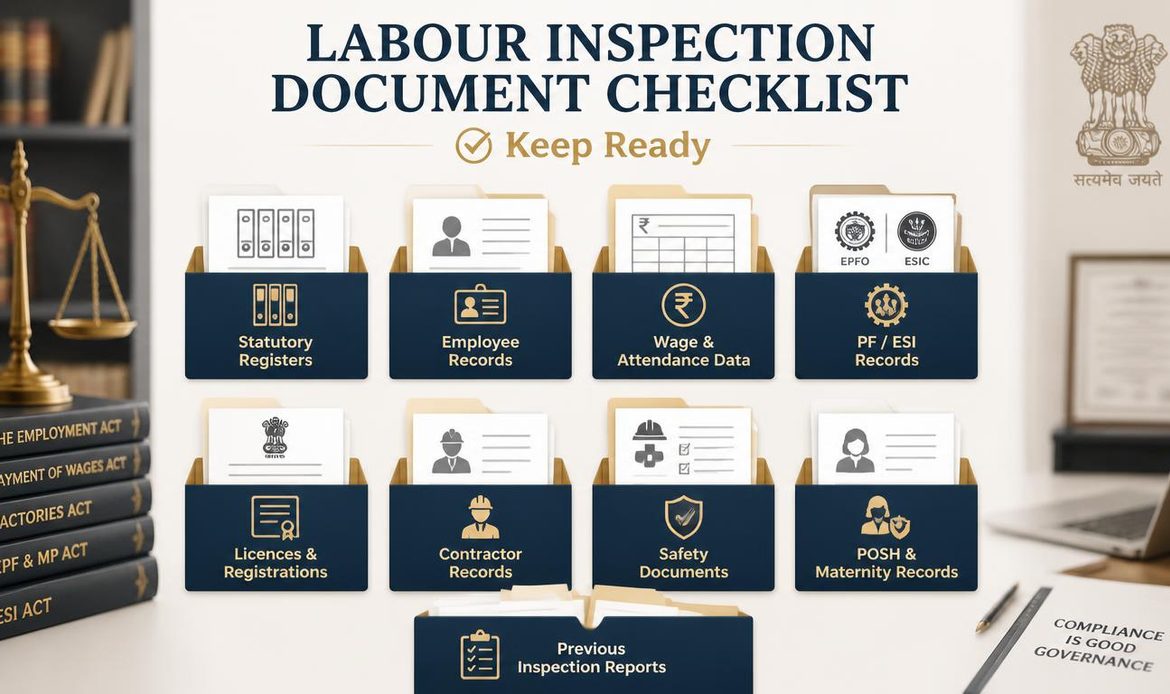
When a labour officer visits an establishment, the discussion almost always turns to one core issue that is documentation. Procuring the correct records is not a favour to the department but a statutory obligation on the employer. A well-organised set of documents, in addition to reducing the time of inspection, also signals that the organisation takes its responsibilities seriously.
1. Essential Statutory Registers and Records
These are the initial papers forming backbone of any labour inspection. They become the foundation of any checklist of labour inspection in India.
Registers that are necessary are:
- Muster Roll / Attendance Register – attendance of all employees on a daily basis.
- Wage Register – comprehensive account of wages, calculation of deductions and balance of payment.
- Overtime Register – specifications of additional hours and rate of payment.
- Register Leave – reflecting the earned, sick and casual leave respectively of each employee.
- Bonus and Fines Register – whether statutory bonus or deductions are applicable.
- Record of Contractors and Contract Workers – where manpower is engaged under the contract of third parties.
- Accident Register – where applicable, particularly for establishments covered under occupational safety and construction-related laws.
These registers have to be updated on a monthly basis, signed by the authorised person and kept in a secure location for the required retention period. While many establishments maintain digital versions, inspectors often expect physical copies to be produced during a visit.
2. Employee-Related Documents
An inspection would usually entail ensuring that the information contained in the registers is a reflection of the employee records. The officers can choose random names and request supportive files, keeping the following ready:
- Offers of appointment or employment agreements.
- Copies of PAN, Aadhaar and bank account proof.
- Salaries slip in line with the wage book.
- Evidence of receipt of payment- e.g. statements of bank transfers or records of salary payments.
- Employee-wise provident fund and insurance contribution details.
- Copies of Employer produced ID cards.
3. Registration Certificates and Establishment Certificates
All the inspectors will also verify whether the establishment itself is duly registered in line with the applicable labour laws. Employers should retain copies of:
- Registration Certificate according to the States Shops and Establishment law factory licences under the occupational safety framework.
- Contractor Licence (where necessary).
- Professional Tax Registration Certificate (applicable states).
- Registration under sector-specific or employment-specific statute.
- Trade licences, fire safety approvals and pollution control consents (where applicable).
4. Statutory Contribution Proofs
A separate, clearly labelled file for statutory payments is advisable. This should include:
- Monthly challans for provident fund and employee insurance contributions.
- Summary of deductions on salaries as contributions by employees.
- Annual or periodic returns submitted on statutory portals.
- Records of Labour Welfare fund, bonus disbursals and Gratuity payment Receipts.
- Copies of Form-16 or tax deduction certificates under the Income Tax Act.
5. Contractor and Subcontractor Records
Where contract labour is engaged, inspectors closely examine whether the principal employer has ensured compliance by contractors. Employers should maintain:
- Copies of all the licences and registration certificates of the contractors.
- Written agreements clearly allocating compliance responsibilities.
- PF, ESI, and wage registers submitted by the contractor.
- ID proofs and muster roll of contract workers deployed at the site.
- History of payment of wages and working time during the contractor.
6. Leave, Attendance, and Overtime Records
To avoid discrepancies:
- Ensure that the attendance record matches the biometric data.
- Ensure that the overtime remuneration is reflected in the attendance and wage records.
- Retain the leave application forms with appropriate approvals.
- Regular internal checks help ensure alignment across records and prevent inconsistencies during inspections.
7. Distribution of Records in connection with Women Employees
If during inspections, the consideration of gender-sensitive compliance is high. The officer may ask for:
- Documents of the POSH Committee constitution and annual report.
- A copy of the Prevention of Sexual Harassment Policy.
- Maternity leave records and benefit details.
- Documentation relating to safety measures, including transportation arrangements for women working late hours, where applicable.
- Communication and Correspondence Records.
Past interactions with labour authorities are also relevant. Employees should maintain:
- Past inspection report and compliance responses.
- Written explanations provided to the authorities.
- Copies of compliance evidence (such as photos, receipts, or updated registers).
9. The Other Factory Records
In the case where the establishment is classified as a factory, the following documents are typically reviewed:
- Workers’ medical examination records.
- Letter of appointment of safety officer where mandated.
- Investigation summary and accident reports.
- Logs of protective equipment dispatched.
- Monthly returns in Form 34 and other forms.
In practice, workplaces that keep their safety systems tight and their records in order usually get through inspections faster, with far fewer issues being raised.
Conclusion
The perception of most employers about a labour inspection is that it is a disruptive element to the activity of the workday, a visit that provides invitations to scrutiny and slows operations. However, as soon as you know how to prepare against a labour inspection, it becomes routine and manageable. Inspections serve as a regulatory check to ensure that workplaces meet basic standards of fairness, safety, and statutory record-keeping. Inspection is not meant to be punitive; when compliance systems are in place, it’s just regulatory oversight, nothing more.
FAQs
1. In India, how frequently are labour inspections carried out?
There is no fixed frequency. Some states follow an annual or risk-based cycle, whereas others come up with haphazard inspections using online systems. Depending on the industry, size, and track record of compliance, an establishment may be inspected once annually or not at all.
2. Which documents should be on-site to be inspected during the labour inspection?
At a minimum, employers should ensure that statutory displays are in place including abstracts of significant labour legislation, working hours, weekly leaves, emergency contacts, and the POSH Committee. These are typically the first items to be inspected by the inspectors.
3. Is it possible that labour inspectors can come on impromptu?
Yes. Several labour laws and enforcement provisions permit surprise inspections. They commonly arise in response to a complaint, workplace accident, or information that indicates non-compliance. Maintaining documents required for labour inspection ensures that the organisation is prepared for unannounced visits.
4. What will occur should there be digital record-keeping?
Most states accept digital records; however, the inspectors might also require printed copies and authenticated extracts. Employers must ensure that the digital and physical copies are consistent. Where records are maintained through the HRMS systems, access credentials should be readily available to avoid delays during inspection.
5. What needs to be done on the notice of labour inspection by a company?
The response should be prompt and professional. Review the notice carefully, collate the mentioned documents, and keep the internal compliance checklist ready before the inspection. Follow-ups to the inspection should be submitted immediately after the inspection, and must be provided within prescribed timelines, with copies retained for record.