

Reviewed and Validated by: Naman Jain, Associate
Introduction to the Employment Exchanges Act 1959 PDF
The Employment Exchanges (Compulsory Notification of Vacancies) Act, 1959. Central Act. Came into force 1960. Applies to whole of India except J&K.
Purpose – not about wages, not about working hours. About vacancies. Employer has to notify vacancies to the Employment Exchange. Notification is compulsory. Selection is still employer’s choice, Act does not force recruitment from the exchange. Corrida Legal has explained this many times, HRs often confuse it.
Key points:
- Objective: collect vacancy data, provide job seekers information.
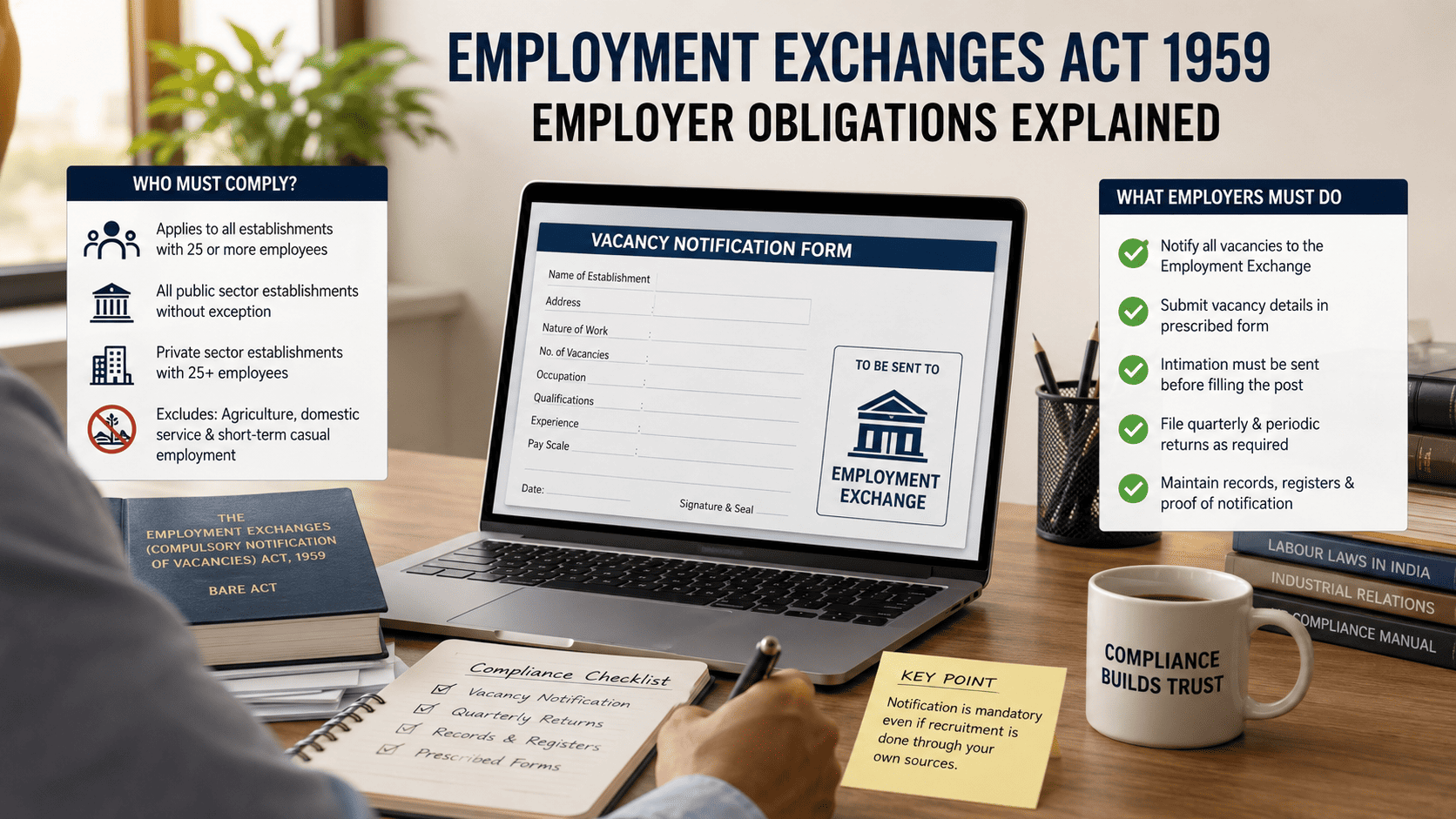
- Coverage: all public sector, private sector if 25 or more employees.
- Exemptions: agriculture, domestic service, short-term casual.
- Obligation: notify vacancies, furnish quarterly and periodic returns.
- Records: keep registers of notifications, people employed, returns filed.
- Penalty: fine for default, higher fine for repeat, false information treated serious.
Corrida Legal note → internal hiring does not exempt. Even if employer already picked a candidate, notification must be sent. Inspectors don’t accept “we already filled the job”.
Common lapses seen:
- registration and returns not filed on time
- short-term and contract jobs wrongly treated as exempt
- no physical file of notifications kept
- delay in producing documents at inspection, treated as refusal
Why this matters. Inspections are routine. Inspectors begin with registers. They ask for quarterly returns. If not available → notice. Penalty may look small but repeated contraventions add up. More important is the record – without proof of notification, employer has no defence. Corrida Legal has handled compounding matters where the only failure was delay of a few days in notification. Still treated as contravention.
Purpose and Scope – Employment Exchanges Act 1959 PDF
The Employment Exchanges (Compulsory Notification of Vacancies) Act, 1959 has a very narrow purpose. Not about wages, not about social security, not about leave. Only one focus → compulsory notification of vacancies.
Why this law was passed
- Government needed authentic data on employment trends.
- Vacancies were not being reported, so unemployed persons had no equal chance.
- Exchanges were created to act as a bridge between employers and job seekers.
- Notification ensures transparency – vacancies are recorded, candidates are informed.
Corrida Legal note → many employers still ask “why should we notify when we recruit on our own?” Answer is simple: the Act is not about recruitment. It is about information. The Government needs statistics to plan employment policy.
Scope of the Act
- Applies to the whole of India (except J&K at that time).
- Applies to every establishment in public sector, without exception.
- Applies also to private sector establishments employing 25 or more persons.
- Smaller establishments exempt unless notified. Types of vacancies covered:
- all posts in technical, clerical, skilled and unskilled categories
- notifiable vacancies include regular, long-term, and some categories of contract roles
- exclusions → agriculture, domestic service, very short-term casual employment
- additional exclusions may be added by notification of Government
Corrida Legal has seen HRs treat apprenticeships as exempt. Not always correct. If it is a real vacancy and not training-only, it must be reported. Inspectors look at the substance, not just the label.
Why employers must care
Purpose is statistical, but obligation is legal. Inspectors have power to check registers, ask questions, demand returns. Failure = offence. Fines may look nominal (few hundred or thousand rupees), but reputation risk is higher. Repeat offences attract stronger action.
Corrida Legal observation – most defaults come not from refusal but from ignorance. HR managers focus on EPF, ESI, Shops & Establishments compliance, and forget about this Act. Inspectors use this as an easy ground to issue notices.
Applicability and Bare Text – Employment Exchanges Act 1959 Bare Act Download
The bare text of the Employment Exchanges (Compulsory Notification of Vacancies) Act, 1959 is short compared to other labour laws. Bare Act download is available, but most HR managers rarely read it. They prefer summaries. Corrida Legal has seen in practice that reliance only on summaries creates problems, because inspectors quote the bare Act directly during inspections.
Who is covered under the Act
- Every establishment in the public sector, without exception.
- Private sector establishments employing 25 or more persons.
- Units below 25 persons generally outside scope, unless specifically notified.
- Establishments engaged in agriculture, domestic service, and short-term casual jobs are excluded.
- State Governments may issue notifications to exempt or include certain categories.
Corrida Legal note → exemptions are not automatic. Unless specifically notified, employers must
assume they are covered. Many startups argue that IT/ITES is not covered. Wrong. IT establishments with 25 or more employees fall squarely under the Act.
What kind of vacancies are included
- All technical and non-technical roles.
- Clerical, skilled, semi-skilled, unskilled positions.
- Supervisory posts, depending on notifications.
- Contractual or temporary vacancies of more than short duration.
What is excluded → agriculture, domestic service, short-term casual employment, unskilled office boys engaged temporarily.
Why Bare Act reference is important
The bare Act download is the authentic text. Inspectors quote specific sections and employers cannot rely on summaries as defence. For example, Section 4 makes it mandatory to notify vacancies to the local employment exchange in prescribed form. HR managers often know the rule generally but not the exact section. Corrida Legal advises clients to keep both – a copy of the bare Act PDF for reference, and a practical compliance checklist for day-to-day use.
In practice
- Inspectors begin with coverage. They ask for employee count. If above 25, Act applies.
- If employer argues exemption, inspector demands proof of notification. Without government notification, exemption is not accepted.
- Public sector employers have no escape. Private employers with more than 25 workers are also squarely included.
- Corrida Legal has handled cases where employers tried to argue “we are a small branch, below 25” while total headcount in other branches exceeded 25. Inspectors aggregated numbers and still issued notices.
Corrida Legal observations
- Bare Act PDF is the baseline – summaries cannot override it.
- Establishments must carefully count employees. Branch offices are not automatically separate.
- Many IT/ITES companies wrongly assume exclusion. Inspectors clarify they are included.
- Vacancy means any post, not just permanent jobs. Even long-term contract posts are not exempt.
- Exemptions are rare, and must be specifically notified.
Duties of Employers – Employer Obligations under Employment Exchanges Act 1959
The central duty under this Act is simple. Employers must notify vacancies. The law calls it compulsory notification. That is why it is named the Employment Exchanges (Compulsory Notification of Vacancies) Act, 1959. Notification is not optional. Corrida Legal has seen many HR managers misunderstand this, treating it as a suggestion. Inspectors do not treat it that way.
Core Obligations under the Employment Exchanges Act 1959 PDF
Employers covered under the Act have to:
- Notify vacancies to the local employment exchange in the prescribed form.
- Furnish information within the prescribed time.
- Submit quarterly returns giving details of employment and vacancies.
- Maintain registers showing notified vacancies and appointments.
Corrida Legal note → not just permanent roles. Even longer contract roles have to be notified. “Short-term casual” exemption is narrow.
Legal Duties as Summarised in the Compulsory Notification of Vacancies Act Executive Summary
The executive summary prepared by Corrida Legal explains it in practical terms:
- Notify all vacancies except exempted categories.
- Do not delay beyond time limit, delay = contravention.
- File quarterly returns without fail.
- Produce registers and returns whenever inspector demands.
Many employers only notify big posts. Wrong. The Act does not say “senior vacancies only”. Every covered vacancy must be reported.
Reference to the Bare Text – Employment Exchanges Act 1959 Bare Act Download
The bare Act download clearly states the obligations in Section 4 and 5. Section 4 → notify vacancies. Section 5 → furnish prescribed information and returns. These two provisions create the entire compliance burden. Inspectors always cite these sections in notices. Corrida Legal advises clients to keep a copy of the bare Act PDF in their HR file, so that managers know what inspectors are quoting.
Specific Employer Obligations under Employment Exchanges Act 1959
- Notify vacancy to the local employment exchange.
- Use the prescribed form.
- Notify before filling the vacancy. Notification after selection is still a contravention.
- Submit quarterly returns in prescribed form.
- Maintain proof of submission (acknowledgement, email, stamped copy).
- Produce records when inspector demands.
Corrida Legal has seen notices issued only because HR could not produce proof of notification, even though they claimed to have sent it. Proof is as important as compliance.
Practical Compliance – Vacancy Notification Compliance India PDF
In practice, compliance is a routine HR duty. But it is often overlooked. Corrida Legal tells clients to:
- Maintain a separate file marked “Vacancy Notifications”.
- Keep copies of every return and every notification sent.
- Update registers weekly.
- Cross-check that vacancies filled = vacancies notified.
This way, during inspection, HR can produce everything in one place. Inspectors usually check the file first. If file is neat and complete, inspection ends quickly. If not, notices follow.
Consequences of Breach – Employment Exchanges Act Penalties and Rules
Failure to comply brings penalties. First offence – fine. Repeat – higher fine. False information – heavier penalty. Continued default – daily fine. Inspectors may prosecute in case of deliberate failure. Corrida Legal experience is that most cases are compounded, but compounding itself costs more than timely compliance.
Corrida Legal Observations
- Internal hiring does not exempt notification.
- Notification must be before filling, not after.
- Proof of submission is essential.
- Many HRs forget quarterly returns, leading to notices.
- Bare Act sections are short but strict.
Vacancy Notification Process – Step by Step Compliance under the Employment Exchanges Act 1959

The Employment Exchanges (Compulsory Notification of Vacancies) Act, 1959 created a fixed process. Notification of vacancies is the heart of compliance. Without this step, the entire Act fails. Corrida Legal has observed that most employers know they “should notify” but very few HR teams know the exact process. That gap usually leads to notices.
Understanding the Requirement – Employment Exchanges Act 1959 PDF
The bare law states that all notifiable vacancies must be reported. A notifiable vacancy means any job opening (technical, clerical, skilled, unskilled) in an establishment covered by the Act. The Employment Exchanges Act 1959 PDF clearly lists exemptions (like agriculture, domestic service, very short casual work). Employers must assume all other posts are covered.
Corrida Legal note → the biggest mistake is HR assuming “short-term” equals exempt. Only very short casual jobs are exempt. Contract jobs of three months or six months are still notifiable.
Step One – Compulsory Notification of Vacancies Act Executive Summary
The process, as explained in the Compulsory Notification of Vacancies Act executive summary, is:
- Identify a vacancy as soon as it arises.
- Fill the prescribed notification form (usually Form ER-I or as prescribed by rules).
- Send the form to the local employment exchange within the prescribed time.
- Maintain an acknowledgement or stamped copy for records.
Notification must happen before filling the job. If HR reports after hiring, inspectors still treat it as default.
Step Two – Legal Authority from Employment Exchanges Act 1959 Bare Act Download
The Employment Exchanges Act 1959 bare act download confirms obligations in Section 4 (notification of vacancies) and Section 5 (furnishing returns). These are the two pillars of the law. Inspectors carry the bare Act text and quote directly from these sections. Corrida Legal recommends employers to keep the Bare Act PDF printed in HR files. That way, managers know the exact legal wording, not just a paraphrase.
Step Three – Practical Employer Obligations under Employment Exchanges Act 1959
Employers must ensure:
- All notifiable vacancies are reported without delay.
- Use of correct prescribed forms.
- Vacancies notified before appointment.
- Quarterly returns filed on time.Registers updated with details of notified and filled vacancies.
- Proof of submission available for inspection.
Corrida Legal observation – Inspectors often ask: “show me the last 3 returns.” If HR cannot produce them, a notice follows immediately.
Step Four – Vacancy Notification Compliance India PDF
Compliance is more than filing one form. It is an ongoing process. The vacancy notification compliance India PDF prepared by Corrida Legal includes checklists:
- Maintain a “Vacancy File” with all forms, returns, and proofs.
- Update the file weekly, not quarterly.
- Cross-check headcount vs vacancies reported.
- Ensure every branch reports separately, unless consolidated reporting is allowed.
Corrida Legal note – Many employers forget to notify branch vacancies. Inspectors treat each branch as an establishment. Notices have been issued for missing branch notifications even when the head office complied.
Step Five – Penalties for Breach – Employment Exchanges Act Penalties and Rules
If the process is ignored, penalties follow. Under the Employment Exchanges Act penalties and rules:
- First offence – fine.
- Second offence – higher fine, often double.
- False information – treated as serious violation.
- Continuing contravention – daily fine until compliance is proved.
In practice, inspectors prefer compounding. Employer pays compounding fee, case closed. But compounding costs more than timely compliance. Corrida Legal has assisted multiple employers in such matters, and the lesson is always the same → cheaper to comply than to pay after default.
Records and Returns – Employer Compliance under the Employment Exchanges Act 1959
The Act does not stop at vacancy notification. Employers must also maintain records and submit periodic returns. In practice, inspectors begin inspections by asking for these documents. If registers or returns are missing, even if vacancies were notified, the employer is still treated as non-compliant. Corrida Legal has seen this often.
What Records must be kept
- A register of all vacancies notified.
- Details of appointments made against those vacancies.
- Employee headcount, broken down into categories.
- Copy of every return sent to the employment exchange.
- Proof of notification – acknowledgement slips, stamped copies, or email confirmations.
Corrida Legal note – digital storage alone is not enough. Inspectors usually ask for hard copies. HR should maintain a physical file labelled “Employment Exchange – Notifications and Returns”.
What Returns must be filed
- Quarterly return on employment situation, usually Form ER-I.
- Returns regarding vacancies notified and filled.
- Special returns if called for by the employment officer.
Quarterly return is compulsory. Many HRs assume one annual return is sufficient. Wrong. The Act specifically requires quarterly reporting.
Process of Filing Returns
- Fill prescribed forms accurately.
- Submit to the local employment exchange within due date.
- Keep proof of submission.
- Cross-check headcount in the return with internal HR records.
In practice – inspectors compare returns with wage registers and attendance sheets. If numbers do not tally, they issue notices. Corrida Legal has handled cases where employers under- reported staff strength to avoid coverage, and inspectors caught the mismatch through PF/ESI records.
Inspection Angle
- Inspectors can demand registers and returns anytime.
- Delay in producing them = offence.
- Back-dated entries are spotted easily. Treated as false records.
Corrida Legal advice: update registers weekly, not quarterly. Producing old data during inspection looks suspicious, even if accurate.
Penalties for Non-Filing of Returns
Under the Employment Exchanges Act penalties and rules:
- Fine for first default.
- Higher fine for repeat offence.
- False or misleading information punished more severely.
- Daily fine in case of continuing contravention.
Compounding is possible, but it costs more. Corrida Legal has seen clients pay compounding fee only because quarterly returns were missed for two quarters. Filing on time would have been cheaper.
Penalties and Offences – Employment Exchanges Act Penalties and Rules
The Employment Exchanges (Compulsory Notification of Vacancies) Act, 1959 has its own penalty framework. Amounts may not look large compared to other labour laws, but enforcement is strict. Inspectors use penalties as the first step to push compliance. Corrida Legal has seen even reputed employers fined for small lapses.
General Penalties
- Failure to notify a vacancy – fine.
- Failure to file quarterly return – fine.
- Furnishing false information – higher fine.
- Repeat offence – higher penalty, sometimes double.
Corrida Legal note → penalties may look nominal, but repeat offences hurt reputation. Inspectors often highlight non-compliance in public reports.
Continuing Contravention
If default continues, daily fine is imposed until compliance is shown.
Example: renewal of return missed → inspector issues notice → if employer still does not file, daily fine starts running.
False Records or Misleading Returns
Providing false information is treated seriously. Inspectors may prosecute.
- Under-reporting of employee strength.
- Declaring exemptions wrongly.
- Back-dated returns.
Corrida Legal has handled cases where HR tried to “adjust” returns after inspection. Inspectors caught the mismatch with PF/ESI records. Penalties were heavier than ordinary defaults.
Prosecution
Court can take cognizance only on inspector’s complaint. In practice, prosecutions are rare but possible. Usually applied in cases of repeated or deliberate falsehood. Corrida Legal experience compounding is the usual outcome, but the threat of prosecution is used to push employers into settlement.
Enforcement and Inspections – Role of Officers under the Employment Exchanges Act 1959
The Act gives powers to enforcement officers, usually called Employment Officers or Inspectors. On paper their role is to guide, supervise and ensure compliance. In practice, they inspect, demand documents, and issue notices. Corrida Legal has seen inspections being used more as enforcement than advisory.
Appointment and Powers of Inspectors
- Appointed by State Government or Central Government.
- Power to enter any covered establishment.
- Check registers, returns, and proof of notifications.
- Ask HR or employees questions.
- Take copies of documents.
Corrida Legal note → inspectors almost always begin with quarterly returns. If missing, notice is issued immediately.
Conclusion – Why Employment Exchanges Act Compliance Matters
The Employment Exchanges (Compulsory Notification of Vacancies) Act, 1959 is often ignored. Many employers see it as minor because fines are smaller. Wrong assumption. Inspectors use this Act as an easy entry point. If vacancy notifications or quarterly returns are missing, notice is issued. Once notice is issued, wider inspection usually follows.
Why employers should take it seriously
- Registration and wage laws already attract attention.
- This Act is simpler, but easier for inspectors to enforce.
- Non-compliance here signals poor HR systems overall.
- Data is cross-checked with PF, ESI, Shops and Establishments records.
