


Reviewed and Validated by: Naman Jain, Associate
Overview of the Karnataka Shops and Commercial Establishments Act 1961 Bare Act PDF
This Act (1961, Act 8 of 1962) continues to be the main law for regulating conditions of work in shops and commercial establishments in Karnataka. The bare act PDF is referred to directly by employers because secondary guides often miss amendments.
Why this Act was introduced – in plain terms:
- To fix working hours per day and per week.
- To make weekly holiday compulsory.
- To provide minimum leave with wages.
- To ensure health, safety and sanitation at workplaces.
- To put an inspection system in place with penalties for breaches.
It is not an optional framework. These are minimum rights. They cannot be contracted out.
Key Objectives – Karnataka Shops and Establishments Act 1962 Executive Summary
Objectives are simple enough but important. Regulation of hours. Grant of leave. Holiday entitlement. Worker welfare. Penalties for default. The executive summary is that the Act gives employees basic protections while allowing establishments to function with some flexibility.
Applicability – Karnataka Shops and Commercial Establishments Act PDF Corrida Legal
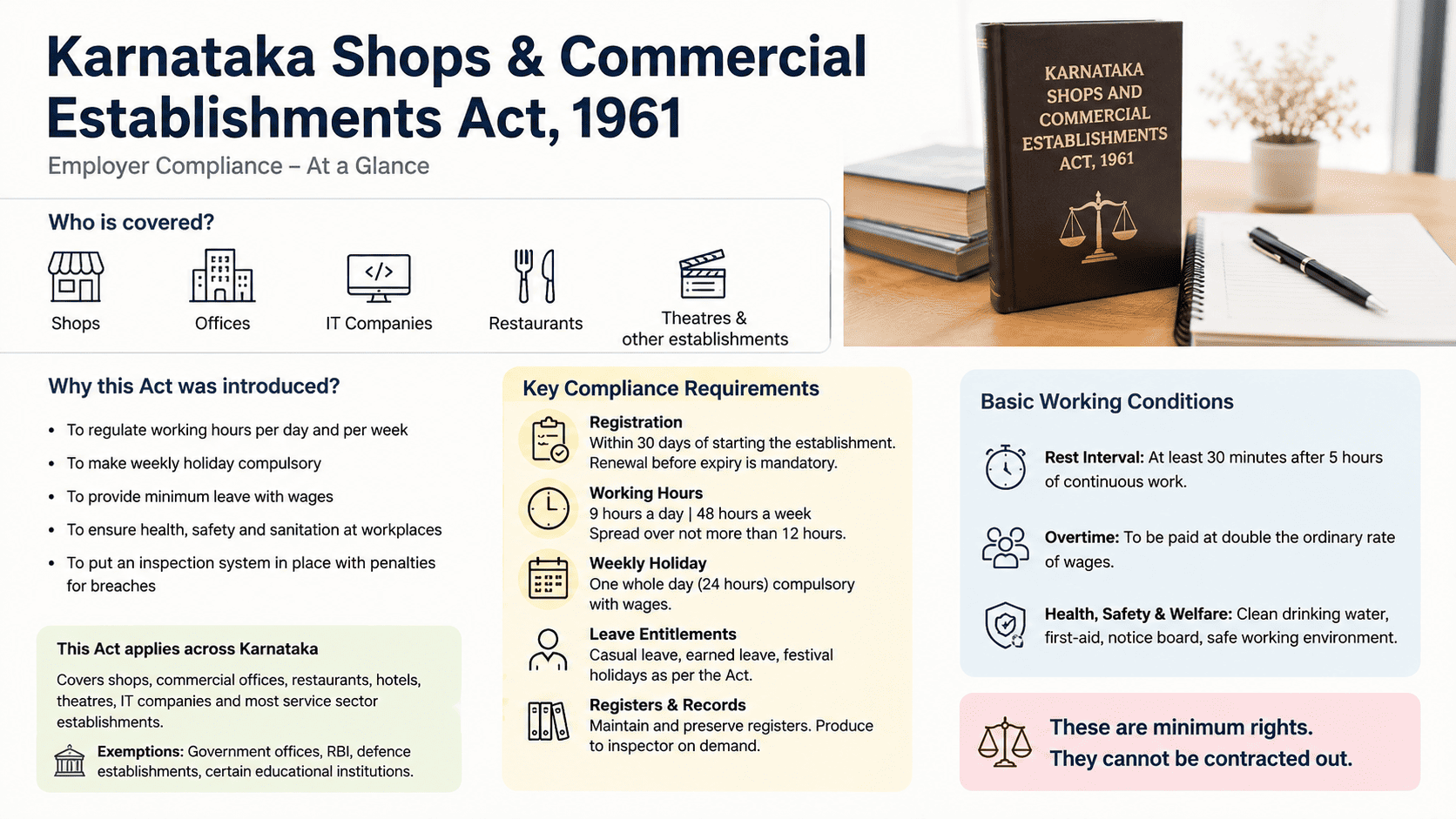
Applies across Karnataka. Covers shops, offices, restaurants, theatres, IT companies, most service businesses. Exemptions: government offices, RBI, defence, certain educational institutions.
Corrida Legal has repeatedly seen notices served on small firms (consultancies, design agencies, IT startups) who thought “we are too small to be covered.” Wrong assumption. Even one employee triggers coverage.
Regulatory Framework – Karnataka Shops and Establishments Act Registration and Compliance PDF
Framework is straight:
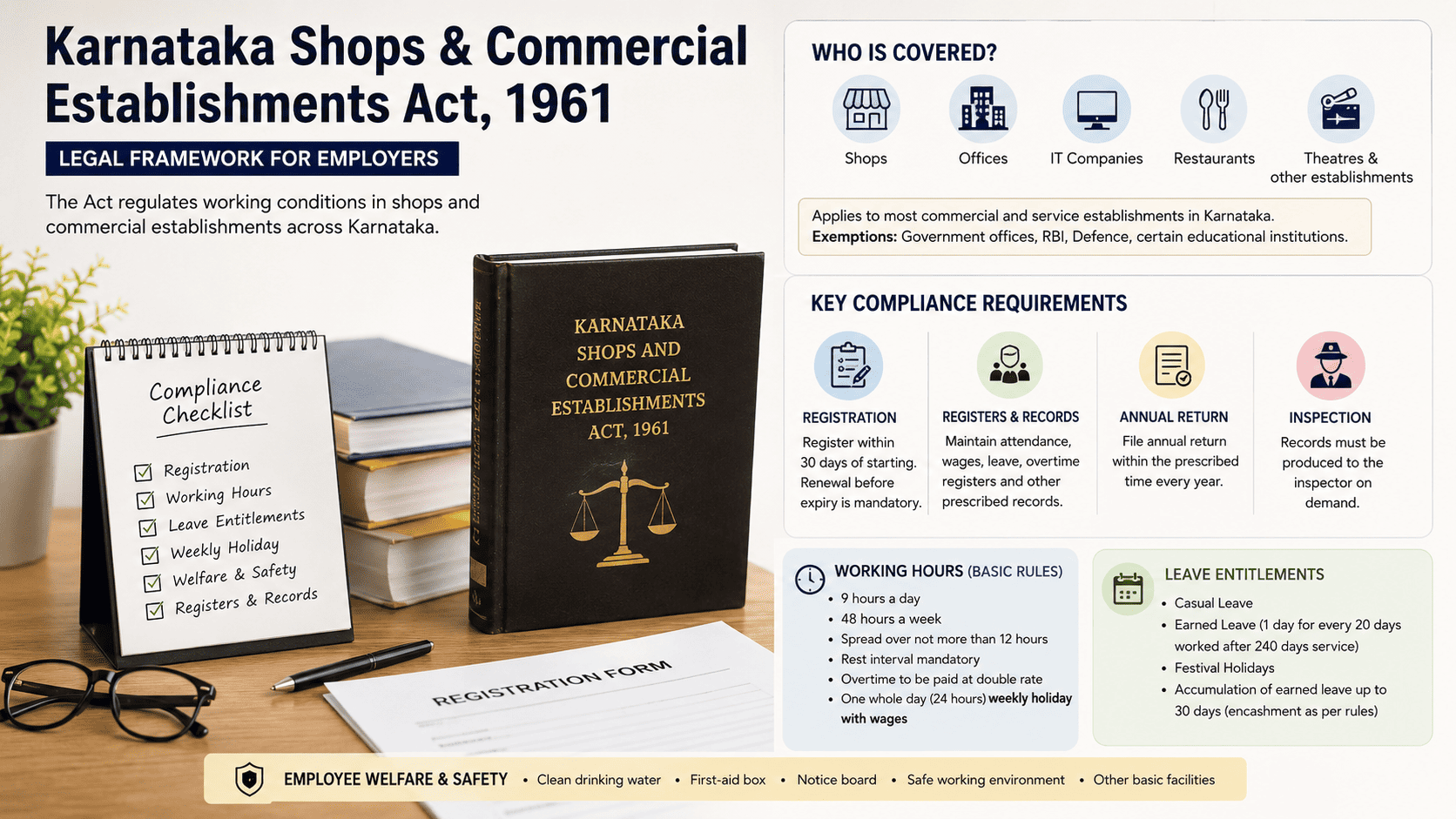
- Registration within 30 days of starting.
- Renewal before expiry.
- Registers – attendance, wages, leave.
- Annual return filing.
- Records to be shown to inspector on demand.
The registration and compliance PDF issued by the Department is the working tool for HR.
Employment Conditions – Working Hours and Leave Rules under Karnataka Shops Act 1961 PDF
Limits: nine hours a day, forty-eight a week. Spread over cannot exceed twelve hours. Rest interval mandatory. Overtime → double wages. Weekly holiday compulsory. Casual leave, earned leave, festival holidays, accumulation up to 30 days. These working hours and leave rules under Karnataka Shops Act 1961 PDF are standard inspection points.
Consequences of Non-Compliance – Penalties and Offences under Karnataka Shops and Commercial Establishments Act PDF
Non-compliance = penalties. For first offence, fine. Repeat → higher fine, sometimes imprisonment. Daily fine for continuing default. Corrida Legal has seen penalties even for non- display of name board or failure to file annual return. The penalties and offences under Karnataka Shops and Commercial Establishments Act PDF are actively applied.
Karnataka Shops and Establishments Act 1962 Executive Summary
The Karnataka Shops and Commercial Establishments Act, 1961 (brought into force as Act 8 of 1962) regulates employment and working conditions across the State. It applies to shops, commercial offices, IT companies, restaurants, hotels, theatres, and most service sector establishments.
The Act is not a technical formality. It is the daily rulebook for employers and HR. Registration, hours of work, leave, and penalties are all contained here. Employers refer to the executive summary PDF for a concise understanding, but compliance always depends on reading the bare Act itself.
Corrida Legal has repeatedly seen that small businesses ignore the Act thinking it is meant for large corporations. This is not correct. Even a small office with two or three employees is covered. Inspectors treat registration and leave compliance as basic — failure on these points often leads to penalty notices.
Key Takeaways from the Executive Summary
- Registration requirement
- Every establishment must be registered within thirty days of starting.Renewal before expiry is mandatory.
- Closure or change in details requires intimation.
- Working hours limits
- Nine hours a day, forty-eight a week.Rest interval and spread-over to be followed.Overtime to be paid at double rate.
- Weekly holiday compulsory.
- Leave entitlement
- Casual leave, earned leave, festival holidays.Accumulation and encashment rules.
- Leave registers to be maintained and produced on inspection.
- Penalties for non-compliance
- Fines for first offence.
- Higher fines and possible imprisonment for repeat or serious offences.
- Daily fines for continuing contravention.
- Corrida Legal has handled several compounding matters where employers failed to renew registration or file annual return.
Working Hours and Leave Rules under Karnataka Shops Act 1961 PDF
The Act fixes limits. Nine hours in a day. Forty-eight hours in a week. Spread-over not more than twelve hours. Rest interval in between. Weekly holiday compulsory. These are not flexible guidelines. They are mandatory. Inspectors almost always begin with this.
Corrida Legal has seen even startups getting questioned on this. “We are only five people, we work late” — inspectors don’t accept that. Overtime = double wages. No exceptions.
Hours of Work
- 9 hours per day.
- 48 hours per week.
- Spread over → max 12 hours.
- Rest interval at least half an hour after 5 hours of continuous work.
In practice: employees often stretch beyond 9 hours in IT/ITES. Employers must record the extra and pay overtime. Law is strict on this, even if employee “agreed” otherwise. An agreement cannot override.
Weekly Holiday
One whole day (24 hours) must be allowed each week. Generally Sunday, but employer may fix another day with notice. Holiday with wages. Corrida Legal has observed that missing holiday lists on notice boards is a very common reason for penalties.
Leave Entitlements
- Earned leave (EL) – 1 day for every 20 days worked, after 240 days service. Accumulation allowed up to 30 days. Beyond that, encash.
- Casual leave (CL) – 12 days per year (varies slightly in rules, but practice is 12).
- Festival holidays – minimum of 10 in a year, list to be approved and displayed.
Encashment is not optional. If leave not availed, balance must be carried or paid. Corrida Legal has settled disputes where employers ignored encashment, leading to litigation.
Women Workers and Night Work
The Act originally restricted women from night shifts. Later amendments + notifications allow night work in IT/ITES, BPO, etc., but with conditions:
- transport facility to and from workplace,
- proper security, and
- written consent of the employee.
Corrida Legal note: inspectors still ask for records of cab services, ID of drivers, etc. Employers must maintain proof, not just policy documents.
Corrida Legal Observations
- Inspectors routinely demand leave registers, overtime registers, holiday lists.
- Non-display of weekly holiday notice attracts fine even if leave was actually given.
- Small companies often fail on encashment and overtime, thinking “informal understanding” is enough. It is not.
Welfare and Safety Provisions – Karnataka Shops and Establishments Act PDF
The Act does not stop at hours and leave. It also prescribes minimum welfare and safety requirements. These are simple on paper but checked very closely during inspections.
Inspectors often begin with registers but always look around the workplace for these.
Health and Safety (General)
- Establishments must be kept clean, ventilated, with proper lighting.
- Sanitation facilities are mandatory. Separate toilets for men and women.
- Safe drinking water must be provided. “Wholesome” is the word used in the bare Act. In practice, inspectors expect RO or similar.
Corrida Legal note: many employers rely on building facilities. If shared toilets are not clean, inspectors still penalise the establishment.
First-Aid Facilities
Every establishment must keep a first-aid box. Accessible, stocked. Not locked away in HR cupboards. This is a very common failure Corrida Legal has seen — inspectors check the box directly. Missing items = notice.
Creche Facility
Where 20 or more women employees are employed → crèche facility is mandatory.
Alternatively, a group of establishments may set up a common facility.
- Distance should be reasonable (within prescribed limit).
- Mere allowance paid in lieu is not accepted.
- Inspectors insist on a physical crèche or tie-up proof.
Canteen
For establishments employing 100 or more persons → canteen must be provided. Common facility may be permitted by authority. But it has to be functional, not just on paper. Corrida Legal has handled cases where employers set up a canteen but did not maintain hygiene — inspectors still imposed penalty.
Registers and Records (Linked to Welfare)
- Attendance registers, wage registers, overtime, leave.
- Annual return to be filed.
- Welfare facilities like creche/canteen must be supported by records (agreement with daycare, canteen vendor bills, etc.).
Corrida Legal Observations
- Inspectors check physical facilities, not just paperwork.
- First-aid box and toilets are the easiest and most common points of penalty.
- Crèche compliance is often ignored — notices are frequent.
- Employers assume canteen is a formality. Inspectors treat it as an active requirement.
- Even small lapses in welfare facilities attract penalties quicker than major defaults.
Records, Registers and Returns – Karnataka Shops and Establishments Act Compliance PDF
Every establishment under this Act has to keep registers. This is where inspectors normally start. If registers are missing, penalties follow — even if other compliance is okay.
What registers:
- Attendance register – who came, when. Daily entry.
- Wages register – salary, allowance, deduction. Must match bank transfers.
- Leave register – earned leave, casual leave, holidays. If not updated, treated as denial of leave.
- Overtime register – extra hours. 9 hours is the limit, anything more = overtime.
Some keep these on Excel. But inspectors insist on physical copy. Showing laptop screen rarely works. Corrida Legal has seen multiple notices where employers argued “we keep digital” — rejected.
Annual return – to be filed every year, prescribed form. Online now in most cases. But HR teams forget, thinking “we are registered already.” Not correct. Return is separate. Many compounding cases are only because of this one miss.
During inspection –
- Attendance book asked first.
- Then wages book.
- Then leave/OT compared with wages.
- If nothing matches, they call it non-compliance, even if salary was paid.
Important: Registers are not just formality. They are proof. Without them, even if you paid correctly, you cannot prove compliance. Corrida Legal tells clients — better to over-maintain than under-maintain. Weekly updates safer than monthly.
False records are worse. Back-dated entries are spotted easily. Once marked false higher penalty, even prosecution.
Penalties and Offences under Karnataka Shops and Commercial Establishments Act PDF
The Act provides for penalties when employers fail to comply. These are not symbolic. They are applied in practice. Corrida Legal has handled multiple matters where penalties were levied for small issues like missing holiday lists or outdated registers.
General Penalties
- For contravention of any provision → fine imposed. Amount depends on the nature of the default.
- First-time offence → usually smaller fine.
- Repeat offence → higher fine, sometimes double.
- Certain contraventions may also carry imprisonment, though prosecutions are less common.
Inspectors treat record-keeping failures as contraventions. Even if wages were actually paid, failure to show registers is enough for penalty.
Specific Penalties (False Records / Obstruction)
- If employer maintains false records, penalties are heavier. Treated as intentional violation.
- Obstructing inspector → offence. Refusing to produce registers or preventing inspector from questioning staff counts as obstruction.
- Penalty in such cases is significantly higher.
Corrida Legal note: many HRs think “delay in producing register” is acceptable. Inspectors treat delay as refusal. Notices follow.
Fines for Repeat Offences
If the same contravention is repeated → fines escalate.
- Second offence → higher range, even if the mistake is minor.
- Continuing contravention → daily fine until compliance is shown.
Daily penalties are a real risk. Employers often ignore this, but inspectors impose per-day amounts where renewal or returns are not filed.
Serious Cases (Imprisonment)
Where violation results in harm or deliberate falsehood → imprisonment provisions are available. Usually applied in accident-related cases or fraud in records. Even if jail term is not imposed, the threat itself is serious.
Compounding of Offences
- Certain offences can be compounded. That means the employer pays a prescribed fee and the matter is closed.
- Compounding is allowed only once for the same offence in five years.
- Fees depend on type of contravention.
- If employer fails to pay the compounding fee within time, an additional fine is added.
Corrida Legal experience: most employers prefer compounding rather than face prosecution. But compounding is costlier than timely compliance.
Enforcement and Inspections – Karnataka Shops and Establishments Act PDF
Inspectors (sometimes called facilitators now) are appointed under the Act. Their job is to check
compliance. On paper they also “advise”, but in practice they inspect.
What powers:
- They can enter premises at any reasonable time.
- Ask for registers, wage records, leave details.
- Question employees directly.Take copies of documents.
- Look around the place – toilets, lighting, first-aid, name board.
Corrida Legal note → they never stick to one issue. If they came for registration, they still ask for leave and overtime registers. How inspections happen:
- Some are routine, some on complaint.
- Employer must cooperate. Refusal is itself an offence.
- Even delay in showing records is treated as “refusal”.
- Inspectors make notes. If they find gaps, they issue notice. If not fixed → prosecution.
Duties of employer at inspection:
- Produce registers immediately.
- Don’t stop inspector from speaking to staff.
- Have a manager or HR present.
Corrida Legal has seen employers argue “we have digital records” – inspectors usually ask for printout. Better to keep both ready.
Notices and prosecutions:
- Notice is first.
- Employer gets chance to comply.
- If ignored, case goes to court.
- Court only acts if inspector files complaint.
Observation from practice: inspectors always begin with registration certificate. If that is missing, rest of inspection becomes harsher. Small misses (like holiday list not displayed) often end up in the same notice as bigger issues.
Miscellaneous & Repeal – Karnataka Shops and Establishments Act PDF
The last part of the Act. General clauses only, but inspectors use them often.
Exemptions
Government may exempt establishments. Done by Gazette notification. Conditions may be added. IT, BPO, essential services usually get relaxations.
It may be noted → exemption is not automatic. Needs specific notification. Corrida Legal has seen employers assume wrongly.
Rights preserved
This Act = minimum. If another law, contract, settlement gives more → that continues. Employer cannot cut benefits citing this Act.
Inspectors sometimes ask workers directly, “do you get more under another law?”. If yes, reduction is treated as violation.
Good faith
Protection given for actions done in good faith. But negligence not covered. Oversight ≠ good faith. We have seen this defence rejected in practice.
Rules
State Government empowered to make rules. Forms, returns, registers, inspection methods, all by rules.
Important: amendments to rules are frequent. HR must track notifications. Many penalties are based on rule breach, not Act breach.
Repeal
Old 1948 Act repealed. Registrations under old Act valid till expiry, then renewal under 1961 Act. Pending prosecutions continued.
Corrida Legal handled cases where client assumed old certificate still valid. Wrong assumption.
Karnataka Shops and Establishments Act 1962 Executive Summary by Corrida Legal
Corrida Legal has prepared a working summary of the Karnataka Shops and Commercial Establishments Act, 1961 (Act 8 of 1962). The idea is simple. Employers and HR managers do not have time to read the bare Act in detail every day. They need the law explained in plain points. The bare Act is still the authority, but this note is what they use in practice.
The law applies to shops, offices, IT companies, hotels, restaurants, theatres, and most service establishments. Exemptions only for government offices, RBI, defence, and some educational institutions. Many small employers assume they are outside. Wrong. Even two employees in a small office bring the Act into play. Corrida Legal has seen notices issued to consultancies and startups who thought otherwise.
Why businesses come to Corrida Legal is not because they cannot find the Act. The Act is available online. What they need is clarity on what inspectors actually check. Our summary PDF sets out exactly that.
Points covered in the executive summary PDF include registration, working hours, leave entitlements, welfare provisions, registers, annual returns, inspections, penalties. Each section is reduced to clear steps. HR can tick them off.
Typical problems we see:
- Registration filed but renewal missed. Renewal is compulsory.
- Annual return ignored because HR thought registration is enough. Wrong. Return is separate.
- Holiday list not displayed on notice board. Small issue, but inspectors treat it as contravention.
- Digital registers shown on laptop. Inspectors demand printouts. Many penalties only for this reason.
- Leave encashment not given. Employers think leave lapses. Law says balance must be carried forward or paid.
Corrida Legal services include compliance audit, preparing registers, wage and leave records, inspection support, compounding assistance, training HR teams. We also update clients when rules change. Our PDF summary is revised and shared whenever new notifications are issued.
The summary document has a penalty chart, sample formats for registers, leave calculation sheet, holiday list format, and a short inspection checklist. These are practical tools. Clients use them to stay inspection-ready.
Corrida Legal observations from practice in Karnataka: inspectors always ask first for the registration certificate, then wage and leave registers, then holiday list. If the certificate is missing, inspection becomes stricter. If registers are not updated, penalty follows. Prosecutions are less common, but compounding is routine. HR managers who update registers weekly rarely face penalties. Those who back-fill are caught easily.
In short, this executive summary by Corrida Legal is a practical compliance guide. It is not a substitute for the bare Act, but it saves time and helps employers prepare.
Practical Compliance Checklist (Employers & HR) – Karnataka Shops and Establishments Act PDF
This checklist is for day-to-day use. It is not a substitute for the bare Act. It is a working note for HR managers and employers. Corrida Legal has seen that most inspection failures come from small lapses.
Registration
- Register the establishment within 30 days of start.
- Keep the registration certificate in print at the office. Inspectors ask for the hard copy first.
- Renewal before expiry. Late renewal = penalty.Intimation of change in name, address, manager, employee strength. Must be filed.
- Closure of establishment → notify within 30 days.
Working Hours & Leave
- Daily limit = 9 hours. Weekly limit = 48 hours. Spread-over not more than 12.
- Overtime at double wages. Record it in the register.
- Weekly holiday compulsory, display notice of weekly off.
- Earned leave, casual leave, festival holidays. Maintain leave register.
- Leave encashment required if balance exceeds limit.
Welfare & Safety
- Provide clean drinking water. Inspectors check RO units.
- Maintain sanitation. Toilets separate for men and women.
- First-aid box → stocked, accessible. Not locked.Crèche facility if 20 or more women employees. Physical facility or notified tie-up.
- Canteen mandatory if 100+ employees. Functional, not just on paper.
Records & Returns
- Attendance register.
- Wage register.
- Leave and overtime register.Annual return to be filed.
- Keep printouts ready even if maintained digitally. Delay in producing = offence.
Penalties & Inspections
- First offence → fine. Repeat → higher fine or prosecution.
- Continuing contravention → daily penalty.
- Compounding available once in 5 years for same offence.
- Inspectors begin with certificate, then registers, then facilities. Sequence is common.
Corrida Legal observations
- Renewal lapses are the most common default.
- Holiday list not displayed leads to penalty even if holidays were given.
- Leave encashment ignored by employers, inspectors pick this up.
- HR teams rely on digital registers, but inspectors still want printouts.
- Small startups are not exempt. Notices are issued even if only two or three employees.
This checklist is meant to be practical. Employers who follow it are usually inspection-ready. Those who ignore small details face penalties.
Conclusion – Why Compliance with Karnataka Shops Act Matters
The Karnataka Shops and Commercial Establishments Act is not just a formality. It decides how an establishment runs on a daily basis. Registration, renewal, hours of work, leave, records, welfare facilities – all of this is under the Act. Employers who treat it casually usually face notices.
Timely registration
Registration is the first check. If the certificate is missing, inspectors treat the establishment as non-compliant from the start. Renewal is equally important. Corrida Legal has seen cases where employers assumed registration is lifetime. Wrong. Renewal before expiry is compulsory.
