

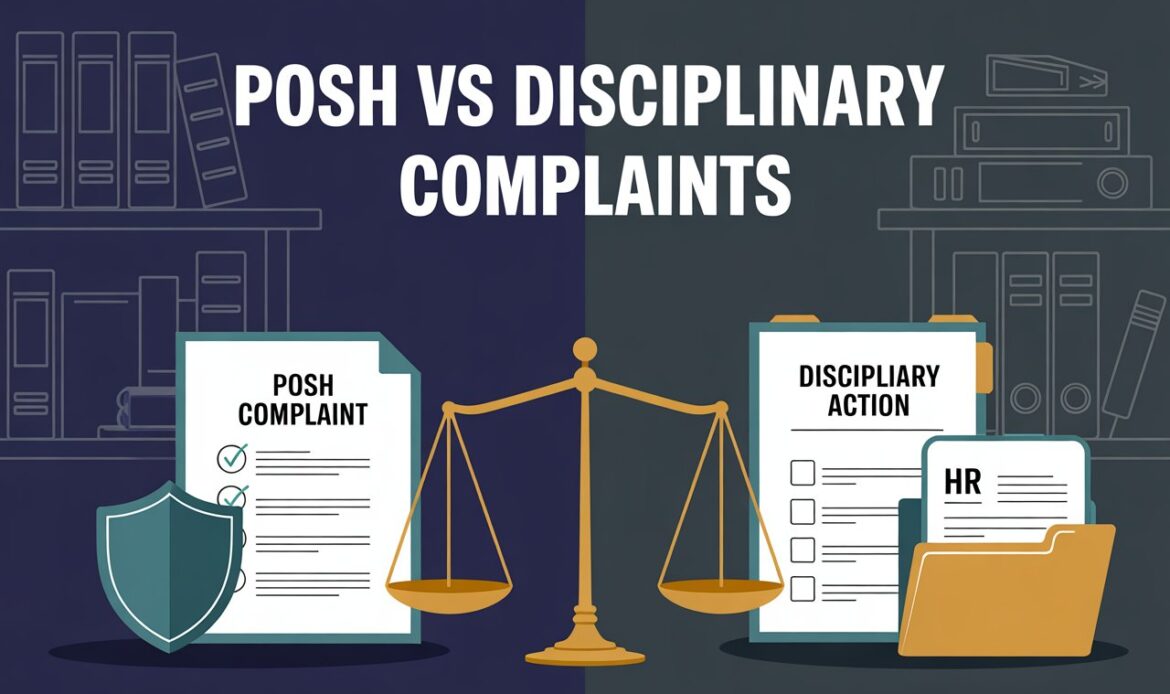
A POSH complaint concerns allegations of sexual harassment governed by the Sexual Harassment of Women at Workplace (Prevention, Prohibition and Redressal) Act, 2013. A disciplinary complaint relates to broader workplace misconduct governed by employment contracts, standing orders, and service rules. The procedure, authority, confidentiality standards, and legal consequences differ materially.
Understanding POSH vs disciplinary complaints is critical for employers, HR heads, and compliance officers. Misclassification of a complaint can invalidate proceedings, expose the organisation to statutory penalties, and compromise termination decisions. This article sets out the Difference between POSH and HR disciplinary inquiry, statutory obligations, inquiry processes, confidentiality norms, and best-practice handling mechanisms.
What is the difference between a POSH complaint and a disciplinary complaint?
A POSH complaint arises within a specific legal framework designed to address sexual harassment of women at the workplace. In contrast, a disciplinary complaint generally relates to misconduct such as insubordination, fraud, absenteeism, violations of company policies, or issues related to performance.
The core distinction between a POSH complaint and a standard disciplinary complaint primarily lies in:
- Applicable law
- Adjudicating authority handling the complaint
- Mandatory procedure
- Confidentiality obligations
- Compliance and reporting requirements
In practical terms, a POSH complaint must follow the Sexual harassment complaint procedure India prescribed under the Sexual Harassment of Women at Workplace (Prevention, Prohibition and Redressal) 2013 Act (“POSH or“Act”). In contrast, a disciplinary complaint follows the employer’s internal disciplinary mechanisms, which must be subject to the principles of natural justice.
Hostile Work Environment and Implied Harassment
The law also recognises that sexual harassment may arise even where there are no explicit advances. Certain workplace situations may still fall within the scope of harassment if the conduct:
- Interferes with the complainant’s ability to perform their work.
- Creates an intimidating, hostile or offensive work environment.
- Is linked to promises of favourable treatment at work.
- Is connected to threats of negative consequences in employment.
This broader approach ensures that the law addresses not only isolated incidents but also patterns of behaviour that create an unsafe or uncomfortable workplace environment.
Workplace Scope
The term “workplace” under the Act is interpreted quite broadly. It is not limited to the physical office and may include:
- Office premises.
- Branche offices and field locations.
- Client or vendor sites.
- Off-site meetings or professional events.
- Work-related travel.
- Virtual or digital workspaces.
Because of this wide definition, conduct that meets the statutory criteria may still fall within the POSH framework even if it occurs outside the traditional office setting. In such cases, the matter must be examined through the Internal Committee (“IC”) process.
Threshold for Referral
When a fresh complaint is made and if the allegations in the complaint prima facie indicate conduct covered by the Act:
- The employer is required to refer the matter to the IC.
- HR cannot substitute a general Workplace misconduct investigation procedure.
- Informal resolution outside the statutory framework is impermissible unless conciliation is sought in accordance with the Act.
This threshold determination is central in analysing POSH vs disciplinary complaints. Misclassification exposes the organisation to statutory non-compliance and may invalidate subsequent action.
What qualifies as sexual harassment under the Act?
Sexual harassment under the Act refers to any unwelcome conduct of a sexual nature that occurs at the workplace or arises in the course of employment. Whether a complaint falls within the scope of the Act must be determined as per the statutory definition and must be applied strictly when analysing POSH vs disciplinary complaints.
The Act sets out specific forms of conduct that constitute sexual harassment. If a complaint discloses allegations falling within this definition, the employer is required to address the matter through a statutory mechanism rather than treat it as a routine workplace misconduct.
Under the Act, sexual harassment may include:
- Unwelcome physical contact or advances.
- A demand or request for sexual favours.
- Sexually coloured remarks.
- Showing or displaying pornography.
- Any other unwelcome physical, verbal, or non-verbal conduct of a sexual nature.
A key element is the absence of consent and the “unwelcome” character of the conduct. While the respondent’s intent may be relevant, it is not the sole determinant; the impact and surrounding circumstances are equally important considerations.
Hostile Work Environment
The statutory framework also recognises that sexual harassment may arise from workplace conditions that are hostile or intimidating.
Situations that may qualify include:
- Implied or explicit promise of favourable treatment in employment.
- Implied or explicit threat of adverse employment consequences.
- Conduct that interferes with work performance.
- Behaviour that creates an intimidating, offensive, or hostile work environment.
- Humiliating treatment that is likely to affect health or safety.
Such conditions fall within the statutory framework even if they do not involve overtly physical acts.
Workplace Scope
The definition of “workplace” under the Act is broad. It is not limited to the physical office environment and can include:
- Corporate office, branch offices and other work premises.
- Off-site meetings, conferences and official travel.
- Client locations.
- Employer-provided transportation.
- Virtual and remote work environments linked to employment.
This expansive scope ensures that complaints cannot be dismissed merely because the incident occurred outside traditional office space.
Mandatory Referral to the IC
Where the allegations in a complaint prima facie fall within the statutory definition of sexual harassment:
- The complaint must be referred to the Internal Committee.
- HR cannot replace a general workplace misconduct inquiry.
- Informal resolution outside the statutory framework is not permissible unless conciliation is sought in accordance with the Act.
The referral obligation to IC is central to the Sexual harassment complaint procedure in India. Failure to follow the prescribed route may render subsequent disciplinary action vulnerable to challenge.
Can the same incident fall under both frameworks?
Yes, it is possible for a single incident to raise both sexual harassment and policy misconduct.
In such cases:
- The sexual harassment aspect must be examined under the IC process as per the statutory procedure.
- The employer may choose to initiate parallel disciplinary proceedings for distinct policy violations.
However, duplication must be avoided. Findings recorded by the IC often form the basis for any further disciplinary action that the employer may decide to take.
When must a complaint be referred to the Internal Committee?
If the allegations in a complaint disclose sexual harassment within the meaning of the Act, the employer must make a referral to the IC.
Since this is a statutory requirement, employers cannot delegate it to HR. Failure to refer the complaint may constitute non-compliance under the Act.
In the context of POSH vs disciplinary complaints, the threshold question is whether the allegation fits statutory criteria.
Referral to the IC is mandatory when:
- The complainant is a woman employee.
- The alleged conduct took place at the workplace or arose in connection with employment.
- The complaint describes behaviour falling within the statutory definition of sexual harassment.
Failure to follow this obligation may attract monetary penalties and reputational harm.
Can HR handle a sexual harassment complaint without IC involvement?
No. The Act requires every establishment employing 10 or more employees to constitute an IC.
The IC mechanism is not discretionary. While the HR may assist with administrative aspects it cannot conduct or replace a statutory inquiry required under the Act.
Handling such complaints outside the IC framework may be vulnerable to challenge and may ultimately be treated as procedurally invalid.
How does the POSH inquiry procedure differ from a domestic disciplinary inquiry?
The inquiry process under the POSH framework is governed by the specific statutory scheme laid down by the Act. A domestic disciplinary inquiry, by contrast, is generally conducted under the terms of employment contracts, company policies, standing orders, and judicially evolved principles of natural justice. This structural divergence in legal foundation is central in analysing POSH vs disciplinary complaints.
Although both processes deal with allegations of misconduct, their legal source, including the authority that conducts the inquiry, confidentiality standards, and outcome mechanisms, differ materially. Using the wrong framework to handle a complaint can create procedural defects and may undermine the validity of the proceedings.
The principal distinctions are set out below.
1. Constitution of the Adjudicating Authority
The authority conducting the inquiry differs fundamentally.
Under POSH:
- Inquiry must be conducted by the IC.
- The IC must include:
- A Presiding Officer, who must be a senior woman employee.
- At least two employee members.
- One external member with experience in women’s rights or legal knowledge.
- This composition is prescribed by statute and cannot be altered at the employer’s discretion.
Under Disciplinary Proceedings:
- The employer typically appoints an Inquiry Officer or disciplinary panel to examine the allegations.
- There is no statutory requirement to include external members.
- The composition and structure are governed by internal service rules or standing orders.
If the IC is not constituted in the manner required by the Act, it may render the inquiry void. This is one of the most critical procedural differences in POSH vs disciplinary complaints.
2. Statutory Timelines
The POSH framework prescribes strict timelines.
POSH Inquiry:
- A complaint should ordinarily be filed within three months (extendable by IC).
- Inquiry must be completed within 90 days.
- The IC must submit its report within 10 days of completion.
- The employer is required to act within 60 days of receiving recommendations.
Disciplinary Inquiry:
- There is generally no statutory timeline under general labour law.
- Time limits depend on internal policy and judicial expectations of reasonableness.
- Delay may raise fairness concerns but does not automatically invalidate proceedings.
These mandatory timelines distinguish the POSH complaint process from ordinary workplace inquiries.
3. Procedural Safeguards and Nature of Proceedings
Both POSH inquiries and disciplinary proceedings are required to apply principles of natural justice. However, the statutory framework under POSH adds specific procedural elements.
POSH Proceedings:
- Submission of a written complaint is required.
- An opportunity to respond was provided to the respondent.
- Witness examination where necessary.
- Conciliation option available before inquiry, and no monetary settlement is involved.
- Strict adherence to confidentiality obligations in the process.
Disciplinary Proceedings:
- Charge sheet issued to the employee.
- Opportunity to submit a written explanation.
- Evidence is recorded before the Inquiry Officer.
- Cross-examination of witnesses is typically permitted.
- No statutory conciliation framework.
The option of conciliation at the complaint’s request is unique to POSH and absent in general misconduct proceedings.
4. Reporting and Outcome Mechanism
The reporting structure under POSH is statutory.
Under the POSH process:
- IC prepares a reasoned report to the employer.
- Recommendations may include:
- Disciplinary action in accordance with service rules.
- Deduction of compensation from the respondent’s salary.
- Other remedial or corrective measures.
- Employer is required to implement recommendations within statutory timelines.
Under Disciplinary Inquiry:
- Inquiry Officer submits findings to the disciplinary authority.
- Management then decides the penalty.
- No statutory compensation framework for compensation exists.
It is important to note that IC does not impose punishment directly; it recommends action.
5. Confidentiality Standards
Confidentiality obligations under POSH are considerably stricter.
POSH Proceedings:
- Identity of complainant, respondent, and witnesses cannot be disclosed.
- Details of the complaint and proceedings must remain confidential.
- Any breach may attract a statutory penalty.
Disciplinary Proceedings:
- No comparable statutory confidentiality requirement.
- Confidentiality is maintained as a matter of organisational prudence.
These confidentiality protections form a core part of POSH confidentiality requirements and do not automatically apply to general disciplinary investigations.
6. External Oversight and Compliance Exposure
POSH compliance includes regulatory exposure.
- Employers must file annual reports regarding complaints.
- Non-constitution of IC attracts monetary penalties.
- Repeated violations may lead to enhanced consequences.
Domestic disciplinary proceedings, on the other hand, are primarily governed by the employment contracts, company policies, or standing orders. They are generally not subject to the same statutory reporting requirements.
Are principles of natural justice applicable in both?
Yes. Both proceedings must observe:
- Providing proper notice of the allegations
- allowing the concerned party to respond
- Impartial adjudication
- Recording clear and reasoned findings
However, the Act codifies procedural safeguards within the Sexual harassment complaint procedure in India, whereas disciplinary inquiries derive safeguards largely from judicial precedent.
Can lawyers represent parties?
The Act itself does not explicitly provide for legal representation during IC proceedings. In practice, many organisations restrict the participation of lawyers to preserve the relatively informal nature of the inquiry process.
In disciplinary proceedings, representation depends on service rules and standing orders.
Employers should ensure that whatever approach is adopted is consistent with internal policies and applied uniformly.
What are the confidentiality obligations under POSH?
Confidentiality under POSH is statutory and strict. Disclosure of:
- Identity of complainant
- Identity of respondent
- Details of witness
- Inquiry proceedings
- Recommendations made by the IC
is prohibited except as permitted under law.
Violation of POSH confidentiality requirements may lead to statutory penalties.
In contrast, disciplinary proceedings do not operate under the same statutory confidentiality restrictions. Nevertheless, prudent employers maintain internal confidentiality and good governance.
Because of these statutory restrictions, confidentiality is one of the most significant distinctions in POSH vs disciplinary complaints.
What are the penalties for breach?
Failure to comply with statutory obligations under POSH may lead to:
- Monetary penalty under the Act.
- Departmental action.
- Reputational consequences for the organisation.
For these reasons, the IC must exercise care in documentation and communication.
Can employers initiate parallel disciplinary proceedings?
Yes, but with caution.
If conduct constitutes both sexual harassment and misconduct:
- IC inquiry should proceed independently as per the statutory process.
- Disciplinary action may be considered based on IC findings, particularly where the conduct also violates internal rules.
Employers may place an employee under suspension during an inquiry if the circumstances are justified and consistent with service rules.
However:
- Forming conclusions before the IC completes its inquiry must be avoided.
- Disciplinary action must not pre-empt or undermine the IC findings.
The sequencing of action is critical in POSH vs disciplinary complaints.
What are the consequences of mishandling a POSH complaint?
Failure to follow the statutory procedure under the Act can lead to significant legal and operational risks. Non-compliance may result in:
- Financial penalties.
- Cancellation or suspension of business licence (in extreme cases).
- Court intervention.
- Reinstatement of the terminated employee if the process is flawed.
Procedural defects in the IC process may invalidate subsequent termination.
Therefore, strict adherence to statutory procedure is essential.
H2: How should employers structure internal policy?
Clear separation between POSH and disciplinary mechanisms is advisable.
Policies should:
- Incorporate the statutory definition of sexual harassment.
- Outline IC composition, functioning, and powers.
- Distinguish general misconduct handling.
- Establish accessible reporting channels.
- Integrate robust confidentiality clauses.
Maintaining this clarity helps to prevent procedural confusion and strengthens compliance.
Frequently Asked Questions (FAQs)
Can a male employee file a complaint under POSH?
The Act is designed to protect women employees. Complaints raised by male employees are generally raised under general disciplinary or grievance mechanisms, not under the POSH framework.
Is every workplace conflict a POSH matter?
No. Only allegations that fall within the statutory definition of sexual harassment fall within the POSH framework.
Can a POSH complaint be withdrawn?
The Act allows conciliation at the request of the complainant before the inquiry begins. Withdrawal after initiation does not automatically terminate proceedings.
Does confidentiality continue after inquiry?
Yes. The confidentiality obligations under the POSH framework continue even beyond the conclusion of the inquiry, except where disclosure is legally mandated.
Can an IC report be challenged?
Yes. Depending upon the circumstances, the Parties may seek judicial review or statutory remedies.
What happens if there is no IC?
Failure to constitute an IC may be treated as a statutory non-compliance and can attract penalties under the Act.
Conclusion
POSH vs disciplinary complaints differ in several key aspects, including statutory foundation, authority, procedure, and confidentiality. Complaints relating to sexual harassment must follow the mandated IC process, whereas disciplinary matters follow service rules and internal inquiry principles.
Recognising the difference between POSH and HR disciplinary procedures is essential for ensuring that complaints are handled lawfully. It also protects employee rights and shields organisations from regulatory and judicial consequences. Employers should therefore ensure that statutory requirements are followed carefully, confidentiality is maintained, and informal HR action is not used as a substitute for statutory process.
About Us
Corrida Legal is a boutique corporate & employment law firm serving as a strategic partner to businesses by helping them navigate transactions, fundraising-investor readiness, operational contracts, workforce management, data privacy, and disputes. The firm provides specialized and end-to-end corporate & employment law solutions, thereby eliminating the need for multiple law firm engagements. We are actively working on transactional drafting & advisory, operational & employment-related contracts, POSH, HR & data privacy-related compliances and audits, India-entry strategy & incorporation, statutory and labour law-related licenses, and registrations, and we defend our clients before all Indian courts to ensure seamless operations.
We keep our client’s future-ready by ensuring compliance with the upcoming Indian Labour codes on Wages, Industrial Relations, Social Security, Occupational Safety, Health, and Working Conditions – and the Digital Personal Data Protection Act, 2023. With offices across India including Gurgaon, Mumbai and Delhi coupled with global partnerships with international law firms in Dubai, Singapore, the United Kingdom, and the USA, we are the preferred law firm for India entry and international business setups. Reach out to us on LinkedIn or contact us at contact@corridalegal.com/+91-9211410147 in case you require any legal assistance. Visit our publications page for detailed articles on contemporary legal issues and updates.
Legal Consultation
In addition to our core corporate and employment law services, Corrida Legal also offers comprehensive legal consultation to individuals, startups, and established businesses. Our consultations are designed to provide practical, solution-oriented advice on complex legal issues, whether related to contracts, compliance, workforce matters, or disputes.
Through our Legal Consultation Services, clients can book dedicated sessions with our lawyers to address their specific concerns. We provide flexible consultation options, including virtual meetings, to ensure ease of access for businesses across India and abroad. This helps our clients make informed decisions, mitigate risks, and remain compliant with ever-evolving regulatory requirements.