

Introduction to the Industrial Disputes Act, 1947 (Bare Act PDF)
The Industrial Disputes Act, 1947 bare act PDF is one of the cornerstones of India’s labour law framework. Enacted in the immediate aftermath of independence, it was designed to address the rising number of conflicts between employers and workmen in factories, plantations, and other industries. The new nation recognised that economic progress could not be achieved without industrial peace, and this Act became the central mechanism for regulating disputes, preventing strikes and lockouts, and creating a legal structure for conciliation and adjudication.
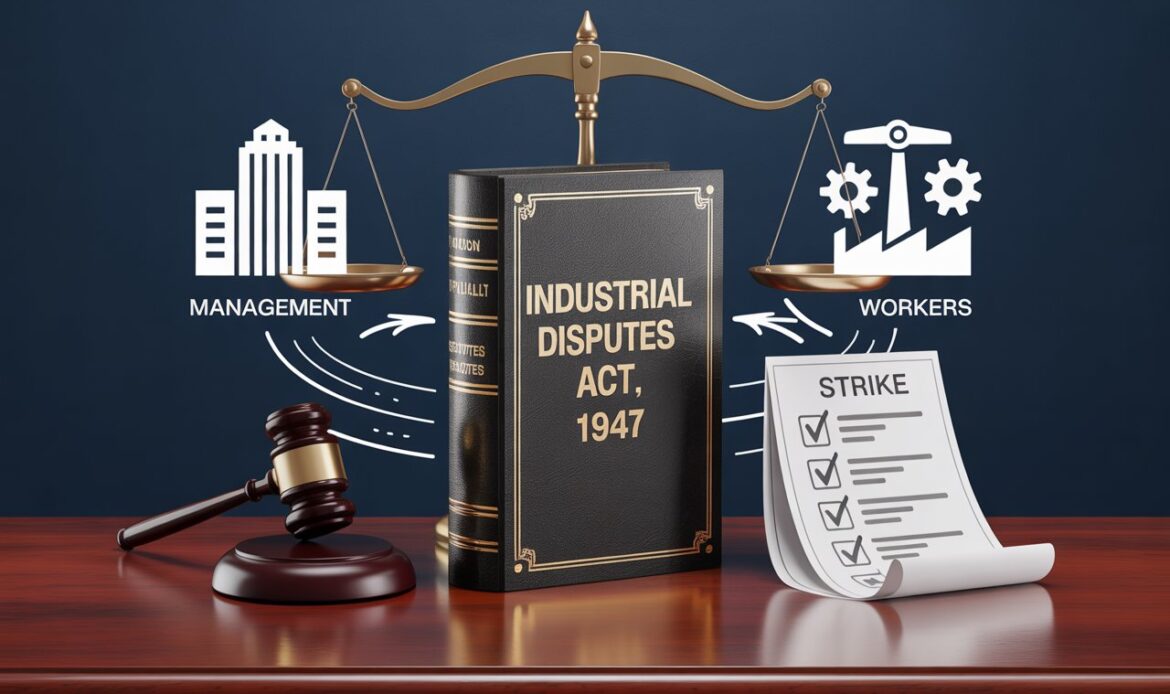
At its core, the Act balances two competing interests: the employer’s right to manage business operations and the workmen’s right to fair treatment and security of employment. It provides institutional mechanisms such as conciliation officers, labour courts, and tribunals to ensure that disputes are resolved through structured procedures rather than disruptive confrontations. Over time, it has become the foundation for interpreting concepts like retrenchment, lay-offs, and industrial closures, shaping the contours of employer- employee relationships in India.
Core Purposes of the Industrial Disputes Act, 1947
The intent of the Act can be summarised in three guiding purposes:
- Prevention of industrial unrest by establishing legal machinery for resolving disputes at an early stage.
- Protection of workmen’s rights by regulating conditions of retrenchment, lay-offs, strikes, and lockouts.
Historical Background and Objectives of the Industrial Disputes Act, 1947 (Executive Summary PDF)
The Industrial Disputes Act, 1947 executive summary PDF reflects the socio-economic realities of post- independence India. In the years leading up to 1947, the country witnessed a surge in industrial growth, but this was accompanied by frequent strikes, lockouts, and disputes over wages, working hours, and service conditions. Industrial peace was fragile, and without a proper legal framework, these disputes often escalated into prolonged unrest, damaging productivity and creating hostility between employers and workers.
The colonial government had attempted to address industrial conflicts through earlier legislations, such as the Trade Disputes Act, 1929. However, these laws were limited in scope and primarily designed to curb strikes rather than resolve underlying causes of disputes. After independence, the Indian Parliament recognised that industrial development and nation-building required a more balanced law, one that would provide structured mechanisms for negotiation, conciliation, and adjudication, while safeguarding the interests of both employers and employees.
The Industrial Disputes Act, 1947 was therefore enacted to create a comprehensive system for the investigation and settlement of disputes. Its objective was not just to regulate strikes and lockouts, but to prevent them by resolving conflicts before they reached a crisis stage. Over time, the Act has become central to India’s industrial relations system, guiding everything from retrenchment rules to compensation in layoffs and closures.
Key Objectives Highlighted in the Industrial Disputes Act 1947 Executive Summary PDF
- To ensure industrial peace and harmony by providing a legal framework for dispute resolution.
- To protect the rights of workmen in matters of wages, employment security, retrenchment, and working conditions.
- To regulate strikes and lockouts in a manner that balances workers’ rights with economic stability.
- To provide a machinery for conciliation and adjudication through labour courts, tribunals, and national tribunals.
- To support India’s post-independence economic growth by minimising disruptions in key industries.
Scope, Applicability, and Coverage in the Industrial Disputes Act, 1947 (PDF Corrida Legal)
The Industrial Disputes Act PDF Corrida Legal outlines in detail the establishments, industries, and categories of employees to which the Act applies. Since the objective of the Act is to maintain industrial peace and protect workmen’s rights, its scope is deliberately wide, ensuring that disputes in various sectors can be addressed through structured mechanisms.
The Act applies to all industries carrying on systematic activity with cooperation between employers and employees for the production or distribution of goods and services. Its coverage extends to factories, plantations, railways, transport services, mines, and numerous other sectors that are vital to India’s economic functioning. This breadth ensures that disputes in critical industries, which could have far-reaching consequences, are managed within the framework of law.
Scope Defined in the Industrial Disputes Act 1947 Executive Summary PDF
The Industrial Disputes Act 1947 executive summary PDF explains the core scope and definitions:
- Industry: Broadly defined to include any business, trade, manufacture, or service where employers and employees collaborate.
- Workman: Any person employed in an industry doing manual, skilled, technical, operational, clerical, or supervisory work for hire or reward, excluding those in managerial or administrative roles.
- Employer: Any person who has control over the affairs of the establishment and authority over the employment of workers.
Applicability Across Establishments in the Industrial Disputes Act PDF Corrida Legal
The Industrial Disputes Act PDF Corrida Legal highlights that the Act applies to:
- All industrial establishments employing workmen across India.
- Both public and private sector enterprises engaged in industrial activities.
- Large-scale industries like mining, transport, and railways, as well as medium and small enterprises.
- Certain government-controlled establishments, ensuring uniformity of dispute resolution.
Key Features in the Industrial Disputes Act 1947 Key Provisions Summary
The Industrial Disputes Act 1947 key provisions summary notes the following coverage details:
- The Act applies irrespective of the number of employees, provided an industry and employer- workman relationship exists.
- It extends to both permanent and temporary workmen, protecting them against unfair labour practices.
- Even daily wage earners and contract workers are included under its umbrella, as clarified by judicial pronouncements.
Importance of Broad Coverage in the Industrial Disputes Settlement and Conciliation PDF
The Industrial Disputes settlement and conciliation PDF explains that such wide applicability is crucial for industrial stability. By bringing a variety of establishments within its fold, the Act prevents fragmented approaches and ensures that all disputes — whether in large industries or smaller units — can be handled with consistency.
Industrial Disputes Settlement and Conciliation (PDF)
The Industrial Disputes settlement and conciliation PDF highlights one of the core strengths of the Industrial Disputes Act, 1947 — its structured mechanisms for peacefully resolving conflicts between employers and workmen. Instead of leaving disputes to escalate into strikes, lockouts, or prolonged hostility, the Act establishes step-by-step procedures for conciliation, adjudication, and voluntary negotiation. This reflects the underlying philosophy that industrial peace is best maintained through dialogue and structured intervention rather than confrontation.
Conciliation is the first and most important step under the Act. It involves neutral officers or boards who mediate between employers and employees, aiming to reach a settlement before matters worsen. If conciliation fails, the Act provides for reference of disputes to Labour Courts, Industrial Tribunals, or National Tribunals, depending on the nature and gravity of the issue. This tiered approach allows disputes to be resolved at the most appropriate level, ensuring both accessibility and authority.
Settlement Mechanisms in the Industrial Disputes Act 1947 Executive Summary PDF
The Industrial Disputes Act 1947 executive summary PDF highlights three primary settlement methods under the Act
- Conciliation Officers and Boards of Conciliation: Appointed by the government to mediate disputes and record settlements.
- Labour Courts: Handle disputes relating to dismissal, retrenchment, and service conditions.
- Industrial Tribunals and National Tribunals: Deal with larger issues like wage structures, working hours, and matters of national importance.
Preventive Role Explained in the Industrial Disputes Act PDF Corrida Legal
The Industrial Disputes Act PDF Corrida Legal explains that conciliation has a preventive role. By ensuring that disputes are mediated early, it prevents escalation into strikes or lockouts that could disrupt production. Conciliation officers are required to actively persuade both sides to compromise and to submit a detailed report to the government, which can then decide on further reference to adjudication.
Role of Arbitration in the Industrial Disputes Settlement and Conciliation PDF
Apart from conciliation and adjudication, the Industrial Disputes settlement and conciliation PDF also recognises voluntary arbitration. Employers and workmen can mutually agree to refer their disputes to an independent arbitrator, whose decision becomes binding. This provides flexibility and speed in dispute resolution, while also reducing the burden on formal tribunals.
Broader Impact in the Industrial Disputes Act 1947 Key Provisions Summary
The Industrial Disputes Act 1947 key provisions summary underlines that these mechanisms have had a significant impact on industrial relations in India. They have reduced the frequency of uncontrolled strikes, provided workers with institutional forums for justice, and given employers legal certainty in managing disputes.
Retrenchment, Lay-Off, and Closure Rules in the Industrial Disputes Act, 1947 (PDF)
The Industrial Disputes Act retrenchment and lay-off rules PDF deals with some of the most sensitive aspects of industrial relations — situations where employers are compelled to reduce their workforce or temporarily halt operations. These provisions are critical because they directly affect the livelihood of workmen while also recognising the operational and financial challenges faced by employers. The Act seeks to strike a balance by ensuring that employers can restructure when necessary, but only under fair and legally regulated conditions that safeguard employees’ rights.
Retrenchment Rules in the Industrial Disputes Act 1947 Executive Summary PDF
The Industrial Disputes Act 1947 executive summary PDF defines retrenchment as the termination of service of a workman by the employer for any reason other than disciplinary action, retirement, or superannuation. To protect employees, the Act mandates:
- Notice Requirement: Employers must give one month’s notice (or wages in lieu) before retrenchment.
- Compensation: Payment of compensation equivalent to 15 days’ average pay for every completed year of service.
- Last-In-First-Out Rule: Employers are generally required to follow the principle of retaining senior employees while retrenching juniors, unless recorded reasons justify otherwise.
Lay-Off Provisions in the Industrial Disputes Act PDF Corrida Legal
The Industrial Disputes Act PDF Corrida Legal explains lay-off as the temporary inability of an employer to provide work due to reasons such as shortage of raw materials, machinery breakdown, or natural calamities. Under the Act:
- Workmen (other than badli or casual workers) are entitled to compensation for the lay-off period, usually 50% of basic wages and dearness allowance.
- Employers must maintain records of lay-offs and report them as required.
- Continuous lay-offs may lead to further obligations such as retrenchment procedures.
Closure Rules in the Industrial Disputes Settlement and Conciliation PDF
The Industrial Disputes settlement and conciliation PDF highlights the closure provisions:
- Employers intending to close an undertaking must give at least 60 days’ notice to the appropriate government.
- In certain cases (for establishments employing 100 or more workmen), prior government approval is required before closure.
- Employees affected by closure are entitled to compensation similar to retrenchment, ensuring financial protection during loss of employment.
Protection in the Industrial Disputes Act 1947 Key Provisions Summary
The Industrial Disputes Act 1947 key provisions summary makes it clear that retrenchment, lay-off, and closure provisions are designed to prevent arbitrary termination and ensure that workmen receive fair compensation. This balance protects both industrial stability and workers’ livelihood.
Key Provisions and Definitions in the Industrial Disputes Act, 1947 (Key Provisions Summary)
The Industrial Disputes Act 1947 key provisions summary highlights the critical definitions and substantive rules that form the backbone of this legislation. These provisions clarify the scope of the law, the rights and duties of workmen and employers, and the mechanisms through which disputes are resolved. By defining terms such as “industry,” “workman,” and “employer,” the Act removes ambiguity and ensures uniform application across sectors.
The law not only addresses the settlement of disputes but also regulates strikes, lockouts, retrenchment, and closure, making it a comprehensive framework for industrial relations. It balances the need for industrial peace with the protection of workers’ rights, thereby fostering both economic progress and social justice.
Core Definitions in the Industrial Disputes Act 1947 Executive Summary PDF
The Industrial Disputes Act 1947 executive summary PDF identifies the key statutory definitions:
- Industry: Any business, trade, manufacture, or service where employers and workmen collaborate. This wide definition ensures that a broad range of establishments are covered.
- Workman: Any individual employed in an industry doing manual, skilled, technical, operational, or clerical work, excluding managerial and supervisory staff.
- Employer: A person or authority who has ultimate control over the affairs of the establishment and the power to hire or dismiss employees.
Substantive Provisions in the Industrial Disputes Act PDF Corrida Legal
The Industrial Disputes Act PDF Corrida Legal explains the major provisions of the Act:
- Settlement of disputes: Through conciliation, arbitration, and adjudication by Labour Courts, Tribunals, and National Tribunals.
- Regulation of strikes and lockouts: Prohibition of strikes and lockouts in public utility services without prior notice, and penalties for illegal actions.
- Protection of workmen: Safeguards against unfair labour practices, arbitrary retrenchment, and denial of compensation.
- Compensation rules: For retrenchment, lay-offs, and closure of undertakings.
Rights and Restrictions in the Industrial Disputes Settlement and Conciliation PDF
The Industrial Disputes settlement and conciliation PDF clarifies additional rights and restrictions:
- Workers have the right to raise disputes through recognised unions or individually.
- Employers cannot change service conditions during the pendency of disputes without permission.
- Governments have the power to refer disputes for adjudication in the interest of public order or economic stability.
Importance of Key Provisions in the Industrial Disputes Act 1947 Key Provisions Summary
The Industrial Disputes Act 1947 key provisions summary underlines the importance of these rules in ensuring predictability and fairness. By defining roles and obligations clearly, the Act creates a balance where disputes can be resolved systematically, strikes and lockouts are regulated, and both employers and employees operate within a legal framework.
Enforcement and Penalties under the Industrial Disputes Act, 1947 (Bare Act PDF)
The Industrial Disputes Act, 1947 bare act PDF does not merely prescribe rights and obligations; it also creates an enforcement framework to ensure that its provisions are implemented in practice. Without
effective enforcement, the mechanisms for conciliation, adjudication, and protection of workmen’s rights would remain theoretical. The Act therefore empowers government authorities, inspectors, and courts to monitor compliance and impose penalties where necessary.
Enforcement under the Act is proactive and preventive in nature. By appointing conciliation officers, labour commissioners, and inspectors, the government ensures that disputes are addressed promptly, records are maintained properly, and employers do not evade their statutory responsibilities. At the same time, penalties act as a deterrent against unfair labour practices, illegal strikes, and lockouts that can disrupt industrial peace.
Enforcement Mechanisms in the Industrial Disputes Act 1947 Executive Summary PDF
The Industrial Disputes Act 1947 executive summary PDF highlights the following enforcement tools:
- Inspectors and labour authorities have powers to demand records, examine wage registers, and question employers and employees.
- Conciliation officers and tribunals ensure that disputes are addressed before they escalate.
- Government intervention allows disputes to be referred for adjudication where public interest or industrial stability is at stake.
Penalties under the Industrial Disputes Act PDF Corrida Legal
The Industrial Disputes Act PDF Corrida Legal explains the penalties for violations:
- Illegal strikes or lockouts: Workmen or employers engaging in such actions may face fines and imprisonment.
- Failure to implement awards or settlements: Employers can be fined or prosecuted if they do not carry out tribunal awards.
- Unfair labour practices: Both employers and workmen can be penalised for practices such as victimisation, coercion, or refusal to bargain in good faith.
- General contraventions: Breach of the Act or rules may attract imprisonment up to six months and fines.
Compliance Perspective in the Industrial Disputes Settlement and Conciliation PDF
The Industrial Disputes settlement and conciliation PDF highlights that compliance is not only about avoiding penalties but also about maintaining a stable workforce. Employers who comply with the law are less likely to face unrest, litigation, or loss of reputation. For employees, enforcement ensures that rights to compensation, retrenchment benefits, and fair dispute resolution are safeguarded.
Importance in the Industrial Disputes Act 1947 Key Provisions Summary
The Industrial Disputes Act 1947 key provisions summary underlines that penalties and enforcement provisions are necessary to ensure that industrial relations remain balanced. They provide accountability, discourage unlawful practices, and ensure that the spirit of the Act — promoting industrial peace and protecting workmen’s rights — is not undermined.
Industrial Disputes Act, 1947 in Relation to Other Labour Laws (Bare Act PDF)
The Industrial Disputes Act, 1947 bare act PDF does not operate in isolation. It is one of the central pillars of Indian labour law but functions alongside other statutes that govern wages, working conditions, social security, and industrial relations. Understanding its relationship with these laws is important because employers and employees often fall under multiple legal frameworks simultaneously. The Act primarily deals
with dispute resolution and industrial peace, while other labour laws regulate pay, safety, welfare, and trade union rights. Together, they form an interconnected system aimed at balancing growth with social justice.
Relation with the Trade Unions Act in the Industrial Disputes Act 1947 Executive Summary PDF
The Industrial Disputes Act 1947 executive summary PDF explains that while the Trade Unions Act, 1926 provides for the registration and recognition of unions, the Industrial Disputes Act creates the legal framework for these unions to raise and settle disputes. Without the Trade Unions Act, collective bargaining would lack legitimacy, and without the Industrial Disputes Act, unions would lack structured forums to resolve conflicts.
Overlap with the Factories Act in the Industrial Disputes Act PDF Corrida Legal
The Industrial Disputes Act PDF Corrida Legal highlights that the Factories Act, 1948 focuses on health, safety, and welfare of workers, whereas the Industrial Disputes Act regulates disputes that arise in the course of employment. While the Factories Act ensures safe working environments, the Industrial Disputes Act ensures that conflicts in those workplaces are addressed legally and fairly.
Connection with the Employees’ State Insurance Act and Social Security Code in the Industrial Disputes Settlement and Conciliation PDF
The Industrial Disputes settlement and conciliation PDF shows the link with the Employees’ State Insurance Act, 1948 and the Social Security Code, 2020. While ESI and the Social Security Code focus on providing medical and financial benefits to workers, the Industrial Disputes Act ensures that disputes over such benefits or employment terms are resolved within a legal structure.
Integration with the Industrial Relations Code in the Industrial Disputes Act 1947 Key Provisions Summary
The Industrial Disputes Act 1947 key provisions summary notes that the Industrial Relations Code, 2020 consolidates and modernises many aspects of industrial law, including dispute resolution mechanisms from the Industrial Disputes Act. This shows the continuing relevance of the Act’s principles even as labour codes replace older laws. The Industrial Disputes Act remains the foundation upon which modern reforms are built.
Download Resources – Industrial Disputes Act, 1947 Bare Act and Guides
The Industrial Disputes Act, 1947 bare act PDF is the central reference for understanding the statutory provisions governing industrial peace and dispute resolution. However, professionals, employers, students, and compliance officers often require simplified versions, summaries, and practical guides to apply the law effectively. These additional resources provide clarity on definitions, settlement mechanisms, retrenchment rules, and judicial interpretations, making them invaluable tools for day-to-day use.
Industrial Disputes Act 1947 Bare Act PDF
The Industrial Disputes Act 1947 bare act PDF contains the full statutory text, including definitions, mechanisms for conciliation, retrenchment provisions, and penalties. It is the authoritative source for legal practitioners, HR managers, and employees seeking to verify statutory obligations.
Industrial Disputes Act 1947 Executive Summary PDF
The Industrial Disputes Act 1947 executive summary PDF condenses the law into an accessible format. It outlines the objectives, scope, applicability, and key provisions of the Act, serving as a quick reference for compliance officers and students.
Industrial Disputes Settlement and Conciliation PDF
The Industrial Disputes settlement and conciliation PDF focuses on the core dispute resolution mechanisms under the Act. It covers the role of conciliation officers, labour courts, and tribunals, showing how disputes can be resolved without prolonged strikes or lockouts.
Industrial Disputes Act Retrenchment and Lay-Off Rules PDF
The Industrial Disputes Act retrenchment and lay-off rules PDF explains termination procedures, notice requirements, compensation entitlements, and closure rules. Employers and HR managers use this resource to ensure compliance when restructuring operations or reducing workforce size.
Industrial Disputes Act 1947 Key Provisions Summary
The Industrial Disputes Act 1947 key provisions summary highlights the most important elements of the law, from definitions of “industry” and “workman” to rules on strikes, lockouts, and retrenchment. This summary is ideal for quick understanding without going through the full text.
Why These Resources Matter
Together, these resources ensure that the Act can be applied effectively. The bare act offers statutory precision, the executive summary simplifies complex rules, Corrida Legal provides compliance-focused interpretation, the settlement and conciliation PDF explains dispute resolution, retrenchment and lay-off rules clarify employer obligations, and the key provisions summary ensures easy referencing. This combination helps both employers and employees maintain industrial peace while safeguarding rights.
Conclusion – Importance of the Industrial Disputes Act, 1947 (Key Provisions Summary)
The Industrial Disputes Act, 1947 key provisions summary shows why this statute has remained the backbone of industrial relations in India for over seven decades. Enacted in the immediate aftermath of independence, the law was a response to rising labour unrest and the urgent need to promote industrial peace. By providing mechanisms for conciliation, adjudication, and voluntary settlement, the Act ensured that disputes could be resolved through structured processes rather than prolonged strikes or lockouts.
For employees, the Act guarantees protection against arbitrary retrenchment, ensures compensation in cases of lay-offs and closures, and provides avenues for raising grievances before impartial forums. For employers, it establishes legal certainty in managing workforce disputes, making restructuring possible within a framework of fairness. For the government, it serves as a tool to maintain economic stability and prevent industrial disruptions that could harm public interest.
Over time, judicial pronouncements have expanded the scope of the Act, interpreting “industry” and “workman” broadly and ensuring that even vulnerable categories of workers benefit from its protection. Amendments and labour reforms, including the consolidation into the Industrial Relations Code, 2020, continue to draw from the principles laid down in this Act, proving its enduring relevance.
About Us
Corrida Legal is a boutique corporate & employment law firm serving as a strategic partner to businesses by helping them navigate transactions, fundraising-investor readiness, operational contracts, workforce management, data privacy, and disputes. The firm provides specialized and end-to-end corporate & employment law solutions, thereby eliminating the need for multiple law firm engagements. We are actively working on transactional drafting & advisory, operational & employment-related contracts, POSH, HR & data privacy-related compliances and audits, India-entry strategy & incorporation, statutory and labour law-related licenses, and registrations, and we defend our clients before all Indian courts to ensure seamless operations.
We keep our client’s future-ready by ensuring compliance with the upcoming Indian Labour codes on Wages, Industrial Relations, Social Security, Occupational Safety, Health, and Working Conditions – and the Digital Personal Data Protection Act, 2023. With offices across India including Gurgaon, Mumbai and Delhi coupled with global partnerships with international law firms in Dubai, Singapore, the United Kingdom, and the USA, we are the preferred law firm for India entry and international business setups. Reach out to us on LinkedIn or contact us at contact@corridalegal.com/+91-9211410147 in case you require any legal assistance. Visit our publications page for detailed articles on contemporary legal issues and updates.
Legal Consultation
In addition to our core corporate and employment law services, Corrida Legal also offers comprehensive legal consultation to individuals, startups, and established businesses. Our consultations are designed to provide practical, solution-oriented advice on complex legal issues, whether related to contracts, compliance, workforce matters, or disputes.
Through our Legal Consultation Services, clients can book dedicated sessions with our lawyers to address their specific concerns. We provide flexible consultation options, including virtual meetings, to ensure ease of access for businesses across India and abroad. This helps our clients make informed decisions, mitigate risks, and remain compliant with ever-evolving regulatory requirements.