

India has become the go to destination for Global Capability Centres. But what really makes the difference is not the location, it is the structure you choose. The best structure for a foreign company to start a GCC in India is the one that matches your business model from day one, your hiring plans, your Intellectual Property strategy, and your comfort level with compliance and tax risk.
In most mature setups, a Wholly Owned Subsidiary set up as a Private Limited Company is the preferred legal structure for a GCC in India. It gives full control to the parent company, separates liability clearly, and supports long term growth. Some companies, however, prefer to start quickly through an Employer of Record (EOR) model or a Build Operate Transfer (BOT) arrangement, and then shift to a Wholly Owned Subsidiary (WOS) once operations are stable. Limited Liability Partnerships (LLP), Branch Offices, and Liaison Offices may work in special cases, but they often limit flexibility for a typical captive centre setup in India. This guide explains each structure in simple terms, when it works best, and the tax implications of a GCC structure in India, including Transfer Pricing and Permanent Establishment risk, so you can make a clear decision and avoid exclusive changes later.
I. Why “structure” determines the success and failure of a GCC?
For a foreign company, a GCC is not just a hiring centre. It becomes an extension of the parent company. It handles sensitive data, builds Intellectual Property (IP), and manages important business processes. That is why choosing the right entity is not just a legal formality, it affects control, risks, and future growth opportunities.
The legal structure for a GCC in India impacts four key areas that are difficult to fix later:
- Who employs the workforce and on what terms?
If you plan to hire quickly, run shifts, allow hybrid work, manage performance formally, and handle exits properly, you need a structure that supports compliant employment documents and internal systems. In third party models, employees may legally be on the payroll of a vendor or an Employer of Record (EOR). This can reduce direct control and make confidentiality and IP ownership more complex unless contracts are very strong. - Who signs contracts and bears liability?
A GCC signs office leases, vendor contracts, software subscriptions, and intercompany agreements. If contracts are signed outside India or through a restricted office type, your activities may be limited by regulation. The Reserve Bank of India (RBI) rules along with clarify that Branch Offices, Liaison Offices, and Project Offices are regulated under FEMA and do not function the same way as a fully incorporated Indian company. - Where IP and data obligations settle
If your GCC develops software, analytics models, product features, or internal tools, you must clearly define who owns the Intellectual Property (IP). Strong IP assignment clauses, confidentiality terms, and data protection systems must be built into employment and vendor contracts. If structure and contracts do not align, ownership and audit rights can become unclear, especially during audits or transitions such as a Build Operate Transfer (BOT) handover. - How tax and transfer pricing (TP) risks show up?
Most GCCs work under intercompany service arrangements. Indian income tax law requires proper Transfer Pricing documentation for such transactions. This means Transfer Pricing compliance should be integrated into the design of the structure from the beginning, not fixed later.
Permanent Establishment (PE) risk is also based on facts and actual business conduct. The way contracts are signed and functions are performed can create taxable presence in India if not planned meticulously. The Organisation for Economic Co-operation and Development (OECD) Base Erosion and Profit Shifting (BEPS) Action 7 framework explains how the PE definitions are constricted to deal with structures and compositions that can trigger tax obligations despite attempts to side-step it.
II. The Four Common Ways a Foreign Company Can Set up in India
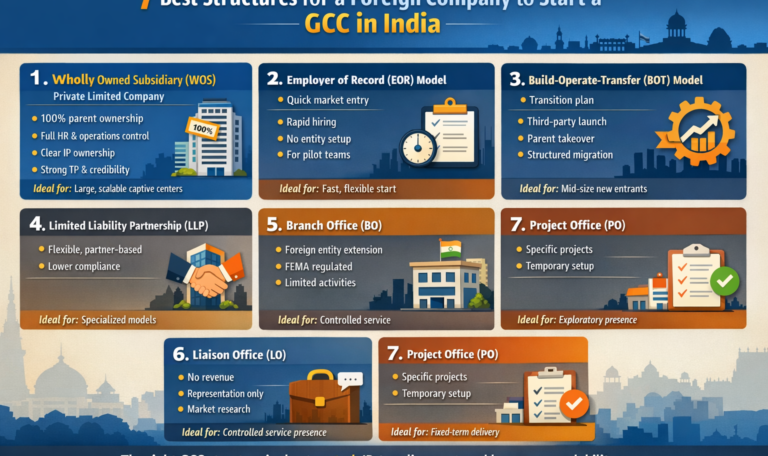
When a foreign company is planning to start a GCC (Global Capability Centre) in India, the structure decision is not just paperwork, it directly impacts control, compliance, scalability, and long-term flexibility.
Typically, the options narrow down to four practical routes:
- Incorporate an Indian company (most commonly a Wholly Owned Subsidiary – WOS – as a Private Limited Company);
- Set up a Limited Liability Partnership (LLP);
- Open a foreign office structure: Branch Office (BO), Liaison Office (LO), or Project Office (PO);
- Use a third-party model (EOR, BOT, or managed services) with a future migration plan.
These are not interchangeable options. Each one operates under a different legal and regulatory framework in India. Foreign office structures like BO/LO/PO are governed under the Foreign Exchange Management Act, 1999 and regulated by the RBI framework, which defines what activities are permitted and what compliance is required.
In contrast, a Private Limited Company is incorporated under the Companies Act, 2013, which provides a detailed governance and compliance structure. While, an LLP is governed separately under the Limited Liability Partnership Act, 2008 (LLPA), with its own incorporation process and partner-based governance model. Read our another article on How to Set Up a Global Capability Centre (GCC) in India in 2026?
III. Wholly Owned Subsidiary (WOS) – Private Limited Company
For most long-term GCC setups, incorporating a Wholly Owned Subsidiary (WOS) as a Private Limited Company is usually the strongest and most future-ready structure.
When it’s usually the best fit?
A WOS typically works best when the company expects:
- Scale – hiring 100+ employees and growing further.
- Control – full authority over HR, compliance, security, procurement, and culture.
- IP creation – engineering, product development, analytics, automation, R&D work.
- Local contracting – signing leases, vendor agreements, IT contracts, and facility arrangements directly in India.
- Structured governance – strong audit systems and internal controls aligned with global standards.
Why it works well for GCCs?
- It offers a clear and stable corporate framework, making governance predictable.
- It supports a clean intercompany service model, which is important for transfer pricing (TP) compliance and documentation.
- It builds credibility with banks, landlords, vendors, insurers, and regulators — especially when scaling operations.
What companies often underestimate?
Compliance is an ongoing, not a one-time activity. Board meetings, statutory filings, audits, and a proper compliance calendar need to be integrated into operations. Transfer pricing discipline must start early. Indian regulations expect proper documentation and reporting from the beginning. Permanent Establishment (PE) risk does not automatically disappear. The analysis depends on actual functions performed and contractual arrangements, not just the legal structure. A WOS works best when companies treat it as a full legal and operational system, incorporating intercompany agreements, employment documentation, IP and data structures, procurement processes, and compliance planning from day one, rather than handling each piece separately.
IV. Limited Liability Partnership (LLP)
An LLP is a separate legal entity governed by the LLP Act framework. It offers flexibility in internal structuring and governance, but it is less commonly used for large, traditional captive GCC models.
When an LLP can make sense?
- Smaller or specialised teams with a limited-service scope;
- Operating models that prefer partner-style governance;
- Situations where the parent company’s global framework aligns better with the LLP mechanism.
Practical limitations for a typical GCC
- Many global headquarters are more familiar and comfortable with corporate (company) structures rather than LLP governance;
- Scaling and funding may be operationally smoother under a company model;
- Banks, landlords, and large enterprise vendors often prefer dealing with a company entity in large-scale setups;
- An LLP can be the right choice in specific situations, especially for smaller or niche setups. But for larger, long-term GCCs, a Private Limited Company (WOS) is usually the default and the more scalable structure.
V. Branch Office (BO)/ Liaison Office (LO)/ Project Office (PO)
These structures are usually forms of “foreign entities” and not India- based entities. The RBI rules and legal framework specify that establishment of Branch, Liaison or Project Offices in India id regulated under the FEMA framework and respective notifications.
How do these structures differ practically?
- Branch Office (BO): Allows the conduct of permitted activities but within regulatory framework.
- Liaison Office (LO): Usually used for representation or liaison activities but usually not for revenue generation.
- Project Office (PO): Generally limited to specific project and not for an ongoing captive delivery centre.
Why these structures can undermine a GCC?
Often GCCs include consistent service execution, vendor ecosystems, scaling hiring systems, and compound contracting. In case the permitted activity scope does not align with the practicalities, the structure can become a block and trigger reorganization pressure.
BO/PO/LO can be legal foreign company registration options in India for specific purposes but these structures require meticulous representation of intended scope of activities and regulations, from day one.
VI. Third-Party Launch (EOR/BOT/ Administered Services) with a Resettlement Plan
This is usually termed as the “hustle” path. Several foreign companies prefer this path for quick hiring, pilots, or short-term periods, and then convert to a WOS on the steadiness of the model.
Where does it fit?
- You want to complete hiring within weeks and not months;
- You just want a pilot team to substantiate delivery and governance;
- You want to concede incorporation until the headcount and scope are proven.
The Behind the Scenes (BTS) Legal Activities (Where risks converge)
Third-party prototypes are not automatically less threats. They move risks from corporate law to contracts and controls. The legal framework should primarily address:
- IP Ownership and Assignment (if engineering/product work is concerned);
- Confidentiality and Trade Secrets Control;
- Data Protection, Security Standards and Audit Rights;
- Background verification, Training and Enforcement of Policies;
- Non-solicit and non-poach configurations;
- Exit and Transition Procedure.
Third-party launch can be a smart channel, only if you consider the contract set as a temporary structure, until the WOS is incorporated or required.
VII. FREQUENTLY ASKED QUESTIONS (FAQs)
What are the tax obligations with respect to GCC in India?
The structure of a GCC in India generally defines how inter-corporate services are valued, documented, and safeguarded. Most of these GCCs, run on related party transactions, so compliances with respect to transfer pricing, benchmarking, and clear evidence channels become very important. This also tends to impact invoicing flows, audit preparedness, etc. Structures such as BO/LO/PO, these can further add scrutiny if the scope of business activities is not in consonance with the permitted activities. It is advisable that you align your taxation, legal, and finance components early on so that your contracts, invoices, and operational realities stay in sync.
Which structure shall correspond to which operating model for a GCC?
For long-term captive GCC, who aim at scalability, swift hiring, vendor contracting and IP rights, WOS (Private Limited Company) is usually the best option. Further, for pilots or swift entry structures, EOR or BOT work preferably best. These structures shall be in addition to a well-defined migration plan to a captive entity in the future. Furthermore, LLP structures usually suit niche or narrow scope delivery models where partner-style governance is acceptable. BO/LO/PO type of structures are suited for restricted or project-based mandates, but the permitted activities and compliances should be in sync.
Ideally, what components should a GCC-ready legal package include?
A GCC-ready package should include the following components:
(1) Entity, incorporation, governance, and signatory controls; (2) Inter corporate agreements, including the scope of activities, pricing, audit, and dispute redressal mechanisms; (3) Employment contract packages with confidentiality, IP assignment, and other clauses. (4) Data and Security contracts including audit rights, breach redressal, cross-border clauses; and (5) Vendor and facility agreements, including robust risk allocation, liability restrictions, and exit or other transition clauses. The primary objective is to integrate a consolidated operating system, not just individual documents.
How does the GCC structure affect permanent establishment risks?
Permanent Establishment (PE) risks depend on the core substance. It includes: What is the scope of activities of the Indian team? Who shall have the key decision-making power and who can negotiate or finalize contracts?
Even within a captive setup, the permanent establishment risks can rise if the Indian team often acts like a revenue-facing branch of the foreign enterprise or exercises real-time contracting authority for it. One can reduce the risks by pre-defining functions, powers, and aligning the contracting authority to the policies. Most importantly, ensuring inter-corporate agreements are in consonance with the daily operations.
In case we begin with the launch of a EOR or BOT, how do we smoothly transition to a captive GCC in the future?
Begin with a migration blueprint from day one. Ensure your contracts include IP ownership, confidentiality, data controls, and non-solicit terms, and a well-defined transition mechanism. This framework shall include the transition of employees and the support, transfer of knowledge, access to tools, timelines, and well-defined handover obligations. For instance, you may begin with a hierarchy-based plan i.e. pilot to equilibrium, entity incorporation, and level-based transfers. If this is executed strategically, the transition shall be legally valid without having the need to restructure under the pressure once the team has been scaled.
Conclusion
The Best structure for a Foreign Company to start a GCC in India is essentially a strategic choice, not a mere corporate requirement. The appropriate entity must implement your corporate group’s policies in India, including decision making power, contracting specialist, hiring regulators, IP ownership, data governance, and the intercorporate service limitations. Once these policies are outlined at the beginning, the legal structure becomes secure, scalable, and immune from future restructuring.
In the longer run, highly-controlled captive centres, a WOS as a Private Limited Company is usually preferred under India’s regulatory framework. When hiring efficiency is paramount, EOR or BOT models are usually preferred but only in addition to a secure contract pack that safeguards IP, confidentiality and audit rights, and transition channels.
Corrida Legal extends end-to-end support to GCCs, including selection of entity, governance, and delegation matrices formats, intercorporate provisions and agreements, Transfer Pricing ready documentation, employment and IP assignment sets, vendor contracting, and BO/LO/PO compliances wherever required.
About Us
Corrida Legal is a boutique corporate & employment law firm serving as a strategic partner to businesses by helping them navigate transactions, fundraising-investor readiness, operational contracts, workforce management, data privacy, and disputes. The firm provides specialized and end-to-end corporate & employment law solutions, thereby eliminating the need for multiple law firm engagements. We are actively working on transactional drafting & advisory, operational & employment-related contracts, POSH, HR & data privacy-related compliances and audits, India-entry strategy & incorporation, statutory and labour law-related licenses, and registrations, and we defend our clients before all Indian courts to ensure seamless operations.
We keep our client’s future-ready by ensuring compliance with the upcoming Indian Labour codes on Wages, Industrial Relations, Social Security, Occupational Safety, Health, and Working Conditions – and the Digital Personal Data Protection Act, 2023. With offices across India including Gurgaon, Mumbai and Delhi coupled with global partnerships with international law firms in Dubai, Singapore, the United Kingdom, and the USA, we are the preferred law firm for India entry and international business setups. Reach out to us on LinkedIn or contact us at contact@corridalegal.com/+91-9211410147 in case you require any legal assistance. Visit our publications page for detailed articles on contemporary legal issues and updates.
Legal Consultation
In addition to our core corporate and employment law services, Corrida Legal also offers comprehensive legal consultation to individuals, startups, and established businesses. Our consultations are designed to provide practical, solution-oriented advice on complex legal issues, whether related to contracts, compliance, workforce matters, or disputes.
Through our Legal Consultation Services, clients can book dedicated sessions with our lawyers to address their specific concerns. We provide flexible consultation options, including virtual meetings, to ensure ease of access for businesses across India and abroad. This helps our clients make informed decisions, mitigate risks, and remain compliant with ever-evolving regulatory requirements.