

Reviewed and Validated by: Jefrin Johny, Advocate
Introduction to the Banking Regulation Act, 1949
The Banking Regulation Act, 1949 is one of the most significant financial laws in India’s legislative framework. Enacted soon after independence, it laid the foundation for regulating and supervising the country’s banking sector a crucial step toward ensuring public confidence, financial stability, and economic growth. Before this law came into force, banks in India functioned largely under company laws, with limited oversight. This often led to frequent bank failures, mismanagement, and loss of depositor funds.
The Banking Regulation Act 1949 Bare Act PDF marks a turning point in India’s economic governance. It created a uniform legal structure that empowered the Reserve Bank of India (RBI) to regulate, monitor, and guide all banking institutions, ensuring that banking activities were carried out safely, transparently, and in the interest of the public.
Background and Legislative Context
In the early decades of the twentieth century, India’s banking system was fragmented and largely unregulated. Many small, family-owned banks operated without proper capital reserves or auditing mechanisms. Bank failures were common, and depositors often lost their savings without legal recourse.
Recognising the urgent need for regulation, the Reserve Bank of India Act, 1934 was passed to establish the RBI as the country’s central bank. However, it was the Banking Regulation Act, 1949 that gave the RBI direct powers to regulate and supervise commercial banks, thereby transforming India’s financial landscape.
The Banking Regulation Act 1949 Executive Summary highlights that this law introduced strict licensing norms, operational guidelines, and prudential safeguards. It also provided mechanisms for protecting depositors’ interests and maintaining the overall health of the financial system.
Purpose and Objectives
The Act was enacted with the following primary objectives:
- To ensure the soundness and stability of the Indian banking system.
- To safeguard depositors’ interests by enforcing prudential regulations.
- To regulate the management and operation of banking companies.
- To empower the Reserve Bank of India with supervisory and corrective authority.
- To prevent malpractices and insolvency through uniform compliance requirements.
By institutionalising these objectives, the Act became the backbone of India’s banking structure, setting standards for financial governance and accountability.
Importance in India’s Financial Framework
The Banking Regulation Act 1949 Bare Act PDF plays a crucial role in India’s economic stability. It ensures that banks operate within a disciplined and transparent environment, thereby sustaining public trust in financial institutions. For regulators, it provides the legal foundation to monitor and intervene when required. For businesses and depositors, it offers assurance that their financial interests are protected under law.
The Act’s significance extends beyond traditional banking — it also forms the basis for regulating cooperative banks, private institutions, and emerging financial entities that contribute to India’s growing economy.
Relevance for Modern Banking
Even decades after its enactment, the principles of this Act continue to guide modern banking. With the growth of digital banking, fintech innovation, and global integration, its provisions remain relevant and adaptable. Amendments over the years have ensured that it stays aligned with the evolving needs of the economy.
The Banking Regulation Act 1949 Executive Summary Corrida Legal illustrates how the Act has evolved from a post-independence reform into a dynamic framework for 21st-century financial regulation — ensuring that India’s banking system remains resilient, responsible, and inclusive.
Key Points to Remember
- The Act empowers the Reserve Bank of India to regulate and supervise banks across India.
- It aims to protect depositors and ensure fair banking practices.
- Licensing, management, and operational compliance are governed under its provisions.
- It serves as the foundation of India’s financial stability and regulatory structure.
- Its adaptability has allowed it to remain relevant in the digital and globalised economy.
In essence, the Banking Regulation Act, 1949 symbolises the evolution of Indian banking from fragmented beginnings to a robust, regulated, and accountable financial system. It stands as a testament to the principle that a strong economy begins with a strong and well-governed banking sector.
Objectives and Purpose of the Banking Regulation Act, 1949
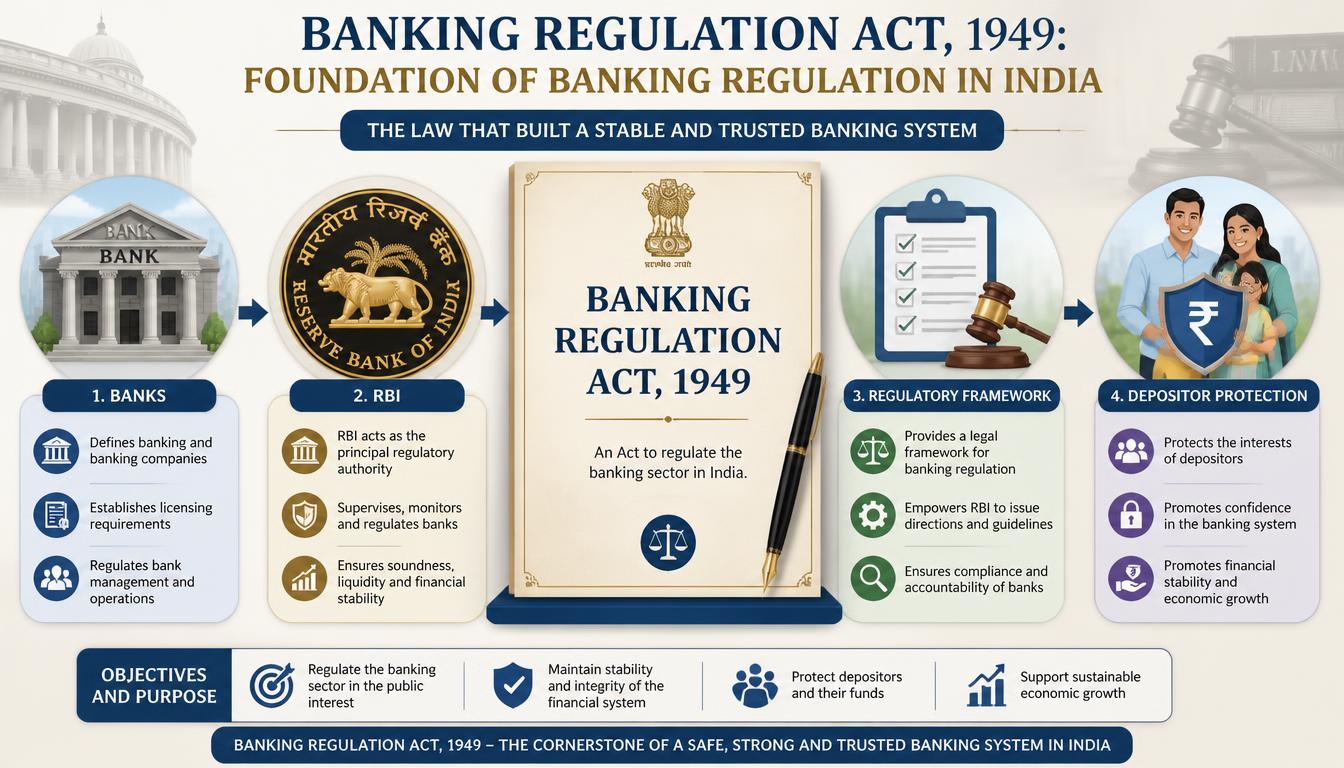
The Banking Regulation Act, 1949 was enacted with a clear purpose — to establish a safe, reliable, and transparent banking system in India. It provides the legal foundation for how banks operate, how they are managed, and how they are supervised by the Reserve Bank of India (RBI). The Act was designed not only to regulate the functioning of banks but also to protect depositors and ensure that banking remains a channel for national economic growth rather than financial instability.
The Banking Regulation Act 1949 PDF Corrida Legal explains that the Act transformed banking in India from an unregulated commercial activity into a structured financial system governed by prudence, discipline, and public accountability. It introduced a comprehensive framework that allowed the RBI to oversee banks’ internal operations, ensure solvency, and intervene when necessary to prevent crises.
Primary Objectives of the Act
The Act serves multiple objectives that together form the foundation of India’s banking discipline:
- To ensure financial stability: By regulating capital adequacy, cash reserves, and lending practices, the Act ensures that banks maintain liquidity and solvency at all times.
- To safeguard depositor interests: It requires banks to follow strict standards for transparency, disclosures, and operational safety so that public deposits remain secure under all circumstances.
- To empower the Reserve Bank of India: The Act gives the RBI the authority to issue directions, inspect banks, cancel licenses, and even replace management in case of misconduct or mismanagement.
- To promote fair competition and efficiency: It encourages healthy banking practices by standardising regulations, preventing monopolistic tendencies, and ensuring fair treatment of borrowers and depositors alike.
- To regulate mergers, reconstruction, and liquidation: The Act provides the RBI with powers to approve amalgamations and manage liquidation processes to protect creditors and depositors.
- To prevent misuse of banking resources: It imposes restrictions on loans to directors, self-dealing, and speculative investments, ensuring that funds are used responsibly.
Through these objectives, the Act ensures that banking remains a tool of trust, growth, and stability rather than speculation and risk.
Scope of the Banking Regulation Act, 1949
The Act extends to the entire territory of India and applies to all banking companies, including nationalised banks, private sector banks, cooperative banks, and even foreign banks operating within Indian jurisdiction.
The Banking Law in India Bare Act PDF Download clarifies that the Act covers every critical aspect of banking — from licensing and management to inspection, amalgamation, and liquidation. It applies to any entity engaged in accepting deposits for the purpose of lending or investment, thereby bringing both traditional and modern financial institutions under a single regulatory umbrella.
Broader Socio-Economic Purpose
When enacted, the Act was not just an economic measure but a social one. Banking had to be transformed into an instrument of public confidence and national development. By regulating operations and setting ethical standards, the Act created a foundation for:
- Channelising savings into productive sectors.
- Preventing bank failures and protecting small depositors.
- Supporting industrial and agricultural growth through stable credit supply.
- Encouraging professionalism and governance in financial management.
This broader vision turned banking into a trusted public service rather than a purely profit-driven enterprise.
Relevance in the Modern Economy
In the contemporary era of digital and global banking, the Act remains deeply relevant. Amendments have expanded its scope to include cooperative banks, digital banks, and payment systems. With the rise of fintech innovation, it serves as a guiding framework to maintain regulatory control without stifling technological progress.
The Banking Regulation Act Key Provisions and Summary notes that the Act’s enduring success lies in its adaptability — balancing innovation with accountability, and progress with protection.
Key Points to Remember
- The Act aims to maintain financial stability and depositor protection.
- It empowers the Reserve Bank of India to regulate and inspect all banks.
- It covers all banking companies, both Indian and foreign.
- It prevents misuse of banking funds and ensures ethical governance.
In essence, the Banking Regulation Act, 1949 was not only meant to control banking operations but to instill a sense of responsibility and integrity across the financial system. It set the foundation for a resilient banking framework that continues to support India’s economic growth while protecting those who trust the system the most, the depositors.
Key Definitions under the Banking Regulation Act, 1949
The Banking Regulation Act, 1949 begins with a series of important definitions that form the foundation for interpreting and applying its provisions. These definitions clarify the meaning of terms such as “banking,” “banking company,” “secured loan,” and “Reserve Bank,” ensuring uniform understanding and consistent implementation across the financial system.
The Banking Regulation Act 1949 Bare Act PDF explains that these definitions are not merely technical; they establish the very scope of the law by determining who is regulated, what constitutes banking activity, and how the Reserve Bank of India exercises its powers. Without these definitions, enforcing the Act would be both confusing and inconsistent.
Definition of Banking
Section 5(b) of the Act defines “banking” as accepting, for the purpose of lending or investment, deposits of money from the public, repayable on demand or otherwise, and withdrawable by cheque, draft, or order.
This definition is significant because it distinguishes banks from other financial intermediaries such as investment firms or credit societies. It establishes three essential elements of banking:
- Acceptance of public deposits.
- Use of deposits for lending or investment.
- Repayment and withdrawal facilities through recognised instruments.
Through this definition, the law sets clear boundaries for what activities require a banking license under the supervision of the Reserve Bank of India.
Definition of Banking Company
Under Section 5(c), a “banking company” means any company that transacts the business of banking in India. This includes both Indian and foreign companies operating within the country.
The Banking Regulation Act 1949 PDF Corrida Legal points out that this definition ensures that any entity dealing in deposit-taking and lending comes under the direct regulatory control of the Reserve Bank of India, thereby maintaining the safety and integrity of the financial system.
Definition of Company
Section 5(d) defines “company” in line with the Companies Act, 1956, meaning any company incorporated under Indian law or a foreign company conducting business in India. This is important because only companies registered under these laws are allowed to operate as banking institutions.
This distinction excludes unincorporated bodies or informal entities, ensuring that all banks remain legally accountable and transparent in their operations.
Definition of Reserve Bank
The term “Reserve Bank” refers to the Reserve Bank of India established under the Reserve Bank of India Act, 1934. The RBI serves as the central authority responsible for implementing and enforcing the provisions of the Act.
The Banking Law in India Bare Act PDF Download highlights that the RBI’s definition within the Act gives it full supervisory and disciplinary powers over all banking companies, ensuring consistency in regulation and compliance nationwide.
Other Important Definitions
Several additional terms play a key role in the Act’s operation:
- Secured loan or advance: A loan backed by tangible security such as property or assets.
- Approved securities: Investments or instruments that banks may hold as part of their statutory liquidity requirements.
- Deposit: Money placed with a bank that may be repayable on demand or after a fixed period.
- Scheduled bank: A bank listed in the Second Schedule of the RBI Act, 1934, and eligible for certain privileges and facilities.
These terms help distinguish between different types of transactions and obligations within the banking structure.
Importance of the Definitions
The Banking Regulation Act Key Provisions and Summary notes that precise definitions are the backbone of financial law. They:
- Prevent ambiguity in regulation.
- Help determine which institutions fall under RBI supervision.
- Clarify the scope of permissible banking operations.
- Provide legal certainty to banks, regulators, and customers alike.
Key Points to Remember
- “Banking” involves accepting deposits for lending or investment with withdrawal rights.
- A “banking company” is any entity engaged in banking business within India.
- The Reserve Bank of India acts as the central supervisory authority.
- Only registered companies can operate as banks under this Act.
- The definitions provide clarity, transparency, and accountability in regulation.
By clearly defining what constitutes banking and who can conduct it, the Banking Regulation Act, 1949 establishes a structured, lawful, and secure foundation for India’s financial ecosystem. These definitions continue to guide regulatory practices even in modern banking, ensuring that the core essence of banking — trust, transparency, and safety — remains protected under law.
Licensing and Regulation of Banks
Licensing is the cornerstone of India’s banking regulation framework. The Banking Regulation Act, 1949 mandates that no company can operate as a bank without obtaining a license from the Reserve Bank of India (RBI). This requirement ensures that only financially sound, well-managed, and credible institutions are allowed to accept public deposits and engage in lending activities. The licensing mechanism thus acts as the first line of defence in maintaining the integrity and safety of the banking system.
The Banking Regulation Act 1949 PDF Corrida Legal explains that the licensing provisions give the RBI complete authority to evaluate the structure, capital, and governance of any proposed banking company before it begins operations. It also empowers the RBI to cancel or suspend licenses if a bank fails to meet the prescribed standards.
Requirement of a Banking License
Under Section 22 of the Act, no company can carry on the business of banking in India without a license issued by the Reserve Bank of India. This applies to:
- All new banking companies established in India.
- Existing banking companies seeking continuation of business.
- Foreign banks operating within Indian jurisdiction.
This licensing process ensures that only responsible and well-capitalised institutions are allowed to handle public funds, thereby protecting the financial system from instability or fraud.
Conditions for Granting a License
Before granting a license, the RBI examines several factors to determine whether the applicant is fit to operate as a bank. The main conditions include:
- The company must have adequate paid-up capital and reserves.
- Its management must be competent and experienced in banking.
- The company’s affairs must not be detrimental to depositors’ interests.
- It must have sound accounting and internal control systems.
- The proposed business must serve public and economic interest.
The Banking Regulation Act 1949 Bare Act PDF notes that the RBI’s discretion is guided by public policy and financial prudence. Even if an applicant meets technical qualifications, the license may be refused if its operations could harm depositors or financial stability.
Power to Cancel or Suspend Licenses
Once granted, a license is not permanent. The RBI retains the power to cancel or suspend a license if:
- The bank ceases to carry on business in India.
- The bank fails to maintain adequate capital or reserves.
- The bank violates the Act’s provisions or RBI directions.
- The bank conducts its affairs in a manner harmful to depositors.
Before cancellation, the bank is given an opportunity to explain its position. This ensures fairness and transparency in regulatory enforcement.
Licensing of Foreign Banks
Foreign banks wishing to operate in India must obtain a license under the same section. They must also comply with additional requirements such as:
- Maintaining a prescribed amount of deposits with the RBI.
- Adhering to India’s foreign exchange and financial laws.
- Ensuring reciprocal treatment for Indian banks in their home country.
This provision allows India to regulate international banking operations effectively while maintaining parity with global practices.
RBI’s Supervisory Powers after Licensing
Obtaining a license is only the beginning. Once a bank is licensed, the RBI continues to monitor its performance through:
- Periodic inspections and audits.
- Directives on interest rates, asset classification, and capital adequacy.
- Approvals for branch expansion or closure.
- Review of management and governance structures.
The Banking Law in India Bare Act PDF Download states that licensing is not a one-time compliance requirement but part of an ongoing regulatory relationship between the bank and the RBI.
Regulation of Branch Operations
Under Section 23, banks cannot open or close any branch without prior RBI approval. The RBI evaluates factors such as public need, business potential, and financial inclusion objectives before approving new branches.
This system ensures that banking services are distributed equitably across urban, semi-urban, and rural areas, supporting India’s broader financial inclusion goals.
Importance of Licensing in Banking Discipline
The Banking Regulation Act Key Provisions and Summary points out that the licensing framework acts as a safeguard for depositors and the economy by:
- Preventing unqualified entities from engaging in banking.
- Ensuring capital adequacy and professional management.
- Allowing continuous regulatory supervision.
- Maintaining depositor trust through strict compliance.
Key Points to Remember
- No company can carry on banking business without an RBI license.
- RBI evaluates financial strength, management, and public interest before approval.
- Licenses can be suspended or cancelled for non-compliance.
- Foreign banks must also obtain licenses under the same framework.
- Licensing ensures safety, transparency, and depositor protection.
The Banking Regulation Act, 1949 establishes licensing as the foundation of responsible banking. It ensures that every bank operating in India does so under the vigilant oversight of the Reserve Bank of India — turning banking into a profession of trust, discipline, and accountability.
Management and Control of Banking Companies
The management and control provisions of the Banking Regulation Act, 1949 form the ethical and operational backbone of India’s banking system. These provisions ensure that banks are managed by competent professionals who uphold integrity, transparency, and accountability. By regulating how directors are appointed, how decisions are made, and how conflicts of interest are avoided, the Act seeks to prevent misuse of depositor funds and maintain public confidence in financial institutions.
The Banking Regulation Act 1949 Executive Summary Corrida Legal highlights that management control is not merely about administration but about responsible governance. The Act entrusts the Reserve Bank of India (RBI) with the power to oversee the appointment, conduct, and qualifications of directors and key officials to ensure that every bank functions in a manner consistent with public interest and national economic policy.
Qualifications and Responsibilities of Directors
Under Sections 10A and 10B, the Act specifies the eligibility criteria for directors and senior executives in banking companies. The aim is to ensure that only individuals with adequate knowledge, integrity, and experience in finance, law, or economics are entrusted with managing banking operations.
Key provisions include:
- A majority of directors must have special knowledge or experience in accountancy, agriculture, banking, economics, finance, or law.
- No director may hold positions in competing businesses that could create a conflict of interest.
- Directors must act honestly and independently, safeguarding the interests of depositors and shareholders.
- The chief executive officer (CEO) or managing director must be approved by the RBI.
The Banking Regulation Act Key Provisions and Summary explains that these measures ensure professional leadership and reduce the risk of mismanagement or political interference in banking decisions.
Restrictions on Shareholding and Voting Rights
The Act restricts individual or corporate shareholding in banks to prevent concentration of control. This ensures that no single shareholder or group can dominate a bank’s management for personal or non-financial purposes.
Under Section 12(2), no shareholder can exercise voting rights exceeding a specified limit (currently capped at 26% for most banks). This promotes collective decision-making and balanced governance.
RBI’s Power to Remove or Appoint Directors
To ensure sound management, the RBI has the authority to remove directors or other officials who act in a manner detrimental to depositors or violate the law. The RBI may also appoint additional directors to safeguard a bank’s interests during crises or reconstruction.
These powers allow the central bank to intervene proactively before mismanagement leads to insolvency or systemic risk. The Banking Regulation Act 1949 PDF Corrida Legal points out that such oversight powers are essential for maintaining discipline and public trust in the financial sector.
Restrictions on Employment and Remuneration
The Act limits the number of top executives and regulates their remuneration to prevent excessive salaries or unjustified bonuses. No managing director or chairman may be appointed or reappointed without the RBI’s prior approval.
This provision ensures that senior leadership aligns with the broader regulatory and ethical framework governing India’s banking institutions.
Prevention of Conflict of Interest
To maintain fairness and transparency, directors and officers of banks are prohibited from engaging in self-dealing or granting loans to themselves or related entities. Section 20 of the Act restricts banks from giving loans or advances to:
- Any director or firm where a director is interested.
- Companies where directors hold significant ownership.
- Entities that could lead to personal benefit or undue influence.
This prohibition ensures that depositor money is used for legitimate banking business, not personal gain.
Control Over Managerial Conduct
The Reserve Bank of India continuously monitors managerial performance to ensure compliance with regulatory standards. It may:
- Call for periodic returns and reports on management decisions.
- Direct changes in the board structure or corporate governance practices.
- Restrict directors from holding conflicting directorships.
- Instruct banks to frame internal codes of conduct.
The Banking Law in India Bare Act PDF Download explains that the RBI’s authority extends beyond policy supervision — it includes moral and ethical oversight to preserve public confidence.
Role of the Board and Accountability
The board of directors plays a central role in shaping banking policies, ensuring risk management, and maintaining internal controls. The Act expects the board to:
- Formulate policies in line with RBI regulations.
- Oversee financial statements and audit compliance.
- Ensure transparent decision-making in lending and investments.
- Maintain an effective internal audit mechanism.
The board, collectively and individually, remains accountable to the RBI and the public for maintaining the safety and integrity of the institution.
Key Points to Remember
- Only qualified professionals can serve as directors or senior executives.
- RBI approval is required for appointments, reappointments, and removals.
- Shareholding and voting rights are restricted to prevent control concentration.
- Conflicts of interest and self-lending by directors are prohibited.
- RBI may intervene to protect depositors and restore sound governance.
The Banking Regulation Act, 1949 thus transforms bank management from a profit-centric model to a responsibility-driven framework. It ensures that those at the helm of financial institutions act with prudence, ethics, and accountability — reinforcing the idea that banking is not just a business, but a public trust.
Regulation of Banking Operations and Accounts
The operational and accounting provisions of the Banking Regulation Act, 1949 are among its most practical and vital elements. They ensure that banks conduct their daily business in a safe, transparent, and disciplined manner while maintaining adequate reserves and capital to meet obligations. These regulations cover every essential function of banking — from accepting deposits and lending money to maintaining balance sheets, managing liquidity, and reporting to the Reserve Bank of India (RBI).
The Banking Regulation Act 1949 Bare Act PDF makes it clear that banks, as custodians of public funds, must function within a strict framework of responsibility. Every rupee received or lent must be accounted for and used in compliance with statutory and prudential norms laid down by the RBI.
Regulation of Capital and Reserves
To safeguard the financial health of banks, the Act requires every banking company to maintain minimum paid-up capital and reserves. This ensures that a bank always has sufficient backing to meet its liabilities and absorb potential losses.
Key provisions include:
- Each bank must maintain cash reserves and liquid assets as directed by the RBI.
- The Statutory Liquidity Ratio (SLR) and Cash Reserve Ratio (CRR) requirements ensure liquidity and prevent over-lending.
- Banks must transfer a fixed percentage of their annual profits to a reserve fund before declaring dividends.
The Banking Regulation Act Key Provisions and Summary explains that these measures help maintain financial stability and build depositor confidence, even during times of economic stress.
Restrictions on Loans and Advances
One of the Act’s most critical functions is to regulate how banks lend money. To prevent reckless or biased lending,
the Act imposes specific restrictions on loans, advances, and investments:
- Banks cannot lend beyond a prescribed percentage of their paid-up capital and reserves.
- Loans cannot be granted to directors, their relatives, or companies in which they hold an interest.
- Certain speculative or high-risk investments are prohibited.
- Advances must be made against approved securities or adequate collateral.
These provisions protect banks from overexposure to risk and ensure that lending serves genuine commercial and developmental purposes.
Control Over Dividend Declaration
A bank can declare dividends only after meeting all its statutory obligations, such as maintaining adequate reserves and provisioning for doubtful debts. This ensures that profits are distributed only when the bank’s financial position is stable and sound.
The Banking Regulation Act 1949 PDF Corrida Legal highlights that this provision encourages prudent financial management, preventing banks from overstating profits or distributing unearned income.
Regulation of Accounts and Balance Sheets
Every banking company must prepare a balance sheet and profit and loss account in the prescribed format at the end of each financial year. These documents must:
- Accurately reflect the bank’s financial position.
- Include all liabilities, deposits, and reserves.
- Be audited by a qualified auditor approved by the RBI.
Auditors are required to report directly to the RBI in case of any irregularities. This direct reporting mechanism
ensures accountability and prevents concealment of facts.
Submission of Returns and Statements
Banks are required to submit periodic returns and statements to the RBI, including:
- Weekly statements of assets and liabilities.
- Quarterly reports on liquidity, reserves, and lending patterns.
- Annual audited financial statements.
The Banking Law in India Bare Act PDF Download explains that such transparency allows the RBI to monitor the entire banking system in real-time, identify risks early, and intervene when necessary.
Inspection and Supervision by the RBI
The Act authorises the Reserve Bank of India to inspect the books, accounts, and operations of any banking company. These inspections are conducted regularly to assess financial health and compliance. If irregularities are found, the RBI may issue corrective directions or impose penalties.
This supervisory power enables the central bank to maintain uniform standards and protect public interest.
Regulation of Branch Expansion and Foreign Operations
Under Section 23, banks cannot open or close branches without prior RBI approval. This prevents overexpansion and ensures that new branches serve genuine economic needs. Similarly, foreign banks must comply with local operational guidelines and maintain prescribed reserves with the RBI.
The Banking Regulation Act Key Provisions and Summary notes that this framework allows India to maintain stability while balancing domestic growth with global banking participation.
Key Points to Remember
- Banks must maintain adequate capital, reserves, and liquidity as per RBI norms.
- Lending is subject to strict limits and restrictions to avoid risk exposure.
- Dividends can be declared only after meeting statutory obligations.
- Audited balance sheets and returns must be submitted to the RBI regularly.
- The RBI has full power to inspect, supervise, and regulate bank operations.
In essence, the operational and accounting framework under the Banking Regulation Act, 1949 ensures that banks operate not just efficiently but responsibly. It turns financial discipline into a legal obligation, protecting both the stability of the banking sector and the confidence of millions of depositors who rely on it every day.
Control over Amalgamation, Reconstruction, and Liquidation of Banks
The Banking Regulation Act, 1949 establishes a detailed and protective framework for the amalgamation, reconstruction, and liquidation of banks. These provisions are vital to maintaining the stability of India’s financial system, especially when a bank faces distress, insolvency, or requires restructuring for efficiency. By placing these processes under the supervision of the Reserve Bank of India (RBI), the Act ensures that any change in a bank’s structure or ownership serves the public interest, safeguards depositors’ money, and preserves confidence in the banking system.
The Banking Regulation Act 1949 Bare Act PDF underscores that amalgamations and liquidations are not purely commercial decisions — they carry social and economic implications. Hence, the law mandates close regulatory scrutiny and formal approval from the RBI before any such action is taken.
Amalgamation of Banking Companies
An amalgamation refers to the merger of two or more banking companies into a single entity. Under Sections 44A and 45 of the Act, no amalgamation can take place without the prior approval of the Reserve Bank of India.
The key features of the amalgamation process include:
- Voluntary Amalgamation: Two banking companies may agree to merge if a draft scheme of amalgamation is approved by a two-thirds majority of shareholders in value, and subsequently sanctioned by the RBI.
- Compulsory Amalgamation: The RBI, in the interest of depositors or financial stability, can prepare and enforce a merger scheme between banking companies, subject to the approval of the Central Government.
- The RBI ensures that the new entity remains financially sound, adequately capitalised, and well-managed.
- The interests of employees and depositors must be protected in all merger schemes.
The Banking Regulation Act 1949 Executive Summary Corrida Legal points out that this process helps prevent disorderly collapses and ensures continuity of essential banking services.
Reconstruction of Banking Companies
Reconstruction is often required when a bank faces operational or financial difficulties but can still be revived through reorganisation. The RBI may initiate or approve such reconstruction under Section 45, with the objective of:
- Strengthening the financial structure.
- Reorganising management.
- Restoring depositor confidence.
- Ensuring long-term viability.
This process may involve capital restructuring, conversion of liabilities, or change in ownership. The Banking Law in India Bare Act PDF Download explains that reconstruction serves as a preventive tool, enabling weak banks to recover rather than being forced into liquidation.
Liquidation of Banking Companies
Liquidation is the final step when a banking company is unable to continue operations. Under Section 38, a bank may be ordered to be wound up by the High Court on specific grounds, including:
- Failure to meet liabilities to depositors.
- Insolvency or inability to maintain adequate capital.
- Violation of statutory provisions or RBI directives.
- Expiry or cancellation of the banking license.
However, before ordering liquidation, the RBI examines all possibilities of reconstruction or merger. The decision to wind up a bank is taken only when it is deemed the last and unavoidable resort.
During liquidation:
- The RBI acts as the primary authority to oversee the process.
- The official liquidator is appointed under the Companies Act, subject to RBI supervision.
- Depositors are given priority in receiving payments.
- Remaining assets are distributed as per the legal hierarchy of claims.
The Banking Regulation Act 1949 PDF Corrida Legal notes that this system ensures that liquidation, though unfortunate, happens in a structured and equitable manner, minimising disruption to the financial system.
RBI’s Role and Approval in Every Stage
The RBI’s involvement in amalgamation, reconstruction, or liquidation is not limited to granting permission. It plays
an active role throughout the process by:
- Evaluating the financial soundness of the entities involved.
- Protecting depositors’ interests through binding conditions.
- Approving schemes of arrangement and overseeing their implementation.
- Reporting to the Central Government on systemic risks and required interventions.
This ensures that all structural changes in banking companies are executed with full regulatory oversight and accountability.
Protection of Depositors and Employees
One of the strongest features of this chapter is the legal protection extended to depositors and employees. In any merger or winding-up scheme:
- Depositors’ interests are placed above those of shareholders.
- The RBI can direct payment priorities to ensure quick settlement.
- Employees’ service conditions cannot be worsened without RBI consent.
These provisions reflect the Act’s emphasis on human and financial justice, not just commercial logic.
Key Points to Remember
- Amalgamations and reconstructions require prior RBI approval.
- The RBI can initiate compulsory mergers in the public interest.
- Liquidation is permitted only when revival is not feasible.
- Depositors and employees enjoy statutory protection during these processes.
- The RBI supervises every stage to maintain systemic stability.
The Banking Regulation Act, 1949 thus provides a strong legal mechanism to deal with financial distress in banks without endangering public confidence. By combining flexibility with control, it ensures that restructuring or liquidation always prioritises the interests of depositors, stability of the economy, and continuity of essential banking services across India.
Special Powers of the Reserve Bank of India
The Reserve Bank of India (RBI) stands at the centre of India’s banking regulation system, and the Banking Regulation Act, 1949 confers upon it a broad range of powers to ensure that the financial system remains safe, transparent, and stable. These powers enable the RBI to supervise, inspect, and direct banking companies, ensuring they operate in accordance with the law and in the best interest of depositors and the national economy.
The Banking Regulation Act 1949 PDF Corrida Legal explains that the authority of the RBI under this Act is not limited to routine supervision — it extends to issuing mandatory directives, enforcing corrective actions, and even replacing management in extreme cases. Through these provisions, the RBI functions as the guardian of India’s banking integrity.
Power to Issue Directions
Under Section 35A, the RBI may issue directions to any banking company or group of banks when it considers it necessary for:
- Ensuring proper management of banking business.
- Protecting depositors’ interests.
- Maintaining financial stability.
- Preventing actions detrimental to public interest.
These directions may relate to interest rates, lending practices, exposure limits, capital adequacy, or liquidity requirements. Every bank is legally bound to comply with such directives, which may be revised or withdrawn as circumstances change.
This ensures that the central bank can respond promptly to evolving financial risks without waiting for legislative amendments.
Power of Inspection and Supervision
The RBI is authorised under Section 35 to inspect the books of accounts and affairs of any banking company. Such inspections may be carried out on its own initiative or at the request of the Central Government.
The inspection process allows the RBI to:
- Assess the financial soundness and solvency of banks.
- Verify compliance with laws and regulations.
- Examine internal control systems and audit practices.
- Identify risks that may threaten stability or depositor safety.
The Banking Regulation Act 1949 Bare Act PDF makes it clear that the RBI’s inspection reports form the basis for further directions, corrective measures, or, if necessary, sanctions against erring banks.
Power to Control Advances and Lending
To maintain prudence in lending, the RBI has the power to regulate:
- The purposes for which banks may grant loans.
- The maximum amounts or margins for secured loans.
- The rate of interest charged by banks.
- The methods of evaluating security or collateral.
By controlling advances, the RBI ensures that banks do not engage in excessive or risky lending and that credit is directed toward productive sectors that support national development.
The Banking Law in India Bare Act PDF Download notes that these controls were particularly crucial in India’s early post-independence years when banks were shifting from speculative trading to developmental financing.
Power to Appoint Additional Directors
Under Section 36AB, the RBI may appoint one or more additional directors to the board of a banking company if it believes such action is necessary for proper management or public interest. These directors hold office during the RBI’s pleasure and act as its representatives to ensure compliance and sound governance.
This mechanism allows the RBI to intervene directly in management without resorting to harsh measures like license cancellation or takeover.
Power to Remove Managerial Personnel
The RBI may remove a chairman, managing director, or any other officer of a bank if:
- Their conduct is detrimental to depositors’ interests.
- They have violated RBI directions or statutory provisions.
- Their continuation in office poses a risk to public confidence.
Such removals can be executed after providing an opportunity for representation, ensuring fairness while preserving the safety of the banking system.
Power to Impose Penalties
The RBI can impose penalties for failure to comply with its directions or with provisions of the Act. These may include monetary fines, restrictions on operations, or disciplinary actions against the management. Persistent violations can lead to suspension or cancellation of licenses under Section 22.
This authority ensures that banks treat compliance as a mandatory duty, not a formality.
Power in Relation to Amalgamation and Reconstruction
As discussed in earlier sections, the RBI also has special powers under Section 45 to prepare and implement schemes of amalgamation or reconstruction in cases where a bank is in distress. This allows the RBI to act quickly to prevent disruption of services and protect depositors’ interests.
The Banking Regulation Act Key Provisions and Summary points out that this power has been used effectively in several cases of weak banks, helping to maintain public trust and financial continuity.
Power to Direct Moratoriums
In certain emergencies, the RBI can request the Central Government to impose a moratorium on a bank’s operations for a specific period. This pause allows time to assess the situation, prepare a revival plan, or facilitate a merger. During the moratorium, withdrawals and other transactions are temporarily suspended to prevent panic and protect depositors.
Power to Call for Information and Returns
Every banking company is required to submit periodic statements, balance sheets, and reports to the RBI. The central bank can call for additional information at any time regarding a bank’s assets, liabilities, income, or management decisions.
This continuous flow of information enables the RBI to detect early warning signs of financial stress and take preventive action.
Key Points to Remember
- The RBI’s powers cover every aspect of banking operations, from licensing to liquidation.
- It can issue binding directions and enforce compliance.
- It can inspect, audit, and supervise all banking companies.
- It may remove or appoint directors in the public interest.
- It regulates advances, capital adequacy, and lending practices.
- It can impose penalties, order moratoriums, or initiate reconstructions.
The Banking Regulation Act, 1949 thus positions the Reserve Bank of India as the cornerstone of financial regulation. By combining authority with accountability, the RBI ensures that India’s banking sector remains resilient, transparent, and aligned with the principles of sound economic governance — a role that continues to be vital in the modern, technology-driven financial ecosystem.
Conclusion
The Banking Regulation Act, 1949 is one of the most enduring and influential laws in India’s financial framework. It laid the foundation for a disciplined, transparent, and well-supervised banking system that continues to guide India’s economic progress even in the era of digital finance. Enacted soon after independence, the Act not only created a uniform structure for regulating banks but also ensured that the Reserve Bank of India (RBI) became the central authority for safeguarding public confidence in the financial sector.
The Banking Regulation Act 1949 Executive Summary Corrida Legal emphasises that the Act is not just a technical statute — it represents the spirit of financial justice. By prioritising depositor protection, managerial accountability, and systemic stability, it ensures that banking functions as a public service built on trust, not merely as a profit- driven enterprise.