


Reviewed and Validated by: Srijan Jha, Associate
Introduction to the Employees State Insurance Act, 1948 (Bare Act PDF)
The Employees State Insurance Act, 1948 bare act PDF is one of the earliest and most significant pieces of labour welfare legislation in independent India. It was enacted with the aim of providing social security and medical protection to workers, especially those employed in industries where health risks and economic insecurities were high. Unlike general labour laws that focus on conditions of employment, the ESI Act directly addresses the wellbeing of employees and their families by ensuring access to healthcare and income support during times of sickness, maternity, disability, or death.
The Act was introduced at a time when industrialisation in India was gaining pace, but workplace health and safety standards were still evolving. Large sections of the workforce remained vulnerable to illness, accidents, and loss of income. To address these concerns, the legislature created a statutory scheme of insurance funded by contributions from both employers and employees. This framework not only protected employees against sudden medical expenses but also provided a steady replacement income during periods when they were unable to work.
Today, the ESI scheme covers millions of workers and their dependants across India. It provides benefits that go beyond mere healthcare, creating a safety net that assures workers their families will not be left destitute in times of crisis. Employers, in turn, are required to register their establishments, enrol eligible employees, and contribute regularly to the fund. This shared responsibility makes the ESI system one of the most comprehensive social security mechanisms in the country.
In practice, the ESI framework can be summarised through three core purposes:
- Healthcare Access: Employees and their dependants are entitled to medical care through ESI hospitals, clinics, and dispensaries.
- Income Replacement: Insured workers receive cash benefits during sickness, maternity leave, or temporary/permanent disablement.
- Family Protection: Dependants’ benefits ensure financial security for families in case of
death of an insured employee due to employment-related injury.
The Employees State Insurance Act, 1948 bare act PDF remains the primary statutory reference for this scheme. Reading it alongside executive summaries, compliance guides, and Corrida Legal’s explanatory notes provides a full understanding of both the letter of the law and its practical application.
Historical Background and Development of the Employees State Insurance Act, 1948 (Bare Act PDF)
The Employees State Insurance Act, 1948 bare act PDF was born out of the urgent need to provide social protection to India’s industrial workforce in the years following independence. During the early 20th century, Indian workers faced hazardous working conditions, low wages, and almost no form of social security. Illness or injury often meant immediate financial crisis, and death of a breadwinner could push entire families into poverty.
The idea of a contributory social insurance scheme gained momentum during the 1940s, influenced by international developments. The International Labour Organization (ILO) had already begun advocating for comprehensive social insurance systems worldwide, and several European countries had established models of worker protection combining health care with income support. India, as a newly independent nation, recognised the importance of adopting similar measures to protect its growing industrial workforce.
The first step came in 1946 when the Government of India invited Professor B. N. Adarkar to prepare a report on health insurance for industrial workers. His recommendations formed the foundation of the ESI Act, which was enacted in 1948 and became the first major social security legislation in independent India. Initially, the scheme covered only a limited number of industries and regions, but over the years, it expanded steadily to include more sectors, employees, and benefits.
Key Milestones in the ESI Act 1948 Executive Summary PDF
The Employees State Insurance Act 1948 executive summary PDF highlights some important stages in its development:
- 1946: Adarkar Report recommended health insurance for industrial workers.
- 1948: ESI Act enacted, covering employees in factories with 10 or more workers.
- 1952: First ESI hospital established to provide comprehensive medical benefits.
- 1970s–1980s: Expansion of coverage to shops, establishments, and service sectors.
- 2010 onwards: Wage ceiling for coverage revised periodically to extend benefits to more workers.
- Current framework: Operated by the Employees’ State Insurance Corporation (ESIC),
with hospitals, dispensaries, and tie-ups across India.
Historical Growth in the Employees State Insurance Act PDF Corrida Legal
The Employees State Insurance Act PDF Corrida Legal explains how the Act evolved beyond just health insurance. Over time, the scheme began covering maternity, disablement, dependants’ benefits, and funeral expenses. The Act also created institutional structures like the ESIC, which administers funds, oversees medical infrastructure, and ensures that both employers and employees comply with their obligations.
This growth reflects how the law has adapted to India’s expanding workforce and the changing needs of employees.
Contextual Comparison in the ESI Act Benefits and Provisions PDF
The ESI Act benefits and provisions PDF points out that at the time of its introduction, India had no other comprehensive law offering medical care along with income replacement. While the Workmen’s Compensation Act, 1923 provided relief for workplace injuries, it did not cover sickness or maternity. The ESI Act filled this gap, becoming the backbone of employee welfare and social security in India.
Why History Matters in the ESI Act 1948 Key Provisions Summary
The ESI Act 1948 key provisions summary shows that understanding the law’s origins is essential to appreciating its objectives. The Act was not merely about legal compliance; it was part of India’s early efforts to align with international labour standards and to protect workers who formed the backbone of industrial growth. Knowing its history helps employers and employees alike to see it as a social justice measure rather than just a financial obligation.
Applicability and Coverage under the Employees State Insurance Act, 1948 (Bare Act PDF)
The Employees State Insurance Act, 1948 bare act PDF is designed to provide social security benefits on a wide scale. Its applicability is determined by the type of establishment, number of employees, and wage levels. The law ensures that workers in both industrial and service sectors are protected, extending its coverage across India through notifications issued by the appropriate government.
At its core, the Act applies to factories and establishments employing 10 or more persons. This threshold ensures that even medium-sized units are covered, while larger employers are firmly brought within the statutory framework. The law has gradually extended its reach to include shops, hotels, restaurants, cinemas, road transport undertakings, and educational institutions. By doing so, it has kept pace with the changing structure of India’s workforce.
Another crucial aspect of applicability is the wage ceiling. Employees earning wages up to the prescribed limit (revised periodically by the government) are eligible for ESI coverage. Once an employee is covered, they remain insured until the end of the contribution period, even if their wages subsequently exceed the ceiling.
Coverage Explained in the ESI Act 1948 Executive Summary PDF
The Employees State Insurance Act 1948 executive summary PDF breaks down coverage into clear categories:
- Factories: Non-seasonal factories employing 10 or more persons.
- Establishments: Shops, hotels, cinemas, educational institutions, and other notified categories with 10 or more employees.
- Geographical Expansion: Initially limited to a few centres, but now extended across almost all districts of India.
- Wage Ceiling: Employees earning wages up to the statutory limit (currently ₹21,000 per month, with higher ceilings for disabled persons).
- Voluntary Coverage: Establishments with fewer than 10 employees may opt in with approval.
Practical Aspects in the Employees State Insurance Act PDF Corrida Legal
The Employees State Insurance Act PDF Corrida Legal highlights certain practical points of coverage:
- Apprentices engaged under the Apprentices Act are excluded.
- Casual or temporary workers are included if they earn within the wage ceiling.
- Principal employers are responsible for compliance even when employees are engaged through contractors.
- Separate branches of the same organisation are treated as a single establishment for applicability.
These provisions prevent employers from evading coverage by outsourcing or splitting operations.
Coverage Insights in the ESI Act Benefits and Provisions PDF
The ESI Act benefits and provisions PDF shows that coverage is deliberately broad, reflecting the law’s social welfare objective. The inclusion of both industrial and service sectors, as well as contract labour, ensures that protection is not restricted to a privileged group of employees but reaches all categories of low and middle-income workers.
Employer Guidance in the Employees State Insurance Compliance Guide PDF
The Employees State Insurance compliance guide PDF advises employers to treat coverage as a proactive duty. Key compliance steps include:
- Registering the establishment with the Employees’ State Insurance Corporation (ESIC).
- Enrolling all eligible employees from day one.
- Updating employee data and wage records regularly.
- Ensuring contributions are deposited within timelines.
Employers who delay or neglect coverage expose themselves to penalties, back payments, and interest liabilities.
Importance of Coverage in the ESI Act 1948 Key Provisions Summary
The ESI Act 1948 key provisions summary emphasises that coverage provisions are central to the Act’s purpose. By applying to a wide range of establishments and keeping the wage ceiling flexible, the law ensures that benefits remain accessible to the workers who need them most. For employers, compliance is not just about legal obligation but about contributing to a system of social justice and workforce stability.
Key Definitions and Concepts in the Employees State Insurance Act, 1948 (Bare Act PDF)
The Employees State Insurance Act, 1948 bare act PDF begins with a set of definitions that form the foundation of the law. These terms decide who qualifies as an employee, what constitutes wages, and who is responsible for compliance. In practice, most disputes under the Act arise from how these definitions are interpreted, making them central to the scheme’s application.
The Act adopts a deliberately wide meaning of “employee” to ensure maximum coverage, and it clearly defines “employer” and “principal employer” so that liability cannot be shifted or avoided. Similarly, the definition of “wages” determines the contribution base and has been the subject of judicial interpretation to prevent manipulation by employers. Together, these concepts create the framework for calculating contributions, delivering benefits, and enforcing obligations.
Employee and Employer in the ESI Act 1948 Executive Summary PDF
The Employees State Insurance Act 1948 executive summary PDF explains that:
- Employee means any person employed for wages in or in connection with the work of a factory or establishment, whether directly or through an immediate employer (contractor). It includes clerical, supervisory, and temporary staff but excludes apprentices under the Apprentices Act.
- Employer includes anyone who has ultimate control over the affairs of the establishment. In factories, this is typically the occupier; in companies, it is the managing director or principal officer.
This ensures that the law covers almost all categories of workers and keeps employers accountable.
Wages Defined in the Employees State Insurance Act PDF Corrida Legal
The Employees State Insurance Act PDF Corrida Legal highlights that wages are not just basic pay. The term includes:
- Basic wages, dearness allowance, and retaining allowance.
- Other additional remuneration paid at intervals not exceeding two months.
- Excludes: contribution to pension or provident fund, travelling allowance, gratuity, or payment made to cover special expenses.
Courts have clarified that any allowance that is paid universally, ordinarily, and necessarily to employees should be treated as wages for ESI purposes. This prevents employers from artificially splitting salaries into allowances to reduce contributions.
Coverage Concepts in the ESI Act Benefits and Provisions PDF
The ESI Act benefits and provisions PDF stresses that definitions like “insured person” and
“dependant” are equally important.
- An insured person is an employee for whom contributions are payable under the Act.
- Dependants include spouse, children, and in some cases, parents who were wholly or partially dependent on the employee at the time of death.
These definitions decide who can claim benefits like medical treatment, maternity benefits, or dependants’ pensions.
Compliance Relevance in the Employees State Insurance Compliance Guide PDF
The Employees State Insurance compliance guide PDF advises employers to pay close attention to definitions when applying the Act. Practical steps include:
- Classifying all categories of workers correctly.
- Calculating wages accurately for contribution purposes.
- Ensuring contract workers are included under the principal employer’s liability.
- Updating records whenever wage structures change.
By doing so, employers reduce disputes and ensure smooth compliance.
Importance of Definitions in the ESI Act 1948 Key Provisions Summary
The ESI Act 1948 key provisions summary underlines that definitions are the backbone of the Act. They determine eligibility, coverage, and obligations, ensuring that the scheme fulfils its social security purpose. For employees, these definitions guarantee access to benefits. For employers, they provide clear lines of responsibility that cannot be avoided through contractual arrangements or wage structuring.
Benefits under the Employees State Insurance Act, 1948 (Bare Act PDF)
The Employees State Insurance Act, 1948 bare act PDF is unique because it does not merely create a contributory fund; it directly provides a wide range of social security benefits. These benefits extend beyond the insured employee to their family members, ensuring a holistic system of protection. Unlike many labour laws that only impose obligations, the ESI Act creates enforceable entitlements — making it one of the most employee-centric statutes in India.
Benefits under the Act are designed to address situations where employees face financial hardship due to illness, maternity, injury, disability, or death. The scheme is comprehensive, covering both medical treatment and income replacement, so that workers and their families are not left vulnerable.
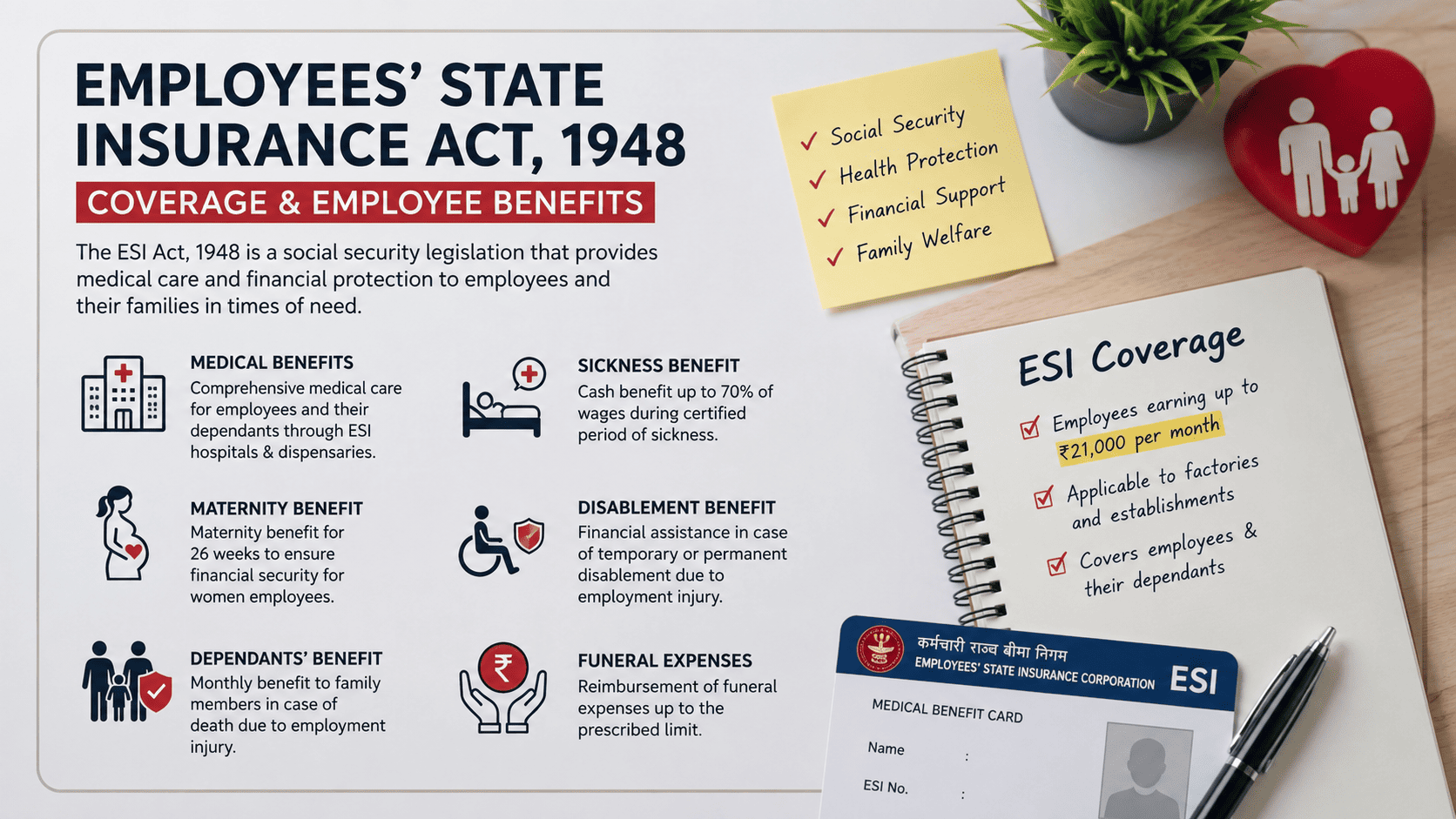
Medical Benefits in the ESI Act 1948 Executive Summary PDF
The Employees State Insurance Act 1948 executive summary PDF explains that medical benefits are the cornerstone of the scheme.
- Insured employees and their dependants are entitled to full medical care from ESI hospitals, dispensaries, and approved private facilities.
- Medical benefits are available from the day an employee enters insurable employment.
- There is no upper limit on expenditure for medical treatment.
- The range of services includes outpatient care, specialist consultation, diagnostic services, hospitalisation, and even super-speciality treatment in certain cases.
Sickness Benefits in the Employees State Insurance Act PDF Corrida Legal
The Employees State Insurance Act PDF Corrida Legal highlights that sickness benefits provide cash compensation when employees cannot work due to illness.
- Payable at 70% of average daily wages.
- Maximum period: 91 days in two consecutive benefit periods.
- Enhanced sickness benefit for specific long-term illnesses such as tuberculosis or cancer, payable for up to two years at a higher rate.
- Requires medical certification and contribution for a minimum qualifying period. This ensures income continuity during health-related absences.
Maternity Benefits in the ESI Act Benefits and Provisions PDF
The ESI Act benefits and provisions PDF details maternity benefits, which are among the most progressive features of the Act.
- Paid leave for 26 weeks, extendable in cases of medical complications.
- Covers confinement, miscarriage, and sickness arising out of pregnancy.
- Benefit amount: full wages, ensuring no income loss during maternity.
- Available to insured women who have contributed for at least 70 days in the preceding two contribution periods.
This provision safeguards both maternal health and financial stability.
Disablement and Dependants’ Benefits in the Employees State Insurance Compliance Guide
The Employees State Insurance compliance guide PDF explains benefits provided in case of accidents or employment-related injuries:
- Temporary disablement benefit: Payable from the first day of disablement until recovery, at 90% of wages.
- Permanent disablement benefit: Lifelong pension, calculated based on loss of earning capacity as certified by a medical board.
- Dependants’ benefit: Monthly pension to widow, children, or other dependants if the insured employee dies due to employment-related injury or occupational disease.
- Funeral expenses: A lump sum payable to family members or nominees to cover funeral costs.
Importance of Benefits in the ESI Act 1948 Key Provisions Summary
The ESI Act 1948 key provisions summary stresses that these benefits make the law stand apart from many other labour statutes. Employees receive not only healthcare but also financial support during the most vulnerable times of their lives. Families are protected against the economic impact of illness, disability, or death, fulfilling the law’s goal of social justice and welfare.
Compliance Duties of Employers under the Employees State Insurance Act, 1948 (Bare Act PDF)
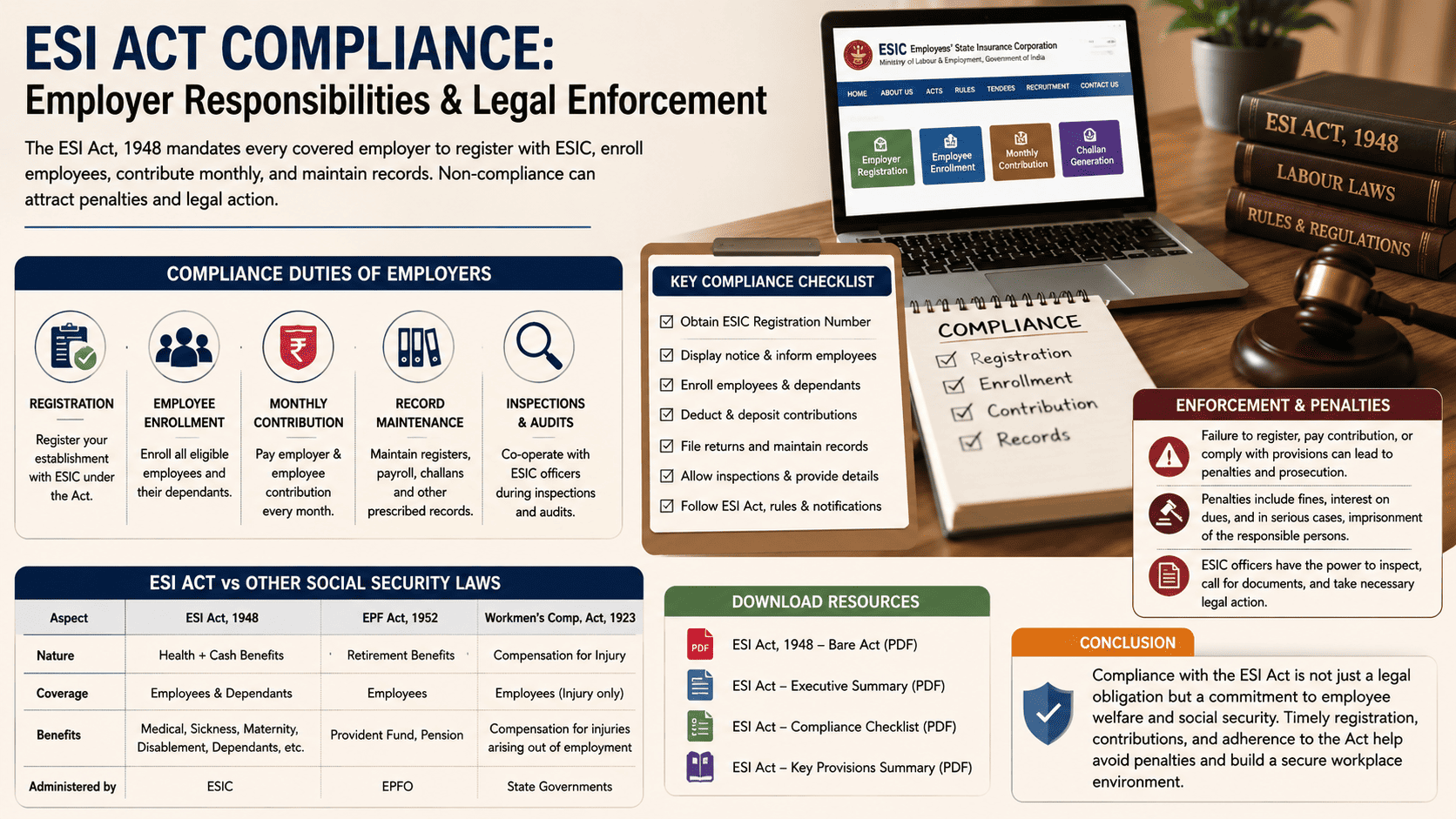
The Employees State Insurance Act, 1948 bare act PDF places significant responsibility on employers to ensure that eligible employees are covered and receive benefits without disruption. The law follows a contributory model, which means the employer’s active role is essential for its success. Compliance is not optional but a statutory duty, and failure to comply attracts both financial penalties and criminal liability.
Employers must treat ESI compliance as a continuous obligation rather than a one-time registration. From enrolling employees at the time of hiring to ensuring timely contributions, maintaining records, and cooperating with inspections, each step is clearly outlined under the Act. These duties create a system where workers are automatically protected without having to fight for their entitlements.
Registration of Establishments in the ESI Act 1948 Executive Summary PDF
The Employees State Insurance Act 1948 executive summary PDF highlights that every employer covered under the Act must register their establishment with the Employees’ State Insurance Corporation (ESIC).
- Registration is mandatory once an establishment employs 10 or more persons.
- Employers must submit details of their workforce, wage structure, and business operations.
- A unique code number is allotted by ESIC for future compliance.
- Delay in registration does not exempt liability — contributions are still payable from the date of applicability.
Enrolment and Contributions in the Employees State Insurance Act PDF Corrida Legal
The Employees State Insurance Act PDF Corrida Legal explains the process of enrolling employees and depositing contributions.
- Every employee earning wages within the statutory limit must be enrolled.
- Contributions are shared: 3.25% by the employer and 0.75% by the employee (total 4%).
- Employers must deduct employee contributions and deposit both shares within 15 days of the following month.
- Contributions are paid electronically through ESIC’s online system. This ensures the scheme has continuous funding to support benefits.
Maintenance of Records in the ESI Act Benefits and Provisions PDF
The ESI Act benefits and provisions PDF outlines the record-keeping duties of employers:
- Maintain registers of wages, attendance, and employee details.
- Submit periodic returns and reports to ESIC.
- Update employee information, including wage revisions or exits.
- Preserve inspection records and correspondence with ESIC authorities.
Proper record maintenance helps prevent disputes during inspections or benefit claims.
Inspections and Compliance in the Employees State Insurance Compliance Guide PDF
The Employees State Insurance compliance guide PDF explains that ESIC has wide inspection powers. Employers are required to:
- Provide access to registers, wage books, and returns.
- Answer queries raised by inspectors.
- Facilitate audits of contributions and benefits.
- Rectify errors or defaults promptly to avoid penalties.
Non-cooperation can result in penalties, prosecution, and recovery proceedings.
Compliance Importance in the ESI Act 1948 Key Provisions Summary
The ESI Act 1948 key provisions summary emphasises that employer compliance is the backbone of the scheme. Without proactive employer participation, employees cannot receive the benefits guaranteed under the law. Compliance ensures:
- Employees have uninterrupted access to medical and cash benefits.
- Employers avoid penalties, damages, and reputational harm.
- Industrial peace is maintained by protecting the social security rights of workers.
Enforcement, Penalties, and Dispute Resolution under the Employees State Insurance Act, 1948 (Bare Act PDF)
The Employees State Insurance Act, 1948 bare act PDF provides not only benefits and compliance obligations but also strict enforcement measures. The objective is to ensure that contributions are paid on time, benefits reach employees, and defaults are dealt with swiftly. The law empowers the Employees’ State Insurance Corporation (ESIC) and its officers with authority similar to revenue recovery officers, ensuring that arrears and penalties can be recovered efficiently.
At the same time, the Act recognises that disputes may arise between employers, employees, and authorities. To address such issues, it establishes specialised adjudicatory forums rather than leaving matters to ordinary civil courts. This balance of strong enforcement and structured dispute resolution creates both accountability and fairness in the system.
Enforcement Powers in the ESI Act 1948 Executive Summary PDF
The Employees State Insurance Act 1948 executive summary PDF highlights key enforcement powers:
- Inspectors may enter establishments, examine records, and question management.
- Recovery officers can attach and sell property to recover dues.
- Bank accounts of defaulting employers can be frozen.
- Authorities can impose interest and damages for delayed contributions. These powers ensure that the law is not merely advisory but enforceable in practice.
Penalties in the Employees State Insurance Act PDF Corrida Legal
The Employees State Insurance Act PDF Corrida Legal specifies penalties for various defaults:
- Failure to pay contributions: Attracts interest and damages up to 25% of the arrears.
- False returns or statements: Punishable with imprisonment up to two years or fine up to ₹5,000.
- Obstruction of inspectors: Can lead to prosecution and fines.
- Repeat offences: Attract stricter punishment, including longer imprisonment terms. These penalties are intended to deter non-compliance and protect employee rights.
Recovery Mechanisms in the ESI Act Benefits and Provisions PDF
The ESI Act benefits and provisions PDF explains that recovery of contributions follows a structured process:
- Issue of a demand notice to the employer.
- If unpaid, attachment of movable and immovable property.
- Recovery from third parties who owe money to the employer.
- Use of revenue recovery procedures similar to those under the Income Tax Act. This system ensures effective collection of dues and continuity of employee benefits.
Dispute Resolution in the Employees State Insurance Compliance Guide PDF
The Employees State Insurance compliance guide PDF outlines the role of the Employees’
Insurance Court, a specialised tribunal established under the Act.
- Jurisdiction: decides disputes relating to coverage, contribution liability, and benefit claims.
- Parties: employers, employees, and ESIC can all approach the court.
- Procedure: quicker and more specialised than civil litigation.
- Appeals: lie to the High Court on substantial questions of law. This mechanism provides fairness and expertise in resolving ESI disputes.
Importance of Enforcement in the ESI Act 1948 Key Provisions Summary
The ESI Act 1948 key provisions summary stresses that enforcement and dispute resolution are integral to the law’s effectiveness. Strong penalties prevent employers from defaulting, while specialised courts ensure that genuine disputes are settled fairly. For employees, this means their benefits are protected; for employers, it ensures clarity and consistency in resolving compliance issues.
Judicial Pronouncements on the Employees State Insurance Act, 1948 (Bare Act PDF)
The Employees State Insurance Act, 1948 bare act PDF has been interpreted and clarified through several landmark judicial decisions. While the statutory text sets out the framework, courts have played an essential role in defining its scope, settling disputes, and ensuring that the law remains faithful to its welfare objective. The judiciary has consistently taken a pro-employee stance, recognising that the Act is a piece of beneficial legislation and must be interpreted liberally in favour of workers.
These judicial pronouncements cover critical issues such as the definition of wages, coverage of establishments, liability of principal employers, and the extent of benefits. By resolving ambiguities, the courts have strengthened the Act’s application and ensured that employers cannot evade compliance by exploiting technicalities.
Read another article: How to Resolve Business Disputes Legally in India: Practical Legal Remedies for Companies
Landmark Rulings in the ESI Act 1948 Executive Summary PDF
The Employees State Insurance Act 1948 executive summary PDF highlights a few important decisions:
- Regional Director, ESIC v. High Land Coffee Works (1991): The Supreme Court held that even temporary or casual employees are entitled to ESI benefits if they meet the wage ceiling criteria.
- ESIC v. Harrison Malayalam Ltd. (1993): Clarified that once an establishment is covered under the Act, it continues to be covered even if the number of employees falls below the statutory limit.
- ESIC v. Ramanuja Match Industries (1985): Confirmed that ESI is a social welfare legislation and its provisions must be interpreted broadly to fulfil its purpose.
Definition of Wages in the Employees State Insurance Act PDF Corrida Legal
The Employees State Insurance Act PDF Corrida Legal highlights judicial rulings on what
constitutes “wages”:
- Courts have consistently ruled that allowances such as dearness allowance, incentive bonuses, and production bonuses fall within the definition of wages.
- The Supreme Court has clarified that employers cannot restructure salary components to reduce ESI contributions.
- This ensures employees receive maximum benefit coverage and employers cannot under- contribute.
Coverage Disputes in the ESI Act Benefits and Provisions PDF
The ESI Act benefits and provisions PDF shows how courts have settled disputes on coverage:
- Establishments like hotels, educational institutions, and private clinics were brought under coverage through judicial interpretation even before they were formally notified.
- Courts have rejected arguments that outsourcing or using contractors exempts employers from liability.
- Judicial intervention has thus expanded the law’s reach and closed potential loopholes.
Dispute Resolution Insights in the Employees State Insurance Compliance Guide PDF
The Employees State Insurance compliance guide PDF notes that courts have also addressed procedural fairness:
- Employers must be given reasonable opportunity before contribution assessments are finalised.
- Recovery actions should follow due process, but they cannot be stalled indefinitely by litigation.
- Courts have supported ESIC’s powers while ensuring employers are not subjected to arbitrary action.
Importance of Judicial Pronouncements in the ESI Act 1948 Key Provisions Summary
The ESI Act 1948 key provisions summary underlines that judicial pronouncements ensure the Act evolves with changing employment patterns. By clarifying definitions, extending coverage, and balancing employer-employee interests, the courts have reinforced the Act’s role as a social security cornerstone. For employees, these rulings guarantee access to benefits; for employers, they provide authoritative guidance on compliance.
ESI Act vs Other Social Security Laws in India (Bare Act PDF)
The Employees State Insurance Act, 1948 bare act PDF is one of several labour welfare legislations in India. While its focus is on providing medical care and income support during sickness, maternity, disability, or death, other social security laws serve different but
complementary purposes. Together, they create a framework of protections that safeguard workers across various stages of employment and life.
Understanding the differences between these laws is essential for both employers and employees. For employers, it ensures compliance with multiple obligations, and for employees, it highlights how each law contributes to their overall social security.
Comparison with the Provident Fund in the ESI Act 1948 Executive Summary PDF
The Employees State Insurance Act 1948 executive summary PDF highlights key distinctions between the ESI Act and the Employees’ Provident Funds Act, 1952 (EPF Act).
- ESI Act: Provides medical benefits, sickness benefits, and family protection during employment.
- EPF Act: Focuses on retirement savings through monthly contributions.
- Common feature: Both create compulsory schemes funded jointly by employers and employees.
- Complementary role: ESI secures present health and income, while EPF secures post- retirement life.
Contrast with Gratuity in the Employees State Insurance Act PDF Corrida Legal
The Employees State Insurance Act PDF Corrida Legal contrasts the ESI Act with the Payment of Gratuity Act, 1972.
- Gratuity: A one-time lump sum payable at the end of continuous service (minimum five years).
- ESI: Provides recurring benefits during employment and in case of contingencies.
- Employee contribution: Not required under gratuity, but mandatory under ESI. Both laws operate differently but are essential for long-term employee welfare.
Distinction from Workmen’s Compensation in the ESI Act Benefits and Provisions PDF
The ESI Act benefits and provisions PDF explains how the ESI Act differs from the Employees’ Compensation Act, 1923.
- Workmen’s Compensation: Provides compensation for workplace accidents or occupational diseases, limited to employment-related causes.
- ESI Act: Provides broader benefits including medical, sickness, maternity, and dependants’ pensions, covering both employment-related and general sickness.
- Overlap: Where ESI applies, it overrides Workmen’s Compensation to avoid duplication.
Integration under the Labour Codes in the Employees State Insurance Compliance Guide PDF
The Employees State Insurance compliance guide PDF highlights that the Code on Social Security, 2020 aims to integrate multiple welfare legislations, including ESI, EPF, gratuity, and maternity benefits.
- A single registration for employers.
- Digital compliance and contribution systems.
- Extension of coverage to gig and platform workers.
- Harmonisation of definitions across laws.
This marks a shift towards a unified social security framework in India.
Broader Context in the ESI Act 1948 Key Provisions Summary
The ESI Act 1948 key provisions summary explains that no single law is sufficient on its own. Instead, the ESI Act works alongside provident fund, gratuity, maternity, and compensation laws to create a multi-layered system of protection. Employees thus receive security during employment, at retirement, and in unforeseen contingencies. Employers, in turn, must view these obligations holistically rather than in isolation.
Download Resources for the Employees State Insurance Act, 1948 (Bare Act PDF)
The Employees State Insurance Act, 1948 bare act PDF is a detailed statute that lays down the framework for medical and cash benefits to employees. However, for students, HR professionals, compliance officers, and employers, the bare text alone is not enough. Having access to structured resources such as executive summaries, compliance guides, and explanatory notes ensures that the law is both understandable and practically applicable.
Corrida Legal provides multiple downloadable resources that go beyond the statutory text, combining legal accuracy with practical insights. These resources help readers save time, avoid errors, and apply the Act correctly in workplace situations.
Employees State Insurance Act, 1948 Executive Summary PDF
The Employees State Insurance Act 1948 executive summary PDF condenses the core features of the law into a simple and accessible format.
- Quick overview of applicability, coverage, and wage ceiling.
- Clear explanation of employee entitlements like sickness, maternity, and medical benefits.
- Useful for students, professionals, and employees who need a reference without reading the full text.
Employees State Insurance Act PDF Corrida Legal
The Employees State Insurance Act PDF Corrida Legal offers both the bare provisions and Corrida Legal’s commentary.
- Illustrative examples of contribution calculation.
- Case law references clarifying definitions and obligations.
- Practical compliance notes for employers and HR managers.
- Guidance on avoiding common mistakes during inspections.
This resource is particularly valuable for organisations and compliance teams.
ESI Act Benefits and Provisions PDF
The ESI Act benefits and provisions PDF provides a thematic compilation of the benefits available.
- Medical care facilities and coverage details.
- Cash benefits during sickness and maternity.
- Disablement and dependants’ pensions.
- Funeral expense provisions.
It acts as a quick handbook for employees and practitioners dealing with benefit claims.
Employees State Insurance Compliance Guide PDF
The Employees State Insurance compliance guide PDF is tailored for employers and payroll professionals.
- Step-by-step instructions on registration, enrolment, and contribution.
- Compliance checklists and timelines.
- Record-keeping formats for inspections.
- Guidance on dispute resolution and avoiding penalties. This makes compliance easier and reduces the risk of litigation.
ESI Act 1948 Key Provisions Summary
The ESI Act 1948 key provisions summary is designed for readers who want a concise yet reliable reference.
- Highlights important definitions and coverage rules.
- Lists employer and employee obligations.
- Summarises enforcement powers and penalties.
- Provides an overview of integration under the Social Security Code, 2020.
Why Downloadable Resources Matter
Together, these resources form a comprehensive package:
- Bare Act PDF: Legal foundation.
- Executive Summary PDF: Simplified understanding.
- Corrida Legal PDF: Commentary and practical guidance.
- Benefits and Provisions PDF: Focused on entitlements.
- Compliance Guide PDF: Employer-centric compliance tools.
- Key Provisions Summary: Concise statutory highlights.
By using these downloads, both employees and employers can bridge the gap between legal theory and practical application.
Conclusion on the Employees State Insurance Act, 1948 (Bare Act PDF)
The Employees State Insurance Act, 1948 bare act PDF remains one of the strongest pillars of India’s labour welfare system. By combining medical care with income security, it offers comprehensive protection that few other laws provide. Its design reflects a simple but powerful idea: employees should not be left helpless in the face of sickness, maternity, disability, or death. Instead, they and their families should have guaranteed access to healthcare and financial support.
Over the decades, the Act has expanded its coverage to millions of workers, adapting to the growth of industries and services across India. It has been reinforced by judicial pronouncements, strengthened through amendments, and now finds its place within the broader framework of the Social Security Code, 2020. Yet, its core welfare spirit has remained unchanged since 1948.
For employees, the scheme is more than a legal entitlement, it is an assurance of dignity and
stability. For employers, it is both a responsibility and an opportunity to contribute to workforce security. Non-compliance not only attracts penalties but also erodes trust within the organisation.
Key Takeaways from the ESI Act 1948 Executive Summary PDF
The Employees State Insurance Act 1948 executive summary PDF shows that compliance means:
- Registering establishments with ESIC on time.
- Enrolling all eligible employees without exception.
- Making contributions regularly and accurately.
- Facilitating access to medical and cash benefits for employees.