


Reviewed and Validated by: Naman Jain, Associate
Introduction to the Maternity Benefit Act, 1961 (Bare Act PDF)
The Maternity Benefit Act, 1961 bare act PDF is a landmark statute in Indian labour law designed to safeguard the health, dignity, and financial security of women during maternity. At a time when women’s participation in the organised workforce was increasing, the legislature recognised the need to provide legal protection for women employees who would otherwise face wage loss, termination, or discrimination during pregnancy and childbirth. The Act was therefore enacted to ensure that motherhood does not become a ground for economic or professional disadvantage.
Unlike many other labour laws that focus on general employment conditions, this Act is specifically centred on the biological and social realities of maternity. It not only grants paid leave to women but also prohibits employers from dismissing or disadvantaging employees during maternity. The idea is to provide women with both time and financial support to recover from childbirth and care for their newborn without fear of losing their jobs.
Over time, amendments have strengthened the scope of this law, most notably the 2017 amendment which extended maternity leave from 12 weeks to 26 weeks and introduced provisions for adoptive and commissioning mothers. The Act also brought in requirements for larger establishments to provide crèche facilities, recognising the continuing responsibility of childcare beyond maternity leave.
Core Objectives of the Maternity Benefit Act, 1961
The Act’s introduction can be understood through three central objectives:
- Protecting women’s health and wellbeing: Ensuring sufficient time off from work with financial support during maternity.
- Preventing workplace discrimination: Prohibiting dismissal or adverse employment action against women because of pregnancy.
- Balancing work and family life: Mandating employer responsibility in supporting maternity leave and childcare facilities.
The Maternity Benefit Act, 1961 bare act PDF remains an indispensable reference for compliance officers, HR managers, and employees seeking clarity on entitlements and obligations. It continues to symbolise India’s commitment to protecting the rights of working women and ensuring gender-sensitive employment practices.
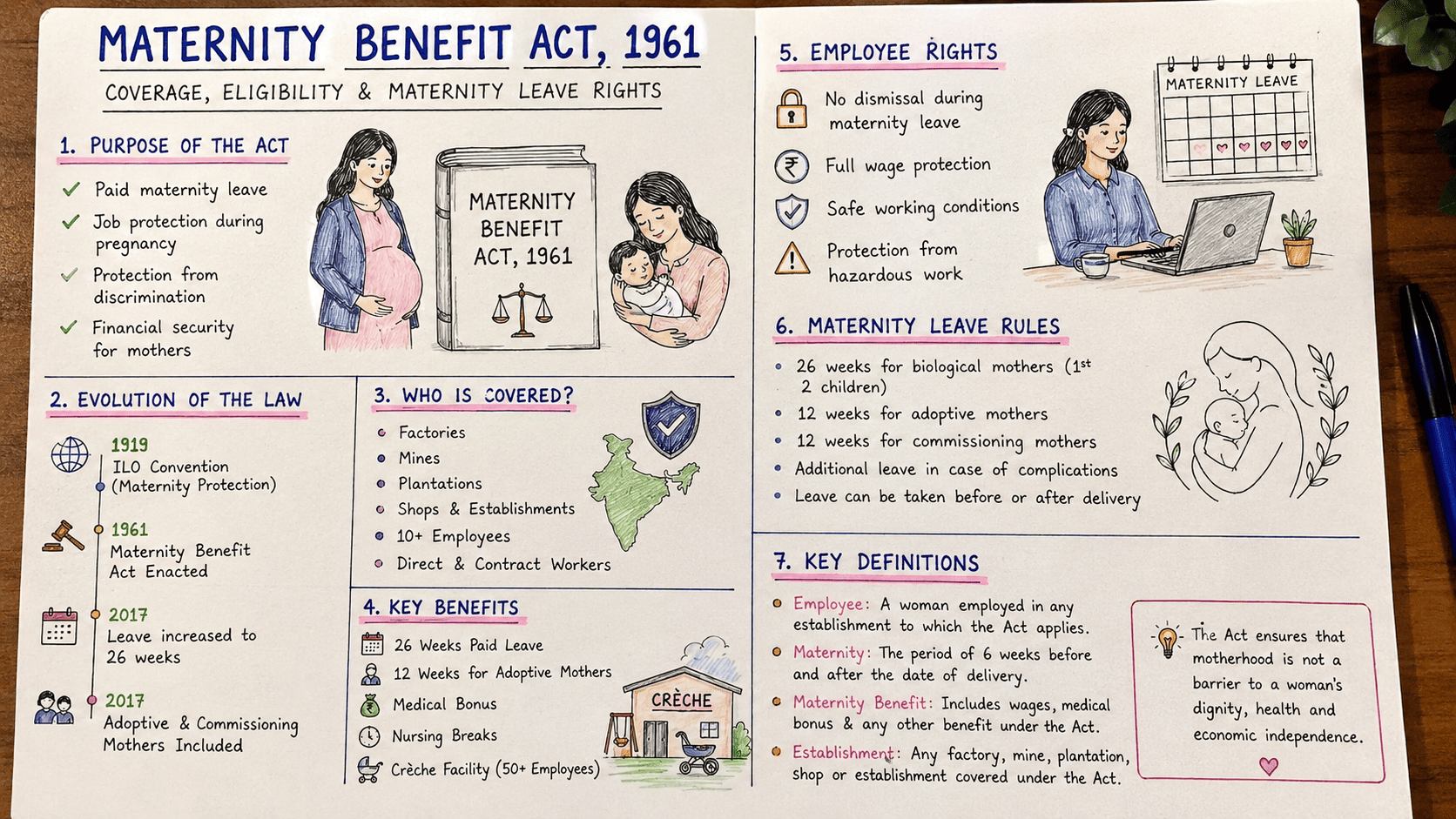
Historical Background and Development of the Maternity Benefit Act, 1961 (Bare Act PDF)
The Maternity Benefit Act, 1961 bare act PDF was not enacted in isolation. It was the result of both international labour commitments and India’s recognition of the need to safeguard women employees in a rapidly modernising economy. Prior to 1961, maternity protections existed in a fragmented manner across different state laws, leading to uneven standards and enforcement. Women in certain sectors enjoyed benefits, while others were left without any statutory support.
Globally, the movement for maternity protection had already gained ground. The International Labour Organization (ILO) had adopted the Maternity Protection Convention, 1919, which laid down principles of maternity leave, financial security, and protection against dismissal. India, as a member of the ILO, was committed to improving working conditions for women in line with international standards.
Within India, increasing female participation in factories, plantations, and offices after independence highlighted the vulnerability of women workers during pregnancy and childbirth. Wage loss, dismissal, and unsafe working conditions created severe hardships. Parliament responded by consolidating existing state laws into a central legislation, ensuring uniformity and nationwide applicability. Thus, in 1961, the Maternity Benefit Act was passed, bringing maternity protection under a single statutory framework.
Milestones in the Maternity Benefit Act 1961 Executive Summary PDF
The Maternity Benefit Act 1961 executive summary PDF traces the key milestones:
- 1919: ILO adopts Maternity Protection Convention.
- 1920s–1950s: Several Indian states enact local maternity laws.
- 1961: Central Act passed, consolidating state laws into one comprehensive statute.
- 1988 Amendment: Enhanced maternity leave and clarified benefits.
- 2017 Amendment: Extended maternity leave to 26 weeks, included adoptive and commissioning mothers, and mandated crèche facilities.
Legislative Intent in the Maternity Benefit Act PDF Corrida Legal
The Maternity Benefit Act PDF Corrida Legal explains that the Act was designed not just to provide leave but to protect women’s employment rights during maternity. It aimed to eliminate the widespread practice of dismissing women once they became pregnant, which often forced them out of the workforce permanently. By prohibiting such practices, the Act established a balance between women’s reproductive roles and their right to remain economically independent.
Broader Context in the Maternity Leave Rules in India PDF
The maternity leave rules in India PDF place the Act within the broader constitutional and social framework:
- Article 39(e) and 42 of the Constitution direct the State to ensure health and maternity relief for women.
- The Act operationalises these directives, giving women statutory entitlements rather than discretionary benefits.
- It represents a shift from welfare policy to enforceable rights.
Importance in the Maternity Benefit Act 1961 Key Provisions Summary
The Maternity Benefit Act 1961 key provisions summary shows that the historical context explains its significance. It was not just about leave — it was about ensuring social justice, workplace equality, and protection of motherhood as a national responsibility. By creating a uniform standard, the Act marked a turning point in India’s labour welfare framework.
Applicability and Coverage under the Maternity Benefit Act, 1961 (Bare Act PDF)
The Maternity Benefit Act, 1961 bare act PDF applies to women employed in certain categories of establishments and ensures that maternity leave and related protections are extended across sectors. Its coverage was designed to reach women in the organised workforce, while also laying the foundation for gradual inclusion of wider categories of employment through amendments and notifications.
The Act is applicable to every establishment employing women, whether directly or through agencies, in factories, mines, plantations, and shops or establishments where 10 or more persons are employed. Over time, its scope has expanded through state notifications, ensuring women in different industries enjoy maternity protection.
It is important to note that the Act applies to all women, whether married or unmarried, as long as they meet the qualifying conditions of employment. By adopting a broad coverage framework, the law ensures that maternity protections cannot be denied on narrow grounds of sector, status, or contract.
Coverage in the Maternity Benefit Act 1961 Executive Summary PDF
The Maternity Benefit Act 1961 executive summary PDF highlights the key aspects of coverage:
- Eligible Establishments: Factories, mines, plantations, and shops or establishments employing 10 or more persons.
- Type of Employees: Women working directly or through contractors, provided they have been employed for at least 80 days in the 12 months preceding the expected delivery date.
- Unorganised Sector: Coverage is limited but certain provisions have been extended through state laws and schemes.
- Special Cases: Adoption, commissioning mothers, and surrogacy are included after the 2017 amendment.
Applicability Explained in the Maternity Benefit Act PDF Corrida Legal
The Maternity Benefit Act PDF Corrida Legal clarifies that the Act applies irrespective of the wage levels of employees. Unlike some other labour statutes, which have wage ceilings, maternity benefits are treated as a universal entitlement within eligible establishments. This reflects the legislative intent to treat maternity protection as a matter of health and dignity rather than income.
Insights from Maternity Leave Rules in India PDF
The maternity leave rules in India PDF explain the wider application introduced by the 2017 amendment:
- Women in all establishments with 10 or more employees are covered.
- Adoption and commissioning mothers are entitled to 12 weeks of maternity leave.
- Employers with 50 or more employees must provide crèche facilities for working mothers.
Compliance Duties in the Maternity Benefit Compliance Guide PDF
The Maternity Benefit compliance guide PDF sets out employer obligations under coverage provisions:
- Ensuring all eligible women are informed of their rights.
- Maintaining registers showing employment details and maternity benefits granted.
- Displaying abstracts of the Act in conspicuous places within establishments.
- Applying maternity leave rules without discrimination against contractual or temporary staff.
Importance in the Maternity Benefit Act 1961 Key Provisions Summary
The Maternity Benefit Act 1961 key provisions summary underlines that wide applicability is essential for achieving its objectives. By covering women across different establishments and employment types, the Act ensures that maternity protection is not a privilege for a few but a statutory right for all eligible women.
Key Definitions and Provisions in the Maternity Benefit Act, 1961 (Bare Act PDF)
The Maternity Benefit Act, 1961 bare act PDF lays down specific definitions and provisions that determine how benefits are applied and enforced. These definitions are important because they clarify who qualifies for maternity benefits, what establishments are bound to comply, and how entitlements are calculated.
Without these guiding terms, the application of the law would be inconsistent and open to manipulation.
The Act not only defines the scope of eligibility but also spells out the nature of benefits, including leave, wages, medical bonus, and protection against dismissal. Over time, amendments—especially the 2017 amendment—have expanded these provisions to reflect evolving social and workplace realities.
Key Terms in the Maternity Benefit Act 1961 Executive Summary PDF
The Maternity Benefit Act 1961 executive summary PDF highlights the important definitions:
- Maternity Benefit: Full wages payable to a woman during her maternity leave, equivalent to the average daily wage for the period of actual absence.
- Woman/Employee: Any woman employed directly or through an agency in an establishment covered under the Act.
- Establishment: Factories, mines, plantations, and shops or establishments employing 10 or more persons.
- Employer: Any person responsible for supervising and controlling employees in an establishment.
Provisions Explained in the Maternity Benefit Act PDF Corrida Legal
The Maternity Benefit Act PDF Corrida Legal explains the main statutory entitlements under the Act:
- Maternity Leave: 26 weeks for women with up to two surviving children; 12 weeks for women with more than two children.
- Adoption and Surrogacy: 12 weeks of maternity leave for adoptive and commissioning mothers.
- Medical Bonus: Additional payment if the employer does not provide free medical care.
- Nursing Breaks: Two nursing breaks per day for new mothers until the child reaches 15 months.
- Prohibition on Dismissal: No woman can be dismissed or discharged during maternity leave.
Maternity Leave Rules in India PDF – Key Insights
The maternity leave rules in India PDF adds further clarity:
- Leave must begin no earlier than 8 weeks before the expected delivery date.
- Employers are prohibited from engaging women in arduous work during the last stages of pregnancy.
- Pregnant women cannot be assigned tasks that may interfere with their health or the child’s development.
Compliance Perspective in the Maternity Benefit Compliance Guide PDF
The Maternity Benefit compliance guide PDF highlights duties tied to these provisions:
- Employers must maintain registers recording maternity leave and benefits granted.
- Abstracts of the Act must be displayed prominently.
- Non-compliance with provisions attracts penalties and inspections.
- Employers should ensure policies are aligned with statutory amendments to avoid disputes.
Maternity Leave Rules in India under the Maternity Benefit Act, 1961 (Bare Act PDF)
The Maternity Benefit Act, 1961 bare act PDF lays down detailed rules on how maternity leave must be provided, making it one of the most significant welfare protections for women employees in India. These rules ensure that women can take adequate time away from work during pregnancy and after childbirth without facing financial insecurity or loss of employment. The Act reflects the understanding that maternity is not only a biological necessity but also a social responsibility that requires legal protection.
The rules have evolved with time, particularly through the 2017 amendment, which extended the duration of leave and included special provisions for adoptive and commissioning mothers. Together, these measures position India among the countries offering some of the most comprehensive statutory maternity protections.
Duration of Leave in the Maternity Benefit Act 1961 Executive Summary PDF
The Maternity Benefit Act 1961 executive summary PDF specifies leave entitlements:
- 26 weeks of maternity leave for women with up to two surviving children.
- 12 weeks of maternity leave for women with more than two surviving children.
- 12 weeks of leave for adoptive and commissioning mothers (from the date the child is handed over).
- 6 weeks of leave in case of miscarriage or medical termination of pregnancy.
Pre- and Post-Delivery Leave in the Maternity Benefit Act PDF Corrida Legal
The Maternity Benefit Act PDF Corrida Legal explains that maternity leave is divided into pre- and post-delivery periods:
- A woman may take up to 8 weeks of leave before the expected delivery date.
- The balance of leave is to be availed after childbirth, ensuring recovery and infant care.
- Employers cannot insist that all leave be taken post-delivery — flexibility lies with the employee.
Additional Provisions in the Maternity Leave Rules in India PDF
The maternity leave rules in India PDF also provide:
- Crèche Facilities: Establishments with 50 or more employees must provide a crèche, with women entitled to four visits a day (including rest and nursing breaks).
- Nursing Breaks: Two additional breaks per day for nursing, until the child reaches 15 months of age.
- Prohibition on Hazardous Work: Employers cannot assign women work that is physically demanding or harmful to their health during pregnancy.
Employer Duties in the Maternity Benefit Compliance Guide PDF
The Maternity Benefit compliance guide PDF outlines employer obligations regarding leave:
- Inform all women employees of their entitlements at the time of appointment.
- Maintain transparent leave records in statutory registers.
- Ensure no woman is dismissed or penalised for availing maternity leave.
- Provide medical bonus where free medical care is not available.
Importance of Rules in the Maternity Benefit Act 1961 Key Provisions Summary
The Maternity Benefit Act 1961 key provisions summary emphasises that maternity leave rules are not just about time off but about ensuring women can balance work and family without disadvantage. By protecting wages, prohibiting dismissal, and requiring supportive facilities, the Act transforms maternity leave from a privilege into a right.
Compliance Duties of Employers under the Maternity Benefit Act, 1961 (Bare Act PDF)
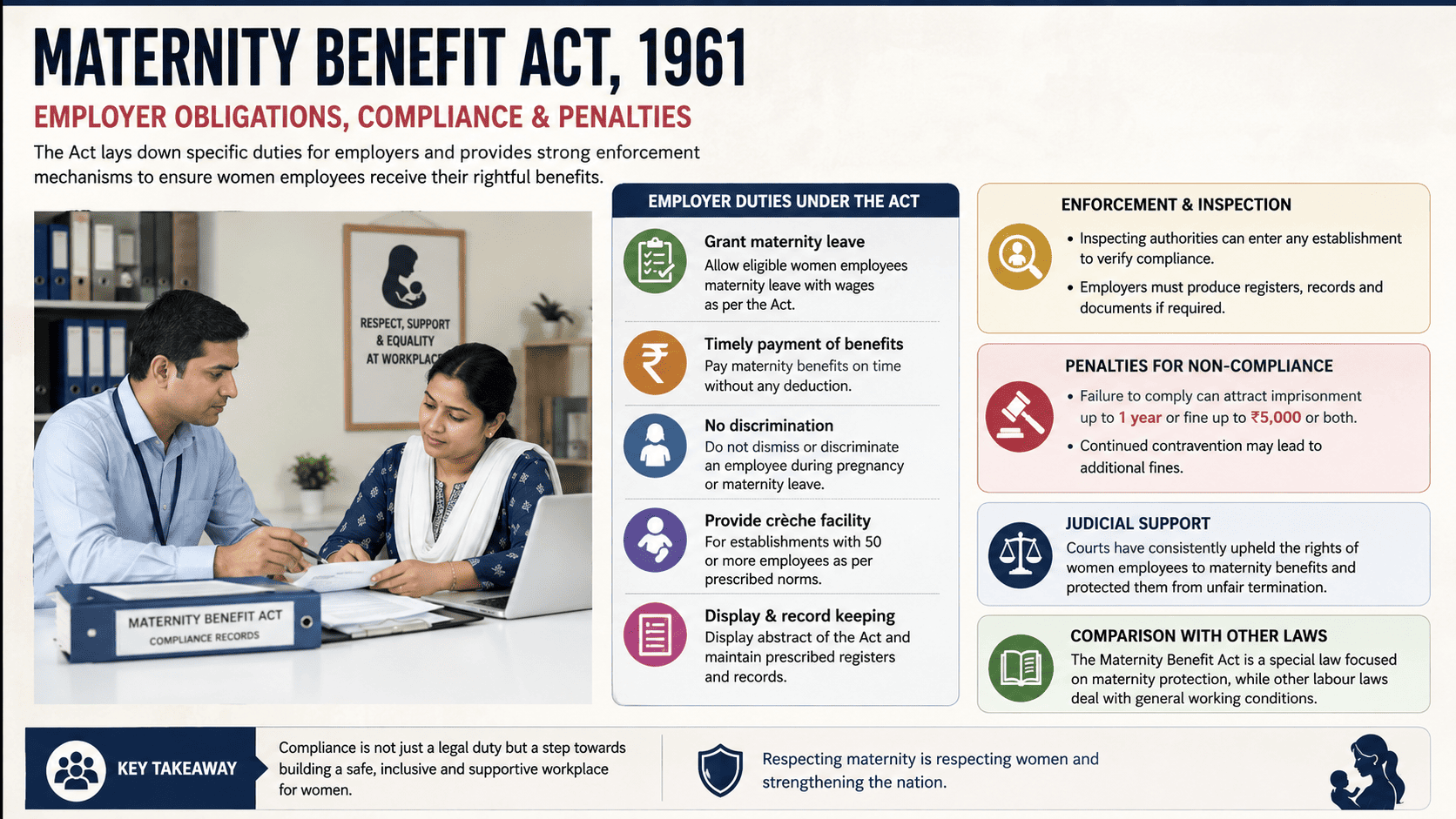
The Maternity Benefit Act, 1961 bare act PDF places significant responsibility on employers to ensure that maternity protections are effectively implemented. Compliance under this Act is not optional — it is a legal mandate. Employers must not only grant the prescribed benefits but also create a workplace environment where women can access their rights without fear of dismissal, discrimination, or undue hardship.
These duties extend beyond simply providing leave. They include maintaining statutory registers, informing women employees of their entitlements, and ensuring that workplace practices align with the protective spirit of the law. The Act also imposes penalties for non-compliance, making it crucial for employers to adopt a proactive approach.
Core Employer Responsibilities in the Maternity Benefit Act 1961 Executive Summary PDF
The Maternity Benefit Act 1961 executive summary PDF lists key compliance duties:
- Grant maternity leave with full wages for the prescribed period.
- Provide leave for miscarriage, adoption, surrogacy, or medical termination of pregnancy.
- Ensure continuation of service benefits, increments, and seniority during maternity leave.
- Prohibit dismissal or disadvantage of women employees due to pregnancy or maternity leave.
Record-Keeping Duties in the Maternity Benefit Act PDF Corrida Legal
The Maternity Benefit Act PDF Corrida Legal explains that employers must maintain proper documentation:
- Registers of employment: Showing names, maternity benefits granted, and duration of leave.
- Abstract display: Posting summaries of the Act at conspicuous places in the establishment.
- Leave records: Keeping accurate data on leave applications and wage payments.
- Medical bonus records: Where applicable, maintaining details of payments made. Failure to maintain these records is itself an offence under the Act.
Obligations Highlighted in the Maternity Leave Rules in India PDF
The maternity leave rules in India PDF add specific duties:
- Employers must not assign pregnant women arduous, long-hour, or hazardous tasks.
- Establishments with 50 or more employees must provide crèche facilities.
- Women must be allowed four visits to the crèche daily, including nursing breaks.
- Employers must ensure safe and supportive working conditions during pregnancy.
Compliance Guidance in the Maternity Benefit Compliance Guide PDF
The Maternity Benefit compliance guide PDF advises employers to adopt proactive practices:
- Conduct periodic audits of HR policies to ensure alignment with the Act.
- Train managers and supervisors on handling maternity benefit requests sensitively.
- Establish clear internal grievance mechanisms for women employees.
- Integrate maternity compliance with broader workplace equality and diversity policies.
Importance of Employer Duties in the Maternity Benefit Act 1961 Key Provisions Summary
The Maternity Benefit Act 1961 key provisions summary stresses that employer compliance is the
backbone of the law’s effectiveness. Without strict adherence by employers, the Act’s purpose of protecting women during maternity would remain unfulfilled. Compliance, therefore, is not just about avoiding penalties, it is about recognising maternity as a protected right and treating it with the seriousness it deserves.
Enforcement, Penalties, and Dispute Resolution under the Maternity Benefit Act, 1961 (Bare Act PDF)
The Maternity Benefit Act, 1961 bare act PDF ensures that its provisions are not merely declaratory but enforceable. To achieve this, the law sets up a framework of inspections, penalties, and dispute resolution mechanisms. This combination of preventive and corrective measures ensures that women can actually access maternity protections and that employers treat compliance as a legal necessity rather than a discretionary benefit.
Inspectors are empowered to monitor compliance, verify records, and investigate complaints. At the same time, the Act prescribes penalties for violations, making non-compliance both costly and reputationally damaging. For employees, the law provides formal forums to resolve disputes, thereby ensuring that maternity protections can be asserted even against resistant employers.
Enforcement Mechanisms in the Maternity Benefit Act 1961 Executive Summary PDF
The Maternity Benefit Act 1961 executive summary PDF highlights enforcement measures:
- Appointment of inspectors by the government with authority to enter establishments and examine records.
- Power to question employers and employees regarding compliance with maternity benefit provisions.
- Authority to require production of wage registers, leave records, and compliance registers.
- Reporting of violations for further legal action.
Penalties under the Maternity Benefit Act PDF Corrida Legal
The Maternity Benefit Act PDF Corrida Legal specifies penalties for violations:
- For dismissing or disadvantaging a woman during maternity leave: Imprisonment up to 3 months, fine up to ₹5,000, or both.
- For failure to pay maternity benefit or medical bonus: Imprisonment up to 1 year and fine up to ₹5,000.
- For general contraventions: Imprisonment up to 1 year, fine up to ₹5,000, or both.
- Repeat offences: Higher penalties including extended imprisonment.
These penalties act as a deterrent against denial of benefits or discriminatory practices.
Dispute Resolution in the Maternity Leave Rules in India PDF
The maternity leave rules in India PDF explain the avenues for dispute resolution:
- Disputes relating to maternity benefits or dismissal during pregnancy can be referred to authorities appointed under the Act.
- Labour Courts and Industrial Tribunals may hear and decide disputes arising out of maternity benefit claims.
- Courts have the power to order payment of unpaid benefits along with compensation.
- Employees can also challenge wrongful dismissal through writ petitions under constitutional provisions.
Employer Guidance in the Maternity Benefit Compliance Guide PDF
The Maternity Benefit compliance guide PDF advises employers on handling enforcement and disputes:
- Maintain updated and accurate registers to avoid penalties during inspections.
- Respond promptly to inspector queries and directions.
- Set up internal redressal systems to resolve maternity-related grievances before they escalate.
- Adopt a proactive compliance policy to reduce litigation risk and demonstrate good faith.
Importance of Enforcement in the Maternity Benefit Act 1961 Key Provisions Summary
The Maternity Benefit Act 1961 key provisions summary stresses that enforcement provisions are as important as the substantive benefits. Without penalties, the law would lack teeth, and without dispute resolution, employees would have no avenue to assert rights. By combining these two elements, the Act ensures that maternity protection is a practical and enforceable reality.
Judicial Pronouncements on the Maternity Benefit Act, 1961 (Bare Act PDF)
The Maternity Benefit Act, 1961 bare act PDF has been shaped and strengthened through landmark judicial pronouncements. While the Act lays down clear statutory protections, courts in India have consistently interpreted its provisions in a progressive and employee-friendly manner, ensuring that the law serves its welfare purpose. Judicial rulings have clarified key issues such as eligibility, the scope of maternity leave, the rights of contractual employees, and the prohibition of dismissal during maternity.
Indian courts have often emphasised that maternity is a natural condition and that women employees should not suffer economic or professional disadvantages because of it. This approach has reinforced the constitutional guarantee of equality under Articles 14, 15, and 21, giving the Act greater depth and enforceability.
Landmark Rulings in the Maternity Benefit Act 1961 Executive Summary PDF
The Maternity Benefit Act 1961 executive summary PDF highlights several important cases
- In Municipal Corporation of Delhi v. Female Workers (Muster Roll), 2000, the Supreme Court extended maternity benefits to daily wage and muster roll workers, holding that denial of benefits would violate constitutional equality.
- In B. Shah v. Presiding Officer, Labour Court, 1977, the Court clarified that maternity leave includes weekly offs and holidays falling during the period of absence, thereby ensuring full benefit to employees.
- In K. Krishnamachari v. Managing Director, APSRTC, 1995, the Court reiterated that employers cannot discriminate against women employees in granting maternity leave, even if they are employed on temporary or casual basis.
- In Dr. Mrs. Shamsher Jahan v. State of Rajasthan, 1987, the Rajasthan High Court held that maternity benefits are a matter of right and cannot be denied merely because service rules did not specifically provide for them.
Broader Constitutional Context in the Maternity Benefit Act PDF Corrida Legal
The Maternity Benefit Act PDF Corrida Legal explains that courts have linked the Act to constitutional principles. Article 42 of the Directive Principles directs the State to make provision for maternity relief, and judicial interpretation has made this directive a practical obligation. The Supreme Court has repeatedly held that any interpretation of the Act must be in line with social justice and gender equality.
Practical Application in the Maternity Leave Rules in India PDF
The maternity leave rules in India PDF demonstrate how judicial intervention has broadened the scope of entitlements. Courts have held that adoptive and commissioning mothers too are entitled to protection, reinforcing the welfare approach of the law. This judicial trend ensures that benefits evolve with social realities rather than remain confined to the text of the original statute.
Compliance Lessons in the Maternity Benefit Compliance Guide PDF
The Maternity Benefit compliance guide PDF draws lessons from judicial pronouncements for employers. Employers must interpret the Act liberally and avoid narrow or technical readings that may deny women their rightful benefits. Courts have consistently penalised employers for non-compliance, making it clear that the judiciary stands firmly on the side of protecting women employees.
Significance in the Maternity Benefit Act 1961 Key Provisions Summary
The Maternity Benefit Act 1961 key provisions summary underlines that judicial pronouncements are central to the law’s continuing relevance. By reinforcing statutory protections with constitutional values, the judiciary has ensured that the Act is not merely a labour law but a fundamental safeguard of women’s rights in the workplace.
Maternity Benefit Act vs Other Labour Laws in India (Bare Act PDF)
The Maternity Benefit Act, 1961 bare act PDF is a specialised piece of legislation that deals exclusively with maternity protection, but it operates within a wider network of labour laws. Understanding its relationship with other statutes is essential for both employers and employees, as compliance often requires navigating overlapping obligations. The Act complements laws that focus on wages, social security, equality, and workplace welfare, making it part of the larger framework of labour protection in India.
Comparison with the Employees’ State Insurance Act in the Maternity Benefit Act 1961 Executive Summary PDF
The Maternity Benefit Act 1961 executive summary PDF highlights the contrast with the Employees’ State Insurance Act, 1948. The ESI Act provides maternity benefits to insured women workers through contributions from employers and employees, whereas the Maternity Benefit Act applies where ESI coverage is not available. In establishments covered under ESI, maternity benefits are paid by the ESI Corporation, while in others the employer directly bears the liability under the Maternity Benefit Act.
Distinction from the Equal Remuneration Act in the Maternity Benefit Act PDF Corrida Legal
The Maternity Benefit Act PDF Corrida Legal explains how it differs from the Equal Remuneration Act, 1976. While ERA focuses on wage parity between men and women, the Maternity Benefit Act ensures that
women receive uninterrupted wages during maternity leave. Together, they address two different but related aspects of gender equality in the workplace – equal pay and protection during maternity.
Overlap with the Factories Act and Shops & Establishments Laws in the Maternity Leave Rules in India PDF
The maternity leave rules in India PDF clarify the overlap with other employment regulations. The Factories Act, 1948 and state-specific Shops and Establishments Acts regulate working hours, health, and safety of employees. While these laws provide general protection, the Maternity Benefit Act is targeted specifically at women during pregnancy and childbirth, ensuring they receive special benefits beyond general employment conditions.
Connection with the Payment of Gratuity Act in the Maternity Benefit Compliance Guide PDF
The Maternity Benefit compliance guide PDF points out that both the Maternity Benefit Act and the Payment of Gratuity Act, 1972 protect employees against sudden loss of income, though at different stages. Maternity benefits secure wages during pregnancy, while gratuity ensures financial security at retirement or termination. Employers must treat both as statutory obligations.
Broader Context in the Maternity Benefit Act 1961 Key Provisions Summary
The Maternity Benefit Act 1961 key provisions summary underlines that these laws collectively advance constitutional goals of social justice and equality. By focusing on maternity relief, the Act complements other labour laws and creates a holistic protection framework. Its unique role lies in recognising maternity as a social responsibility, ensuring that women are not forced to choose between employment and family.
Download Resources – Maternity Benefit Act, 1961 Bare Act and Guides
The Maternity Benefit Act, 1961 bare act PDF is the primary legal document governing maternity rights in India, but professionals, employers, and students often require more than just the statutory text. To make compliance simpler and to help employees understand their entitlements, supplementary resources such as executive summaries, compliance guides, and Corrida Legal commentaries are indispensable. These resources bring clarity to complex provisions, highlight judicial interpretations, and provide practical guidance for day-to-day application of the law.
Maternity Benefit Act 1961 Bare Act PDF
The Maternity Benefit Act 1961 bare act PDF provides the original text of the statute as passed by Parliament. It contains all provisions relating to maternity leave, benefits, dismissal protection, and compliance obligations. This is the essential reference point for legal practitioners, HR professionals, and compliance officers.
Maternity Benefit Act 1961 Executive Summary PDF
The Maternity Benefit Act 1961 executive summary PDF condenses the statutory provisions into an easy-to-read format. It highlights coverage, eligibility conditions, leave entitlements, and employer responsibilities, making it especially useful for HR managers and employees seeking a quick understanding of their rights.
Maternity Benefit Act PDF Corrida Legal
The Maternity Benefit Act PDF Corrida Legal goes beyond the bare act by providing practical interpretation and commentary. It includes compliance insights, illustrations from case law, and actionable checklists that help employers and professionals implement the law in practice.
Maternity Leave Rules in India PDF
The maternity leave rules in India PDF explains statutory leave entitlements, crèche facility obligations, and
provisions for adoptive and commissioning mothers. It brings together legal text and practical examples to guide both employees and employers.
Maternity Benefit Compliance Guide PDF
The Maternity Benefit compliance guide PDF is designed for organisations that want to proactively ensure compliance. It contains templates for registers, steps for handling inspections, and guidance on preventing discrimination in the workplace. Employers can use this resource to align internal policies with statutory requirements.
Maternity Benefit Act 1961 Key Provisions Summary
The Maternity Benefit Act 1961 key provisions summary highlights the most critical parts of the law. It explains core definitions, leave entitlements, protections against dismissal, and penalties for non-compliance. This makes it a handy reference tool for students, legal practitioners, and compliance officers.
Why These Resources Matter
Together, these resources provide a complete toolkit for understanding and applying the law. The bare act ensures statutory accuracy, the executive summary simplifies complex provisions, Corrida Legal adds practical interpretation, the maternity leave rules contextualise entitlements, the compliance guide supports employers, and the key provisions summary makes quick referencing easier. By combining all of these, professionals and employees gain a well-rounded understanding of the Act’s requirements and protections.
Conclusion on the Maternity Benefit Act, 1961 (Bare Act PDF)
The Maternity Benefit Act, 1961 bare act PDF remains one of the most significant welfare legislations in India, designed to protect women during a crucial stage of life. By guaranteeing paid leave, safeguarding against dismissal, and recognising maternity as a right rather than a privilege, the Act transformed the way workplaces deal with women employees. It established a framework that balances the needs of motherhood with the continuity of employment, thereby promoting both social justice and gender equality.
Over time, the Act has been strengthened by amendments and judicial pronouncements. The 2017 amendment in particular marked a milestone by extending maternity leave to 26 weeks, introducing benefits for adoptive and commissioning mothers, and mandating crèche facilities in larger establishments. These changes reflect evolving social realities and India’s commitment to supporting women in the workforce.
For employees, the Act is a guarantee of health, dignity, and financial security during maternity. For employers, it is a statutory obligation that demands careful compliance, from record-keeping to creating supportive workplace policies. For society, it represents recognition of the fact that protecting motherhood is not only a family matter but also a collective responsibility embedded in law.
