

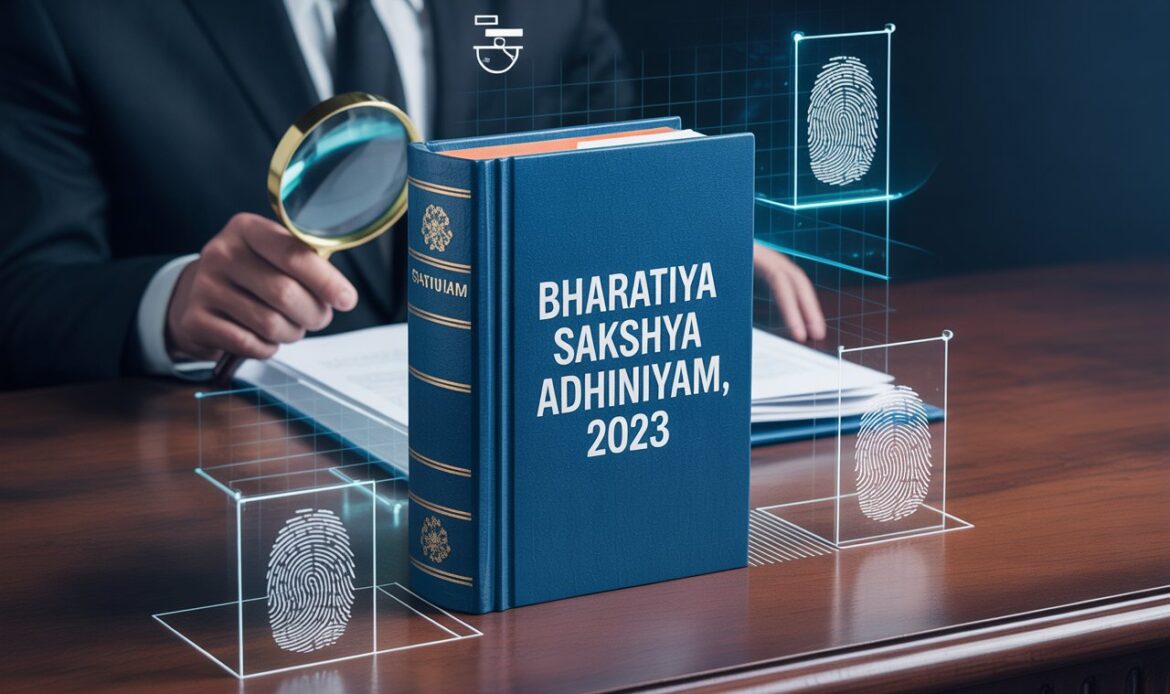
The Bharatiya Sakshya Adhiniyam, 2023 is India’s new evidence law that succeeds the colonial-era Indian Evidence Act of 1872. As part of the sweeping criminal law reforms of 2023, this piece of legislation is designed to modernize, simplify, and harmonize rules of evidence with the requirements of today’s justice system. Through this, it will respond to both conventional trial norms and contemporary challenges of digital records, electronic contracts, and cross-border transactions.
The object of this Adhiniyam can be comprehended in three components:
- Consolidation of principles: The Act consolidates fundamental rules of evidence into one, revised statute, eschewing the contradictions and obsolete language of the previous law.
- Modernisation: It acknowledges electronic records, digital signatures, and other technology-based documents as admissible evidence, thereby sharply breaking with an exclusively paper-based system.
- Accessibility: With more understandable language and organized provisions, it is made more accessible not just to lawyers and judges but also to businesses, compliance officers, and investigators.
The scope of the Bharatiya Sakshya Adhiniyam Bare Act is broad:
- It encompasses all judicial proceedings in courts in India.
- It covers courts-martial held under Army, Navy, and Air Force legislation.
- Some things, including affidavits and proceedings in arbitrations, continue to be outside its scope, as was the case under the old system.
The significance of the Act is that it provides the basis for an equitable trial. Rules of evidence determine what facts can be established, how they may be established, and how much weight is attributed to them. Without well-defined standards of evidence, justice can be denied or postponed.
For compliance teams, students, and professionals alike, having access to the Bharatiya Sakshya Adhiniyam Corrida Legal resource, both in the form of the Bharatiya Sakshya Adhiniyam PDF file and as an option for a genuine bare act download, guarantees that the law is accessible, dependable, and uncomplicated to utilize in practice.
Key Definitions under the Bharatiya Sakshya Adhiniyam, 2023
The Bharatiya Sakshya Adhiniyam, 2023 starts with definitions, which are the building blocks of the entire law of evidence. They are technical and also influence how courts, attorneys, and investigators understand what can be presented before a judge and how facts are to be established.
Court
The definition “court” embraces all magistrates and judges, as well as individuals legally empowered to receive evidence. It does not embrace arbitrators, however. This clearly indicates that judicial proceedings are covered under the Adhiniyam but leaves arbitration to an independent framework.
Document
A “document” within the Adhiniyam is not limited to writing on paper. It extends to anything communicated through letters, figures, marks, or electronic media. PDF stored contracts, emails, and even digital signatures fall within the definition.
Evidence
“Evidence” includes and means:
- All statements allowed or required to be made by witnesses in the court, and
- All documents, including electronic records, produced for examination by the court.
- This definition understands that oral and documentary evidence are both at the heart of trials.
Fact and Fact in Issue
A “fact” is something which can be sensed by the senses or any mental state of which an individual is aware. A “fact in issue” is a fact that the court will have to determine to decide the case. For instance, whether a contract was executed or whether a consent was given in a criminal case can be a fact in issue.
Conclusive Proof and Presumption
When the Adhiniyam states a fact to be conclusive evidence of another, the court is bound to hold it final and will not permit evidence to contradict it. Presumptions, however, can be mandatory (“shall presume”) or discretionary (“may presume”), and are afforded to courts the latitude to make inferences where direct proof might be lacking.
Relevance of Digital and Electronic Records
One of the key amendments in the Bharatiya Sakshya Adhiniyam Bare Act is the specific incorporation of electronic and digital records. This ensures that emails, digital contracts, CCTV footage, and other computer-based materials are admissible as evidence on par with conventional documents.
Relevance of Facts and Evidence Rules
The Bharatiya Sakshya Adhiniyam, 2023 lays down elaborately what type of facts may be led into evidence before a court. Not all facts that appear related to a case are relevant in law. The Act lays down strict guidelines so that courts depend upon evidence exclusively that aids in establishing or negating the facts in issue.
Facts in Issue and Relevant Facts
A “fact in issue” is the key point which the court has to resolve, for example, whether a contract was signed or whether a person accused of something did a certain act. “Relevant facts” are those which are so related to the facts in issue that they enable the court to conclude. This distinction is significant because it helps keep trials centered on facts of significance, rather than inundated with irrelevant detail.
Same Transaction Principle
At other times, a group of facts might seem unimportant in isolation, but by viewing them together, they are part of the same line of events. The Adhiniyam permits such facts to be taken into account if they are all part of the “same transaction.” For instance, the steps involved in a fraud, even if they occurred separately, can all be brought before court if they reveal a consistent sequence.
Motive, Preparation and Conduct
At times, a group of facts can be unimpressive individually but together, they are part of the same sequence of events. The Adhiniyam permits such facts to be admissible in court if they are part of “the same transaction.” Steps towards a fraud, for instance, no matter how they occurred at different times, could all be brought before the court if they demonstrate a consistent sequence.
Facts Required to Explain or Introduce Facts in Issue
Some facts are accepted only because they explain or put the facts in issue into context. Such evidence is provided for in the Act, as it would otherwise leave the facts in issue looking incomplete or inconclusive. For example, background facts or attendant circumstances might be required so that the court can fully enjoy the evidence.
Types of Evidence
The Bharatiya Sakshya Adhiniyam, 2023 sets out the different forms of evidence that can be presented before a court. Evidence may come through spoken words, written or recorded documents, or through digital and electronic records. Each type has its own rules of admissibility and weight.
Oral Evidence
Oral evidence refers to statements made by witnesses in court. The general rule is that oral testimony must be direct, the person who perceived the fact must speak about it. For example, if someone saw a contract being signed, only that person can testify to the signing. Hearsay, or statements made by someone who did not directly observe the fact, is not accepted except in limited situations recognised by law.
Documentary Evidence
Documentary evidence includes all documents that are produced before the court for inspection. This is divided into two categories:
- Primary evidence – the original document itself, such as the original signed contract or deed.
- Secondary evidence – copies or other forms used when the original is not available, subject to the conditions laid down in the Act. For example, a certified copy of a registered document may be admitted as secondary evidence.
The distinction matters because courts prefer primary evidence and accept secondary evidence only when legally permitted.
Electronic and Digital Records
A major change under the Bharatiya Sakshya Adhiniyam bare act is the clear recognition of electronic and digital records as admissible evidence. Emails, digital contracts, CCTV footage, text messages, and electronic signatures are all expressly covered. The Act also prescribes conditions for proving the authenticity of such records to ensure reliability. This provision reflects the reality of modern disputes, where electronic material often forms the main part of the evidence.
Admissions and Confessions
The Bharatiya Sakshya Adhiniyam, 2023 addresses admissions and confessions as significant sources of evidence. Such provisions determine when statements by parties or persons accused can be relied upon in court and under what conditions they have to be ruled out to provide justice.
Admissions and Their Relevance
An admission is an oral or written statement that invites an inference regarding a fact in controversy or a pertinent fact. Admissions are not conclusive evidence, but they are extremely important. Admissions can be used against a person for whom they were made because they represent acknowledgment of something. For instance, a party’s letter stating that they accept liability can be considered an admission in a civil action.
Statements by Parties, Agents, and Third Parties
Admissions do not just include parties themselves. Statements by agents in authority, partners in a firm, or individuals in common interest can also be admissions. Third-party statements, too, can be relevant if they were made under authority or in conditions in which the law acknowledges their impact. It thus broadens what could be taken to court as an admission.
Confession Rules – Admissibility and Exclusion
Confession is a declaration made by a person accused of a crime confessing his/her guilt. Law, however, goes slow in acting on confessions. A confession, to be acceptable as evidence, should be voluntary and unbiased, free from any pressure, threat, or inducement. If got through coercion or undue pressure, it is not accepted, for such admissions are not expressions of the free will of the accused.
Confession Before Police or Magistrates
The Adhiniyam incorporates the rule that confessions to police officers are not admissible per se. This protection ensures that there cannot be an abuse of authority and the accused is safe under the law. Yet, a confession in the presence of a magistrate, recorded as per the procedure prescribed by law, is accepted. The presence of a judicial officer ensures that the statement is voluntary and true.
Statements by Persons Not Available as Witnesses
The Bharatiya Sakshya Adhiniyam, 2023 makes specific provision in the case of a person being unable to present themselves as a witness but their statement can still prove useful in court. The Act enumerates clear categories wherein such statements are admissible. This prevents material facts from being lost simply because the witness is not available. Reading the original Bharatiya Sakshya Adhiniyam PDF file makes professionals more aware of these exceptions.
Dying Declarations
A confession made by an individual regarding the cause of his death, or the events that resulted in it, is admissible if the individual dies. Such dying declarations have been accepted in Indian law since a long time ago, as they are deemed truthful and trustworthy. The Bharatiya Sakshya Adhiniyam bare act follows this practice and accepts such statements as valid evidence.
Statements in the Ordinary Course of Business
Entries and records made in the ordinary course of business, including account books, registers, or official logs, can also be admissible even when the author is unable to testify. Since they are made in the course of doing business and for regular purposes, the law deems them to be reliable. This is especially beneficial to companies and compliance officers making use of the Bharatiya Sakshya Adhiniyam Corrida Legal resource for advice.
Judicial Notice and Presumptions
The Bharatiya Sakshya Adhiniyam, 2023 also sets out rules about judicial notice and legal presumptions. These provisions save time in court and provide clarity in situations where certain facts are either too well-known to be proved, or where the law itself requires an assumption to be made. The authentic text of the Bharatiya Sakshya Adhiniyam PDF file explains these categories in detail.
Facts of Which Courts Take Judicial Notice
Courts are not required to demand formal proof for certain facts that are already established or commonly known. These include matters like the existence of laws, official seals, the course of nature, or widely recognised events. By taking judicial notice of such facts, courts ensure that proceedings are efficient. Under the Bharatiya Sakshya Adhiniyam bare act, parties are spared the unnecessary effort of proving facts that are already beyond doubt.
Presumptions in Law
The Adhiniyam also deals with presumptions. These operate when direct evidence may be missing but the law allows the court to draw an inference. The Act recognises three kinds of presumptions:
- “May presume” – The court has discretion to treat a fact as proved, but it is not bound to do so.
- “Shall presume” – The court must treat the fact as proved unless evidence is given to disprove it.
- Conclusive proof – The court must accept the fact as final and cannot allow any evidence against it.
These presumptions guide judges in evaluating cases fairly and consistently. For professionals and compliance officers, referring to the Bharatiya Sakshya Adhiniyam Corrida Legal resource or downloading the Bharatiya Sakshya Adhiniyam, 2023 bare act is essential to understand how presumptions apply in different situations.
Opinions of Experts and Third Parties
The Bharatiya Sakshya Adhiniyam, 2023 recognises that courts cannot always decide complex issues on their own. In matters involving science, technology, handwriting, or specialised fields, the opinion of experts becomes relevant. The law also allows certain non-expert opinions to be considered when they relate to customs, relationships, or matters of general interest. These provisions are clearly explained in the Bharatiya Sakshya Adhiniyam PDF file, making it easier for professionals to apply them in practice.
Expert Opinions
When a case involves questions of science, art, foreign law, handwriting, or the authenticity of electronic records, the court may rely on expert opinion. For example, a handwriting expert may be asked to compare signatures, or a digital forensic expert may testify about the reliability of electronic evidence. Under the Bharatiya Sakshya Adhiniyam bare act, such expert evidence is not conclusive but helps the court form a judgment on technical matters.
Opinions on Customs and Relationships
The Act also permits opinions of persons who are familiar with long-standing customs or family relationships. For instance, in cases involving succession, marriage validity, or usage-based rights, the testimony of those acquainted with local customs may be relevant. This approach recognises that social practices cannot always be proved with documents, and oral knowledge may be necessary.
Opinions on General Rights or Public Matters
In addition, the law allows opinions on issues of public rights, communal practices, or matters of general interest to be admitted. Such opinions are treated cautiously but provide useful guidance where written records do not exist. This ensures that courts have access to local and practical knowledge while deciding disputes.
For lawyers, compliance officers, and students, the availability of the Bharatiya Sakshya Adhiniyam Corrida Legal resource and the option to access the Bharatiya Sakshya Adhiniyam, 2023 bare act download ensures that these rules are readily available in an authentic format for study and practical use.
Conclusion
The Bharatiya Sakshya Adhiniyam, 2023 replaces the 150-year-old Indian Evidence Act and provides a framework that matches the needs of today’s courts and society. By formally recognising electronic records, simplifying language, and keeping the core principles of evidence intact, the Act balances continuity with reform.
For practitioners, judges, investigators, and compliance officers, the Act serves as the foundation for every trial. It determines what can be proved, how it must be proved, and the degree of reliability to be attached to facts. Without such a clear law of evidence, the functioning of criminal and civil justice would lack uniformity and certainty.
Students and professionals benefit from having the authentic Bharatiya Sakshya Adhiniyam PDF file available for direct reference. Through Corrida Legal’s resources, the Bharatiya Sakshya Adhiniyam bare act download is accessible in a reliable format, along with executive summaries that highlight the key provisions. This helps users avoid dependence on incomplete notes or outdated commentaries.
In short, the Bharatiya Sakshya Adhiniyam Corrida Legal resource ensures that the new law of evidence is not only available but also easy to understand and apply. As India moves forward with updated criminal law, this statute will guide courts and legal practitioners in deciding how facts are proved and justice is delivered.
About Us
Corrida Legal is a boutique corporate & employment law firm serving as a strategic partner to businesses by helping them navigate transactions, fundraising-investor readiness, operational contracts, workforce management, data privacy, and disputes. The firm provides specialized and end-to-end corporate & employment law solutions, thereby eliminating the need for multiple law firm engagements. We are actively working on transactional drafting & advisory, operational & employment-related contracts, POSH, HR & data privacy-related compliances and audits, India-entry strategy & incorporation, statutory and labour law-related licenses, and registrations, and we defend our clients before all Indian courts to ensure seamless operations.
We keep our client’s future-ready by ensuring compliance with the upcoming Indian Labour codes on Wages, Industrial Relations, Social Security, Occupational Safety, Health, and Working Conditions – and the Digital Personal Data Protection Act, 2023. With offices across India including Gurgaon, Mumbai and Delhi coupled with global partnerships with international law firms in Dubai, Singapore, the United Kingdom, and the USA, we are the preferred law firm for India entry and international business setups. Reach out to us on LinkedIn or contact us at contact@corridalegal.com/+91-9211410147 in case you require any legal assistance. Visit our publications page for detailed articles on contemporary legal issues and updates.
Legal Consultation
In addition to our core corporate and employment law services, Corrida Legal also offers comprehensive legal consultation to individuals, startups, and established businesses. Our consultations are designed to provide practical, solution-oriented advice on complex legal issues, whether related to contracts, compliance, workforce matters, or disputes.
Through our Legal Consultation Services, clients can book dedicated sessions with our lawyers to address their specific concerns. We provide flexible consultation options, including virtual meetings, to ensure ease of access for businesses across India and abroad. This helps our clients make informed decisions, mitigate risks, and remain compliant with ever-evolving regulatory requirements.