

Reviewed and Validated by: Aakrist Goyal, Associate
Introduction
Employment contracts are vital in defining the relationship between employers and employees, outlining rights, responsibilities, and expectations. This article, “Drafting Employment Contracts in India: Legal Guidelines and Case Laws,” explores the essential legal guidelines and significant case laws that influence the drafting of employment contracts in India.
Essential Elements of Employment Contracts
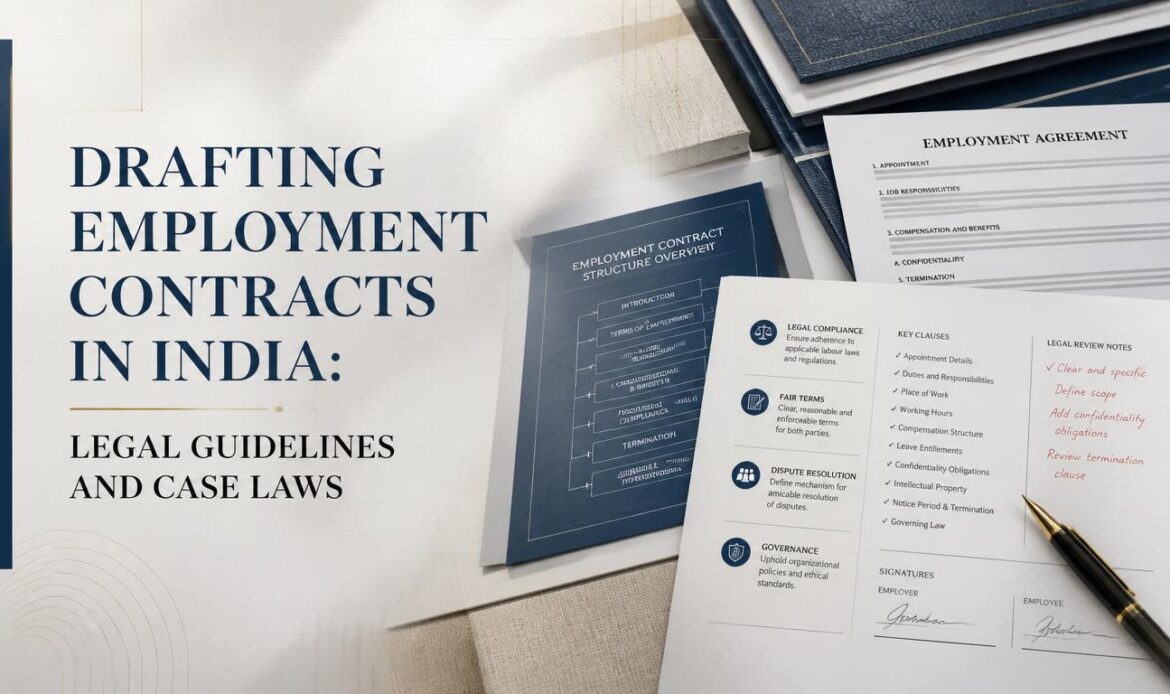
- Key Clauses: Job description, salary and benefits, working hours, confidentiality, and termination conditions.
- Legal Requirements: Must comply with Indian labor laws and regulations, ensuring all statutory rights are protected.

Statutory Requirements for Employment Contracts
- Compliance with Labor Laws: Contracts must align with statutes such as the Industrial Employment (Standing Orders) Act, 1946, and the Contract Labour (Regulation and Abolition) Act, 1970.
- Non-Compete and Non-Disclosure Agreements: Must be reasonable in scope and duration to be enforceable.
Read another article: Key Challenges in Implementing POSH Policies in Corporate India
Dispute Resolution in Employment Contracts
- Internal Mechanisms: Grievance redressal procedures and arbitration clauses.
- External Mechanisms: Recourse to labor courts and industrial tribunals.
Notable Case Laws on Employment Contracts
- Niranjan Shankar Golikari v. Century Spinning and Mfg. Co. Ltd. (1967): Validated the enforceability of non-compete clauses.
- Superintendence Company of India v. Krishan Murgai (1980): Addressed the reasonableness of restrictive covenants.
- Central Inland Water Transport Corporation v. Brojo Nath Ganguly (1986): Established principles for unfair dismissal and unconscionable contracts.
Conclusion
Drafting effective employment contracts requires a thorough understanding of legal requirements and judicial interpretations. Ensuring compliance and clarity can prevent disputes and foster a positive employment relationship.