

Reviewed and Validated by: Naman Jain, Associate
Introduction – Specific Relief Act 1963 PDF
The Specific Relief Act 1963 PDF replaced the old law of 1877. Parliament brought it in to give remedies where damages are not enough. It is not about making contracts, it is about enforcing them. The Act allows courts to order specific performance of contracts, recovery of possession, rectification of documents, injunctions, and declaratory relief. This is why it is treated as a special civil law. Lawyers, students, and even businesses often keep the bare act handy, since most disputes in property and contracts end up relying on it.
Purpose – Specific Relief Act 1963 Bare Act
The Specific Relief Act 1963 bare act shows the purpose clearly – damages are not always the right remedy. Many contracts cannot be settled with money. Land, property, and certain commercial projects require actual enforcement. The bare act provides that courts can grant specific performance, order rectification of contracts, or cancel instruments that are void or unlawful. It is based on equity – giving the right remedy for the right situation.
Scope – Specific Relief Act Executive Summary
The Specific Relief Act executive summary makes it clear that the Act applies only to civil rights. It does not cover criminal wrongs. The scope is limited but powerful. It covers performance of contracts, injunctions, declaration of rights, substituted performance, rectification, and recovery of possession. It is often used in property disputes, real estate contracts, and business agreements. Courts apply it where ordinary contract law is not enough.
Remedies – Specific Relief Act Key Provisions
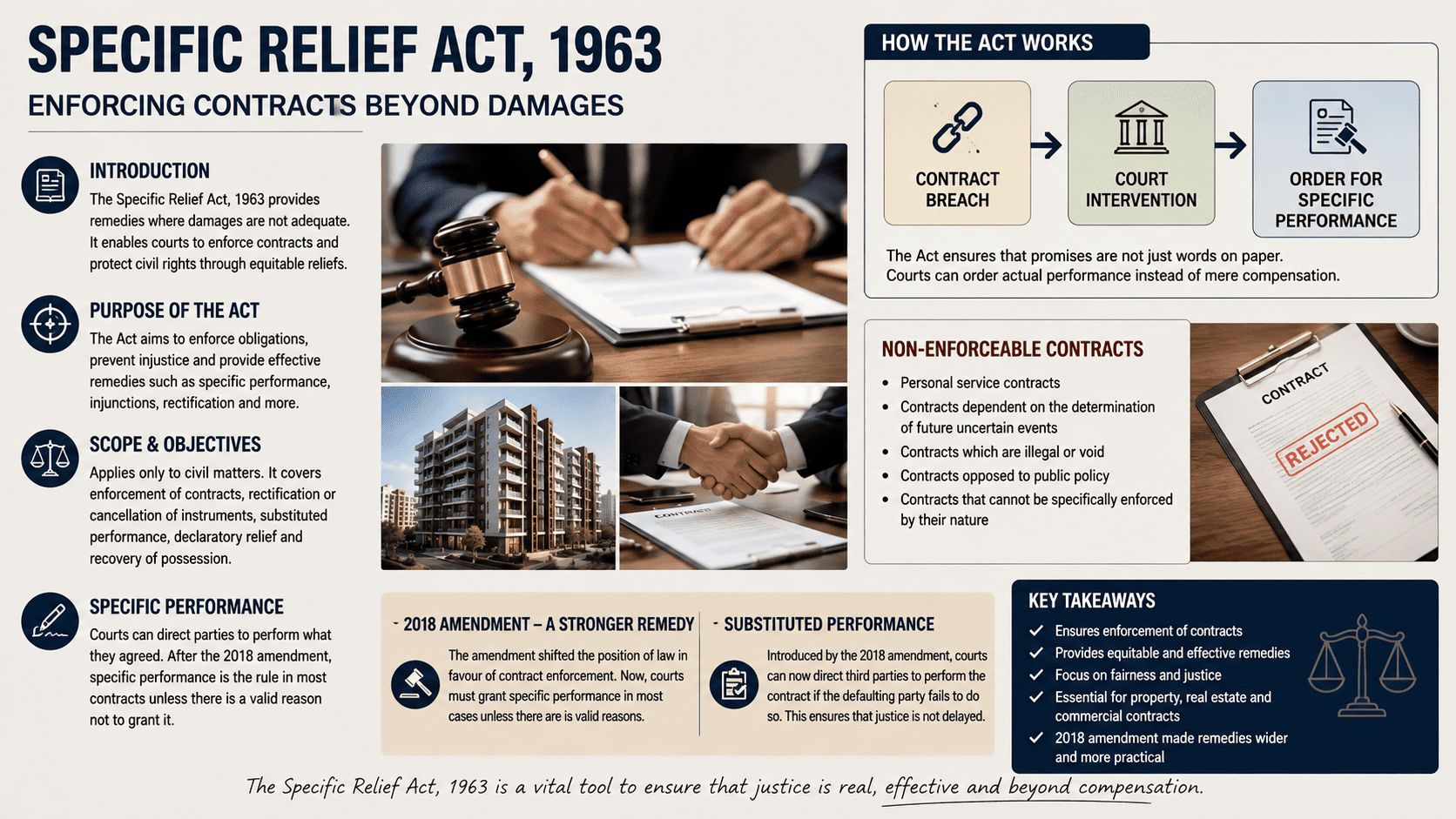
The Specific Relief Act key provisions are specific performance, injunctions, declaratory decrees, substituted performance, and recovery of property. These remedies are narrow but effective. They stop breach from becoming permanent. They also ensure that parties cannot escape liability by just paying damages. For contracts of property and infrastructure, these provisions are central.
Performance – Specific Relief Act Specific Performance
The Specific Relief Act specific performance provisions are the heart of the Act. Courts can direct parties to perform what they agreed. Earlier this was discretionary. After the 2018 amendment, courts must grant specific performance in most contracts, unless there is clear reason not to. This has changed the law in favour of performance, especially in commercial contracts and real estate.
Preventive Relief – Specific Relief Act Injunctions and Remedies
The Specific Relief Act injunctions and remedies include temporary and permanent injunctions. Courts grant them to stop unlawful acts, protect property, and prevent breach of contracts. Preventive relief ensures rights are preserved before damage is done. Injunctions, along with specific performance, are the most common reliefs granted under this Act.
Observations
- Act is narrow but effective.
- Applies where damages cannot give complete justice.
- Specific performance and injunctions are central.
- Used mainly in property, real estate, and commercial contracts.
- 2018 amendment made remedies wider and stronger.
Scope and Objectives – Specific Relief Act 1963 Bare Act
The Specific Relief Act 1963 bare act is not a wide law. It has limited scope. It applies only to civil rights. It does not apply to criminal wrongs. It comes in only when ordinary damages are not enough.
The Act covers enforcement of contracts, injunctions, rectification or cancellation of instruments, substituted performance after amendment, declaratory relief, and recovery of possession. That is the scope. Nothing beyond this. If another statute already provides full remedy, then this Act does not apply. That is why it is called specific relief.
Objectives – Specific Relief Act Executive Summary
The Specific Relief Act executive summary makes the objectives clear. To enforce obligations. To prevent unlawful acts. To protect property and possession. To provide equitable remedies when money is not sufficient.
The Act is not punitive. It is remedial. It ensures that promises are carried out and rights are preserved. Courts use it to give relief that is precise and effective, not general.
Key Areas – Specific Relief Act Key Provisions
The Specific Relief Act key provisions show how objectives are achieved. Specific performance of contracts. Injunctions to stop breaches. Rectification and cancellation of documents. Declaratory decrees where rights are uncertain. Substituted performance as a new remedy. Recovery of possession when unlawful dispossession occurs. These are the areas where the Act operates.
Performance – Specific Relief Act Specific Performance
The Specific Relief Act specific performance provisions reflect the main purpose. Instead of damages, courts order actual performance. This is important in contracts relating to land, property, or major projects. Earlier it was discretionary. After the 2018 amendment, it became the rule in most cases.
Preventive Role – Specific Relief Act Injunctions and Remedies
The Specific Relief Act injunctions and remedies part is preventive. Courts grant injunctions to stop harm before it happens. Temporary or permanent injunctions, depending on the situation. Relief to maintain rights until the case is decided. Protection against trespass, nuisance, or breach of agreement.
Key Definitions – Specific Relief Act 1963 PDF
The Specific Relief Act 1963 PDF begins with basic definitions which set the scope of the law. These definitions are not many, but they control how the Act works. Courts and inspectors rely on them first. A single definition can decide whether a party will get relief or not. In practice, these terms are referred to again and again during arguments and judgments.
Relief – Specific Relief Act 1963 Bare Act
Under the Specific Relief Act 1963 bare act, relief means the remedy a civil court can grant. Relief is not a penalty. Relief is not punishment. Relief is not general damages. Relief here means:
- enforcing performance of a contract,
- granting an injunction to stop a wrongful act,
- declaring rights in property or agreements,
- rectifying or cancelling instruments, and
- recovering possession.
This Act is about giving the exact remedy needed to protect the right, not about imposing punishment.
Civil Rights – Specific Relief Act Executive Summary
The Specific Relief Act executive summary makes it clear that the Act applies only to civil rights. Civil rights here include rights in property, rights under contract, rights of lawful possession. Criminal wrongs are outside the scope. For example, trespass or breach of agreement can be handled under this Act because they are civil in nature. But theft, assault, or fraud leading to criminal prosecution is not covered.
Specific Performance – Specific Relief Act Key Provisions
The Specific Relief Act key provisions define specific performance as the order of court directing a party to actually perform its contractual obligation. This is different from damages. It is applied only in certain cases:
- contracts for immovable property,
- commercial contracts where compensation is not adequate,
- obligations that can be supervised by court.
Contracts that are personal in nature, require special skill, or are determinable are not enforceable. The definition is precise because courts should not enforce agreements which cannot be practically supervised.
Injunctions – Specific Relief Act Specific Performance
The Specific Relief Act specific performance part is closely tied to injunctions. Injunction means a court order to stop an act or to maintain status. Injunctions may be temporary or permanent. They are preventive in nature. Common cases include preventing construction on disputed land, stopping use of confidential information, or stopping breach of contract before it happens. The Act defines injunctions as one of the primary reliefs.
Remedies – Specific Relief Act Injunctions and Remedies
The Specific Relief Act injunctions and remedies section defines the various remedies available under the law. These include:
- specific performance of contracts,
- injunctions (temporary and permanent),
- declaratory relief where rights need clarification,
- rectification or cancellation of instruments,
- substituted performance introduced by the amendment, and
- recovery of possession of property.
Each of these is limited, but each has clear scope. Together they form the specific reliefs that courts can grant under this Act.
Types of Relief Available – Specific Relief Act 1963 PDF
The Specific Relief Act 1963 PDF provides only certain forms of relief. These are limited in number but very effective. The idea is that courts should not give general damages under this Act. That is left to the Contract Act. Here the focus is on remedies that directly protect the right. The Act recognises preventive and remedial relief. Preventive means stopping something before harm is done. Remedial means restoring or enforcing a right already affected.
Relief Against Breach – Specific Relief Act 1963 Bare Act
The Specific Relief Act 1963 bare act lists relief against breach of obligation. If a person is bound by contract or obligation, and they refuse to perform, the court can step in. Relief includes: ordering performance, restraining breach, rectifying documents, or declaring rights. It is important to note that not every breach qualifies. The breach must be such that damages alone cannot repair the harm.
Preventive Relief – Specific Relief Act Executive Summary
The Specific Relief Act executive summary states preventive relief is mainly by injunction. Injunctions are orders of the court telling a person not to do something unlawful. Examples include preventing a person from trespassing, stopping disclosure of confidential information, or halting construction on disputed land.
Preventive relief ensures the harm is stopped before it becomes permanent. It preserves rights while the dispute continues.
Remedial Relief – Specific Relief Act Key Provisions
The Specific Relief Act key provisions also provide remedial relief. These remedies enforce existing rights. Examples include: compelling a party to specifically perform a contract, declaring the legal rights of a person, or cancelling a document that was wrongly executed. The remedial side of the Act is about ensuring justice even after breach has occurred.
Specific Performance – Specific Relief Act Specific Performance
The Specific Relief Act specific performance rules fall under remedial relief. Instead of awarding damages, the court orders actual performance of a contract. This is common in property contracts, real estate agreements, and business arrangements where money is not a sufficient substitute. Courts apply this remedy to make sure that the aggrieved party gets what was agreed, not just money in place of it.
Injunctions and Declarations – Specific Relief Act Injunctions and Remedies
The Specific Relief Act injunctions and remedies part covers injunctions and declaratory decrees. Injunctions are preventive, while declarations clarify rights. For example, in a property dispute, a declaration can confirm ownership or lawful possession, while an injunction can prevent interference. Together, they provide both certainty and protection.
Specific Performance of Contracts – Specific Relief Act 1963 PDF
The Specific Relief Act 1963 PDF makes specific performance the most important remedy under this law. Instead of awarding damages, the court may order that the contract itself be carried out. This ensures that the aggrieved party gets the exact performance promised. The law recognises that in many cases money is not a sufficient substitute. Land, property, business projects, or contracts involving unique goods are examples where damages cannot fully protect the right.
Enforceable Contracts – Specific Relief Act 1963 Bare Act
The Specific Relief Act 1963 bare act explains which contracts can be specifically enforced. These include contracts for immovable property, contracts where compensation in money is not adequate, and commercial contracts where supervision of performance is possible. Courts also allow specific performance in cases where substituted performance by a third party is not practical.
In practice, enforceable contracts usually include:
- contracts for sale or transfer of land,
- real estate development agreements,
- business or infrastructure contracts where damages would not restore the position.
Non-Enforceable Contracts – Specific Relief Act Executive Summary
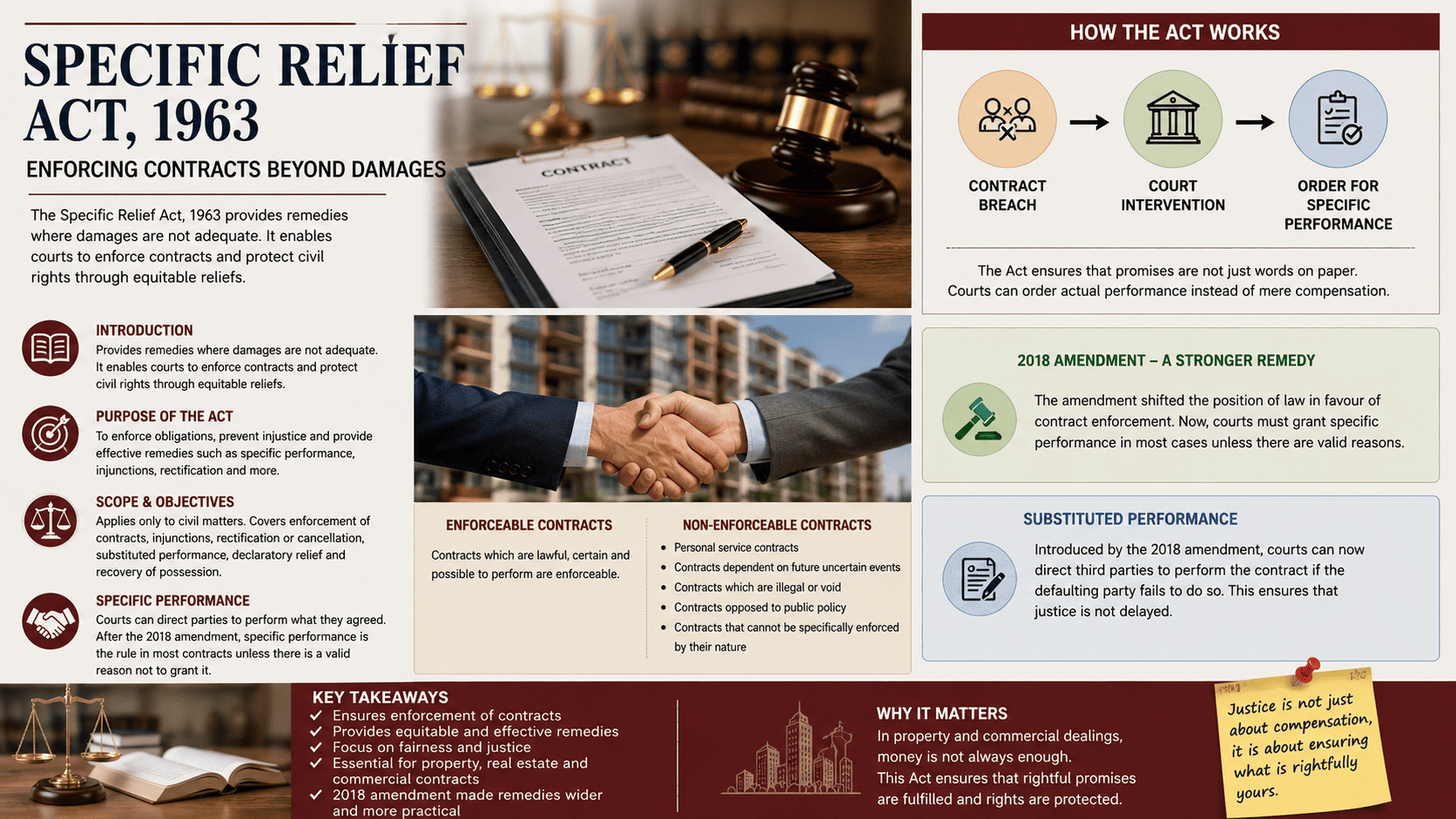
The Specific Relief Act executive summary also makes clear which contracts cannot be enforced. These are
contracts depending on personal skill, contracts that are uncertain in terms, and contracts that are by nature determinable. For example, an employment contract for personal services cannot be enforced. Similarly, a vague agreement without clear terms cannot be enforced.
This limitation protects courts from supervising contracts that are impossible or impractical to enforce.
Court’s Discretion – Specific Relief Act Key Provisions
The Specific Relief Act key provisions earlier gave discretion to courts to decide whether or not to grant specific performance. After the 2018 amendment, the discretion is reduced. Now, specific performance is the rule and not the exception. Courts are expected to grant this relief unless the case falls in the category of contracts excluded under the Act. This change was made to support business certainty and infrastructure projects.
Importance – Specific Relief Act Specific Performance
The Specific Relief Act specific performance remedy is widely used in property and business disputes. Courts direct parties to perform what they agreed, especially in cases of immovable property where land or property is unique. The importance of this remedy is that it prevents parties from escaping obligations by paying damages. It ensures contracts are honoured in substance, not just compensated in money.
Supporting Relief – Specific Relief Act Injunctions and Remedies
The Specific Relief Act injunctions and remedies provisions often work alongside specific performance. While the main relief is to compel performance, injunctions may be granted to stop the other party from transferring the property to someone else or from violating the agreement during the pendency of the case. Both remedies support each other to ensure complete justice.
Injunctions – Specific Relief Act 1963 PDF
The Specific Relief Act 1963 PDF also provides preventive relief in the form of injunctions. This is one of the most common remedies used in civil courts. Injunction means a court order to stop a person from doing something or to maintain a certain status. It is granted when damages are not an adequate remedy, and when immediate protection of rights is needed. Courts grant injunctions to avoid irreparable harm.
Nature of Injunctions – Specific Relief Act 1963 Bare Act
The Specific Relief Act 1963 bare act mentions two main types of injunctions: temporary and perpetual.
- Temporary injunctions are granted at an interim stage to maintain the situation until the final decision.
- Perpetual injunctions are granted by decree at the end of trial to permanently restrain unlawful acts. Temporary injunctions are governed by the CPC, but the substantive right to injunction comes from this Act.
The Specific Relief Act executive summary shows injunctions are a form of preventive relief. They are used in disputes involving property, possession, nuisance, trespass, and breach of contract. The idea is to stop harm before it becomes permanent. Common examples include:
- preventing sale of disputed property,
- restraining breach of confidential agreements,
- stopping encroachment on land,
- preventing misuse of trust property.
These are granted where damages are not sufficient protection.
When Courts Refuse – Specific Relief Act Key Provisions
The Specific Relief Act key provisions also make it clear when injunctions cannot be granted. Courts refuse injunctions when:
- damages are an adequate remedy,
- contract is determinable,
- injunction would stop performance of a contract dependent on personal skill,
- injunction would interfere with public duties.
This ensures that injunctions are granted only in proper cases, not as a weapon to harass the other side.
Connection with Performance – Specific Relief Act Specific Performance
The Specific Relief Act specific performance provisions often work together with injunctions. While specific performance compels a party to fulfil the contract, injunctions stop the party from breaching it during litigation. For example, when a contract for sale of land is under dispute, the court may order specific performance and also issue an injunction to stop the seller from transferring the property elsewhere.
Broader Role – Specific Relief Act Injunctions and Remedies
The Specific Relief Act injunctions and remedies provisions show injunctions are not only about contracts. They extend to property rights, trusts, and even negative obligations. A negative covenant in a contract — for example, an agreement not to compete — can also be enforced by injunction. This makes injunctions one of the broadest remedies under this Act.
Declaratory Relief – Specific Relief Act 1963 PDF
The Specific Relief Act 1963 PDF also provides for declaratory relief. This remedy is used when a person needs legal certainty about their rights. A declaration by the court does not order performance or grant damages. It simply states what the legal position is. This is important in property disputes, trust matters, and agreements where rights are unclear. Once the court declares a right, it becomes binding on all parties.
Nature of Declaration – Specific Relief Act 1963 Bare Act
The Specific Relief Act 1963 bare act explains that any person entitled to a legal character, or any right as to property, may seek a declaration from court. This means if a person’s status or property right is denied or challenged, they can approach court for a declaration. For example, if ownership of land is questioned, or if a trust deed creates confusion, a declaration can be sought.
Object of Declaration – Specific Relief Act Executive Summary
The Specific Relief Act executive summary highlights the object of declaratory relief. It is meant to remove uncertainty. It prevents future disputes by settling the legal position once and for all. Some common situations include:
- ownership disputes in property,
- interpretation of wills or trust deeds,
- status of a person under a contract,
- clarification of rights in partnership or family property.
The declaration acts as a shield, giving the party legal protection against future claims.
Limitation of Declaration – Specific Relief Act Key Provisions
The Specific Relief Act key provisions also set limits on this relief. A declaration alone cannot be sought where further relief is possible. If a person needs possession or injunction along with declaration, they must claim it. Courts do not allow mere academic declarations without practical purpose. The Act ensures that declarations are granted only when they serve a real need.
Link with Performance – Specific Relief Act Specific Performance
The Specific Relief Act specific performance rules sometimes go hand in hand with declaratory relief. For example, in a contract for sale of land, a declaration of ownership may be sought first, followed by a suit for specific performance. In this way, declarations are often the foundation for other remedies.
Supporting Role – Specific Relief Act Injunctions and Remedies
The Specific Relief Act injunctions and remedies provisions also connect with declarations. Often, a declaration is followed by injunction to stop interference with the declared right. For example, once the court declares a party as lawful owner, an injunction may be issued to restrain others from trespassing. The remedies complement each other.
Substituted Performance – Specific Relief Act 1963 PDF
The Specific Relief Act 1963 PDF after the 2018 amendment introduced substituted performance. Before this, the party had to depend on court orders for specific performance. Now, if one side refuses, the other side can get the work done by another person and then recover the cost. It keeps the project going. It avoids long delay.
Nature of Substituted Performance – Specific Relief Act 1963 Bare Act
The Specific Relief Act 1963 bare act says that substituted performance can be taken only after notice. The aggrieved party must give notice to the defaulting party. If the notice is ignored, then substituted performance is allowed. It is simple in process:
- serve notice,
- wait for reasonable time,
- arrange third party to complete the work,
- recover expenses from defaulting party.
This works well in contracts like construction, supply, infrastructure.
Object – Specific Relief Act Executive Summary
The Specific Relief Act executive summary shows the object. Work should not stop because one party refuses. Earlier, court cases took years, projects remained incomplete. Now substituted performance allows continuation. Later, expenses can be claimed. The main aim is continuity, not punishment.
Limits – Specific Relief Act Key Provisions
The Specific Relief Act key provisions make clear limits. Once substituted performance is taken, the aggrieved party cannot again ask for specific performance. They can only claim expenses. One choice must be made. This avoids double remedies.
Role in Contracts – Specific Relief Act Specific Performance
The Specific Relief Act specific performance remains important, but substituted performance adds another tool. In commercial projects, builders, contractors, suppliers cannot afford delay. This remedy is practical. It shifts the risk from courts to parties.
Support – Specific Relief Act Injunctions and Remedies
The Specific Relief Act injunctions and remedies often come together with substituted performance. Example: injunction to stop the defaulting party from obstructing the substituted performance. This keeps the process smooth and ensures rights are protected.
Rectification and Cancellation of Instruments – Specific Relief Act 1963 PDF
The Specific Relief Act 1963 PDF also covers rectification and cancellation of instruments. This is important because many disputes arise from documents which do not reflect the true agreement of parties, or which are void, fraudulent, or unlawful. Courts under this Act can either correct the document or cancel it altogether. The aim is to protect rights and avoid misuse of wrong instruments.
Rectification – Specific Relief Act 1963 Bare Act
The Specific Relief Act 1963 bare act says that when, through fraud or mutual mistake, a contract or instrument does not express the real intention, the court may rectify it. Rectification means correction. The court amends the document so that it represents the actual agreement. This is done only when both parties intended something else but the document shows error.
Common situations include:
- spelling mistake in name of party or property,
- wrong boundaries in land documents,
- omission of an agreed clause,
- clerical errors changing meaning. Rectification restores the true intention.
Cancellation – Specific Relief Act Executive Summary
The Specific Relief Act executive summary also provides cancellation as a remedy. If an instrument is void or voidable, the person affected may sue to have it cancelled. This prevents the document from being used against them in future. For example, forged sale deeds, fraudulent agreements, or documents executed without authority. Cancellation is a preventive measure so that invalid papers do not harm lawful rights.
Court’s Power – Specific Relief Act Key Provisions
The Specific Relief Act key provisions clarify the conditions. Rectification is allowed only where both parties intended differently but recorded wrongly. Cancellation is allowed when document is void, voidable, or likely to cause harm if left outstanding. The court balances equities before granting this remedy.
Link with Specific Performance – Specific Relief Act Specific Performance
The Specific Relief Act specific performance often works with rectification. If a contract is wrongly written, the court may first rectify it, then order specific performance of the corrected terms. Without rectification, enforcement would be unfair. This shows how remedies under the Act complement each other.
Support from Injunction – Specific Relief Act Injunctions and Remedies
The Specific Relief Act injunctions and remedies also support cancellation. Often injunction is granted to prevent use of fraudulent document until it is formally cancelled. This ensures protection during litigation. Courts may also combine cancellation with declaration and injunction for full relief.
Recovery of Possession – Specific Relief Act 1963 PDF
The Specific Relief Act 1963 PDF also provides the remedy of recovery of possession. This is one of the allows courts to restore possession even without deciding ownership in some cases. The idea is simple – lawful possession cannot be disturbed without authority of law.
Nature of Remedy – Specific Relief Act 1963 Bare Act
The Specific Relief Act 1963 bare act states that a person in possession of immovable property cannot be dispossessed except in accordance with law. Even a true owner cannot forcibly evict a lawful occupant. They must go to court. This is based on the principle that possession itself is a right and deserves protection.
Typical cases include:
- unlawful eviction by landlord,
- trespass by neighbours,
- interference by co-owners without authority,
- dispossession during pending disputes.
In all such cases, possession is restored first, then rights are decided separately.
Scope – Specific Relief Act Executive Summary
The Specific Relief Act executive summary shows that recovery of possession applies both to immovable and movable property. Immovable property includes land, houses, buildings. Movable property includes goods, machinery, even vehicles. If possession is unlawfully taken, the court can order return. This prevents strong-arm tactics and protects rule of law.
Procedure – Specific Relief Act Key Provisions
The Specific Relief Act key provisions outline the procedure. A suit for possession must be filed within limitation period. Plaintiff must prove possession and unlawful dispossession. Ownership proof is not necessary at this stage. The defendant can defend only on limited grounds, such as better title or lawful authority. This makes the remedy quick and effective.
Link with Specific Performance – Specific Relief Act Specific Performance
The Specific Relief Act specific performance and recovery of possession are often connected. For example, after decree for specific performance of sale agreement, possession of property is handed over through this remedy. Thus, recovery of possession completes the process of enforcement.
Supporting Relief – Specific Relief Act Injunctions and Remedies
The Specific Relief Act injunctions and remedies support recovery by preventing further interference. Injunctions are often granted along with possession orders, so that the dispossessed party is not again harassed. This ensures stability after restoration.
Conclusion – Specific Relief Act 1963 PDF
The Specific Relief Act 1963 PDF remains a central law in civil remedies. It is narrow in scope but very strong in effect. The Act covers only civil rights, not criminal wrongs. It provides remedies like specific performance, injunctions, declaratory decrees, rectification, cancellation, substituted performance, and recovery of possession. These are limited but effective.
The law ensures that parties cannot escape obligations by simply paying damages. Contracts are enforced, unlawful acts are prevented, and possession is protected. The remedies under this Act are equitable, not punitive. They are designed to give exact justice in cases where ordinary compensation is not enough.
