

Reviewed and Validated by: Naman Jain, Associate
Introduction – Consumer Protection Act 2019 PDF
The Consumer Protection Act 2019 PDF was enacted to replace the old Consumer Protection Act of 1986. The earlier law was not enough to deal with new forms of trade, online platforms, and misleading advertisements.
With the growth of e-commerce, digital transactions, and new methods of consumer exploitation, a stronger law was needed. The 2019 Act is therefore a complete framework for consumer rights and dispute resolution. It gives wider powers and faster remedies compared to the 1986 Act. Lawyers, students, and business owners frequently rely on the Consumer Protection Act 2019 PDF as a ready reference.
Background – Consumer Rights in India 2019
The consumer rights in India 2019 are built on the principles of safety, information, choice, and redressal. Earlier these rights were recognised but not properly enforced. The 2019 Act recognises them clearly and gives a statutory basis. The law now protects consumers not only against defective goods and services but also against digital unfair practices, fake reviews, and online fraud.
Objectives – Consumer Protection Act Executive Summary
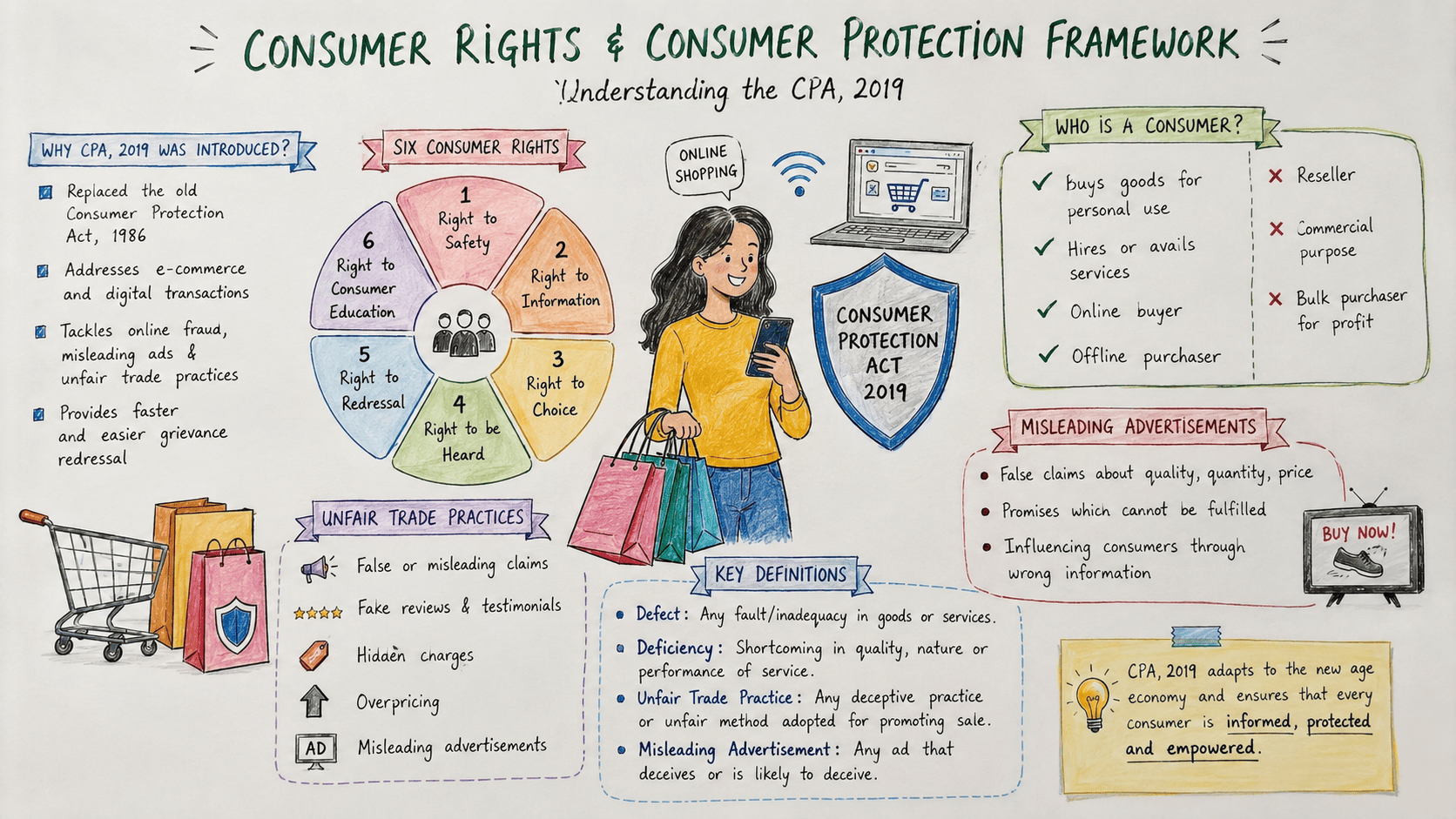
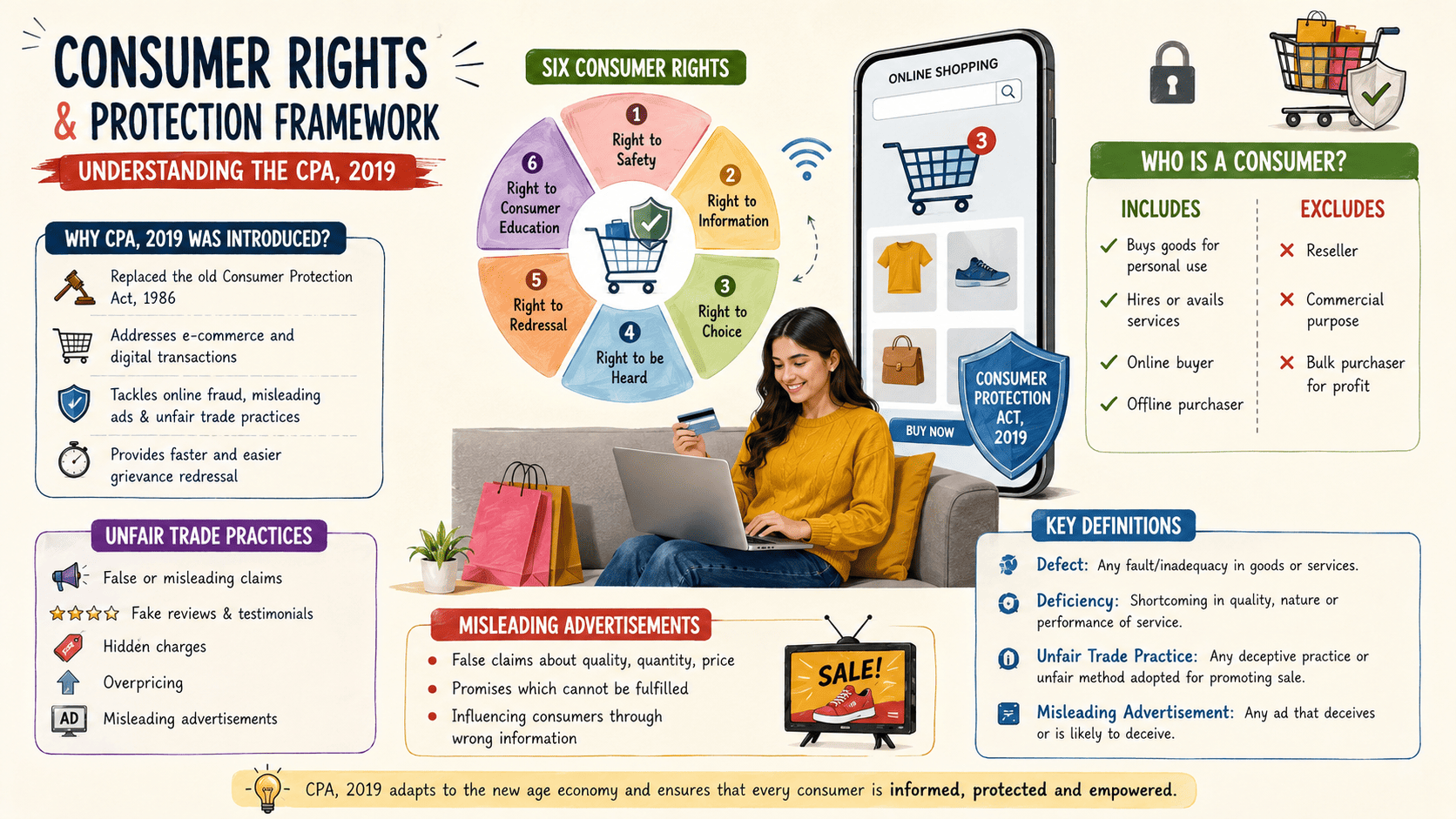
The Consumer Protection Act executive summary shows the objective of the new Act. It was brought in to:
- strengthen consumer councils and commissions,
- establish a central authority with powers to investigate,
- widen the definition of consumer to include online transactions,
- give faster remedies through mediation and online filing. The objective is to create a modern law in line with today’s economy. Replacement – Consumer Dispute Redressal PDF
The consumer dispute redressal PDF provisions are the backbone. The 1986 Act had a three-tier system but pecuniary limits were outdated. The 2019 Act revises limits, allows e-filing of complaints, and creates scope for mediation. District, State, and National Commissions have been restructured to handle larger volumes and higher claims.
New Authority – Central Consumer Protection Authority 2019
The Central Consumer Protection Authority 2019 (CCPA) was created as a new regulator. This was missing in the earlier law. The CCPA can investigate unfair trade practices, penalise misleading advertisements, order recall of goods, and even take action against endorsers. This makes enforcement stronger and quicker.
Wider Framework – Consumer Protection Councils and Commissions PDF
The consumer protection councils and commissions PDF sections strengthen advisory and redressal bodies. Consumer councils at Central, State, and District levels promote rights. Commissions decide disputes with higher financial powers. Together with the CCPA, they form the framework for modern consumer protection.
Objectives – Consumer Protection Act executive summary
The consumer protection act executive summary makes clear that the 2019 law was needed because the old 1986 Act had become insufficient. The market has changed with e-commerce, online payments, misleading digital ads, and large-scale consumer exploitation. The new Act was brought to give stronger enforcement, faster dispute resolution, and wider protection of rights. It is focused on preventing unfair practices, penalising wrongdoers, and creating a balance between business and consumer rights.
Recognition of Rights – consumer rights in India 2019
The consumer rights in India 2019 are specifically written in the Act. They are: the right to be protected against hazardous goods and services, the right to be informed about price and quality, the right to choose, the right to be heard, the right to redressal, and the right to consumer education. These six rights are not only guiding principles but enforceable. Earlier laws recognised them indirectly, but this Act makes them statutory and binding.
Stronger Bodies – consumer protection councils and commissions PDF
The consumer protection councils and commissions PDF sections show that institutions are given a stronger role. There are councils at central, state and district levels which guide policy and promote awareness.
Commissions are the dispute forums with revised pecuniary limits. Now, larger claims can be decided at district and state levels. The institutions are restructured so that consumers can approach them more easily and get quicker justice.
New Enforcement – central consumer protection authority 2019
The central consumer protection authority 2019 (CCPA) is created under this Act. This is a new body that did not exist earlier. It has powers to investigate unfair trade practices, to penalise companies for misleading advertisements, to recall defective goods, and even to act against endorsers who promote false claims. The CCPA can pass binding orders and impose penalties. This makes consumer law stronger because earlier commissions could only decide individual disputes.
Speed of Remedy – consumer dispute redressal PDF
The consumer dispute redressal PDF provisions bring in faster remedies. Complaints can now be filed online. The process allows mediation as an alternative, so disputes can be settled without long court battles. Pecuniary limits are updated — for example, higher-value disputes can now be filed at state or national level without confusion. This ensures that consumers get justice at a pace matching modern business transactions.
Modern Approach – consumer protection act 2019 PDF
The consumer protection act 2019 PDF shows the modern approach. It does not only cover goods and services in physical form but also includes e-commerce, online trade, and digital platforms. It balances responsibilities of sellers and platforms with protection of consumers. It also makes endorsers and advertisers accountable. The Act adapts consumer law to the new economy.
Key Definitions – consumer rights in India 2019
The consumer rights in India 2019 are based on clear definitions in the Act. Definitions decide who is a consumer, what counts as defect or deficiency, and how unfair trade practices are identified. Without these, the law cannot be applied. Courts and commissions rely on these words exactly as written. The scope of the Act expands because the definitions now cover online and digital transactions also.
Who is a Consumer – consumer protection act 2019 PDF
The consumer protection act 2019 PDF defines a consumer as a person who buys goods or hires services for consideration. It includes users of such goods and services, but it does not include people who purchase for resale or commercial purpose. The 2019 Act adds digital and e-commerce transactions, so buyers on online platforms are also included.
Key points under this definition:
- payment can be full, partly paid, or promised,
- goods and services both covered,
- online, offline, and electronic modes included,
- excludes resale or commercial use.
Unfair Practices – central consumer protection authority 2019
The central consumer protection authority 2019 provisions highlight unfair trade practices. These include misleading advertisements, false representation of quality, hoarding, charging more than MRP, or adopting unfair terms in contracts. The Act also covers e-commerce unfair practices, such as fake online reviews or hiding material information.
Misleading Advertisements – consumer protection councils and commissions PDF
The consumer protection councils and commissions PDF sections recognise misleading advertisements as a separate issue. Any ad that gives false description, exaggerates quality, or conceals facts is treated as misleading. This applies not only to manufacturers but also to endorsers and influencers. Penalties can be imposed through the CCPA and commissions.
Dispute and Complaint – consumer dispute redressal PDF
The consumer dispute redressal PDF provisions define complaint as any allegation filed by a consumer regarding unfair trade practice, defective goods, deficient service, charging more than fixed price, or sale of hazardous goods. Dispute means the conflict between consumer and trader or service provider regarding such complaint. These basic definitions guide how commissions admit and decide cases.
Consumer Rights – consumer rights in India 2019
The consumer rights in India 2019 are now fully recognised under the Act. Earlier, these were guiding principles but not enforceable in the same way. The 2019 Act makes them statutory. A consumer can directly rely on them before a commission. These rights apply to goods and services, offline as well as online, traditional markets as well as digital platforms.
Right to Safety – consumer protection act 2019 PDF
The consumer protection act 2019 PDF provides that every consumer has the right to be protected against goods and services which are hazardous to life and property. This means that manufacturers and service providers must ensure safety standards. For example, unsafe food, defective vehicles, or poor quality medical treatment come under this.
Right to Information – consumer protection act executive summary
The consumer protection act executive summary recognises the right to be informed. Consumers must know about quality, quantity, purity, standard, and price. Sellers and service providers are bound to disclose material information. Examples include details on packaging, MRP, expiry date, warranty, and risks associated with usage.
Right to Choice – central consumer protection authority 2019
The central consumer protection authority 2019 ensures that consumers have the right to choose from a variety of goods and services at competitive prices. Practices like tying arrangements, monopoly supply, or forcing specific brands are against this right. Choice is an essential safeguard for consumers in both physical stores and e-commerce platforms.
Right to Be Heard – consumer protection councils and commissions PDF
The consumer protection councils and commissions PDF highlight the right to be heard. Consumers can present their grievances before forums, councils, and commissions. This right ensures that complaints are not ignored. Representation before consumer bodies is part of this right.
Right to Redressal – consumer dispute redressal PDF
The consumer dispute redressal PDF provisions secure the right to redressal. A consumer can approach district, state, or national commission depending on the value of goods or services. Redressal may include refund, replacement, removal of defects, or compensation. The Act also provides for mediation to resolve disputes quickly.
Right to Education – consumer rights in India 2019
The consumer rights in India 2019 include the right to consumer education. The Act requires awareness programs, campaigns, and promotion of consumer rights at all levels. This ensures that consumers are informed of their rights and remedies available under the law.
Authorities Established – central consumer protection authority 2019
The central consumer protection authority 2019 is one of the major features of the new Act. The earlier 1986 law did not have a central regulator. Disputes were only taken before councils and commissions. The 2019 Act creates a new authority called the CCPA. It has wide powers to regulate, investigate, and penalise. Its role is preventive as well as corrective.
Composition and Structure – consumer protection act 2019 PDF
The consumer protection act 2019 PDF sets out the composition of the CCPA. It consists of a Chief Commissioner and other Commissioners. Officers and staff are appointed to carry out investigations and enforcement. The structure is designed like a regulator, not like a forum, so it can take suo motu action without waiting for individual complaints.
Powers of CCPA – consumer protection act executive summary
The consumer protection act executive summary lists powers of the CCPA. These include:
- investigating unfair trade practices,
- conducting inquiries on complaints,
- ordering recall of unsafe goods and services,
- imposing penalties on manufacturers and endorsers,
- passing orders to stop misleading advertisements,
- directing modification of contracts or practices harmful to consumers.
Action Against Misleading Advertisements – consumer rights in India 2019
The consumer rights in India 2019 are protected by CCPA through strict action on misleading advertisements. The authority can order discontinuation of false claims, penalise the company, and hold endorsers liable. This is important because advertisements strongly influence consumer choices, and misleading claims cause direct harm.
Role in Digital Markets – consumer dispute redressal PDF
The consumer dispute redressal PDF mechanism handles individual disputes, but the CCPA deals with systemic issues. Especially in digital markets, online fraud, and e-commerce unfair practices, the authority has power to investigate and pass binding orders. This reduces the load on commissions and gives faster relief in cases where public interest is involved.
Support from Councils and Commissions – consumer protection councils and commissions PDF
The consumer protection councils and commissions PDF provisions work alongside the authority. While councils are advisory and commissions decide disputes, the CCPA acts as the enforcement regulator. Together, they create a full system of consumer protection with both adjudication and investigation powers.
Dispute Redressal Mechanism – consumer dispute redressal PDF
The consumer dispute redressal PDF provisions form the main part of the Act. The 2019 law continues the three-tier system but makes changes. District Commission, State Commission, and National Commission remain. Jurisdiction is changed, pecuniary limits revised, and online filing introduced. Mediation is also added. The object is faster disposal.
Forums and Jurisdiction – consumer protection act 2019 PDF
The consumer protection act 2019 PDF fixes jurisdiction by claim value. District Commission takes up to 1 crore. State Commission takes above 1 crore and up to 10 crore. National Commission hears above 10 crore. Earlier, small claims also went to higher levels. Now most disputes stay at local level.
Filing Procedure – consumer protection act executive summary
The consumer protection act executive summary explains the process. A complaint can be filed by a consumer, a group of consumers, a voluntary association, or the government. Filing can be in person or online. The usual steps are:
- complaint filed with documents and fee,
- notice to the opposite party,
- hearing both sides,
- interim or final order passed by the commission. The process is designed to be simpler than civil court. Mediation – consumer rights in India 2019
The consumer rights in India 2019 are supported by mediation under the new Act. Parties may agree to settle by mediation. Mediation centres are attached to commissions. It reduces time and pendency. It gives relief faster than long hearings.
Appeals and Orders – central consumer protection authority 2019
The central consumer protection authority 2019 is separate, but appeals in consumer disputes move from District to State to National Commission. Orders are binding like a civil court decree. Non-compliance can lead to penalties or jail. This ensures that orders are not ignored.
Support from Councils – consumer protection councils and commissions PDF
The consumer protection councils and commissions PDF provisions support the redressal system. Councils create awareness and advise, commissions give remedies, and the CCPA enforces. Together they form the consumer protection structure under the 2019 Act.
Consumer Protection Councils – consumer protection councils and commissions PDF
The consumer protection councils and commissions PDF parts deal with advisory bodies. These councils are not courts, but they guide policy and promote consumer rights. They exist at three levels – Central, State, and District. Their role is to spread awareness and protect interests of consumers. They support the dispute redressal system by ensuring that rights are promoted even before disputes arise.
Central Council – consumer protection act 2019 PDF
The consumer protection act 2019 PDF provides for the Central Consumer Protection Council. It is chaired by the Union Minister in charge of consumer affairs. It includes ministers, officials, and representatives from different fields. The Central Council’s role is to advise the government on consumer protection policies, to review the progress of enforcement, and to make recommendations.
State Councils – consumer protection act executive summary
The consumer protection act executive summary also sets up State Consumer Protection Councils. These are chaired by the State Minister in charge. Their function is similar at state level – to advise the state government, to spread awareness, and to monitor implementation of consumer law.
District Councils – consumer rights in India 2019
The consumer rights in India 2019 are promoted through District Consumer Protection Councils. These are headed by the District Collector. They are closer to people at the local level. They take up awareness campaigns, hold meetings with local officials, and advise on matters affecting consumers in the district.
Nature of Role – central consumer protection authority 2019
The central consumer protection authority 2019 enforces, but the councils only advise. They do not pass binding orders. They are meant for promotion and policy guidance. Their work is preventive, to strengthen consumer rights by education and awareness. Enforcement remains with commissions and the CCPA.
Support to Redressal System – consumer dispute redressal PDF
The consumer dispute redressal PDF system works with councils indirectly. While commissions decide disputes, councils focus on promotion of rights. This balance ensures that consumers have both awareness and remedies. Councils act like the advisory wing, commissions like the judicial wing, and the CCPA like the enforcement authority.
Product Liability – consumer protection act 2019 PDF
The consumer protection act 2019 PDF introduces product liability as a new chapter. This was not present in the old 1986 law. Product liability means responsibility of manufacturers, sellers, and service providers for harm caused by defective goods or deficient services. Earlier, consumers only had the option of refund or replacement. Now they can claim compensation for injury, loss, or damage.
Scope of Liability – consumer protection act executive summary
The consumer protection act executive summary makes it clear that liability is wide. Manufacturers are liable for defective design, poor quality, failure to give instructions or warnings. Sellers can also be liable if they sell defective goods knowingly, alter expiry dates, or fail to check authenticity. Service providers are liable if there is deficiency in care, quality, or performance.
Grounds of Action – consumer rights in India 2019
The consumer rights in India 2019 are protected by allowing claims on specific grounds. These include:
- manufacturing defect or design defect,
- failure to warn about danger,
- misleading information about product safety,
- faulty installation or service,
- harm caused by inadequate instructions.
Enforcement of Liability – consumer dispute redressal PDF
The consumer dispute redressal PDF forums decide product liability claims. District, State, and National Commissions can award compensation depending on claim value. Cases can include injury, property damage, or even death caused by defective products. This ensures serious accountability.
Support by Councils – consumer protection councils and commissions PDF
The consumer protection councils and commissions PDF promote awareness of product liability. They spread information about rights of consumers to claim compensation. Councils also advise governments on stricter enforcement against unsafe goods and practices.
Conclusion – consumer protection act 2019 PDF
The consumer protection act 2019 PDF is a complete law for consumer rights in India. It replaced the old 1986 law because that framework had become outdated. The 2019 Act recognises six consumer rights in India 2019, creates stronger councils and commissions, and establishes the central consumer protection authority 2019. It introduces product liability, higher pecuniary limits, online filing, and mediation.
The act protects consumers in both physical markets and digital platforms. It brings accountability to manufacturers, sellers, service providers, advertisers, and endorsers. The consumer dispute redressal PDF provisions ensure that disputes are resolved at district, state, and national levels with binding orders. Councils support with awareness, while commissions decide cases and the CCPA enforces penalties.
The law gives consumers confidence by providing enforceable rights and faster remedies. Businesses are made responsible to provide safe goods and fair services. It balances the interests of both sides. The consumer protection councils and commissions PDF show the advisory and remedial structure, and the consumer protection act executive summary makes clear that enforcement is now stronger and wider.
