


Reviewed and Validated by: Shubham Dwivedi, Advocate
Introduction to the Real Estate (Regulation and Development) Act, 2016 (RERA Act 2016)
The real estate industry in India has long been a vital part of the nation’s economy, but for decades it lacked a clear regulatory structure. Homebuyers often faced challenges such as project delays, misleading advertisements, hidden costs, and poor construction quality. Developers, too, struggled with unclear approval systems and inconsistent state regulations. To address these long-standing issues and bring order, trust, and transparency into the housing market, the Government of India introduced The Real Estate (Regulation and Development) Act, 2016 (RERA Act 2016).
This landmark legislation established a transparent and accountable system to protect consumers and promote fair business practices. It became the first comprehensive law to standardise how real estate projects are marketed, sold, and executed. By creating the Real Estate Regulatory Authority (RERA) in each state and union territory, the Act ensured that every stakeholder — from developers and agents to homebuyers — operates under a uniform, lawful framework.
The Real Estate Regulation and Development Act 2016 Bare Act PDF Download reflects the spirit of reform that India’s property market needed. It is not just a legal text but a statement of intent: to ensure that every rupee invested by a homebuyer leads to a secure, timely, and lawful delivery of property.
Key Objectives of the RERA Act 2016
The RERA Act was designed to achieve a balance between consumer protection and industry regulation. Its objectives can be summarised as follows:
- Transparency: Mandatory registration of projects and public disclosure of all essential project details.
- Accountability: Developers are held responsible for adhering to approved plans, quality standards, and delivery timelines.
- Consumer Protection: Empowering homebuyers with clear rights and access to grievance redressal mechanisms.
- Financial Discipline: Ensuring that funds collected from buyers are used strictly for the purpose of the specific project.
- Market Stability: Promoting a fair, competitive, and professional real estate environment.
Why the RERA Act 2016 Was Needed
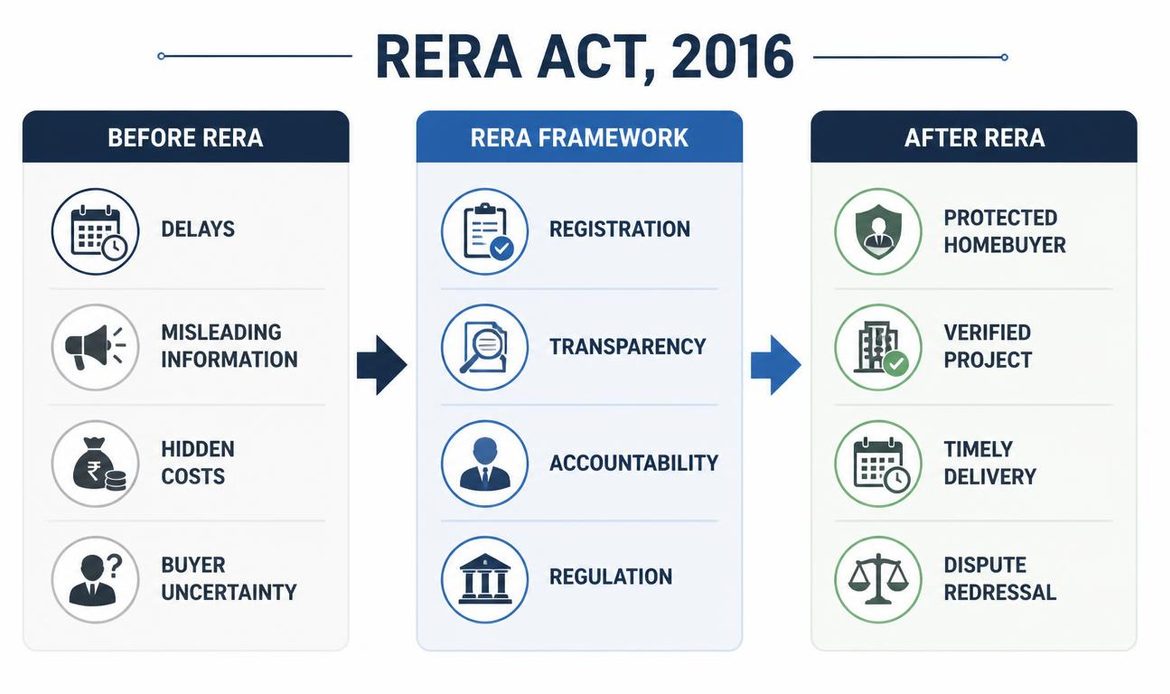
Before this legislation, the real estate sector operated with limited oversight. Buyers had little recourse if developers defaulted on commitments, while state-level laws varied widely. The RERA Act 2016 Executive Summary Corrida Legal underlines how this law transformed the landscape:
- It made registration and disclosure mandatory for every real estate project before sale or marketing.
- Developers are now required to deposit 70% of buyer funds into a dedicated escrow account to prevent misuse.
- Homebuyers gained the legal right to timely possession, refund, or compensation for delays.
- A centralised authority was created to adjudicate disputes swiftly without lengthy court battles.
Broader Impact on the Real Estate Sector
The Real Estate Regulatory Authority Rules and Compliance PDF shows that this Act has changed the very character of India’s housing market. Developers now function with greater credibility, buyers are more confident, and the overall sector has become more transparent. Over time, RERA has improved market discipline and reduced speculative activity, ensuring that projects move from planning to possession more efficiently.
Highlights of What the Act Covers
The Act governs:
- Registration of new and ongoing real estate projects.
- Licensing of agents and promoters.
- Disclosure of project details to the public.
- Buyer and developer rights and obligations.
- Dispute resolution mechanisms.
- Enforcement of penalties for non-compliance.
The RERA Act 2016 Key Provisions and Summary Corrida Legal highlights that this legislation is not only a buyer’s safeguard but also a roadmap for responsible business conduct. It builds an ecosystem where trust replaces uncertainty, and legal structure replaces ambiguity.
By regulating the complex dynamics between developers, agents, and homebuyers, the Real Estate Regulation Act 2016 Registration and Penalties PDF ensures that the dream of owning a home is grounded in legal protection and ethical business practice. This transformative law continues to reinforce India’s progress toward a transparent, efficient, and consumer-friendly real estate sector.
Objectives, Scope, and Applicability under the RERA Act 2016 Executive Summary Corrida Legal
The Real Estate (Regulation and Development) Act, 2016 was enacted with a clear intent — to restore confidence in India’s housing market and protect the interests of homebuyers while bringing accountability to developers and real estate agents. The Act applies uniformly across the country and sets out the foundation for fair, transparent, and efficient property transactions. Its scope extends beyond consumer protection to include structural reform of how the entire real estate ecosystem functions.
The RERA Act 2016 Executive Summary Corrida Legal outlines that this law was never meant to restrict business but to ensure that business is conducted responsibly. It redefined the relationship between buyers and promoters, ensuring that promises made on paper translate into projects delivered in reality.
Core Objectives of the RERA Act 2016
The Act’s objectives are multifaceted, aimed at both protecting consumers and professionalising the sector.
They include:
Ensuring transparency: Every real estate project must disclose detailed information about layout plans, approvals, contractors, timelines, and financial status on the RERA website.
Promoting accountability: Developers must adhere strictly to sanctioned plans and maintain financial integrity by utilising buyer funds only for the registered project.
Securing buyer confidence: Homebuyers are granted rights to timely possession, refunds, and interest in case of delay or breach.Creating a regulatory structure: The establishment of the Real Estate Regulatory Authority (RERA) in every state ensures consistent enforcement.
Balancing interests: The Act maintains equilibrium between the legitimate interests of developers and the protection of buyers.
Each of these objectives aligns with the broader goal of promoting ethical growth and long-term sustainability in India’s real estate industry.
Scope of Application
The scope of the Real Estate Regulation and Development Act 2016 Bare Act PDF Download is comprehensive, covering a wide range of entities and activities within the property development chain. It applies to:
- Residential and commercial real estate projects exceeding 500 square metres or involving more than eight units.
- Ongoing projects without a completion certificate at the time of the Act’s enforcement.
- Promoters and developers engaged in construction, marketing, or sale of real estate units.
- Real estate agents and brokers involved in facilitating property transactions.
- Buyers or allottees purchasing property directly from a registered developer.
The Act applies uniformly across all states and union territories, with each establishing its own Real Estate Regulatory Authority (RERA) and Appellate Tribunal to enforce compliance.
Key Exemptions
While broad in scope, the Real Estate Regulatory Authority Rules and Compliance PDF specifies certain exemptions. Projects not covered under the Act include:
- Projects smaller than the prescribed size threshold (below 500 square metres or eight units).
- Renovation or repair projects that do not involve marketing or new allotments.
- Industrial and government-owned development works not offered for sale.
These exemptions ensure that the law focuses on large-scale projects affecting public interest while keeping small-scale developments outside the compliance burden.
Central and State Coordination
The Act’s effectiveness relies heavily on coordination between the Central Government and State Governments. The central law provides the legislative framework, while each state notifies its own RERA rules and establishes its regulatory authority. The RERA Act 2016 Key Provisions and Summary Corrida Legal explains that this structure allows flexibility while maintaining uniformity across the country.
Each state authority is responsible for:
- Registering and monitoring real estate projects.
- Publishing project information online for public access.
- Conducting hearings and resolving disputes.
- Enforcing penalties for violations.
- Reporting compliance and progress to the central government.
This decentralised system ensures that RERA functions effectively across India, adapting to local market conditions while adhering to national legal standards.
Alignment with Other Laws and Policies
The Real Estate Regulation Act 2016 Registration and Penalties PDF aligns closely with India’s broader
legal and policy framework, complementing existing laws such as:
- The Indian Contract Act, 1872 — ensuring enforceability of property contracts.
- The Consumer Protection Act, 2019 — providing remedies for unfair trade practices.
- The Insolvency and Bankruptcy Code, 2016 — protecting homebuyers as financial creditors.
- The Benami Transactions (Prohibition) Act, 1988 — preventing misuse of property ownership.
This alignment ensures that RERA operates harmoniously within the legal ecosystem, creating a unified approach to real estate governance.
Broader Impact of Applicability
Since its enactment, the RERA Act has dramatically altered how real estate operates in India. Developers must now meet stricter disclosure norms, buyers can access project details online, and agents are bound by licensing requirements. The RERA Act 2016 Consumer Rights and Developer Obligations PDF demonstrates how this shift has improved investor confidence, curbed unethical practices, and brought credibility to the real estate market.
By defining its objectives and scope with clarity, the RERA Act 2016 has created a predictable, transparent, and legally sound framework that benefits all stakeholders. Its reach ensures that whether a project is in a metropolitan city or a small township, the same rules of fairness and accountability apply.
Through this strong legal foundation, the Act continues to empower India’s real estate industry to grow with integrity, ensuring that every homebuyer’s investment is safeguarded and every developer operates within a system of trust and responsibility.
Key Definitions and Concepts under the Real Estate Regulatory Authority Rules and Compliance PDF
Every effective law begins with clear definitions, and the Real Estate (Regulation and Development) Act, 2016 is no exception. To ensure uniform interpretation and prevent disputes, the Act precisely defines terms that govern real estate transactions and relationships among buyers, developers, and agents.
Understanding these definitions is essential for applying the law correctly and maintaining compliance across projects and jurisdictions.
The Real Estate Regulatory Authority Rules and Compliance PDF serves as a guide for interpreting these core terms, helping legal practitioners, builders, and consumers understand their respective positions under the law.
Promoter
A promoter refers to any person or entity that develops or constructs a building, apartment, or plot for sale. It also includes developers who convert existing structures into apartments or act on behalf of owners in marketing projects. The definition ensures that even joint ventures and landowners with development rights come within the Act’s ambit.
Promoters are the central figures in real estate development, and under the RERA framework, they carry the primary responsibility for registration, disclosure, and compliance.
Allottee
An allottee is a buyer who has been allotted or sold a unit, apartment, or plot by a promoter. The Real Estate Regulation and Development Act 2016 Bare Act PDF Download includes within this term those who have agreed to buy property but have not yet taken possession. Allottees are entitled to timely possession, information about the project, and protection against false representation or delay.
This definition ensures that homebuyers are recognised not just as consumers but as stakeholders with enforceable rights.
Real Estate Project
A real estate project includes the development of buildings, conversion of existing structures, or development of land into plots or apartments for sale. The RERA Act mandates that every such project must be registered with the respective state authority before advertising, marketing, or selling any unit.
This ensures that projects are transparent, financially secure, and executed under the supervision of the Real Estate Regulatory Authority.
Carpet Area
Carpet area refers to the net usable floor area within an apartment, excluding walls, balconies, and other non-usable spaces. The RERA Act 2016 Executive Summary Corrida Legal made it mandatory for developers to sell property based on carpet area rather than super built-up area.
This definition revolutionised property transactions by providing clarity and eliminating deceptive pricing practices that previously led to disputes between buyers and builders.
Advertisement
Advertisement under RERA includes any form of public communication that markets a real estate project, whether through print, digital media, or physical display. The Real Estate Regulation Act 2016 Registration and Penalties PDF clarifies that no advertisement can be issued unless the project is duly registered.
This prevents misleading marketing and ensures that buyers rely on authentic, verified project information published on official RERA websites.
Completion Certificate and Occupancy Certificate
A completion certificate is issued by the local authority confirming that the project complies with sanctioned plans and legal requirements. An occupancy certificate follows, authorising occupation of the building.
These documents are crucial in determining whether a project is ready for possession or still under development.
The RERA framework makes it illegal to hand over possession or advertise completion before obtaining these certificates, ensuring that buyers occupy safe, lawful properties.
Ongoing Project
An ongoing project refers to any development that was not completed or did not have a completion certificate at the time the Act came into force. Such projects were required to be registered retrospectively. This brought several previously unregulated projects under the purview of RERA, offering long-awaited protection to buyers.
Real Estate Agent
A real estate agent is any person who facilitates the sale or purchase of a property for commission. The RERA Act 2016 Key Provisions and Summary Corrida Legal mandates that agents must be registered with registered projects are marketed to clients.
This formalised structure eliminated the informal brokerage practices that once dominated the sector and introduced professional accountability to real estate transactions.
Structural Defect
A structural defect includes faults in design, workmanship, or quality that affect the building’s safety or utility. Developers are liable to rectify such defects within five years of possession without additional cost to the buyer. This provision ensures lasting quality assurance and protects homeowners from post- possession risks.
Relevance of Definitions
These definitions form the foundation of the RERA Act’s enforcement. Each term eliminates ambiguity and establishes clear lines of responsibility. The RERA Act 2016 Consumer Rights and Developer Obligations PDF emphasises that clarity in definitions prevents misuse of language and ensures consistent application across India.
Registration and Approval Process under the RERA Act 2016
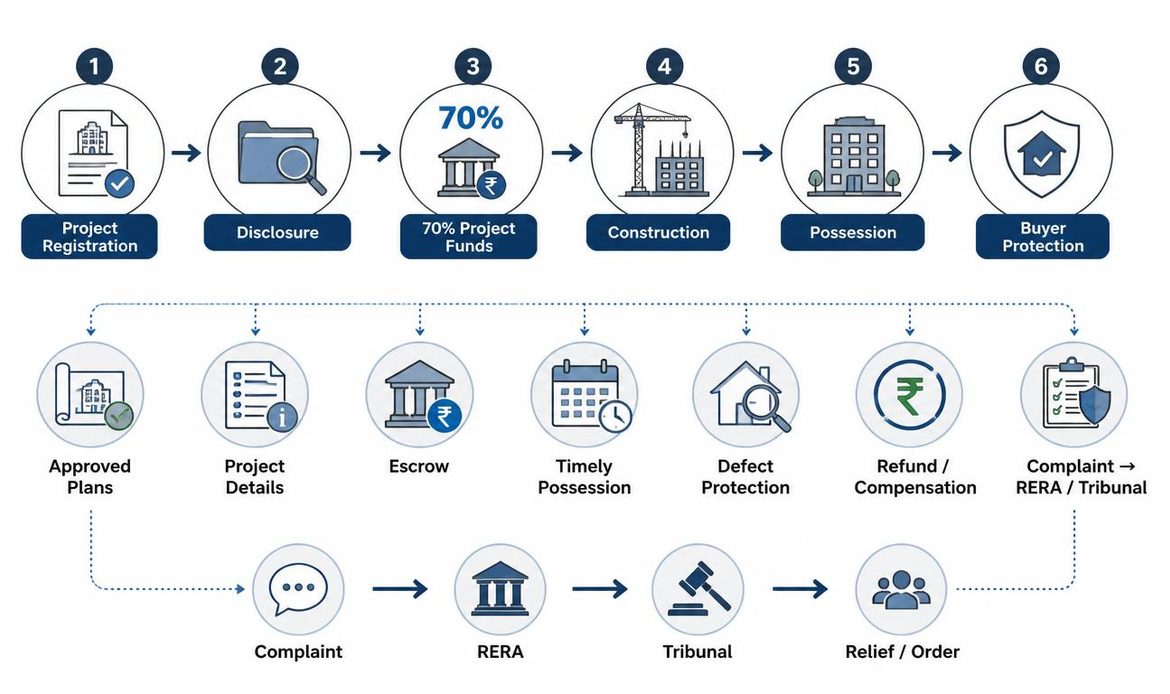
The Real Estate (Regulation and Development) Act, 2016 introduced one of the most impactful reforms in India’s property sector — the mandatory registration of real estate projects and agents. Before this law came into effect, many builders launched and marketed projects without securing approvals, often leading to delays, incomplete constructions, and financial losses for buyers. RERA changed this landscape completely by establishing a transparent and traceable registration system.
The RERA Act 2016 Key Provisions and Summary Corrida Legal explains that no developer can advertise, market, book, or sell any part of a real estate project unless it is first registered with the respective state’s Real Estate Regulatory Authority. This requirement ensures that only approved and legally compliant projects reach the market, providing buyers with an assurance of safety and accountability.
Mandatory Registration of Real Estate Projects
Every promoter or developer must register their project with RERA before launching it for public sale. This rule applies to both residential and commercial projects exceeding 500 square metres or involving more than eight units. Even ongoing projects without completion certificates must be registered.
The registration process helps authorities monitor project timelines, verify legal permissions, and safeguard buyer investments. It also prevents developers from using funds collected for one project on another.
Documents Required for Registration
To obtain registration, the promoter must submit detailed documentation. The Real Estate Regulation and Development Act 2016 Bare Act PDF Download lists the following key requirements:
- Authenticated copies of land ownership and title deeds.
- Approved building plans, layout designs, and development permissions.
- Timeline for completion and delivery schedule.
- Details of contractors, engineers, and architects associated with the project.
- Financial statements and project cost structure.
- Declaration that 70% of the amounts received from buyers will be deposited in a dedicated bank account for project use only.
These documents serve as a guarantee of legitimacy and form the basis for the public information available on the official RERA website.
Registration of Real Estate Agents
RERA also brought structure to the intermediary segment of the market by making it mandatory for real estate agents to register. The Real Estate Regulation Act 2016 Registration and Penalties PDF explains that no agent can facilitate the sale or purchase of property without valid registration.
Key conditions for agent registration include:
- Submission of business credentials, PAN, and proof of address.
- Disclosure of any prior criminal or civil violations.
- Commitment to transact only in registered projects.
Registered agents are issued unique identification numbers, which they must quote in all transactions and advertisements. This step significantly reduced fraudulent and unverified property dealings.
Application and Approval Procedure
Once an application is submitted, the Real Estate Regulatory Authority examines the details and verifies compliance. If satisfied, it grants a registration number that remains valid for the project’s duration.
The RERA Act 2016 Executive Summary Corrida Legal outlines that the authority must process registration within 30 days, ensuring efficiency and predictability. If the application is rejected, the promoter must be informed with reasons, allowing them to correct deficiencies and reapply.
This transparent procedure minimises delays and promotes professionalism among developers.
Display of Registration Details
Every registered project must prominently display its RERA registration number in all advertisements, brochures, and websites. This allows potential buyers to verify the project’s legal status directly through the RERA portal.
The Real Estate Regulatory Authority Rules and Compliance PDF emphasises that buyers can access full project details, including:
- Sanctioned layout and plans.
- Progress of construction.
- Names of contractors and promoters.
- Approvals obtained from local authorities.
- Financial disclosures and escrow account details.
This public accessibility transformed the real estate market into an open and verifiable space, where information is no longer hidden behind promotional promises.
Validity and Renewal of Registration
The registration is valid for the period declared by the promoter during application. If a project is delayed, an extension may be granted by RERA under justified circumstances, such as force majeure. However, failure to complete within the registered timeline without approval attracts penalties and possible cancellation.
Extensions, when allowed, are limited and carefully scrutinised, ensuring that developers cannot misuse them to indefinitely postpone projects.
Penalties for Non-Registration
The RERA Act 2016 Consumer Rights and Developer Obligations PDF sets strict penalties for non- compliance. Developers who advertise or sell without registration can face fines up to 10% of the project cost and imprisonment for repeat offences. Similarly, unregistered agents involved in such transactions can be penalised heavily or barred from future dealings.
These penalties serve as deterrents and reinforce the seriousness of compliance under RERA.
Benefits of Mandatory Registration
Mandatory registration under RERA has been a turning point for India’s property sector. It has introduced
transparency, instilled buyer confidence, and improved project delivery standards. Key benefits include:
- Assurance that funds are utilised only for the specific project.
- Access to verified information about developers and timelines.
- Reduction in fraudulent pre-launch schemes.
- Legal protection for homebuyers against defaulting promoters.
- Improved investor trust in the real estate market.
Through this framework, the RERA Act 2016 Key Provisions and Summary Corrida Legal established a culture of discipline and documentation in real estate transactions.
By making registration the cornerstone of project approval, RERA ensured that every building, advertisement, and sale is backed by legality and transparency. This single reform reshaped India’s property market into a system that values integrity, compliance, and accountability over unchecked commercial gain.
Rights and Obligations of Promoters and Developers under the Real Estate Regulation Act 2016 Registration and Penalties PDF
The Real Estate (Regulation and Development) Act, 2016 sets out a balanced framework of rights and obligations for promoters and developers. It ensures that while they have the freedom to conduct business, they must do so responsibly and transparently. The Act introduces a shift from a loosely monitored sector to a structured environment where developers are accountable to both the law and the homebuyer.
The Real Estate Regulation Act 2016 Registration and Penalties PDF outlines that every promoter must uphold fair practices, honour commitments made to allottees, and maintain financial discipline. By defining these obligations, the law has established a culture of responsibility that strengthens consumer trust and promotes ethical growth within the real estate industry.
Mandatory Disclosures by Promoters
Before marketing or selling a property, every developer must make comprehensive disclosures to the Real Estate Regulatory Authority. These disclosures, verified during the registration process, ensure that buyers have full knowledge of what they are investing in. Key details include:
- Title of the land and proof of ownership.
- Layout plan, specifications, and sanctioned design.
- Details of approvals and pending permissions.
- Project timelines and completion schedules.
- Details of contractors, engineers, and architects.
- Information on any encumbrances or litigations related to the project.
The purpose is to replace ambiguity with transparency, allowing buyers to make informed decisions based on verified data.
Financial Accountability and Escrow Mechanism
One of the most crucial reforms under the RERA Act 2016 Executive Summary Corrida Legal is the financial safeguard introduced through the 70 percent escrow rule. Developers are required to deposit seventy percent of the funds received from buyers into a separate bank account dedicated to that specific project.
This amount can be withdrawn only in proportion to the stage of construction and after certification by an engineer, architect, and chartered accountant. This rule prevents diversion of funds to other projects, which was a common cause of delay and project failure before the enactment of the law.
Adherence to Approved Plans and Specifications
Developers are bound to follow the sanctioned layout and building plans as approved by competent authorities. Any alteration or deviation can be made only with the consent of two-thirds of allottees. The Real Estate Regulation and Development Act 2016 Bare Act PDF Download ensures that this provision protects buyers from unexpected changes in project design, layout, or amenities that could otherwise affect the property’s value or usability.
This rule has significantly improved construction quality and promoted fairness by holding promoters accountable for every modification.
Timely Completion and Delivery of Projects
The RERA Act mandates that every project be completed within the time period mentioned during registration. Delays without valid reasons can attract heavy penalties and compensation claims. If the project is not delivered on time, buyers have the right to withdraw and claim a full refund with interest or choose to remain and receive compensation for the delay.
By enforcing these deadlines, the law has introduced a sense of discipline and professionalism into real estate development.
Structural Defects and Quality Assurance
Developers are responsible for ensuring construction quality. In case of any structural defects or deficiencies in workmanship, quality, or services, the promoter must rectify them within five years from the date of possession at no extra cost. The Real Estate Regulatory Authority Rules and Compliance PDF makes this provision a key protection for homebuyers, ensuring that property value and safety are not compromised after delivery.
This accountability clause ensures lasting consumer confidence and promotes long-term reliability in housing projects.
Obligations Regarding Conveyance and Possession
Upon completion, the promoter must hand over possession and execute a registered conveyance deed in favour of the allottee within the time specified. Additionally, all common areas, facilities, and documents must be transferred to the association of allottees.
Failure to do so can result in penalties and further legal action. This ensures that ownership rights are not delayed or withheld once the project is finished.
Marketing and Advertising Regulations
Before issuing any advertisement or promotional content, developers must mention their RERA registration
number. All promotional material must be accurate and consistent with the approved project details. Any misleading advertisement constitutes a punishable offence under the Real Estate Regulation Act 2016 Registration and Penalties PDF.
This restriction has eliminated false claims and misleading campaigns that once dominated the market.
Rights of Promoters
While the law imposes several obligations, it also recognises certain rights of developers, such as:
- Right to receive payments as per the sale agreement.
- Right to amend plans with due consent of allottees.
- Right to be compensated for legitimate delays caused by government approvals or unforeseen events.
- Right to approach the Appellate Tribunal for dispute resolution.
These rights maintain balance, ensuring that developers are not overburdened and can operate within a fair and predictable legal structure.
Penalties for Non-Compliance
Non-compliance with any provision of the Act leads to strict penalties. Developers who fail to register, delay possession, or provide false information can face fines up to ten percent of the project cost. Repeat offenders may face imprisonment of up to three years.
The Real Estate Regulation Act 2016 Registration and Penalties PDF underscores that these penalties are not punitive alone — they are preventive measures designed to deter misconduct and preserve the integrity of the market.
Significance of Compliance
The introduction of RERA has reshaped the relationship between developers and buyers into one based on trust, fairness, and transparency. Developers who comply not only avoid penalties but also gain long-term credibility and goodwill in the market.
The Real Estate Regulation Act 2016 Registration and Penalties PDF demonstrates that these obligations serve a larger purpose — to create a responsible and reliable real estate environment where both investment and integrity can thrive together.
By defining clear duties, imposing accountability, and guaranteeing buyer protection, RERA has successfully transformed India’s real estate sector from an unregulated marketplace into a lawful, transparent, and consumer-oriented system that encourages ethical business and sustainable growth.
Rights and Protections for Homebuyers under the RERA Act 2016 Consumer Rights and Developer Obligations PDF
Before the Real Estate (Regulation and Development) Act, 2016 came into force, homebuyers in India often found themselves in uncertain situations. Many invested their life savings into housing projects that were delayed, altered, or abandoned without clear legal remedies. The RERA Act changed this imbalance permanently by giving homebuyers a strong legal voice. It created a framework where buyers are not passive investors but recognised stakeholders with enforceable rights and protections.
The RERA Act 2016 Consumer Rights and Developer Obligations PDF serves as a charter of rights for property purchasers. It ensures transparency, timely possession, financial security, and accessible grievance redressal, marking a significant shift in how consumer protection operates within the real estate industry.
Right to Full Disclosure and Transparency
Every homebuyer is entitled to complete transparency from the developer. Before booking or purchase, the promoter must share detailed project information such as layout plans, land title, approvals, and completion timelines. The Real Estate Regulation and Development Act 2016 Bare Act PDF Download mandates that all such details be published on the official RERA website for public access.
This eliminates the secrecy that once surrounded real estate transactions and allows buyers to verify all project details before investing.
Right to Timely Possession
Timely delivery of property is one of the most important rights under RERA. Developers must adhere to the deadlines declared at the time of registration. If possession is delayed, buyers have two options — withdraw and receive a full refund with interest, or remain invested and receive compensation for each month of delay.
The RERA Act 2016 Executive Summary Corrida Legal highlights that this provision ensures accountability and discourages developers from making unrealistic promises about completion dates.
Right to Refund, Interest, and Compensation
If a promoter fails to deliver as promised, misrepresents facts, or violates approved plans, buyers can claim a refund of the amount paid along with interest. Additionally, they are entitled to compensation for any loss caused by the delay or defect. The Real Estate Regulation Act 2016 Registration and Penalties PDF provides a legal route for such claims, ensuring that buyers no longer rely on lengthy consumer court proceedings.
This provision builds confidence and protects individuals who invest in real estate as a long-term asset rather than speculative venture.
Right to Accurate Measurement and Carpet Area
The Act introduced a major reform by standardising the concept of “carpet area.” Developers can now sell apartments only based on the net usable floor area, not on super built-up or arbitrary calculations. If the final carpet area differs from what was agreed upon, buyers have the right to claim refund or adjustment in price.
This change, recorded in the Real Estate Regulatory Authority Rules and Compliance PDF, made property pricing more transparent and uniform across the country.
Right to Defect Liability Protection
If a buyer notices structural defects, poor workmanship, or substandard materials within five years of taking possession, the developer is legally bound to fix them at no extra cost. The Real Estate Regulation Act 2016 Registration and Penalties PDF enforces this clause to ensure long-term safety and value for property owners.
It protects buyers not just at the time of purchase but through the initial years of occupancy, making the law one of the strongest in consumer protection globally.
Right to Fair Contract Terms
RERA prohibits one-sided contracts that favour developers. All sale agreements must be balanced, clearly stating the obligations of both parties. Clauses regarding payment schedules, possession dates, and penalties must comply with the RERA format prescribed by each state.
This provision prevents developers from inserting hidden conditions or unfair penalties that disadvantage buyers.
Right to Information During Construction
Homebuyers are entitled to continuous updates on the progress of construction, fund utilisation, and status of approvals. The Real Estate Regulation and Development Act 2016 Bare Act PDF Download ensures that developers regularly upload project updates to the RERA website, giving buyers real-time visibility into how their investments are being used.
Such transparency allows buyers to monitor whether the project is proceeding as promised and to hold developers accountable if deviations occur.
Right to Participate in Project Management
Upon completion of the project, buyers collectively form an association or society to manage the property’s common areas and facilities. Developers are required to hand over maintenance responsibilities and documentation to this association.
The RERA Act 2016 Key Provisions and Summary Corrida Legal recognises this as a fundamental right, ensuring that buyers have a direct role in maintaining the property and safeguarding its long-term value.
Right to Grievance Redressal and Legal Remedy
Every homebuyer can approach the Real Estate Regulatory Authority for quick resolution of complaints against developers, agents, or even regulatory violations. If unsatisfied, they can appeal before the Real Estate Appellate Tribunal.
The Real Estate Regulation Act 2016 Registration and Penalties PDF establishes a time-bound grievance system, making justice accessible and efficient. This mechanism has significantly reduced reliance on traditional litigation by offering a dedicated forum for property disputes.
Empowerment of the Consumer through RERA
The RERA Act 2016 Consumer Rights and Developer Obligations PDF has given homebuyers unprecedented empowerment. They now have legal recourse against delays, transparency over their investments, and financial protection in case of default.
By turning information into a right and accountability into an obligation, RERA ensures that property ownership is no longer a gamble but a legally protected investment. It has redefined the homebuyer’s place in the market — from vulnerable participant to informed decision-maker.
Through these protections, the Real Estate (Regulation and Development) Act, 2016 restored fairness, discipline, and dignity to India’s housing sector. It stands as a guarantee that every homebuyer’s trust, effort, and savings are shielded by law — ensuring that the dream of owning a home is fulfilled with confidence, security, and justice.
Role, Powers, and Functions of the Real Estate Regulatory Authority (RERA)
The Real Estate Regulatory Authority, commonly known as RERA, is the central institution that ensures the effective implementation of the Real Estate (Regulation and Development) Act, 2016. It functions as both a watchdog and a facilitator—monitoring compliance, protecting consumer interests, and promoting professionalism across the real estate sector. Through its active role, RERA has transformed how property transactions are regulated, making transparency, accountability, and trust the foundation of the housing market.
The Real Estate Regulation and Development Act 2016 Bare Act PDF Download establishes RERA in every state and union territory, ensuring that real estate activities are governed locally but under a uniform national framework.
Appellate Tribunal and Adjudication Mechanism under the RERA Act 2016 Bare Act PDF Download
One of the strongest features of the Real Estate (Regulation and Development) Act, 2016 is its dedicated grievance redressal framework. The Act establishes a structured, time-bound mechanism that allows homebuyers, developers, and agents to resolve disputes efficiently without depending on lengthy civil litigation. This system operates through two key bodies — the Real Estate Regulatory Authority (RERA) and the Real Estate Appellate Tribunal (REAT). Together, they ensure that justice in real estate matters is swift, fair, and enforceable.
The Real Estate Regulation and Development Act 2016 Bare Act PDF Download explains that this adjudication structure is designed to ensure accountability at every stage. It provides accessible remedies for violations such as project delays, non-registration, misrepresentation, and unfair trade practices, making it one of the most effective consumer protection mechanisms in India.
Establishment of the Real Estate Appellate Tribunal
Every state and union territory must establish its own Real Estate Appellate Tribunal (REAT) to hear appeals against decisions of the RERA or its adjudicating officer. Each tribunal is chaired by a senior judicial officer, usually a retired High Court judge, along with two technical and administrative members.
This ensures that decisions are informed not only by law but also by expertise in real estate, urban planning, and finance. The Real Estate Regulation Act 2016 Registration and Penalties PDF highlights that this institutional setup ensures legal precision, fairness, and efficiency in handling disputes.
Jurisdiction and Powers of the Appellate Tribunal
The Appellate Tribunal acts as the second level of authority for resolving conflicts under RERA. It has the power to:
- Hear appeals against orders or directions issued by RERA.
- Review adjudicating officer decisions on compensation and penalties.
- Enforce compliance with its judgments and impose fines for disobedience.
- Summon individuals, call for documents, and conduct inquiries similar to a civil court.
The Real Estate Regulation and Development Act 2016 Bare Act PDF Download ensures that the tribunal’s decisions are binding on all parties unless challenged in the High Court.
Process of Filing Appeals
Any aggrieved party — whether a homebuyer, developer, or real estate agent — can appeal to the Appellate Tribunal within 60 days from the date of the RERA order. The application must include details of the dispute, copies of the impugned order, and relevant evidence.
Once admitted, the tribunal issues notices to all parties and conducts hearings in a time-bound manner. This system eliminates procedural delays typical of conventional courts, providing faster resolution of real estate disputes.
Role of the Adjudicating Officer
In addition to the tribunal, the Act empowers RERA to appoint an Adjudicating Officer, typically a District Judge or equivalent officer, to determine claims for compensation. This officer focuses on disputes related to delayed possession, defective construction, false representations, or financial mismanagement.
The RERA Act 2016 Executive Summary Corrida Legal notes that this inclusion ensures that compensation claims are handled by trained judicial professionals who can assess damages quickly and fairly.
Time-Bound Resolution and Enforcement
One of RERA’s key reforms lies in its commitment to time-bound dispute resolution. Both RERA and the Appellate Tribunal must strive to dispose of cases within 60 days of filing. In cases of unavoidable delay, reasons must be recorded in writing.
Orders passed by the Tribunal are executable as decrees of a civil court. If a promoter fails to comply, RERA can initiate recovery proceedings as arrears of land revenue, ensuring that homebuyers receive the compensation they are entitled to.
Penalties for Non-Compliance with Tribunal Orders
Failure to comply with an order issued by the Appellate Tribunal is treated as a serious offence. Promoters or agents who ignore such orders can face imprisonment of up to three years, or fines that may extend to 10 percent of the project cost.
The Real Estate Regulation Act 2016 Registration and Penalties PDF underscores that this provision gives the law real strength — it transforms tribunal orders into enforceable obligations rather than advisory decisions.
Appeal to the High Court
If either party remains dissatisfied with the Tribunal’s decision, they can appeal to the High Court within 60 days. However, appeals can only be filed on substantial questions of law, ensuring that higher courts intervene only where necessary. This maintains the integrity and efficiency of the specialised real estate adjudication process.
The RERA mechanism functions independently but does not bar homebuyers from seeking remedies under other laws such as the Consumer Protection Act. The Real Estate Regulation Act 2016 Registration and Penalties PDF provides that buyers can choose either RERA or the consumer forum based on their preference, though they cannot pursue the same complaint simultaneously in both.
This flexibility ensures that buyers are never left without a legal remedy, regardless of the nature of their grievance.
Benefits of the RERA Adjudication System
The introduction of RERA’s adjudicatory framework has brought multiple benefits to the real estate ecosystem:
- Faster and more specialised resolution of disputes.
- Reduction in fraudulent and unethical developer practices.
- Legal recognition of homebuyers as primary stakeholders.
- Decreased burden on civil and consumer courts.
- Consistency and uniformity in real estate decisions across states.
The Real Estate Regulation and Development Act 2016 Bare Act PDF Download demonstrates that this model is one of the most progressive legal systems in India, bridging the gap between regulation and justice.
By combining a strong authority with a swift appeals process, RERA has turned accountability into a practical reality. It ensures that grievances are not buried under bureaucracy but resolved through a transparent, accessible, and legally binding mechanism — a system where every buyer’s right finds its rightful protection under the law.
Conclusion
The Real Estate (Regulation and Development) Act, 2016, often referred to as the RERA Act, marked a turning point in India’s property sector. For decades, real estate operated in an unregulated and fragmented manner, often leaving homebuyers vulnerable to delays, misinformation, and financial loss. With the enactment of RERA, this long-standing imbalance was finally corrected. The Act introduced transparency, accountability, and fairness, transforming a trust-deficit market into a structured and
The Real Estate Regulation and Development Act 2016 Bare Act PDF Download reflects the government’s vision of ensuring that every homebuyer’s investment is protected by law. It created an organised system that mandates registration, continuous disclosures, and compliance across every project and stakeholder
Key Takeaways
- Transparency as a Legal Obligation: Developers must disclose every project detail — from layout and approvals to financial progress — ensuring buyers have full visibility before investing.
- Financial Accountability: The 70 percent escrow rule guarantees that buyers’ funds are used only for the project they invested in, bringing long-overdue discipline to real estate financing.
- Consumer Empowerment: Homebuyers now have enforceable rights to possession, refund, compensation, and legal recourse through RERA and its appellate bodies.
- Professionalisation of the Industry: Real estate agents and developers are subject to licensing, compliance audits, and ethical regulations, fostering credibility in the sector.
- Speedy Redressal Mechanism: Dedicated authorities and tribunals provide efficient resolution of disputes, replacing years of legal uncertainty with timely justice.
- National Impact: RERA’s implementation across states has unified India’s real estate market under a common standard of fairness and transparency.
The RERA Act 2016 Executive Summary Corrida Legal highlights that beyond compliance, this law represents a shift in mindset — from unregulated profit-driven practices to a governance model grounded in accountability and trust. It has restored faith among homebuyers, encouraged responsible developers, and enhanced India’s image as a safe and reliable destination for real estate investment.
