

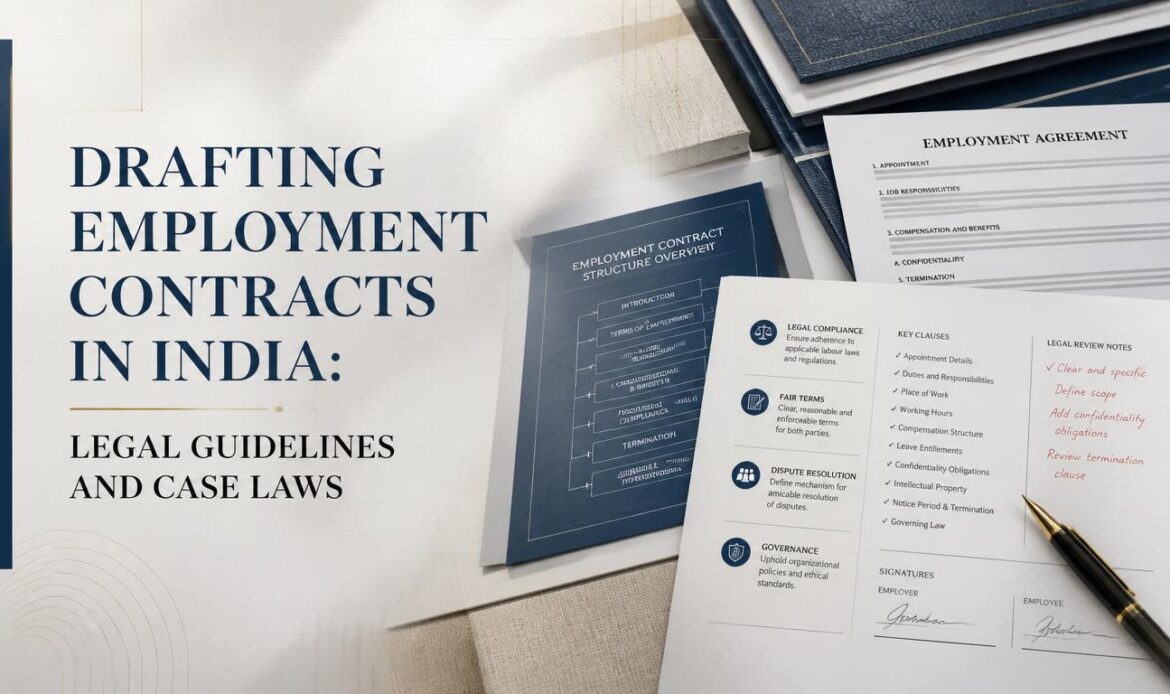
Drafting Employment Contracts in India: Legal Guidelines and Case Laws        

Introduction

Employment contracts are vital in defining the relationship between employers and employees, outlining rights, responsibilities, and expectations. This article, “Drafting Employment Contracts in India: Legal Guidelines and Case Laws,” explores the essential legal guidelines and significant case laws that influence the drafting of employment contracts in India.

Essential Elements of Employment Contracts

  • Key Clauses: Job description, salary and benefits, working hours, confidentiality, and termination conditions.
  • Legal Requirements: Must comply with Indian labor laws and regulations, ensuring all statutory rights are protected.

Statutory Requirements for Employment Contracts

  • Compliance with Labor Laws: Contracts must align with statutes such as the Industrial Employment (Standing Orders) Act, 1946, and the Contract Labour (Regulation and Abolition) Act, 1970.
  • Non-Compete and Non-Disclosure Agreements: Must be reasonable in scope and duration to be enforceable.

Dispute Resolution in Employment Contracts

  • Internal Mechanisms: Grievance redressal procedures and arbitration clauses.
  • External Mechanisms: Recourse to labor courts and industrial tribunals.

Notable Case Laws on Employment Contracts

  1. Niranjan Shankar Golikari v. Century Spinning and Mfg. Co. Ltd. (1967): Validated the enforceability of non-compete clauses.
  2. Superintendence Company of India v. Krishan Murgai (1980): Addressed the reasonableness of restrictive covenants.
  3. Central Inland Water Transport Corporation v. Brojo Nath Ganguly (1986): Established principles for unfair dismissal and unconscionable contracts.

Conclusion

Drafting effective employment contracts requires a thorough understanding of legal requirements and judicial interpretations. Ensuring compliance and clarity can prevent disputes and foster a positive employment relationship.


Other useful links:

Visit our publication page for detailed articles on contemporary legal issues and updates, including: Rights and Duties of Employers and Employees in India , Effective Grievance Redressal Mechanisms in Indian Employment Law, Legal Guidelines on Termination of Employment in India      

Corrida Legal is the preferred corporate law firm in Gurgaon (Delhi NCR) and Mumbai. Reach out to us on LinkedIn or contact us at contact@corridalegal.com/+91-9211410147 in case you require any legal assistance.

Fact Checked & Updated by Corrida Legal Lawyers

Our Fact Checking Process

As qualified Indian lawyers, we understand that our articles are relied upon the thousands of our readers who read our articles daily. We accordingly ensure that all our articles go through a regular process of fact checking and updation by qualified lawyers of the Corrida Legal team. Here's how we maintain high standards:
  1. Expert Review: All articles are reviewed in a periodical manner by Corrida Legal's qualified lawyers.
  2. Source Validation: We ensure that any resource being relied upon for the preparation of the article is of a credible Government authority. We do not as a thumb rule quote any law, circular, guideline or notification present on unreliable websites.
  3. Transparency: We ensure to clearly cite references and disclose potential conflicts wherever we deem it appropriate to do so. Our author lawyers ensure to highlight the concerns and caveats in their articles.
Curated and reviewed by qualified lawyers from Corrida Legal team.

Our Review Board

All our articles are curated and reviewed by our expert team of lawyers at Corrida Legal to ensure accuracy and relevance.
  • Unique legal perspective: Each article is assessed by our specialist lawyers to ensure that we add the unique legal perspective that readers are looking for.
  • Up-to-date Insights: We incorporate the latest research, trends, and standards and all articles are reviewed in a periodical manner by Corrida Legal's qualified lawyers.
  • Legal Accuracy:   Every article is rigorously vetted by Corrida Legal lawyers against current statutes, judicial precedents, and regulatory notifications to provide reliable, actionable guidance that businesses can trust.

Leave a Reply

Your email address will not be published. Required fields are marked *

To Top