

Reviewed and Validated by: Shreya Paharia, Advocate
If you are evaluating the Cost of Setting Up a Global Capability Centre (GCC) in India, the primary cost drivers aren’t just your incorporation fees. These costs are usually dependent on the early decisions that you make. First, whether this is just a pilot setup or a long-term captive. Second, how will you be hiring and managing employees? Third, how will the data move cross-borders? Fourth, how will this Indian entity sign contracts, take ownership of IP assets, and get paid by the main group? Through this guide, we help you understand the GCC setup costs in India with respect to legal and compliance framework. The primary objective is to help you accurately devise a financial plan and avoid any sort of costly restructuring. Most importantly, choose a structure that promotes audit preparedness and long-term scalability.
Understanding GCC costs for leaders and stakeholders
A GCC is assessed differently at each level of the organisation. For instance, leadership tends to look for swiftness and control. While finance looks for scalability. Risk and compliances team look for defensibility and human resources looks for consistency across employee lifecycles. While most importantly, legal forms the nucleus of all the four i.e. the cost of setting up a global capability centre is well understood as more than just a one time, incorporation exercise.
In real time practice, GCC set up cost in India are usually determined by the legal and compliance framework that is designed early and how consistently it supports governance and scalability. In the upcoming sections, we simplify the key legal and regulatory machinery that influences the costs of setting up a global capability Centre in India and help you understand what usually increases or reduces the cost as the centre scales.
What factors influence GCC setup costs in India?
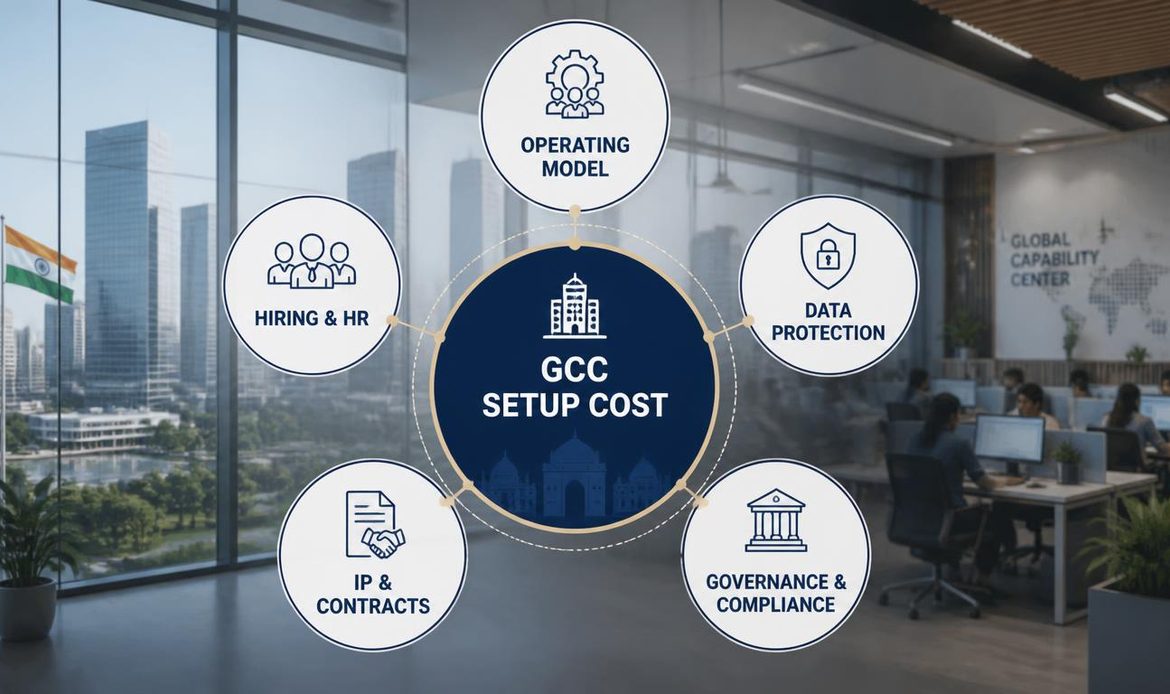
Usually, when organizations discuss the cost of setting up a global capability centre in India, the most common question that arises is not what is the number? but what will move the number for us? The primary reason is that GCC is usually set up by multiple stakeholders, finance, HR, operations, procurement, technology, and risk teams. This is why the cost structure varies basis the decisions made across these functions and not just initial legal filings.
To begin with: one of the most important cost drivers of GCC setup costs in India is the operating model and the structure that you select when you incorporate the entity. Usually, a captive entity requires a stronger governance at the forefront, but it also gives well-defined control over contracts, employment, and IP assets. However, this control can minimize the downward resistance and convert the cost structure of captive centres in India to being more stable as the centre scales.
Further, the second important cost driver is the structure of the employees, i.e., human resources. The pace of hiring, the use of contractors, team operations across one state or multiple states tends to change the compliance outline exponentially. Therefore, the legal cost of establishing a GCC in India is not just limited to setup costs. It is also about setting up the documentation, policies, human resources, and operations which can run on consistently, even when the number of employees keep growing.
Furthermore, the third cost driver includes data and IP assets. If the GCC accesses personal sensitive data, and has integrated customer support. If it also controls HR systems, designs product deliverables, legal and compliance work also expands beyond just templates into governance and vendor contracting discipline. This in turn affects compliance expenses for GCC in India because this becomes a recurring cost and not a one-time setup cost.
Lastly, intercorporate document discipline and delivery is a cost many organizations usually underestimate. When these services are clearly defined and authenticated by recurring documentation rhythm, cost tends to become predictable. However, when they are left ambiguous, costs usually later appear as restructuring, especially during audits or diligence. Collectively, these factors help all stakeholders to plan setup costs more judiciously and they also explain why the cost of setting up a global capability centre is best planned as a set of choices and trade-offs rather than a single figure.
Why GCC setup costs in India vary?
India cannot be termed as an emerging GCC ecosystem. Rather, it should be called a mature GCC ecosystem. The latest Indian landscape reports place India at about more than 1,700 GCCs in the financial year 2024, including around 3,000 units with over 1.9 million professionals employed. However, this range varies how boards and teams across the world evaluate the cost of setting up a global capability centre. The forward going discussion is less about can we launch and more about can we launch in a way that guards through diligence, audits, and cross-border investigations. This shift is important because the largest cost usually does not come from incorporation alone. It is visible when hiring accelerates, vendors are onboarded, the scope of data expands and inter-corporate delivery becomes a routine. This is why GCC setup costs in India should be a part of the operational foundation planning.
It begins with who does what?
The legal costs of establishing a GCC in India become inevitable when the operating structure is well-defined and is clear on the following things. Who will employ people, who shall sign the contracts, who shall own the IP assets, and how the Indian entity shall be funded and governed. It is highly observed that when these components are decided last-minute, teams often end up restructuring contracts, reforming the templates, and re-examining all the approvals. For instance, foreign investment preparedness is a practical example of the same. RBI-aligned FEMA reporting expectations include time-bound reporting of foreign investment transactions. Public guidance commonly refers to reporting within 30 days for relevant issuances in older RBI circulars. However, RBI notifications also mention different reporting timelines for specific transaction types such as Foreign Currency- Transfer of Shares (FC-TRS).
The major element of cost planning is not the filing fee, but it is the work structure. If funding, valuation, and allotment are not aligned properly, the clear-out efforts consume time and legal bandwidth at the later stage. In a similar manner, employment and workplace compliances is the prime zone wherein the costs scale along with the increase in employees. In real-time practice, inconsistent offer letters, vague confidentiality and IP terms, or impromptu contractor use can turn into preventable friction when the GCC scales. This friction remains a meaningful part of compliance expenses for GCC in India.
Data protection: a setup cost
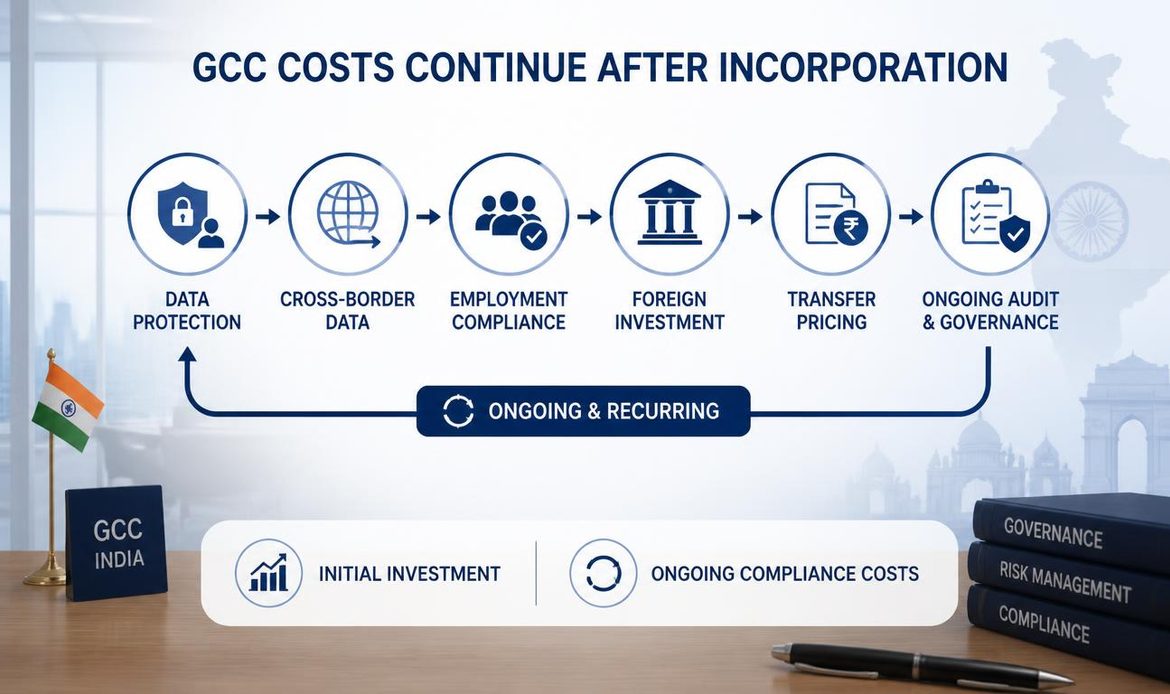
For several GCCs, the biggest risk and cost driver is data. India’s DPDP rules 2025, notified in November 2025, enable the DPDP framework and make data governance a compliance pre-requisite for organizations tackling personal data. Reuters’ reporting on the rules highlights obligations surrounding mitigating data collection transparency and breach-related obligations. This reinforces the concept of why governance cannot be postponed. Let us take a practical example. A GCC launches human resource operations and customer analytics and later realizes that its vendors and internal tools are not aligned with DPDP contracting and access controls. This results in re-negotiating vendors, reshaping governance, and amending notices and processes after the GCC goes live. This is why in advance DPDP preparedness should form a part of the early planning of the cost of setting up of a global capability centre, especially when the GCC shall consider HR systems, customer data, and indulge in cross-border access.
Inter-corporate delivery and transfer pricing: Why is it a recurring cost?
If the Indian GCC delivers services to group entities, transfer pricing becomes a part of the operating structure. Transfer pricing is not another tax concept; it is a documentation practice. Form 3CEB is widely referred to as the accountant’s report for entities required to furnish a report under section 92E. The common guide refers to 31st October as the due date for the relevant assessment cycle, subject to the extensions as may be specified.
Let us consider a practical example to understand it better. A GCC starts providing support services without pre-defining service categories and the allocation keys. At a later stage, the finance team struggles to uphold this cost allocation and the team ends up doing a year-end revision of documents. The cost involved here is not just another advisory expense. It also includes the leadership time, audit exposure, and operational distraction. It is important to get this right as you begin with structuring of GCC to reduce reckoning compliance expenses for GCC in India and to stabilize the cost structure of captive centres in India.
FREQUENTLY ASKED QUESTIONS (FAQs)
What is the general cost of setting up a global capability centre in India?
Industry benchmarks place initial setup costs in the broad range of INR 4.6 crores to 27.5 crores, basis the number of employees, city, and operating model. This is best considered as a planning range and can be revised once the scope of activities, hiring structure, and compliances are decided upon.
What are the cost drivers of GCC setup in India?
When you try to set up a GCC in multi-city, usually costs increase when you handle sensitive personal information or high vendor contracts, if you develop IP-based assets, or you require inter-corporate pricing across multiple service structures. Now each of these tend to add governance and documentation work at respective levels, which keeps getting compounded over time.
What are the inclusions of the legal cost of establishing a GCC in India?
The legal costs of setting up a GCC in India include structuring of the organization, governance framework, foreign investment, compliances, and reporting framework. Further, it also includes employment and workplace compliances, contractual frameworks, and intercorporate documentation support. However, the exact scope of legal activities vary basis the operating models and the risks included.
Why can’t compliance expenses for GCC setup in India not be one-time?
Compliance expenses are usually tied to the operating model and the operational framework. While hiring, vendor onboarding, data processing, and the corporate delivery begins, obligations become recurrent as the centre scales and expands throughout the year. Digital Personal Data Protection (DPDP), 2023 preparedness, employment governance framework, and transfer pricing documentation are some of the common examples of recurring compliances.
How does the cost of a captive centre differ from a BOT or a vendor-led structure?
A captive model usually requires a stronger entity at the forefront, governance, and compliance framework, but it also offers greater dominance over employment, contracting and IP assets. Whereas BOT or vendor-led structures usually reduce the setup efforts, but they move the costs into ambiguous contracts, planning of transition and the future movement to a captive model.
Conclusion
The cost of setting up a Global Capability Centre in India becomes far more anticipated when it is considered a policy and governance activity, not just an incorporation activity. A well-designed GCC is built on the foundation of well-defined internal policies, including contracts, employers, accessibility of data, ownership, and management of IP assets. Furthermore, it also depends on how inter-corporate services, are detailed and evaluated. These decisions directly shape the GCC setup costs in India because they in turn reduce the uncertainty surrounding it, limit restructuring, and create an operational mechanism that safeguards the centre even when it scales.
From a legal perspective, the strongest cost results are usually achieved when the GCC is set up with the help of well- detailed controls, recurrent compliance frameworks rather than just an occasional filing. This includes preparedness for foreign investment, employment, and workplace regulations, Digital Personal Data Protection (DPDP) Act, 2023, aligned data practices, predetermined standards, and transfer pricing documentation. Collectively, these elements form the backbone of the policies that support a stable cost structure of captive centre in India. Further, these compliance expenses for GCC in India aligned with growth rather than driven by emergencies.
If you are a foreign company who is planning to have a new GCC or expand an existing one, we are here to support you with a policy and audit-oriented legal framework. This will include a GCC legal and compliance blueprint that includes your operating model, well-defined timelines, scope of activities, and cost drivers. Further, it includes the implementation and execution of the incorporation and setting up of entities, contracts, employment frameworks, data governance, and inter-corporate documentations. Furthermore, if you would like Corrida Legal to review your current blueprint: please share the expected census, the scope of operations to us. Let us connect to help you with a roadmap tailored as per the structure of GCC you intend to set up.