

Reviewed and Validated by: Srijan Jha, Associate
Introduction to West Bengal Shops and Establishments Act 1963 PDF
The West Bengal Shops and Establishments Act 1963 PDF is one of the earliest labour laws applied to shops and commercial establishments in the State. Its purpose is simple: regulate employment conditions and provide minimum rights for employees. The Act fixes working hours, holidays, leave, welfare facilities, and duties of employers. It also gives powers to inspectors for enforcement.
This law is not optional. Every shop and establishment in West Bengal must comply. Even small outlets with one or two workers are covered. Corrida Legal has seen notices served on small retailers in Kolkata only for not displaying the registration certificate.
The Act 13 of 1963 West Bengal bare act download sets out its key objectives clearly:
- To regulate daily and weekly working hours.
- To ensure employees receive weekly holidays and national holidays.
- To provide basic welfare facilities at the workplace.
- To mandate registration of every establishment within the prescribed time.
- To enforce maintenance of registers relating to attendance, wages, and leave.
- To empower inspectors to check compliance and impose penalties.
These objectives show that the law is preventive. It is meant to ensure basic conditions are always maintained. Corrida Legal has observed that inspectors use this Act as the first compliance check. If there is a gap here, they assume there will be gaps under PF, ESI, or gratuity.
The West Bengal Shops and Establishments Act executive summary shows wide applicability. Shops, commercial establishments, restaurants, hotels, IT companies, consultancy offices — all are included. Exemptions are very limited. Many employers wrongly assume that being a service provider excludes them. Inspectors in practice reject such claims.
From a compliance angle, labour law compliance under West Bengal Shops and Establishments Act must be seen as a minimum standard. Registers, renewals, leave records, and holiday notices are always checked first. Corrida Legal has seen several clients face penalties not because wages were unpaid, but because the holiday list was missing from the notice board.
For employees, the working hours and holidays West Bengal Shops and Establishments Act provisions are statutory rights. Weekly offs, festival holidays, maximum working hours — these are non-negotiable. An agreement to the contrary has no legal value.
Finally, employer obligations and penalties under West Bengal Shops and Establishments Act 1963 highlight that contraventions attract fines. First offences may appear minor, but repeat or continuing defaults escalate quickly. Corrida Legal has handled matters where fines multiplied over time, costing employers more than maintaining preventive compliance from the beginning.
Scope and Applicability of Act 13 of 1963 West Bengal Bare Act Download
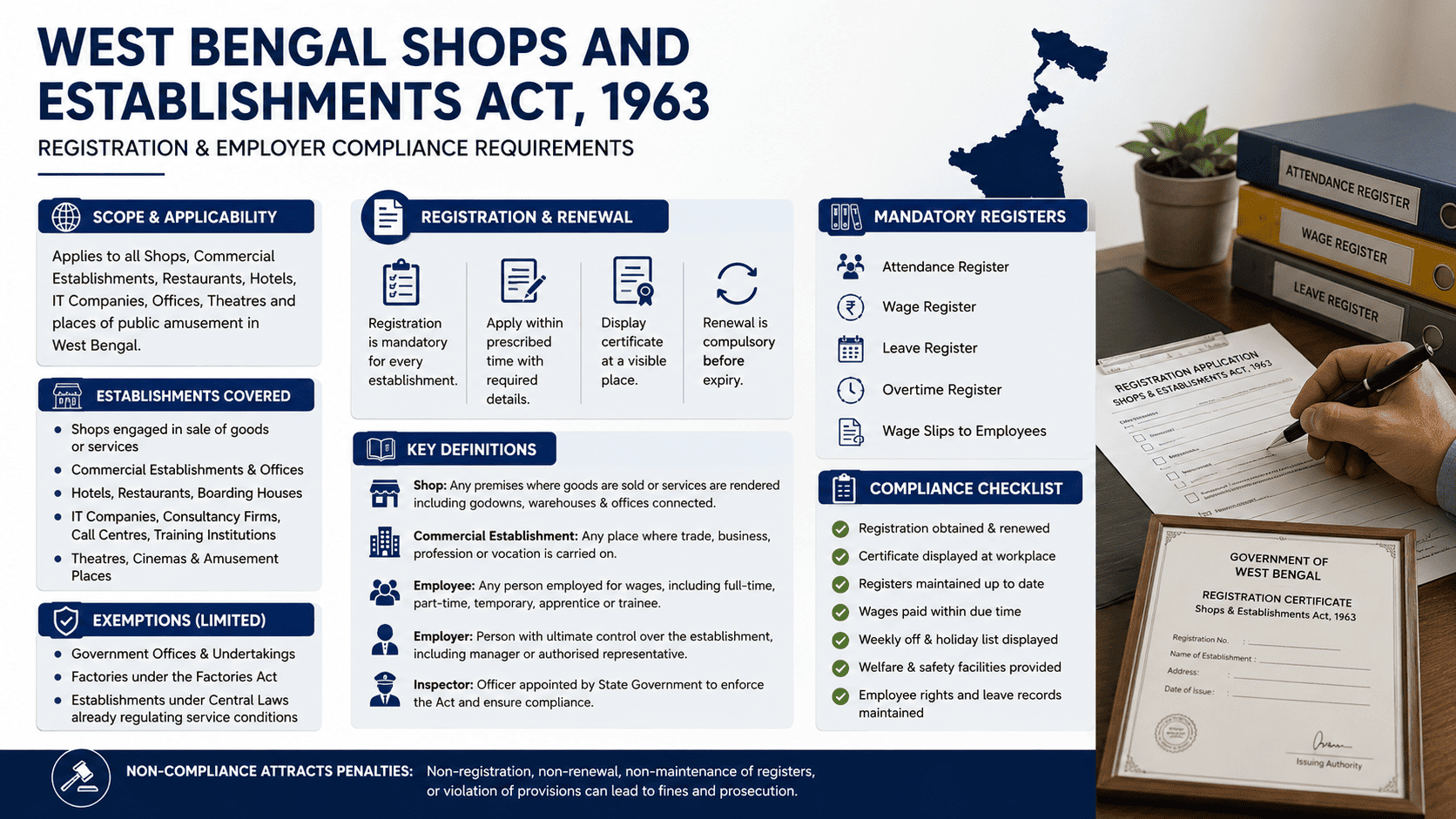
The Act 13 of 1963 West Bengal bare act download applies across the State of West Bengal. It regulates all types of commercial activity except those specifically exempted. Inspectors treat the scope very widely. Corrida Legal has seen cases where even small consultancy firms were brought under the Act.
Establishments Covered under West Bengal Shops and Establishments Act 1963 PDF
The West Bengal Shops and Establishments Act 1963 PDF applies to:
- Shops engaged in sale of goods or services.
- Commercial establishments such as offices, banks, trading houses.
- Hotels, restaurants, boarding houses.
- Theatres, cinemas, places of public amusement.
- IT and consultancy firms, call centres, training institutions.
Corrida Legal note – many employers think they are not “shops” in the ordinary sense. But law covers all commercial establishments, not only retail outlets.
Exemptions under West Bengal Shops and Establishments Act Executive Summary
The West Bengal Shops and Establishments Act executive summary shows that certain establishments are excluded.
- Government offices and undertakings.
- Factories covered under the Factories Act.
- Establishments under central laws already regulating service conditions.
These exemptions are narrow. In practice most private employers in West Bengal are covered.
Territorial Application under Labour Law Compliance in West Bengal Shops and Establishments Act
Labour law compliance in West Bengal Shops and Establishments Act applies to all establishments within the State. Urban and rural. Metropolitan Kolkata as well as small towns. Registration requirement is the same regardless of size or location.
Corrida Legal observation – even a small shop in a village can be inspected if there is a complaint.
Coverage of Employers and Employees – Working Hours and Holidays West Bengal Shops and Establishments Act
The working hours and holidays West Bengal Shops and Establishments Act provisions apply to every employee, permanent or temporary, full time or part time. Apprentices and trainees are also included. Employer definition includes the person having ultimate control, manager, or authorised representative.
Corrida Legal has seen inspectors in West Bengal treat interns also as employees for purpose of leave and welfare rights.
Compliance Implications – Employer Obligations and Penalties under West Bengal Shops and Establishments Act 1963
Employer obligations and penalties under West Bengal Shops and Establishments Act 1963 arise once the establishment falls within scope. Registration is compulsory. Renewal is compulsory. Non- registration is treated as contravention. Inspector may issue notice at first inspection itself.
Corrida Legal note – safest practice is to register even if in doubt. Penalty for over-registration is none. Penalty for non-registration is heavy.
Key Definitions under West Bengal Shops and Establishments Act Executive Summary
The Act starts with definitions. These decide the scope. Inspectors use them to bring employers within coverage. Disputes usually fail once definitions are read out because the wording is wide.
Definition of Shop – West Bengal Shops and Establishments Act 1963 PDF
A shop under the West Bengal Shops and Establishments Act 1963 PDF means any premises where goods are sold or services are rendered. It also covers attached godowns, warehouses, and offices connected with such activity.
In practice, this includes:
- Retail shops and showrooms.
- Wholesale trading premises.
- Repair workshops and service centres.
- Storage godowns linked to sales outlets.
Employers often assume storage or back-office premises are not covered. Inspectors treat them as part of the shop if they support business activity.
Definition of Commercial Establishment – Act 13 of 1963 West Bengal Bare Act Download
The Act 13 of 1963 West Bengal bare act download defines commercial establishment in broader terms. It includes places where trade, business, or profession is carried on. Offices, hotels, restaurants, boarding houses, clubs, educational institutions, theatres, and amusement houses are all covered.
Exclusions are narrow:
- Factories under the Factories Act.
- Government offices.
- Establishments already regulated by separate labour laws.
For most private entities in West Bengal, especially service firms, this definition brings them under the Act.
Employee Definition – Working Hours and Holidays West Bengal Shops and Establishments Act
Employee means any person employed for wages in a shop or establishment. Full-time, part-time, temporary, permanent, or apprentice – all are included. Clerical staff, sales assistants, cleaners, and support workers are also covered.
In many inspections, even interns and trainees have been treated as employees for purposes of leave and welfare. This is because the law focuses on the fact of employment, not the designation.
Employer Definition – Labour Law Compliance under West Bengal Shops and Establishments Act
Employer means the person with ultimate control over the affairs of the establishment. In case of a company, this extends to the manager or agent in charge of day-to-day operations. For compliance purposes, responsibility cannot be shifted.
Practical responsibility includes:
- Ensuring registration and renewal.
- Maintaining attendance, wage, and leave registers.
- Displaying certificates and notices.
- Allowing inspection of premises and records.
Inspector Definition – Employer Obligations and Penalties under West Bengal Shops and Establishments Act 1963
Inspector means an officer appointed by the State Government to enforce the Act. Their powers include entering establishments, demanding records, questioning staff, and issuing notices for contraventions. Once definitions are established, the inspector’s jurisdiction becomes clear and unavoidable.
Observations
- The Act deliberately defines terms broadly to ensure maximum coverage.
- Shops are not limited to sales counters; attached godowns and offices are included.
- Commercial establishment covers most service-sector employers.
- Employee definition is wide enough to include apprentices and sometimes interns.
- Employer liability attaches to managers or HR when they exercise control.
- Inspector authority is rooted in these definitions and difficult to contest.
Registration and Renewal Requirements under West Bengal Shops and Establishments Act 1963 PDF
The West Bengal Shops and Establishments Act 1963 PDF makes registration compulsory. Every shop, office, or establishment must be registered. This is the first requirement of the law. Without registration, the business itself is treated as in violation. Inspectors usually start their visit by asking for the certificate. If it is not there, the employer is already in default.
The Act 13 of 1963 West Bengal bare act download requires application for registration within the time fixed after opening business. The employer must give name of establishment, address, details of employees, and the nature of work. A small fee is also prescribed. Documents asked are basic – proof of premises, proof of employer identity, and details of employees. Once approved, the authority issues a certificate.
Renewal is also compulsory. Registration does not run for life. The West Bengal Shops and Establishments Act executive summary makes it clear that every certificate has a validity period. Renewal before expiry is required. Delay attracts penalty. If ownership changes, or if the nature of the business changes, then fresh particulars must be submitted with the renewal.
Display of certificate is another condition. Labour law compliance under West Bengal Shops and Establishments Act requires the registration certificate to be shown at the workplace. It should be on the notice board or in a visible place. If it is kept inside a drawer or file, inspectors treat it as non- display. Non-display is recorded as offence, even if the certificate is valid.
Effect of default is serious. Without registration, the working hours and holidays West Bengal Shops and Establishments Act provisions cannot be implemented. The law does not recognise an unregistered shop as compliant. Non-registration itself becomes the first ground for prosecution.
Employer obligations and penalties under West Bengal Shops and Establishments Act 1963 cover this area. First offence attracts fine. Repeat offences attract higher fine. Continuing default brings daily fine until corrected. Courts have supported inspectors when employers argue that small businesses should be exempt. Once establishment falls within definition, registration is compulsory.
Working Hours and Holidays under West Bengal Shops and Establishments Act 1963
The West Bengal Shops and Establishments Act 1963 fixes hours of work and weekly holidays. This is one of the most used provisions during inspection. Even if salary is correct, if hours or holidays are not in line, it is treated as violation.
Daily and Weekly Hours – Act 13 of 1963 West Bengal Bare Act Download
Under the Act 13 of 1963 West Bengal bare act download, hours are capped.
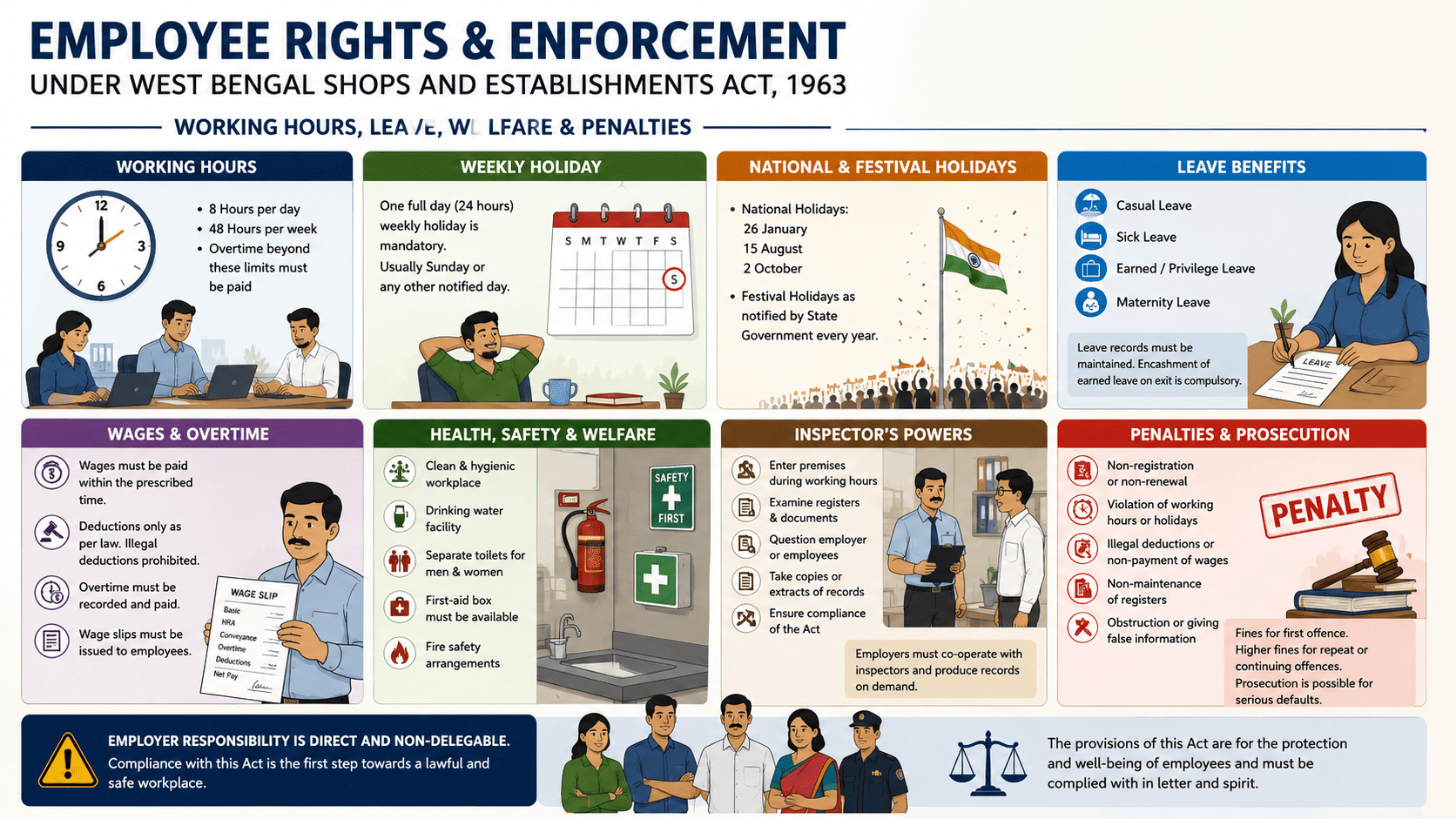
- 8 hours per day.
- 48 hours per week.
- Spread-over including breaks cannot cross the limit fixed by rules.
- Anything above this is overtime.
Inspectors in West Bengal compare attendance records with wage sheets. If employees stay late beyond 8 hours, but no overtime shown, notice is issued.
Weekly Holiday – West Bengal Shops and Establishments Act 1963 PDF
The West Bengal Shops and Establishments Act 1963 PDF makes one full-day holiday compulsory.
- Must be continuous 24 hours.
- Sunday is usual, but employer can fix another day.
- The weekly holiday must be displayed.
If holiday is not displayed, inspectors record non-compliance. Actual weekly off given but not displayed is still treated as violation.
National and Festival Holidays – West Bengal Shops and Establishments Act Executive Summary
The West Bengal Shops and Establishments Act executive summary requires three national holidays:
- 26 January
- 15 August
- 2 October
Festival holidays are fixed by State notification every year. Employer must declare which festival holidays will apply. If an employee works on a holiday, two conditions apply – double wages and compensatory leave.
Overtime – Labour Law Compliance under West Bengal Shops and Establishments Act
Labour law compliance under West Bengal Shops and Establishments Act requires overtime to be paid and recorded. Inspectors check three things together: attendance, overtime register, and wages. If overtime is paid in salary but not entered in register, it is still an offence.
Link with Leave – Working Hours and Holidays West Bengal Shops and Establishments Act
The working hours and holidays West Bengal Shops and Establishments Act provisions are different from leave entitlements. Weekly offs and holidays do not replace earned leave. Many employers argue that extra offs are equal to annual leave, but inspectors reject this defence.
Penalties – Employer Obligations and Penalties under West Bengal Shops and Establishments Act 1963
Employer obligations and penalties under West Bengal Shops and Establishments Act 1963 cover this area.
- Not giving weekly off = offence.
- Not declaring or displaying holiday list = offence.
- Working beyond 8 hours without proper overtime = offence.
- Consent of employee is not a defence.
- First offence = fine. Repeat = higher fine. Continuing default = daily fine.
Leave and Benefits under West Bengal Shops and Establishments Act 1963
The West Bengal Shops and Establishments Act 1963 provides for leave and minimum benefits to employees. This is another area where inspectors check records. Even if weekly offs and holidays are correct, if leave is not granted or not recorded, it is treated as non-compliance.
Types of Leave – Act 13 of 1963 West Bengal Bare Act Download
The Act 13 of 1963 West Bengal bare act download recognises different types of leave:
- Casual leave for short absence.
- Sick leave for illness.
- Earned leave or privilege leave based on days worked.
- Maternity leave for female employees.
Leave rules are not uniform for all. They depend on number of days worked in the year. For earned leave, entitlement accrues after a fixed number of days of service.
Benefits – West Bengal Shops and Establishments Act PDF
The West Bengal Shops and Establishments Act 1963 PDF also ensures minimum benefits linked with leave.
- Full wages must be paid during earned leave.
- Sick leave must not be denied if medical proof is given.
- Maternity leave benefit is compulsory for female workers.
- Leave record must be maintained in the prescribed register.
Failure to maintain leave register is treated as violation even if leave is given.
Accumulation Rules – West Bengal Shops and Establishments Act Executive Summary
The West Bengal Shops and Establishments Act executive summary provides that earned leave can be carried forward. Accumulation up to the prescribed limit is allowed. If employee leaves service, unused earned leave must be encashed.
Employers often fail to pay encashment of leave at termination. This becomes a common ground for complaints.
Link with Working Hours – Labour Law Compliance under West Bengal Shops and Establishments Act
Labour law compliance under West Bengal Shops and Establishments Act treats leave separately from weekly holidays and national holidays. Weekly offs are statutory, holidays are statutory, leave is in addition. Substituting leave with extra holidays is not allowed.
Penalties – Employer Obligations and Penalties under West Bengal Shops and Establishments Act 1963
Employer obligations and penalties under West Bengal Shops and Establishments Act 1963 cover leave defaults also.
- Denial of leave when entitled = offence.
- Not paying wages during leave = offence.
- Not maintaining leave register = offence.
- Non-encashment of leave on exit = offence.
Each offence can attract fine, and continuing failure increases penalty.
Wages and Record-Keeping under West Bengal Shops and Establishments Act 1963
The West Bengal Shops and Establishments Act 1963 makes wages and record-keeping a central part of compliance. It is not enough to simply pay employees. The law demands that wages are paid correctly, on time, and also that every payment is supported by registers, slips, and documents which can be shown to an inspector. In practice, inspectors rarely ask employees first — they always begin by checking registers. If records are incomplete or missing, it is assumed that wages were not paid as per law, even when employers argue otherwise.
Wage Payment Rules – Act 13 of 1963 West Bengal Bare Act Download
Under the Act 13 of 1963 West Bengal bare act download, an employer must ensure wages are disbursed within the statutory time after the close of the wage period. The Act permits payment either in cash, through cheque, or bank transfer, but all payments must be traceable. Deductions are allowed only when the law specifically permits, for example statutory contributions or authorised fines. Any deduction beyond this is unlawful. Inspectors in West Bengal often insist on seeing both the wage register and supporting proof of transfer. If the wage register shows deduction but no explanation or legal ground, the inspector records violation. The rule is clear – employee consent does not legalise an illegal deduction.
Records – West Bengal Shops and Establishments Act 1963 PDF
The West Bengal Shops and Establishments Act 1963 PDF requires that specific registers be maintained. These include the attendance register, wages register, leave register, and overtime register. Each register must be updated daily or weekly depending on its purpose. Employers often believe that maintaining payroll software is enough, but inspectors in practice ask for statutory registers in the prescribed format. If these are not available, it is taken as non-compliance even if payroll records are otherwise accurate.
For example, attendance registers should show actual hours of work. If attendance shows employees leaving after 8 hours but overtime register shows no extra hours, the inspector will treat this as a mismatch and issue a notice. The leave register must show leave applied, leave granted, and balance. If an employee complains about denial of leave and the register is blank, the inspector takes the complaint as valid.
Wage Slips – West Bengal Shops and Establishments Act Executive Summary
The West Bengal Shops and Establishments Act executive summary also makes it compulsory for employers to issue wage slips to employees. The slip must clearly mention gross wages, allowances, overtime, deductions, and net wages paid. It is not enough to prepare the slip internally — it must be issued to each employee. Wage slips are the simplest evidence for employees to confirm correct payment. When wage slips are missing, inspectors assume underpayment or manipulation, and employers then struggle to prove otherwise.
Importance of Records – Labour Law Compliance under West Bengal Shops and Establishments Act
Labour law compliance under West Bengal Shops and Establishments Act is built around records. An employer may be paying correct wages, but without proper registers and slips, compliance is considered incomplete. Inspectors rely on documents more than oral explanations. They cross-check wage slips, registers, and payment proofs. Any inconsistency, however small, is treated as a contravention. Employers often fail not because they did not pay, but because they did not document correctly.
Penalties – Employer Obligations and Penalties under West Bengal Shops and Establishments Act 1963
Employer obligations and penalties under West Bengal Shops and Establishments Act 1963 are strict in this area. Non-payment of wages within time, wrongful deductions, non-maintenance of registers, or failure to issue wage slips all count as offences. First-time fines may appear small, but repeat violations or continuing defaults escalate the penalty. Inspectors usually treat absence of wage records as one of the most serious breaches, because it directly affects employee rights. Courts in West Bengal have also upheld penalties in such cases, stating that compliance under this Act is record-based and not intention-based.
Observations
- Wages must be paid within the statutory time frame.
- Deductions only where law allows. Consent of employee does not validate illegal deductions.
- Registers (attendance, wages, leave, overtime) must be in prescribed format. Payroll software alone is not enough.
- Wage slips must be issued to every employee.
- Records are the primary proof in inspections; oral statements are not accepted.
- Absence or mismatch in records leads to notices and penalties even where wages were actually paid.
Health, Safety and Welfare Measures under West Bengal Shops and Establishments Act 1963
The West Bengal Shops and Establishments Act 1963 does not stop at working hours and wages. It also deals with health, safety, and welfare at the workplace. These provisions are often overlooked by employers, but inspectors take them seriously because they directly affect employee well-being. Even small shops with very few workers must comply.
General Safety Rules – Act 13 of 1963 West Bengal Bare Act Download
The Act 13 of 1963 West Bengal bare act download requires every establishment to maintain basic safety standards. This includes keeping the workplace clean, free from hazards, and properly ventilated. Lighting must be adequate, and drinking water must be provided. Fire safety arrangements, including exits and equipment, must be in working condition.
Employers sometimes treat these as minor requirements, but inspectors in West Bengal record them during inspections. For example, absence of proper lighting, lack of ventilation, or blocked fire exits are treated as direct contraventions.
Welfare Facilities – West Bengal Shops and Establishments Act 1963 PDF
The West Bengal Shops and Establishments Act 1963 PDF requires certain welfare facilities to be provided for employees. These include seating arrangements for employees who stand for long hours, separate toilets for men and women, and sufficient rest facilities where necessary. In case of larger establishments, canteen or lunch room facilities may also be required.
Registers must also reflect that facilities are in place. Inspectors often insist on seeing the premises physically, not just relying on registers.
Cleanliness and Health – West Bengal Shops and Establishments Act Executive Summary
The West Bengal Shops and Establishments Act executive summary makes cleanliness a legal duty. Every employer must ensure that premises are clean, floors are washed, walls and ceilings are maintained, and no accumulation of dirt or waste is allowed. Proper disposal of waste is compulsory.
If an employee complains about poor sanitation or unhygienic workplace, inspectors treat it as a violation even without full inspection. Complaints are enough to trigger enquiry.
Labour Law Compliance – Health and Welfare under West Bengal Shops and Establishments Act
Labour law compliance under West Bengal Shops and Establishments Act covers welfare facilities in addition to safety. First-aid boxes with prescribed contents must be kept. Drinking water supply must be adequate and accessible. Washing facilities should be separate and maintained. Employers often focus on wages and hours, but inspectors in West Bengal frequently issue notices on welfare gaps such as no separate toilet for women or absence of seating arrangements.
Penalties – Employer Obligations and Penalties under West Bengal Shops and Establishments Act 1963
Employer obligations and penalties under West Bengal Shops and Establishments Act 1963 apply equally to health and welfare. Non-maintenance of cleanliness, not providing drinking water, not arranging first-aid, or ignoring fire safety provisions are all treated as offences. Inspectors have wide powers to impose penalties and in some cases can even recommend prosecution.
Enforcement and Inspector’s Powers under West Bengal Shops and Establishments Act 1963
The West Bengal Shops and Establishments Act 1963 is not self-executing. It is enforced through inspectors appointed by the State Government. These officers have wide powers under the law. Their role is not only to check paperwork but also to physically inspect establishments, talk to employees, and verify compliance on the ground.
Appointment and Authority – Act 13 of 1963 West Bengal Bare Act Download
Under the Act 13 of 1963 West Bengal bare act download, inspectors are appointed by the Government. Their area of jurisdiction is notified. Once appointed, their authority covers every shop and establishment within their zone. Employers cannot deny entry to an inspector. Doing so itself is treated as obstruction and punishable.
Powers of Inspection – West Bengal Shops and Establishments Act 1963 PDF
The West Bengal Shops and Establishments Act 1963 PDF lays down the specific powers of an inspector. These include the right to:
- Enter the premises during working hours.
- Examine registers, records, and documents.
- Question the employer, manager, or employees.
- Take copies or extracts of registers.
- Check facilities like drinking water, sanitation, and fire safety.
Inspectors are expected to carry an identity card and act within their legal authority. But in practice, once they begin inspection, most employers have little scope to resist.
Duty of Employer – West Bengal Shops and Establishments Act Executive Summary
The West Bengal Shops and Establishments Act executive summary makes it clear that employers must cooperate with inspectors. This includes producing registers on demand, answering questions truthfully, and not hiding documents. Non-cooperation is treated as a separate offence. Even small delays in producing records are recorded by inspectors.
Link with Compliance – Labour Law under West Bengal Shops and Establishments Act
Labour law compliance under West Bengal Shops and Establishments Act depends heavily on inspection reports. Employers may believe they are compliant, but if records are not updated or certificates not displayed, inspectors treat the establishment as in default. Most prosecutions under this Act are based on inspection notes.
Penalties – Employer Obligations and Penalties under West Bengal Shops and Establishments Act 1963
Employer obligations and penalties under West Bengal Shops and Establishments Act 1963 also include obstruction of inspector, failure to produce registers, or giving false information. Penalties range from monetary fines to prosecution for continuing offences. Inspectors have authority to initiate proceedings before the labour authorities or magistrates.
Penalties and Prosecution under West Bengal Shops and Establishments Act 1963
The West Bengal Shops and Establishments Act 1963 sets out clear penalties for contraventions. Compliance under this Act is not voluntary. Every rule on registration, working hours, holidays, leave, records, and welfare carries consequences if ignored. Penalties apply even to small defaults.
Prosecution is possible where offences are repeated or continuous.
Nature of Offences – Act 13 of 1963 West Bengal Bare Act Download
Under the Act 13 of 1963 West Bengal bare act download, offences include a wide range of defaults. Non-registration, failure to renew, non-display of certificate, forcing employees to work beyond hours, denial of holidays, wrongful deductions in wages, failure to keep registers, absence of welfare facilities – all are punishable. Even minor omissions like not displaying the weekly holiday notice are listed as offences.
Scale of Penalties – West Bengal Shops and Establishments Act 1963 PDF
The West Bengal Shops and Establishments Act 1963 PDF prescribes fines for first offences. The amount may look small but increases sharply for repeat offences. For continuing contraventions, a daily fine is added until the violation is corrected. In practice, this means an employer who delays registration or fails to renew for months ends up paying far more than the initial fee.
Prosecution – West Bengal Shops and Establishments Act Executive Summary
The West Bengal Shops and Establishments Act executive summary provides that inspectors can initiate prosecution for serious defaults. Cases are filed before the magistrate or competent authority. Penalties are not limited to fines – prosecution can also involve orders for compliance, recovery of dues, and in some cases imprisonment for wilful and repeated breach.
Employer Liability – Labour Law Compliance under West Bengal Shops and Establishments Act
Labour law compliance under West Bengal Shops and Establishments Act makes the employer directly liable. The Act does not allow shifting of responsibility. Managers and agents in charge of operations can also be held responsible. In companies, inspectors often issue notices in the name of both employer and manager.
Strict Enforcement – Employer Obligations and Penalties under West Bengal Shops and Establishments Act 1963
Employer obligations and penalties under West Bengal Shops and Establishments Act 1963 are strictly enforced because these provisions deal with employee rights. Inspectors treat excuses like “consent of employees” or “lack of awareness” as irrelevant. Courts have also upheld this strict approach, stating that these laws are for protection of workers and must be applied without relaxation.
Conclusion and Compliance Approach under West Bengal Shops and Establishments Act 1963
The West Bengal Shops and Establishments Act 1963 is not a complex law, but it is strict. It touches every aspect of employment in shops and commercial establishments — from registration and working hours to wages, leave, holidays, health, and welfare. For employers in West Bengal, this Act is the starting point of labour compliance. Inspectors almost always begin here before moving to PF, ESI, or other laws.