

Reviewed and Validated by: Naman Jain, Associate
Introduction – Telecom Regulatory Authority of India Act, 1997 Executive Summary PDF
The telecom industry in India was once a closed and slow-moving space. Until the early 1990s, communication services were largely run by the Government through the Department of Telecommunications. Waiting periods were long, competition was absent, and consumers had little choice. As India opened its economy, the arrival of private players demanded a new legal order — one that could balance commercial freedom with public responsibility.
The Telecom Regulatory Authority of India Act 1997 Bare Act PDF was enacted to meet that need. It created a specialised and independent regulator, the Telecom Regulatory Authority of India (TRAI), entrusted with maintaining fairness and discipline in the sector. The Act ensured that while private investment expanded access and technology, regulation would preserve integrity and protect the interests of consumers.
The Telecom Regulatory Authority of India Act 1997 Executive Summary PDF explains how this statute reshaped the relationship between government, operators, and the public. For the first time, there was a clear separation between policymaking, service operation, and regulation — an arrangement that gave credibility to India’s liberalisation efforts.
The TRAI Act 1997 PDF Corrida Legal interpretation highlights a simple but lasting idea: competition must be guided by fairness. The law’s purpose was not only to control prices or licensing but to make telecom a reliable public service governed by transparency and accountability.
Over time, this framework became the foundation of modern Telecom Law and Regulation in India. Every development since — from tariff reforms to digital connectivity — traces its roots back to the principles laid down in this Act. It turned communication into a right accessible to all, not a privilege of a few.
The structure of licensing, defined under Telecom Licensing and Compliance under TRAI Act 1997, continues to uphold that balance. It allows innovation and private growth while keeping consumer welfare at the centre.
The establishment of the Telecom Disputes Settlement and Appellate Tribunal (TDSAT) under TRAI Act later added a fair and specialised dispute mechanism, ensuring that conflicts are resolved with expertise rather than bureaucracy. Together, these reforms built a legal ecosystem where telecom could grow responsibly — an industry regulated by law, not power.
Key Takeaways
- The TRAI Act, 1997 emerged from the telecom reforms of the 1990s.
- It separated policy, operation, and regulation to ensure transparency.
- The law focuses on competition that benefits consumers.
- Licensing and compliance remain guided by fairness and accountability.
- The creation of TDSAT strengthened dispute resolution in the sector.
- The Act continues to anchor India’s telecom governance even in the digital age.
Background and Legislative Intent – Telecom Regulatory Authority of India Act, 1997 Executive Summary PDF
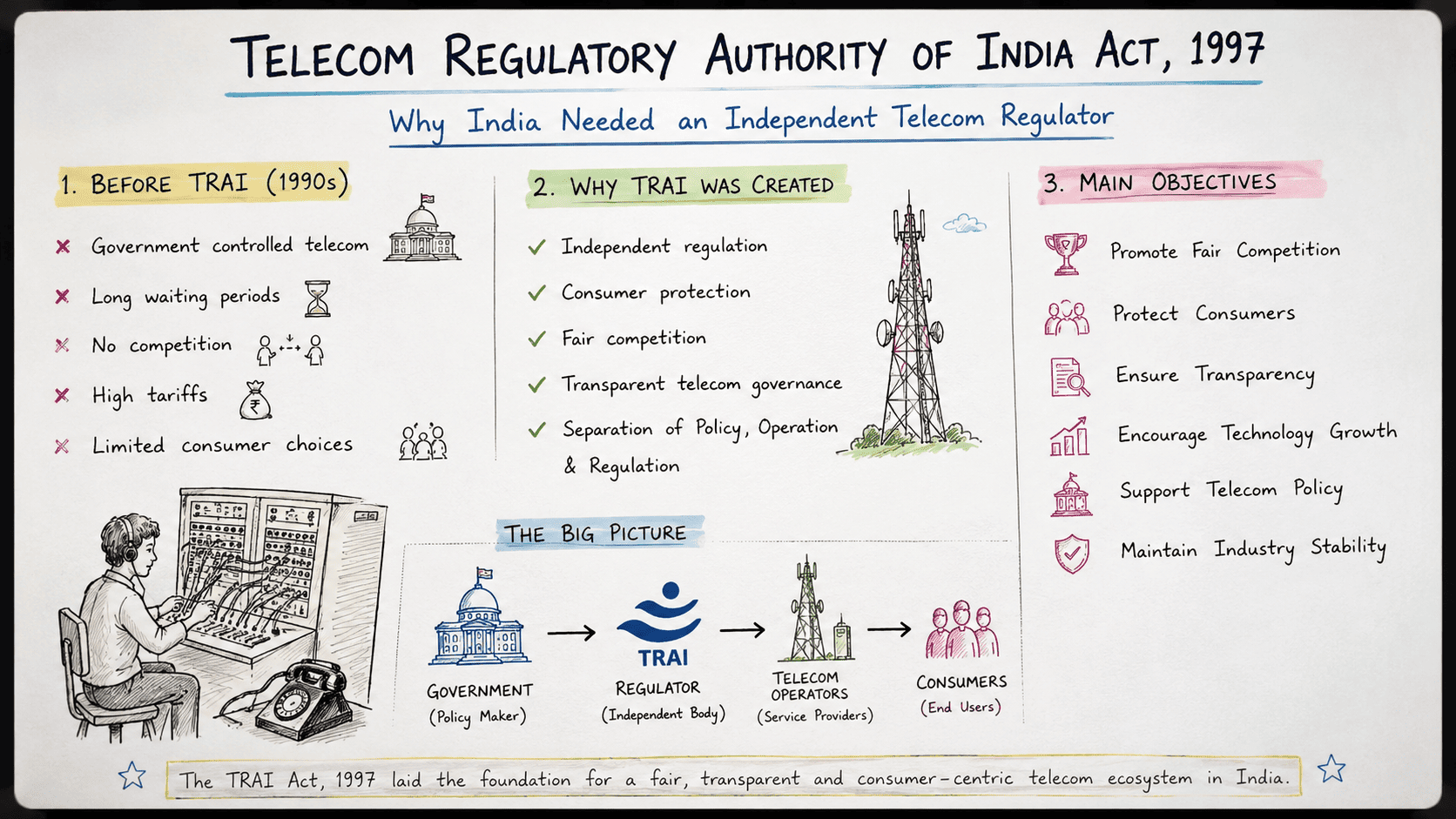
The story of the Telecom Regulatory Authority of India Act, 1997 begins much before the law itself came into force. Through the 1980s and early 1990s, India’s telecommunication system was fully controlled by the Government. The Department of Telecommunications (DoT) functioned as both operator and policymaker. Waiting years for a new connection was common, and tariffs remained high because competition simply did not exist.
The early phase of economic liberalisation in the 1990s changed this reality. The private sector entered the telecom space through the National Telecom Policy, 1994, and for the first time, telephone services were seen as a potential growth engine rather than a bureaucratic service. Yet, with this new freedom came confusion — there were no uniform rules to regulate the behaviour of multiple players in a market that was once a monopoly.
It was in this environment that Parliament enacted the Telecom Regulatory Authority of India Act 1997 Bare Act PDF. The intent was not just to regulate a growing industry but to ensure that the benefits of competition reached consumers fairly. The law separated the Government’s role as operator from that of a neutral regulator, laying the groundwork for a transparent and credible telecom market.
The Telecom Regulatory Authority of India Act 1997 Executive Summary PDF explains that TRAI was conceived as an independent institution capable of balancing two parallel objectives — promoting investment and protecting public interest. It had to keep pace with technology, mediate disputes, and guide the industry towards long-term sustainability.
The Legislative Purpose
The legislative intent behind the TRAI Act 1997 PDF Corrida Legal interpretation can be summarised through three broad goals:
- Establish independence in regulation — to ensure that market oversight was free from political and commercial influence.
- Protect the consumer — to make sure that pricing, quality of service, and transparency were consistent across operators.
- Enable fair competition — to prevent monopoly or collusion and encourage equal access for new entrants.
The law drew inspiration from global models but was tailored for Indian realities. It recognised that telecom was no longer a state-controlled facility; it was a public utility that needed a neutral referee to maintain trust and efficiency.
The Shift from Monopoly to a Managed Market
This reform was not just economic — it was institutional. The Telecom Law and Regulation in India changed from command-and-control to oversight and facilitation. TRAI’s establishment represented a shift towards professional governance where the regulator, rather than the Government, would decide tariffs, approve interconnection agreements, and monitor service quality.
The introduction of Telecom Licensing and Compliance under TRAI Act 1997 made licensing procedures more transparent. Operators were now accountable not only to the Government but also to a regulator that ensured their compliance with fair practices.
Balancing Development and Discipline
The legislative philosophy behind the Act was to create a self-correcting system — one that encouraged growth but kept it disciplined. TRAI was given both consultative and enforcement powers, allowing it to respond quickly to market irregularities.
When disputes began to emerge between private operators and the Government, a new institutional framework was needed for fair adjudication. This led to the later creation of the Telecom Disputes Settlement and Appellate Tribunal (TDSAT) under TRAI Act, which now serves as a neutral forum for resolving complex issues between service providers, consumers, and the regulator.
Objectives and Scope of the Telecom Regulatory Authority of India Act, 1997 Executive Summary PDF
The objectives of the Telecom Regulatory Authority of India Act, 1997 were shaped by the challenges of a
transforming economy. India’s telecom market was moving from monopoly to competition, and this
transition required a steady hand. The Act’s purpose was clear — to create an independent authority that would guide the telecom sector towards fair growth while protecting public interest.
The Telecom Regulatory Authority of India Act 1997 Bare Act PDF lays down these objectives in a structured manner. It was designed to ensure that the telecom industry developed in an orderly and transparent way, where service quality, consumer protection, and financial discipline worked together to build trust.
The law recognised that communication was no longer a luxury but an essential part of economic progress. It introduced a governance model that could respond to rapid changes in technology and market dynamics. Through the Telecom Regulatory Authority of India Act 1997 Executive Summary PDF, one can see how the Act continues to shape both policy and practice in India’s telecom sector.
Key Objectives of the TRAI Act
- Promoting fair competition – The Act encourages multiple players in the market while preventing any single operator from dominating.
- Protecting consumer interests – It mandates reasonable tariffs, quality of service standards, and grievance redressal mechanisms.
- Ensuring transparency – All operators are required to follow uniform procedures in tariff filing, licensing, and reporting.
- Encouraging technological advancement – The Act allows TRAI to recommend policy reforms that support innovation and digital expansion.
- Maintaining financial stability – Service providers must comply with solvency, investment, and reporting norms to prevent market disruption.
- Supporting policy formulation – TRAI assists the Government in framing national telecom policies and reviewing their implementation.
These objectives together form the foundation of modern telecom governance. They represent a balance between regulation and reform — allowing the market to grow while keeping consumer welfare at the heart of every decision.
Scope and Reach of the Act
The TRAI Act 1997 PDF Corrida Legal interpretation highlights its broad scope. The Act applies to all licensed telecom operators, including mobile, broadband, satellite, and internet service providers. Its reach extends beyond pricing and licensing to include interconnection agreements, quality of service, and dispute resolution.
The scope of the Act also includes oversight of broadcasting and cable services, brought within TRAI’s jurisdiction through later amendments. By linking telecom and broadcasting under one regulatory umbrella, India created a unified framework for communication services — a step that would later support the rise of digital convergence.
Core Functions within Telecom Law and Regulation in India
Within the larger system of Telecom Law and Regulation in India, the TRAI Act serves three core functions:
- Regulatory: Overseeing the operational conduct of service providers, issuing directions, and ensuring compliance.
- Recommendatory: Advising the Government on licensing, mergers, and foreign investment in telecom.
- Adjudicatory (before TDSAT): Facilitating dispute resolution and maintaining market discipline.
Each of these functions supports the other, ensuring that India’s telecom market operates with clarity, stability, and fairness.
Licensing and Compliance Framework
The Telecom Licensing and Compliance under TRAI Act 1997 forms a vital part of this structure. TRAI reviews license terms, monitors compliance, and ensures that operators follow the principles of non- discrimination and transparency. The Authority also plays an advisory role in defining license conditions, helping the Government maintain uniform standards across the industry.
Through this process, the Act ensures that telecom services remain consistent, reliable, and affordable, even as the market evolves.
Role of TDSAT within the Framework
The Telecom Disputes Settlement and Appellate Tribunal (TDSAT) under TRAI Act provides an additional safeguard within this ecosystem. It hears appeals and settles conflicts between service providers, consumers, and the regulator. The presence of a specialised tribunal allows disputes to be resolved with sectoral expertise, reducing delays and ensuring fairness.
Structure and Composition of TRAI under the Telecom Regulatory Authority of India Act, 1997 Executive Summary PDF
When the Telecom Regulatory Authority of India (TRAI) was established under the 1997 Act, it was not merely another government institution — it was meant to be an independent authority with a professional structure, insulated from political or commercial pressure. The Telecom Regulatory Authority of India Act 1997 Bare Act PDF outlines this structure carefully, ensuring that the regulator could perform its duties objectively while maintaining accountability to Parliament and the public.
The success of any regulatory framework depends on its institutional design. The Telecom Regulatory Authority of India Act 1997 Executive Summary PDF explains that TRAI was created with a balance of expertise and independence. It was to function neither as a ministry nor as a private board, but as a neutral referee that understood both law and technology.
Composition of the Authority
The TRAI Act 1997 PDF Corrida Legal interpretation notes that the Authority is composed of a Chairperson and not more than two full-time and two part-time Members. All are appointed by the Central Government, based on their knowledge of telecom, finance, management, law, or consumer affairs.
This mix of expertise is deliberate. The Chairperson brings leadership and direction, while the Members contribute domain-specific insight. Together, they make decisions that influence the pricing, quality, and accessibility of communication across the country.
Appointment, Tenure, and Independence
The Act prescribes transparent procedures for appointments to avoid conflicts of interest. The Chairperson and Members are appointed for a fixed term, after which they are not eligible for reappointment. This prevents dependency on the Government and reinforces independence in decision-making.
Their salaries and conditions of service are also fixed under statute. This ensures that TRAI’s functioning remains free from external influence and that its decisions are guided by law and public interest, not political convenience.
Secretariat and Operational Structure
Supporting the Authority is the TRAI Secretariat — a dedicated administrative unit responsible for research, policy drafting, and stakeholder coordination. It includes professionals from technical, legal, and economic backgrounds who assist in the preparation of consultation papers, regulatory guidelines, and policy recommendations.
This Secretariat structure allows TRAI to function continuously and respond to changes in the market with informed expertise. It is one of the reasons why the Telecom Law and Regulation in India remains dynamic and adaptable despite rapid technological growth.
Decision-Making Process
All important decisions are made collectively by the Chairperson and Members, ensuring that no single viewpoint dominates. TRAI’s working method relies heavily on consultation — a process through which it invites public comments and industry feedback before issuing regulations.
This consultative approach has become a hallmark of transparency under Indian telecom regulation. It encourages participation from all stakeholders, including consumers, operators, and policy experts, before a final order is passed.
Relationship with the Government
While TRAI is independent, it functions in coordination with the Department of Telecommunications (DoT) and the Ministry of Communications. The Act allows the Government to issue directions in matters of public interest, but these must be consistent with the objectives of the Act.
This balance ensures that the Telecom Licensing and Compliance under TRAI Act 1997 continues to function under clear boundaries — the regulator monitors the industry, while the Government frames the broader policy.
Role of TDSAT in Institutional Framework
To complement TRAI’s regulatory role, the Telecom Disputes Settlement and Appellate Tribunal (TDSAT) under TRAI Act was later established as a separate adjudicatory body. While TRAI regulates and monitors, TDSAT resolves disputes between the regulator, service providers, and consumers. This separation between regulation and adjudication ensures fairness and clarity in the enforcement of telecom laws.
Powers and Functions of TRAI under the Telecom Regulatory Authority of India Act, 1997 Executive Summary PDF
When the Telecom Regulatory Authority of India was set up, it was not meant to be a symbolic body. It was created with real powers and clear responsibilities. The Telecom Regulatory Authority of India Act 1997 Bare Act PDF defines TRAI as the regulator of a fast-changing industry — one that needed constant oversight, yet enough freedom to grow. The law gave TRAI authority to supervise, regulate, and guide the telecom sector while protecting consumers and ensuring fair competition.
At its core, the Telecom Regulatory Authority of India Act 1997 Executive Summary PDF shows that TRAI was designed to function independently. It was expected to strike a balance between commercial ambition and public interest. As the industry evolved from landlines to mobile phones and now into digital communication, TRAI’s powers expanded in both scope and influence.
Regulatory Powers
The TRAI Act 1997 PDF Corrida Legal interpretation explains that regulation is the backbone of TRAI’s work. The authority controls tariffs, quality of service, and interconnection between operators. It ensures that service providers compete fairly and that no single company uses its size to control the market.
TRAI also supervises how service providers handle consumer data, billing, and grievance redressal. By framing binding directions, it makes sure that operators act within the law. This keeps the market stable and transparent while giving consumers confidence that their rights are protected.
Recommendatory Powers
In addition to its regulatory functions, TRAI advises the Government on major policy matters. This includes decisions on spectrum allocation, licensing terms, and entry of new players into the market. TRAI’s recommendations are not political—they are based on analysis, consultation, and long-term vision.
The law allows TRAI to suggest reforms in:
- Licensing and merger policies for telecom operators.
- Pricing and competition guidelines.
- Promotion of digital and rural connectivity.
- Technology-driven reforms to support emerging services like broadband and VoIP.
This advisory role makes TRAI an active participant in shaping telecom policy, rather than a passive observer.
Supervisory and Monitoring Functions
Under Telecom Law and Regulation in India, TRAI has the power to monitor the functioning of every licensed operator. It can demand reports, inspect records, and verify compliance with its directions. The authority also conducts audits and performance checks to ensure that telecom companies follow established standards.
If a service provider violates these rules, TRAI can:
- Issue a warning or show-cause notice.
- Impose financial penalties.
- Recommend suspension of the license in severe cases.
- Direct the operator to take corrective action.
This system of supervision keeps the market disciplined and ensures that accountability is continuous, not occasional.
Consumer Protection and Service Quality
A large part of TRAI’s mandate is focused on the consumer. It monitors call quality, network reliability, and billing accuracy. TRAI also publishes regular reports comparing the performance of different operators, creating healthy competition based on transparency.
Through public consultations, TRAI involves consumers in its decision-making process. Every regulation or tariff order is preceded by an open discussion where users, experts, and companies can share their opinions. This participatory method has made TRAI one of the most transparent regulators in India.
Promotion of Growth and Innovation
The Telecom Licensing and Compliance under TRAI Act 1997 highlights TRAI’s role in encouraging investment and innovation. It supports new entrants, simplifies licensing norms, and ensures that smaller players are not sidelined by dominant operators.
TRAI’s guidelines have been central to India’s telecom revolution—creating conditions for affordable mobile services, digital inclusion, and rapid expansion of internet connectivity. Its regulatory consistency has given investors long-term confidence in India’s telecom ecosystem.
Coordination and Dispute Prevention
While TRAI regulates the market, disputes between operators, or between operators and the Government, are handled by the Telecom Disputes Settlement and Appellate Tribunal (TDSAT) under TRAI Act. The coordination between the two bodies helps maintain order. TRAI’s proactive consultations often prevent disputes before they reach the tribunal.
This arrangement ensures that issues are resolved within the system rather than through lengthy litigation, making telecom regulation efficient and predictable.
Licensing and Compliance Framework under the Telecom Regulatory Authority of India Act, 1997 Executive Summary PDF
Licensing has always been at the centre of India’s telecom regulation. Without a well-defined license
system, it would have been impossible to maintain order in an industry driven by rapid expansion and technological change. The Telecom Regulatory Authority of India Act 1997 Bare Act PDF recognises this and gives TRAI the responsibility to advise, oversee, and monitor how telecom licenses are granted and maintained.
Before 1997, the licensing process was controlled entirely by the Department of Telecommunications. This meant that the same body made policies, operated services, and issued licenses — a structure that often led to conflicts of interest. The creation of TRAI changed that approach. By separating the policymaking and operational functions from regulation, the Telecom Regulatory Authority of India Act 1997 Executive Summary PDF ensured that the licensing process would become transparent and fair.
Role of TRAI in the Licensing System
TRAI’s role in licensing is both advisory and supervisory. While the power to grant licenses remains with the Central Government, TRAI examines market conditions, evaluates proposals, and recommends terms and conditions to ensure fair competition.
The TRAI Act 1997 PDF Corrida Legal interpretation shows that the regulator’s recommendations are
based on three guiding ideas:
- Equal opportunity for all eligible players.
- Protection of consumer interest through service obligations.
- Promotion of healthy competition to avoid dominance or cartelisation.
TRAI’s oversight continues even after a license is granted. It monitors compliance with license terms, reviews operational performance, and advises on policy reforms when necessary.
Types of Telecom Licenses
Under Telecom Law and Regulation in India, licenses are issued for different kinds of telecom services. These include:
- Unified Access Service License (UASL) for mobile and basic phone services.
- Internet Service Provider (ISP) license for broadband and internet access.
- Infrastructure Provider license for telecom towers and networks.
- National and International Long Distance licenses for data and voice carriage.
Each license carries obligations related to coverage, quality of service, lawful interception, and customer grievance handling. TRAI ensures that these obligations are not merely formalities but actual operating standards that shape industry behaviour.
Compliance and Monitoring
The Telecom Licensing and Compliance under TRAI Act 1997 provides a detailed framework for monitoring license conditions. Service providers must submit regular performance reports, tariff filings, and network audits to TRAI. The authority reviews these submissions to verify whether the operator is meeting its commitments under law.
If violations are found, TRAI can:
- Direct the licensee to correct deficiencies within a specified period.
- Recommend penalties or suspension of operations for repeated non-compliance.
- Report serious breaches to the Department of Telecommunications for further action.
This layered structure ensures accountability without obstructing business. It encourages companies to operate responsibly while maintaining regulatory oversight for public protection.
Fair Access and Non-Discrimination
An important principle introduced through this law is non-discriminatory access. All licensed operators must provide fair interconnection to other networks and cannot block, delay, or favour specific providers. TRAI monitors such arrangements closely, preventing market manipulation that could harm smaller operators or consumers.
This system of open interconnection has been one of the main reasons for India’s telecom success. It allowed new entrants to grow, expanded connectivity, and reduced tariffs through real competition.
Adherence to Quality and Tariff Rules
Compliance is not limited to technical performance. Operators must also adhere to tariff orders, consumer protection guidelines, and quality-of-service benchmarks set by TRAI. Regular audits and field checks are carried out to confirm that these standards are met.
The authority publishes reports comparing service quality among operators, creating public accountability and encouraging companies to improve performance.
Role of TDSAT in Compliance Disputes
When disagreements arise over licensing or compliance, the Telecom Disputes Settlement and Appellate Tribunal (TDSAT) under TRAI Act provides a neutral platform for resolution. Disputes over license fees, interconnection, or interpretation of TRAI’s orders can be taken before TDSAT. Its judgments carry legal force and often shape future regulatory directions.
Tariff Regulation and Consumer Protection under the Telecom Regulatory Authority of India Act, 1997 Executive Summary PDF
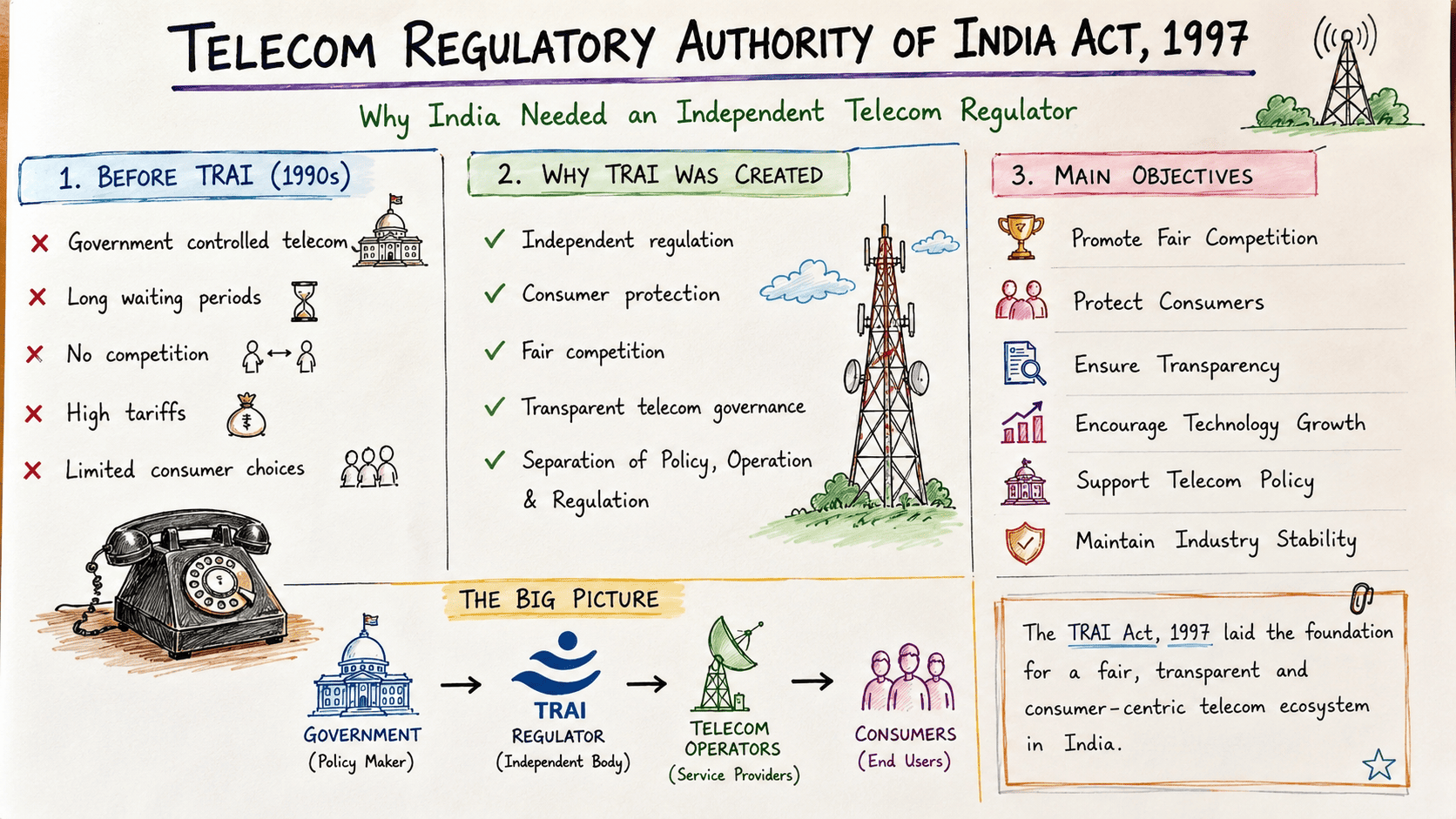
Tariff regulation has always been one of the most visible aspects of TRAI’s work. The authority’s role is not limited to setting prices — it ensures that the entire system of communication services remains accessible, affordable, and fair. The Telecom Regulatory Authority of India Act 1997 Bare Act PDF gives TRAI the power to oversee tariffs, monitor their impact on consumers, and prevent exploitative pricing practices in the telecom market.
In the years before TRAI was established, telecom tariffs were often fixed without transparency. Operators followed a uniform rate structure with little competition or consumer consideration. The introduction of the Telecom Regulatory Authority of India Act 1997 Executive Summary PDF changed that. It required a systematic approach to pricing, one that balanced commercial sustainability with public welfare.
Evolution of Tariff Regulation
The TRAI Act 1997 PDF Corrida Legal interpretation highlights that tariff regulation evolved with the industry itself. Initially, TRAI prescribed detailed tariff orders that fixed prices for calls, rentals, and data services. As competition grew, the authority shifted towards a model of tariff forbearance — allowing operators to decide their own prices within broad limits, provided they remained fair and non-discriminatory.
This transition reflected maturity. It encouraged innovation in service plans while keeping consumer protection intact. TRAI continues to monitor tariffs to prevent predatory pricing, hidden charges, or unfair differentials that might distort competition.
Principles Governing Tariff Fixation
TRAI follows a few simple but strong principles while regulating tariffs under Telecom Law and Regulation in India:
- Transparency – All operators must publish their tariffs and inform customers of any changes in advance.
- Non-discrimination – Similar subscribers must be charged similar rates for similar services.
- Fair competition – Operators cannot use pricing to drive competitors out of the market.
rural and low-income segments. These principles have ensured that India’s telecom prices remain among the lowest in the world while sustaining industry growth.
Consumer Protection Mechanisms
Beyond tariffs, TRAI’s role extends to protecting consumers against poor service quality, hidden fees, and misuse of personal data. The Telecom Licensing and Compliance under TRAI Act 1997 obliges operators to maintain a grievance redressal mechanism, appoint nodal officers, and resolve complaints within specific timelines.
TRAI’s consumer protection framework covers:
- Billing accuracy and transparency – Customers must receive clear and itemised bills.
- Network performance – Operators must meet benchmarks for call quality, internet speed, and reliability.
- Unsolicited communication – TRAI introduced rules to curb spam calls and messages through the National Do Not Disturb (NDND) registry.
- Digital literacy and awareness – Regular campaigns educate consumers about their rights and complaint procedures.
These measures are not optional; they are regulatory obligations monitored through periodic reports and audits.
Tariff Orders and Reporting Obligations
Under the Telecom Regulatory Authority of India Act 1997 Bare Act PDF, TRAI can issue tariff orders that are binding on all service providers. These orders specify how tariffs must be structured, reported, and publicised. Operators are required to file their tariff plans with TRAI before introducing them to the public.
Failure to comply can lead to penalties, withdrawal of plans, or suspension of services. This system of prior approval prevents misleading offers and ensures that consumers always know what they are paying for.
Handling Consumer Disputes
When consumer disputes arise — whether over billing, service quality, or tariff misrepresentation — the first level of resolution lies with the service provider. If the complaint remains unresolved, TRAI’s oversight allows the issue to escalate to higher authorities. For larger or technical disputes between consumers and operators, the Telecom Disputes Settlement and Appellate Tribunal (TDSAT) under TRAI Act acts as the final adjudicatory body.
This multi-layered grievance mechanism ensures that justice is accessible and efficient. It also reinforces accountability in a sector where millions of small consumers depend on reliable service every day.
Corrida Legal Insight
Corrida Legal’s interpretation of the Telecom Regulatory Authority of India Act 1997 Executive Summary PDF observes that tariff control and consumer protection are not two separate goals — they are deeply connected. By regulating prices and enforcing service quality, TRAI protects the trust that keeps the industry functioning.
The authority’s approach combines flexibility with responsibility. It allows competition to flourish, but always within the framework of fairness. Over time, this has helped India build one of the most competitive yet consumer-friendly telecom markets in the world.
Spectrum Management and Interconnection Regulation under the Telecom Regulatory Authority of India Act, 1997 Executive Summary PDF
Spectrum is the invisible foundation on which all modern communication stands. Every call, message, or data transmission depends on this limited natural resource. The Telecom Regulatory Authority of India Act 1997 Bare Act PDF recognises spectrum as a national asset that must be used efficiently and fairly.
Managing it is not only a technical task but a matter of public policy and economic balance.
Before the 1997 Act, spectrum allocation and management were entirely under the control of the Department of Telecommunications. The system lacked transparency, and disputes were frequent. With the creation of TRAI, the process became more structured. The regulator was given the responsibility to advise the Government on spectrum use, allocation, and pricing. Over time, this role evolved into one of the most critical aspects of TRAI’s work.
Role of TRAI in Spectrum Management
The Telecom Regulatory Authority of India Act 1997 Executive Summary PDF outlines that TRAI does not directly allocate spectrum — that remains the Government’s function — but it plays a central role in shaping how spectrum is distributed, shared, and priced. The authority examines market demand, technological requirements, and competition levels before making recommendations on auctions or renewals.
TRAI’s guidance ensures that spectrum allocation supports both national priorities and business viability. The TRAI Act 1997 PDF Corrida Legal interpretation notes that its recommendations have led to major reforms such as transparent auction mechanisms, liberalisation of spectrum use, and guidelines for trading and sharing between operators.
Spectrum Pricing and Auctions
Pricing spectrum is a complex exercise that affects government revenue, industry cost, and consumer affordability. TRAI develops detailed consultation papers to determine reserve prices and auction formats. These papers take into account international benchmarks, market readiness, and financial health of operators.
The objective is always balanced — spectrum should generate fair value for the public while ensuring that operators can use it sustainably without burdening consumers. This transparent approach has reduced disputes and improved efficiency in spectrum utilisation.
Interconnection Regulation
Interconnection — the ability of one network to connect with another — is what makes communication seamless across service providers. Without it, consumers on different networks would not be able to talk or share data with each other.
The Telecom Law and Regulation in India treats interconnection as a mandatory obligation. TRAI’s role is to ensure that these connections remain fair, non-discriminatory, and technically efficient. It frames interconnection regulations, monitors agreements, and resolves conflicts related to connectivity and charges.
The authority also prescribes interconnection usage charges (IUC), which operators pay one another for carrying calls across networks. This system prevents misuse of infrastructure and ensures that small operators can compete with established ones on equal terms.
Challenges in Spectrum and Interconnection
Despite progress, managing spectrum and interconnection remains one of the most challenging aspects of regulation. The rapid growth of mobile data, 5G deployment, and over-the-top (OTT) communication has placed new pressure on limited resources. TRAI continuously updates its recommendations to accommodate new technologies and changing traffic patterns.
In interconnection, conflicts still arise over quality, charges, and access. TRAI’s regular reviews and public consultations play an important role in keeping these issues in check.
Compliance Obligations for Operators
Under the Telecom Licensing and Compliance under TRAI Act 1997, operators must:
- Use spectrum only for authorised purposes.
- Maintain required technical and security standards.
- Report usage and interference data to the regulator.
- Enter into fair and transparent interconnection agreements.
Any violation of these obligations can attract penalties or restrictions. Persistent breaches may also be referred to the Telecom Disputes Settlement and Appellate Tribunal (TDSAT) under TRAI Act for adjudication.
Executive Summary of the Telecom Regulatory Authority of India Act, 1997
The Telecom Regulatory Authority of India Act, 1997 established a modern regulatory framework for the country’s telecom sector. It was designed to ensure fairness, transparency, and accountability as India moved from a state-controlled system to a liberalised communication market. The Telecom Regulatory Authority of India Act 1997 Bare Act PDF captures the foundation of this transformation through the creation of TRAI — an independent body regulating telecom operations, tariffs, and consumer protection.
Key Highlights
- Purpose of the Act
- To create an independent authority (TRAI) for regulating and supervising telecom services.To ensure that competition, innovation, and consumer welfare remain central to sectoral growth.
- To separate policy formulation (Government) from regulation (TRAI).
- Structure of the Authority
- The Telecom Regulatory Authority of India Act 1997 Executive Summary PDF defines
TRAI’s structure as a Chairperson with full-time and part-time Members.
- Members are selected for their expertise in law, technology, finance, and management.
- The design ensures professional independence and technical competence in decision- making.
- Core Functions of TRAI
- Regulatory: Oversees tariffs, service quality, and interconnection between operators.
- Supervisory: Monitors compliance, issues directions, and imposes penalties for violations.
- Tariff Regulation and Consumer Protection
- TRAI ensures affordability, transparency, and non-discrimination in telecom pricing. Establishes grievance redressal mechanisms and quality benchmarks for operators.
- Periodic reviews protect users from overcharging and poor service.
- Licensing and Compliance Framework
- The TRAI Act 1997 PDF Corrida Legal interpretation shows that TRAI oversees how licenses are granted and maintained.
Conclusion of the Telecom Regulatory Authority of India Act, 1997 Executive Summary PDF
The Telecom Regulatory Authority of India Act, 1997 marked a turning point in the country’s economic and institutional evolution. It replaced a monopolised, government-driven communication system with a transparent and accountable framework that could support competition, private participation, and public interest. The Telecom Regulatory Authority of India Act 1997 Bare Act PDF reflects this shift — from control to governance, from exclusivity to access.
The law established TRAI as an independent authority that could regulate tariffs, licensing, and service standards without political interference. It gave India’s telecom sector the stability it needed to grow into one of the world’s largest and most affordable communication networks. The Telecom Regulatory Authority of India Act 1997 Executive Summary PDF also shows how TRAI became a bridge between technology, law, and society — ensuring that advancement never came at the expense of fairness or consumer rights.
Over the years, TRAI’s powers have evolved through amendments, most notably the creation of the Telecom Disputes Settlement and Appellate Tribunal (TDSAT) under TRAI Act, which introduced a balanced system of regulation and adjudication. Together, these institutions continue to uphold the integrity of the telecom ecosystem.
Corrida Legal’s reading of the TRAI Act 1997 PDF Corrida Legal interpretation underlines a key point — the Act was never just about supervision; it was about building trust. By embedding principles of transparency, independence, and accountability, it ensured that telecom became a service for all, not a privilege for a few.
The Telecom Licensing and Compliance under TRAI Act 1997 and its continuing evolution prove the enduring relevance of the 1997 law. Decades later, the framework still delivers on its founding promise: to connect India through fairness, discipline, and innovation, under a regulatory system built on trust.
