

Reviewed and Validated by: Naman Jain, Associate
Introduction – Understanding Long-Term Construction Liabilities
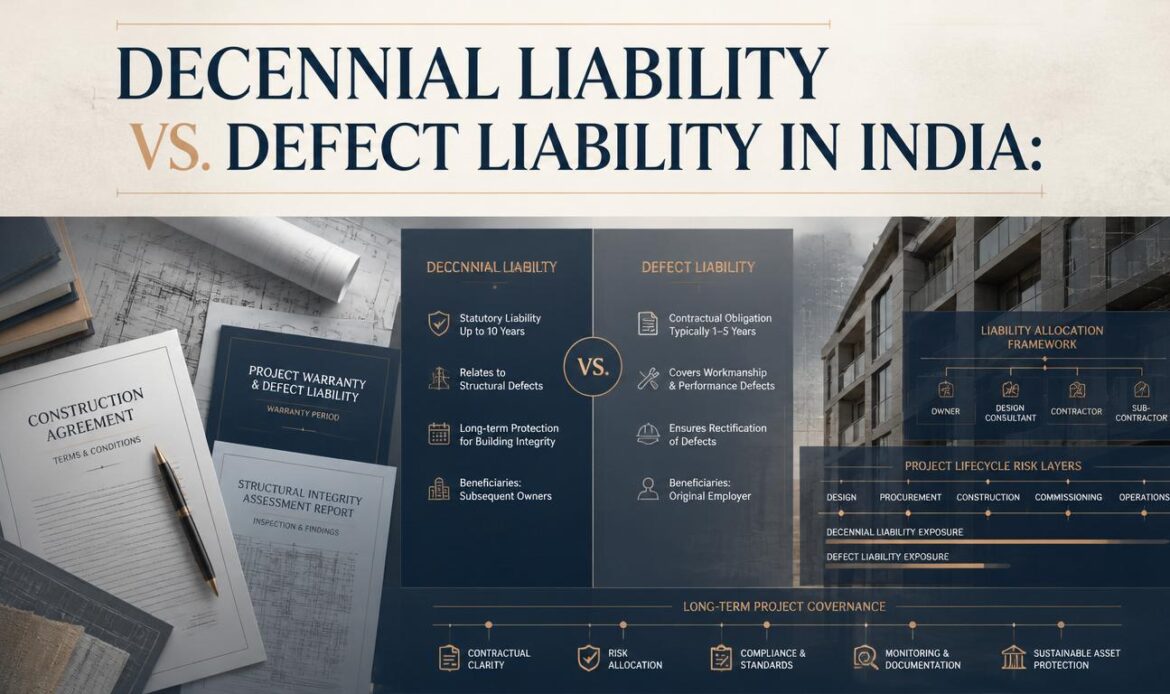
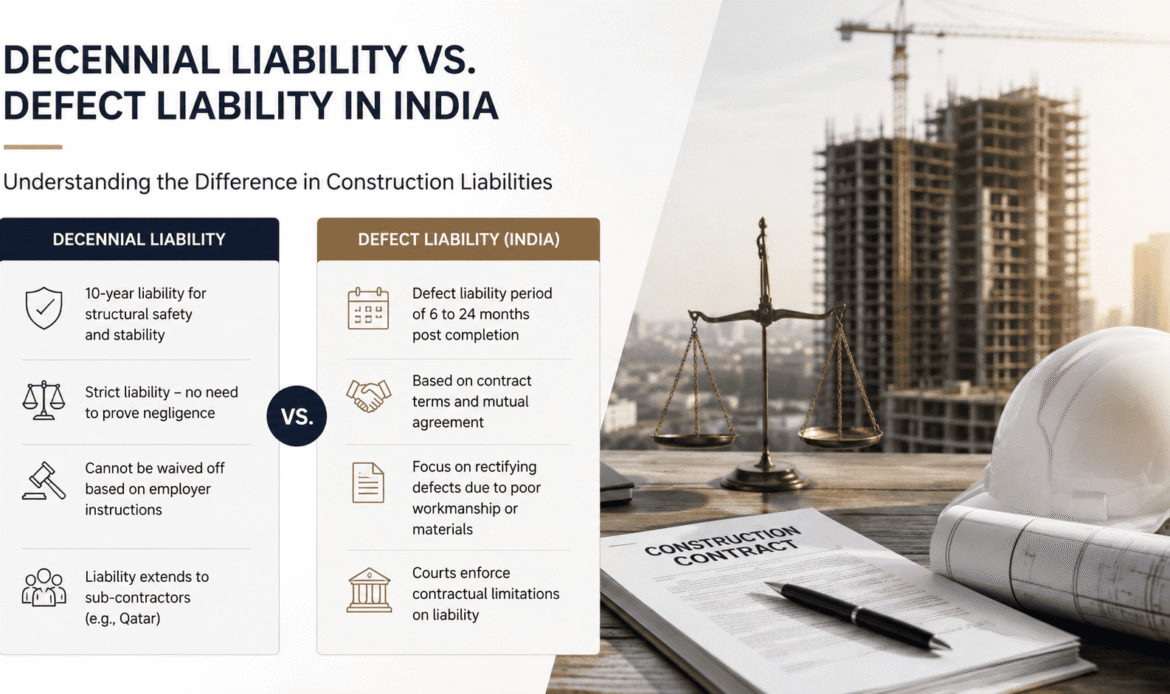
Decennial liability is a ten year liability imposed on the contractors and design professionals with respect to ensuring the safety and stability of the construction. Decennial liability as a concept is not recognized in India and the purpose is covered as such in the ‘defect liability period clauses which generally runs from 6 months to 24 months post completion of work.
Concerns of Decennial Liability for Engineering Consultants
The Decennial liability aspect is of concern to an engineering consultant for multiple reasons. The Decennial liability is strict and generally does not require proof beyond the failure in structure or stability of the construction. There are instances where the Employer, due to reasons best known to it, requires the work to be completed in a limited amount of time, which results in not giving the contractor enough time to assess the requirements, etc., or conduct the work most comprehensively. Subject to applicable laws, such instructions from the Employer do not generally absolve the contractor from the obligation under a decennial liability clause. Further, in certain jurisdictions like Qatar, the contractor cannot absolve itself from liability based on the fact that the liability is attributable to a sub-contractor.
Decennial Liability vs. Indian Legal Framework
On the other hand, Indian law predominantly focuses on contractual provisions, including the defect liability period, and managing defects arising post-construction. This period, which commonly spans 6 to 24 months, mandates contractors to address defects resulting from poor materials or work. On the other hand, while decennial liability is a type of strict liability for ten years, the Indian regime permits a more collaborative approach whereby contractors and/or consultants are granted the right to agree on the terms of their post-completion responsibilities with their clients. Indian courts have also historically enforced contractual limitations on liability which makes it critical for contracting parties to clearly articulate their rights, responsibilities, and exclusions in construction contracts.
Emerging Trends in Long-Term Construction Liabilities in India
Although India does not have a formal decennial liability framework, longer liability periods are increasingly being embedded through specific contracts in large-scale infrastructure and public-private partnership (PPP) projects.
The Need for a Structured Long-Term Liability Framework
In the wake of India’s thrust for infrastructure development and foreign investments in the nation’s construction sector, a growing debate has taken shape around whether a structured long-term liability framework (similar to decennial liability) ought to be introduced to improve accountability and drive a higher standard of construction. Through this comprehensive analysis, reform in this sector needs to be designed considering local concepts related to law and business practice and defining such dynamic impact on cost for the construction and contractors’ liability.